
How to Choose the Right Damage Restoration Company in Manhattan
The right damage restoration company in Manhattan is the one that handles the entire job, from first extraction to final trim, under one license and one name. Anything less means you inherit the role of project manager the moment the fans come out. And that’s exactly where most restoration complaints in this city are born.
Most homeowners don’t realize the single biggest decision isn’t which company to call. It’s whether the company you call actually finishes what it starts. The majority of water damage restoration complaints filed with the Better Business Bureau in the tri-state area involve one specific failure: the company that dried the house was not the company that did the rebuild, and neither one accepted responsibility for the moisture reading that came back wrong six weeks later.
If you’d rather skip the vetting and talk to someone who does all of it, call Floodline Restoration Co. of Manhattan at (917) 924-4221. Free estimate, no obligation.
The One Question That Separates Restoration Companies in Manhattan
Before you sign anything, ask this: “Who signs the completion certificate, and are they the same licensed contractor who did the extraction?”
It sounds bureaucratic. It’s the most important question you’ll ask. Here’s why.
If the company doing the water extraction subcontracts the drying, and then a different crew handles the rebuild, you now have three parties and zero accountability. When mold shows up behind the baseboard eight weeks later, the extraction company blames the drying crew. The drying crew blames the rebuilders. The rebuilders say they just installed what they were told to install. You stand in the middle, holding a moisture meter you don’t know how to read and three phone numbers that all go to voicemail.
In Manhattan, where co-ops and condos add board approvals and building management to the chain, that accountability gap gets wider. We’ve seen board-mandated timelines get blown because the extraction company finished, the drying company delayed, and the rebuilding contractor couldn’t get access until the following month.
A full-cycle company answers the completion certificate question with one name. Same license. Same crew. Same person you can call at two in the morning.
How to Read a Restoration Company’s License Portfolio
Most homeowners check one thing: is the company licensed? That’s a start. It’s not enough.
Restoration work in Manhattan spans three regulatory worlds. Mitigation certification (IICRC or RIA) covers the science of drying a structure correctly. A contractor’s license covers the legal right to perform construction work. A mold remediation license covers the removal of contaminated material under specific containment protocols. Three separate credentials. Three separate sets of questions.
Here’s what to look for when you’re comparing companies in Manhattan:
- Mitigation certification (IICRC or RIA): This tells you the crew understands psychrometrics, the science of how moisture moves through building materials. Without this, drying is guesswork.
- Contractor’s license: This is non-negotiable for any rebuild work. If the “restoration company” can’t legally pull a permit, that rebuild is being done by someone else, often someone you never meet.
- Mold remediation license: In New York, mold assessment and mold remediation are separate licensed activities. A legitimate company will hold the remediation license and follow the state’s required protocols for containment and clearance.
The critical test: all three credentials should be held by the same entity. Not a parent company. Not a partner firm. The actual name on your contract. When the entity that signed your agreement holds all three, the chain of accountability has no gaps to fall through. When any one of them belongs to a subcontractor, you’re back to playing messenger.
In our experience serving Manhattan since 2010, the companies that get this right are the ones that planned to be around long enough for their reputation to matter. The storm-chasers renting a license for the season are the ones who disappear when the third party asks a hard question.
What a Written Guarantee Must Specify to Be Worth the Paper
“Satisfaction guaranteed” is legally meaningless. It sounds good in a brochure. It gives you nothing to point at when the work fails.
An enforceable guarantee names four specific things:
- The moisture threshold: What number on a moisture meter means “dry”? If the guarantee doesn’t state a numerical standard, “dry” means whatever the company says it means.
- The inspection method: How will dryness be verified? Visual inspection? Non-invasive meters? Core samples where appropriate? The method matters. A wall can look dry and read 22% moisture behind the paint.
- The remedy obligation: If the moisture standard is not met, what exactly does the company do? Re-dry? Remove and replace? Who pays for the second round of work?
- The timeframe: How long does the company have to make it right once you notify them in writing? Open-ended obligations have a way of stretching into next season.
At Floodline Restoration Co. of Manhattan, our 90-Day Done Right Promise, the Keystone Standard, names these terms in the contract. We don’t ask homeowners to trust us on good faith. We hand them a written commitment with the K.E.Y.S. values behind it: Krafted right, Every time, Your home first, Standing behind it. That’s not marketing language. That’s the standard our crews are trained to and the one we’re held to.
When you compare restoration companies in Manhattan, ask to see the actual guarantee language, not the marketing summary. If the company won’t show you the guarantee before you sign, that’s your answer.
Insurance Billing: The Criterion Most Homeowners Skip
Here’s a scenario we see too often in Manhattan: a pipe bursts, water runs through three floors, the insurance carrier says “get it dried, document everything,” and the homeowner suddenly realizes they’re fronting $12,000 hoping for reimbursement.
Not every restoration company bills insurance the same way. The distinction matters more than most people realize.
Direct insurance billing means the restoration company invoices your carrier for covered work, works with the adjuster on scope and pricing, and you’re not asked to be the bank in between. The company has an established adjuster relationship. They know how to document moisture readings, photo-log every stage, and submit claims that get approved without weeks of back-and-forth.
Homeowner-fronted billing means you pay the restoration company, then chase your own carrier for reimbursement. This is common with smaller operations and storm-chasers who don’t want the administrative overhead. It’s not automatically a scam. It does mean you’re financing your own insurance claim.
How to confirm a company’s billing competency before disaster hits:
- Call your insurance agent and ask if the company has handled claims with your carrier before.
- Ask the restoration company directly: “Do you bill the carrier directly, and can you give me a reference from a past claim with [your insurance carrier]?”
- Ask whether they provide a written scope of work before beginning, so the adjuster can approve line items up front rather than negotiate after the fact.
A company that has been restoring homes in Manhattan for decades has an adjuster relationship in place. They’ve handled claims with every major carrier writing policies in the city. That’s a selection criterion you can verify with one phone call.
Red Flags Specific to Manhattan’s Restoration Market
Manhattan’s density, building types, and weather patterns create a specific set of risks when choosing a restoration company. Here are the warning signs local homeowners should recognize:
- Storm-chasing crews that arrive after major weather events: The unmarked van in the neighborhood two days after a nor’easter or flash flood, knocking on doors with a “special today” offer. Legitimate Manhattan restoration companies don’t door-knock looking for victims.
- Unmarked equipment: If the crew shows up with no company branding on the van, the dehumidifiers, or their uniforms, you’re dealing with a rental crew. Rental equipment belongs to someone else. So does the accountability.
- Verbal-only scopes of work: “Yeah, we’ll take care of the drywall for you, don’t worry about it.” That’s not a contract. That’s a promise with no leverage if the work is abandoned halfway through. In Manhattan real estate, where everything is documented and notarized, a handshake deal on a $20,000 restoration makes no sense.
- Pressure to sign the same day: Legitimate companies in Manhattan can give you 24 hours to review a contract. The ones demanding a signature before they leave your kitchen have a reason for the hurry, and it’s not your best interest.
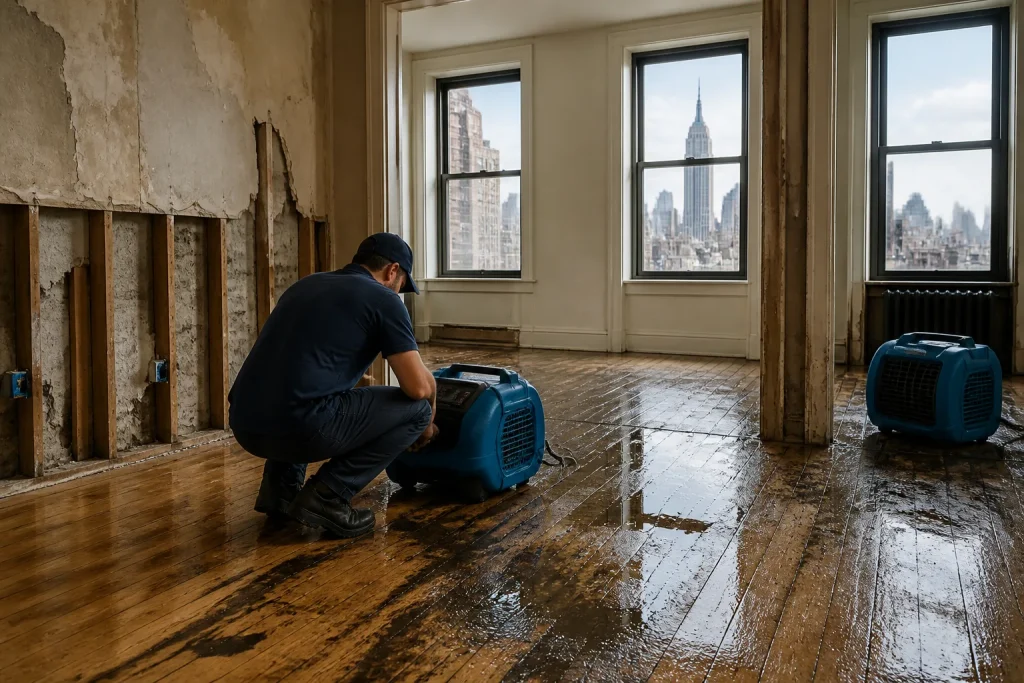
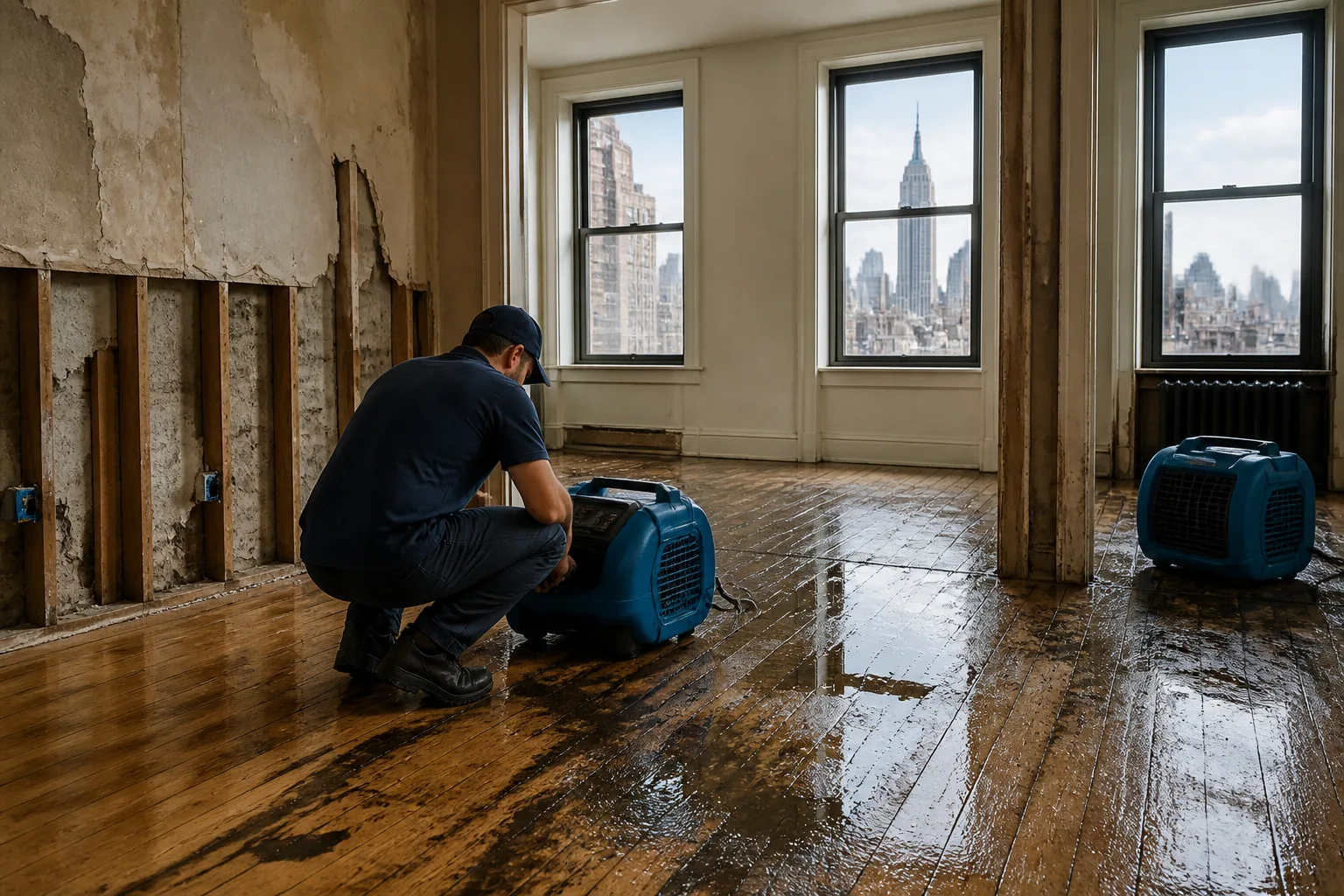
We pulled a dehumidifier out of a pre-war building on the Upper West Side last year where a previous company had set up fans in the basement, “dried” for three days, and left without touching the moisture trapped behind the lath and plaster walls. The homeowner had a verbal scope, no moisture log, and no way to hold anyone responsible. The line the water left is where we start, but that job started six weeks too late because nobody had a written agreement.
When to Call a Pro
If you’re reading this while standing in a puddle, the answer is now. Water damage in Manhattan moves fast. Moisture wicks through drywall, hardwood, and subfloor within hours. Mold can establish in 48 to 72 hours. The longer water sits, the more the repair envelope expands.
But beyond the emergency, call a professional when you see stains, smell must, or notice paint bubbling along baseboards months after a leak was “fixed.” These are signs of trapped moisture. They don’t go away on their own. And by the time they’re visible, the damage behind the surface is often already extensive.
If you’re in Manhattan and need water damage restoration, mold remediation, or fire and smoke cleanup, see our related services: Water Damage Restoration in Byram, Mold Remediation in Byram, and Fire & Smoke Damage Restoration in Byram.
The Bottom Line
Choosing a restoration company in Manhattan comes down to one principle: the entity that starts the job must be the entity that finishes it, and that entity must hold every license, credential, and written obligation in its own name. Ask who signs the completion certificate. Read the guarantee’s actual language. Confirm direct insurance billing. Walk away from verbal scopes and unmarked trucks.
We’ve spent 42 years in this business, serving Manhattan and the surrounding communities since 2010, built around a dispatch board rather than a sales desk. Calls answered by a live person, 24/7. Background-checked, uniformed technicians trained to IICRC, RIA, and IFA standards. Professional-grade equipment from Dri-Eaz, Phoenix, XPOWER, B-Air, and Injectidry, moisture-mapped from day one with daily readings logged until the dry standard is met.
If you’re in Manhattan and need help, Floodline Restoration Co. of Manhattan offers free estimates. Call (917) 924-4221. A live person answers. Every time.
Frequently Asked Questions
Check three things: proper licensing (mitigation certification, contractor’s license, and mold remediation license held by the same entity), a written guarantee with specific moisture thresholds and remedy obligations, and direct insurance billing capability with an established adjuster relationship. If all three check out, you’re dealing with a full-cycle company, not a referral-and-handoff operation.
A real guarantee names the moisture threshold (the numerical dry standard), the inspection method used to verify dryness, the remedy obligation if the standard isn’t met, and the timeframe for making it right. Vague “satisfaction guaranteed” language carries no legal weight and gives you nothing to enforce.
Most homeowner’s policies cover sudden, accidental water damage, fire, and storm damage, subject to your deductible and coverage limits. The key is a restoration company that bills your carrier directly, documents every stage with photo logs and moisture readings, and has an established relationship with your adjuster. That’s the difference between a claim resolved in weeks and one that drags for months.
For water damage and emergency mitigation, a legitimate full-cycle company should be able to dispatch a certified crew the same day. In Manhattan, where building access and co-op board rules add complexity, the right company has experience navigating those hurdles efficiently. Call (917) 924-4221 and a live dispatcher will get the process moving immediately, not send you to voicemail.
Written by Curt Bowman, Owner at Floodline Restoration Co. of Manhattan, serving Manhattan since 2010.
Need Damage Restoration Help?
Call Floodline Restoration Co. of Manhattan - licensed & insured, available 24/7 in Manhattan.
(917) 924-4221