
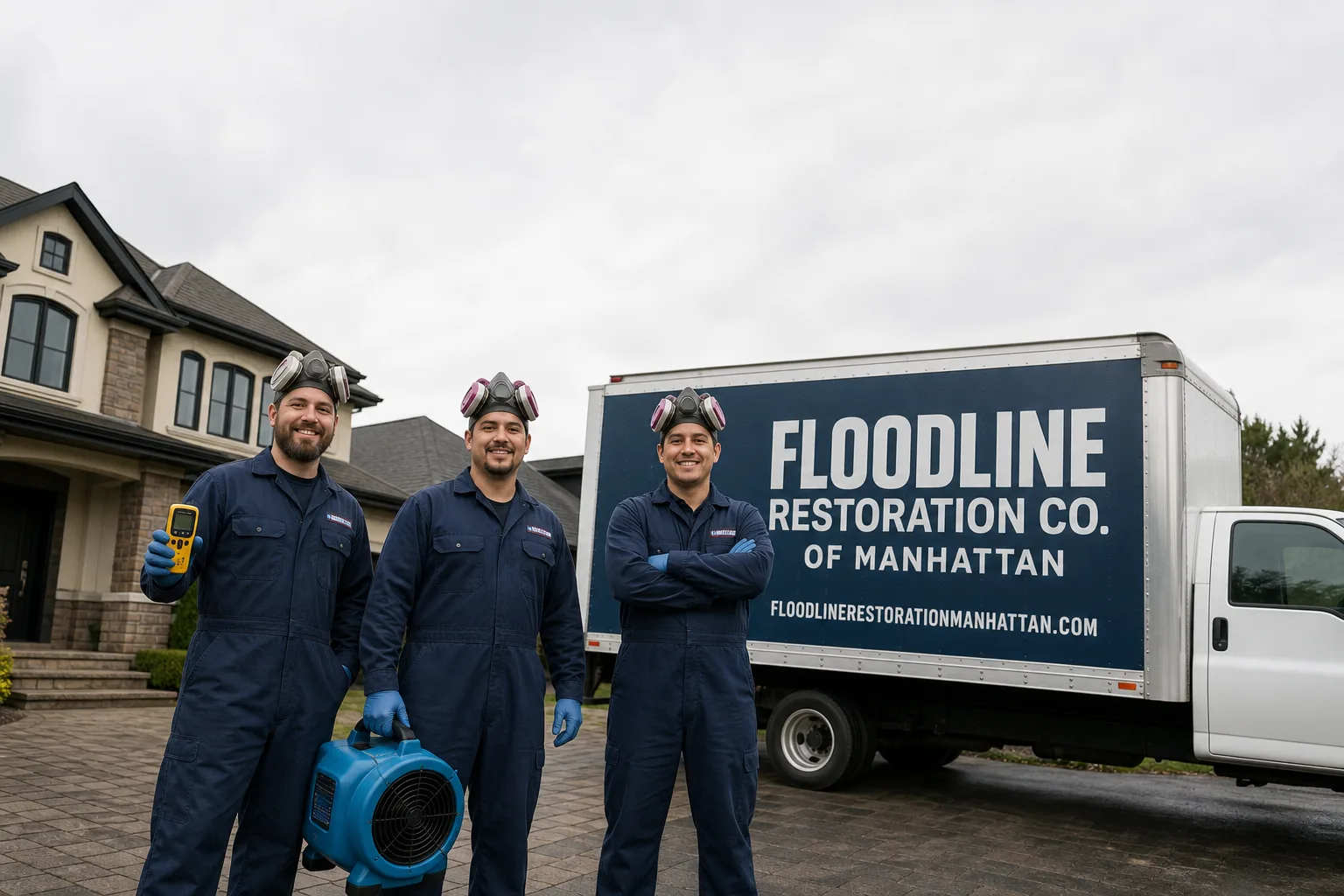
Free visual inspection and a written scope of work before any mitigation begins - photos, moisture readings, and drying logs go in your claim file
The scope we write is the scope we bill. Anything new gets shown to you, in writing, before we touch it.






 Before
 After
After Before
 After
After Before
 After
After24/7 Emergency Storm & Disaster Restoration in Irvington
Storm damage in Irvington doesn’t wait for business hours, and neither do we. A live dispatcher answers at (917) 924-4221 around the clock, every day of the year. When a nor’easter pushes the Hudson over its banks near the Metro-North line or a summer thunderstorm sends hillside runoff cascading into a century-old foundation on the upper ridge, the first hour determines whether you’re facing a cleanup or a rebuild. Our crews stage response vehicles near the Saw Mill River Parkway corridor so we can reach Irvington properties fast. Every call begins the same way: a person answers, asks what you’re seeing, and sends a background-checked technician in a marked vehicle. No phone tree. No recording. The line the water left is where we start.
Storm events in Irvington split into two distinct emergencies. Along the waterfront near Matthiessen Park and down by the train station, riverine flooding brings Category 3 water into basements and crawlspaces. Up on the ridge above Main Street and along Station Road, saturated hillsides push groundwater through rubble-stone foundations that have stood since the 1880s. We handle both. Our Storm & Disaster Restoration team carries the equipment to extract, dry, and stabilize either profile, often within hours of each other on the same street. The first hour matters because water in older Irvington construction doesn’t just sit on the surface. Plaster-and-lath walls wick moisture upward, and century-old floor joists begin absorbing it before you can see a stain.
Understanding Storm & Disaster Restoration Severity in Irvington Properties
Water from a storm isn’t all the same, and Irvington’s geography means a single property can face multiple categories. Category 1 water, the kind that comes from a burst supply line during a January freeze, starts clean but degrades fast in older homes. Category 2 water carries contaminants from washing machines, sump failures, or surface runoff. Category 3 water, which is what you get when the Hudson floods the low-lying streets near the waterfront, contains sewage, river sediment, and whatever the storm surge carried in. That distinction drives everything: extraction method, antimicrobial treatment, disposal protocols, and whether contents can be saved.
Severity in Irvington is also a structural question. Late-Victorian and Edwardian homes here, built between the 1870s and 1920s, hide moisture in ways modern construction never does. Original plaster and lath acts like a sponge, pulling water up from a flooded basement into wall cavities nobody can see. Rubble-stone foundations, common on upper-ridge lots off Station Road and along Harriman Road, have mortar joints that leak for decades before interior damage shows. Moisture mapping with thermal imaging and hygrometers reveals the true wet zone, which is frequently two to three times larger than the visible stain. We don’t guess at severity. We measure it, log it, and show you the readings.
Why Irvington Property Owners Choose Floodline Restoration Co. of Manhattan
- 45-minute response commitment. When you call with storm damage in Irvington, we commit to having a technician on site within 45 minutes. Our dispatch board tracks every vehicle so we know who’s closest to your street, not just your zip code.
- 24/7 live answer, always a person. Curt Bowman built Floodline around a dispatch board, not a sales desk. The person who answers at 2 a.m. is the same kind of trained dispatcher who takes calls at 2 p.m. No automated system, no voicemail.
- IICRC-certified crews. Our technicians hold WRT, FSRT, and AMRT certifications and train to IICRC, RIA, and IFA standards. When we set containment on a Category 3 flood near the Hudson Line, the person running the air scrubber knows exactly why.
- Free visual inspection. Before any work begins, we walk the damage with you and tell you what we see, what we’d do, and what it’s likely to cost. That inspection costs you nothing.
- Direct insurance billing. We document everything from the first hour, bill your carrier directly, and coordinate with your adjuster. You never play messenger between Floodline and the insurance company.
- One team from extraction to reconstruction. The same certified crew that reads the moisture map on day one handles daily readings, hands the log to you and your carrier, and rebuilds what needs rebuilding. No mid-job handoff, no inherited strangers.
Our Storm & Disaster Restoration Process
Inspection & Assessment
We arrive, walk the property from the floodline outward, and map moisture throughout the affected area. On Irvington’s older homes, this includes checking wall cavities and foundation joints that out-of-area crews often skip. You get a written scope before any work starts.
Extraction & Stabilization
We remove standing water with truck-mounted and portable extraction units, then stabilize the structure. For storm-damaged windows and openings, we install board-up and roof tarping immediately so no additional water or debris enters.
Drying & Dehumidification
We place Dri-Eaz and Phoenix dehumidifiers with B-Air and XPOWER air movers, then set daily moisture readings. The placement matters as much as the equipment, especially in plaster-and-lath homes where air movement must reach concealed cavities.
Cleaning & Sanitization
Floodwater from the Hudson carries more than water. We apply antimicrobial treatments appropriate to the water category, HEPA-vacuum surfaces, and run air scrubbers where needed to protect the rest of the house.
Storm-Specific Treatment
Irvington’s split damage profile demands different treatments. Hillside groundwater calls for foundation drainage corrections and moisture-barrier work. Waterfront flooding calls for full Category 3 protocols, including content cleaning and disposal documentation.
Repairs & Restoration
We repair what can be saved and rebuild what can’t, respecting the original construction. On late-Victorian homes, that means working with plaster and original trim rather than defaulting to drywall and paint. Standing behind the result in writing is the Keystone Standard.
Need Emergency Storm & Disaster Restoration in Irvington Now?
Crews minutes away, answering live 24 hours a day. The sooner we start, the less it costs.
Working With Your Insurance Company
Storm and flood claims in Irvington move faster when the documentation is thorough from the first hour. We photograph every room before we touch anything, log moisture readings daily, and write a line-item scope that matches the actual damage, not a generic template. Your adjuster gets industry-standard estimates with the detail they need to approve the work without back-and-forth. You shouldn’t have to translate between a restoration crew and an insurance carrier. We handle that directly, including phone calls, documentation requests, and scope negotiations. When the claim covers less than the damage, we tell you plainly and help you understand your options. No surprises on the bill means exactly that, even when the surprise is from the insurance side.
What We Provide Your Insurer
- Thorough documentation of the loss
- Photos of all damage, room by room
- Moisture readings and drying logs
- A detailed, line-item scope of work
- Direct coordination with your carrier
Built for Irvington’s Loss Calendar
Irvington’s storm damage follows a rhythm, and we’ve learned it over the years. January brings deep freezes that split supply lines in uninsulated crawlspaces and against exposed foundation walls on upper-ridge lots. When the thaw comes in March, all that water finds its way downhill, and basement seepage spikes in homes along Broadway and down toward the river. Spring rain saturates the hillside above Station Road, and groundwater pressure against old rubble-stone foundations peaks. By July and August, thunderstorms drop inches of rain in an hour, overwhelming drainage systems that were sized for a different century and sending surface runoff straight into older foundations. Nor’easters in the fall and early winter push the Hudson up over the waterfront streets near the train station. The cycle repeats every year. Knowing it means we stock the right equipment, pre-stage in the right places, and answer the phone expecting Irvington’s next call.
Storm & Disaster Restoration Across Irvington’s Neighborhoods
Irvington is a small village, but the damage profiles vary sharply by elevation. Up along Harriman Road and the upper reaches of Station Road, we respond to hillside groundwater intrusion in century-old estates where the damage starts invisibly behind plaster walls. The homes are large, the foundations are stone, and the drying scopes are long. Down near Main Street and the commercial core, storm losses tend to come from roof damage and wind-driven rain, plus the occasional flash-flood event when drainage backs up. Along the waterfront by Matthiessen Park and the Metro-North Hudson Line, the picture changes completely: riverine flooding, storm surge, and Category 3 water in basements that sit near the water table. Each zone demands a different first response, different equipment placement, and a different conversation with your insurance carrier. We know which one your address falls into before we park the truck.
The Irvington homes we serve include some of the oldest in Westchester, and we treat them accordingly. A board-up on a 1910 carriage house off Station Road is not the same job as a board-up on a 1980s colonial in Ardsley. The trim is different, the glazing is different, and the salvage value is different. We preserve what’s original whenever the water category allows it.
Specialized Storm & Disaster Restoration Services We Offer in Irvington
Flood Damage Restoration
When the Hudson floods the low-lying streets near the waterfront, the water is almost always Category 3. We extract it with truck-mounted equipment, remove contaminated materials under containment, apply antimicrobial treatments, and dry the structure with professional-grade Dri-Eaz and Phoenix equipment. On Irvington’s upper-ridge lots, the flooding is different: groundwater, not river water. That calls for a hydrostatic-pressure assessment and drainage corrections, not just extraction. Both profiles count as flood damage here, and we handle both.
Storm Damage Cleanup
Wind-driven debris, downed trees, and roof damage leave messes that go beyond water. We remove storm debris from the property, clear access paths, and document everything for your claim. The goal is a site you can walk through safely by the end of our first visit, even if full repairs take longer. In Irvington, mature tree cover means storm cleanup often starts with a chainsaw and ends with a drying log.
Emergency Board-Up
A broken window or a storm-pulled door on a late-Victorian home isn’t just an opening; it’s an invitation for rain, animals, and further damage. We board up openings the same day we’re called, using methods that don’t chew into original trim. Security and weather-tightness are the goal, and we size the board-up to the actual opening, not a standard sheet of plywood.
What happens when you call
- 1
A real person answersNo phone trees - you reach a local pro.
- 2
You get an upfront price rangeHonest numbers before anyone is dispatched.
- 3
A background-checked tech heads outLicensed & insured, dispatched right away.
- 4
You approve before work beginsNothing starts until you say go.
Storm & Disaster Restoration Costs in Irvington, NY
Storm restoration costs in Irvington run higher than in flatter inland Westchester villages, and the geography explains why. A Category 3 flood extraction in a waterfront basement near the Hudson Line typically runs $4,000 to $12,000 depending on square footage and contents. Hillside groundwater intrusion on upper-ridge lots, where the wet zone hides behind plaster walls, often runs $7,000 to $20,000 once you account for structural drying, containment, and historic-sensitive finish work. Emergency board-up runs $450 to $1,100 per opening. Roof tarping runs $350 to $900 depending on pitch and access. Debris removal is typically $300 to $800 per load. Insurance covers most storm-related water damage, though flood damage from riverine events may require separate flood coverage. We walk you through what’s covered before work begins, and the visual inspection is free.
We Also Serve Cities Near Irvington
The same crews that serve Irvington also respond to storm damage in Dobbs Ferry, Ardsley, Elmsford, and Hartsdale. When a storm sweeps through central Westchester, we move from one village to the next without losing momentum or documentation quality.
Serving Irvington, NY - Our Local Coverage Area
We’re based in the Irvington area and know this community well. Use the map below to see our service coverage - if you’re nearby, we can almost certainly help.
Irvington Storm & Disaster Restoration Questions, Answered
Why does storm restoration cost more on Irvington’s upper-ridge lots than in neighboring Ardsley?
Upper-ridge Irvington homes sit on steep grades where hillside groundwater presses against old rubble-stone foundations, and the damage hides behind plaster-and-lath walls that absorb moisture far longer than modern drywall before visible stains appear. That means larger drying scopes, more containment, and historic-sensitive finish work that adds real cost. Ardsley’s flatter terrain drains faster, so the wet zones are smaller and the finishes are newer. Call (917) 924-4221 for a free inspection and a firm scope based on your actual conditions.
What category of water should I expect in an Irvington waterfront basement flood during a nor’easter?
Category 3. Nor’easter flooding along Irvington’s Hudson River waterfront brings in river water mixed with storm surge, sediment, and often sewage from overwhelmed systems. That means full containment, antimicrobial treatment, and disposal of saturated porous materials. We treat every waterfront flood in Irvington as Category 3 unless testing proves otherwise, because guessing wrong on that question sets up mold and structural decay. Call (917) 924-4221 the moment water appears.
How quickly does mold start after a storm leak in an old Irvington plaster-and-lath wall?
Mold can begin colonizing within 24 to 48 hours in warm, humid conditions, and Irvington’s river-hugging humidity accelerates that timeline. Plaster-and-lath walls hold moisture in hidden cavities, so the visible stain you see days later doesn’t reflect how much water is actually sitting inside the wall. We run air scrubbers and set containment early on any storm leak involving older Irvington construction. Call (917) 924-4221 and we’ll assess whether you need drying only or full mold remediation.
Do you need to pack out contents from a flooded Irvington basement before water extraction?
Sometimes, but not always. If the water is Category 3, we pack out affected contents, document everything for your insurance claim, and clean or dispose of items based on the restoration standard for that category. If the water is Category 1 or 2 and the contents sit above the waterline, we can often work around them. We make that call on site, with you, before extraction starts. Call (917) 924-4221 for a free assessment.
What makes Irvington’s hillside storm damage different from a flat Westchester village like Elmsford?
Elmsford’s flat terrain drains surface water away from foundations. Irvington’s upper ridge pushes groundwater downhill directly into them. On a Station Road estate, the water arrives through the foundation walls themselves, saturating wall cavities and floor systems from the inside out. Out-of-area crews that treat it like a standard basement leak consistently under-scope the job. We moisture-map the full envelope, not just the visible stain. Call (917) 924-4221 to get an honest read on your hillside property.
How fast can you actually get to an Irvington storm damage call?
We commit to 45 minutes from your call to our technician on site, 24 hours a day. Irvington is part of our regular response area, and our dispatch board tracks vehicles in real time so the nearest marked truck gets routed to you, whether you’re off Station Road or down by Matthiessen Park. Call (917) 924-4221 and a live person answers right away.
Can we stay in our Irvington home during storm damage restoration?
That depends on the water category, the affected area, and the drying setup. A contained, Category 1 attic leak on the upper ridge usually allows you to stay. A Category 3 basement flood near the waterfront may require access restrictions and air scrubbers running around the clock, which many homeowners find disruptive. We’ll tell you honestly what your situation requires. Call (917) 924-4221 for a straight answer.
What certifications do your Irvington storm restoration crews hold?
Our technicians are IICRC-certified, with the relevant codes for your loss: WRT for water damage, FSRT for fire and smoke, and AMRT for mold. They also train to RIA and IFA standards and are background-checked and uniformed. The person who reads your moisture map on day one is the same person who stands behind the drying log at the end. Call (917) 924-4221 for a free inspection.
Written by Curt Bowman, Owner at Floodline Restoration Co. of Manhattan. Founded in 2010 and built around a dispatch board, not a sales desk, with crews serving Irvington 24 hours a day.