
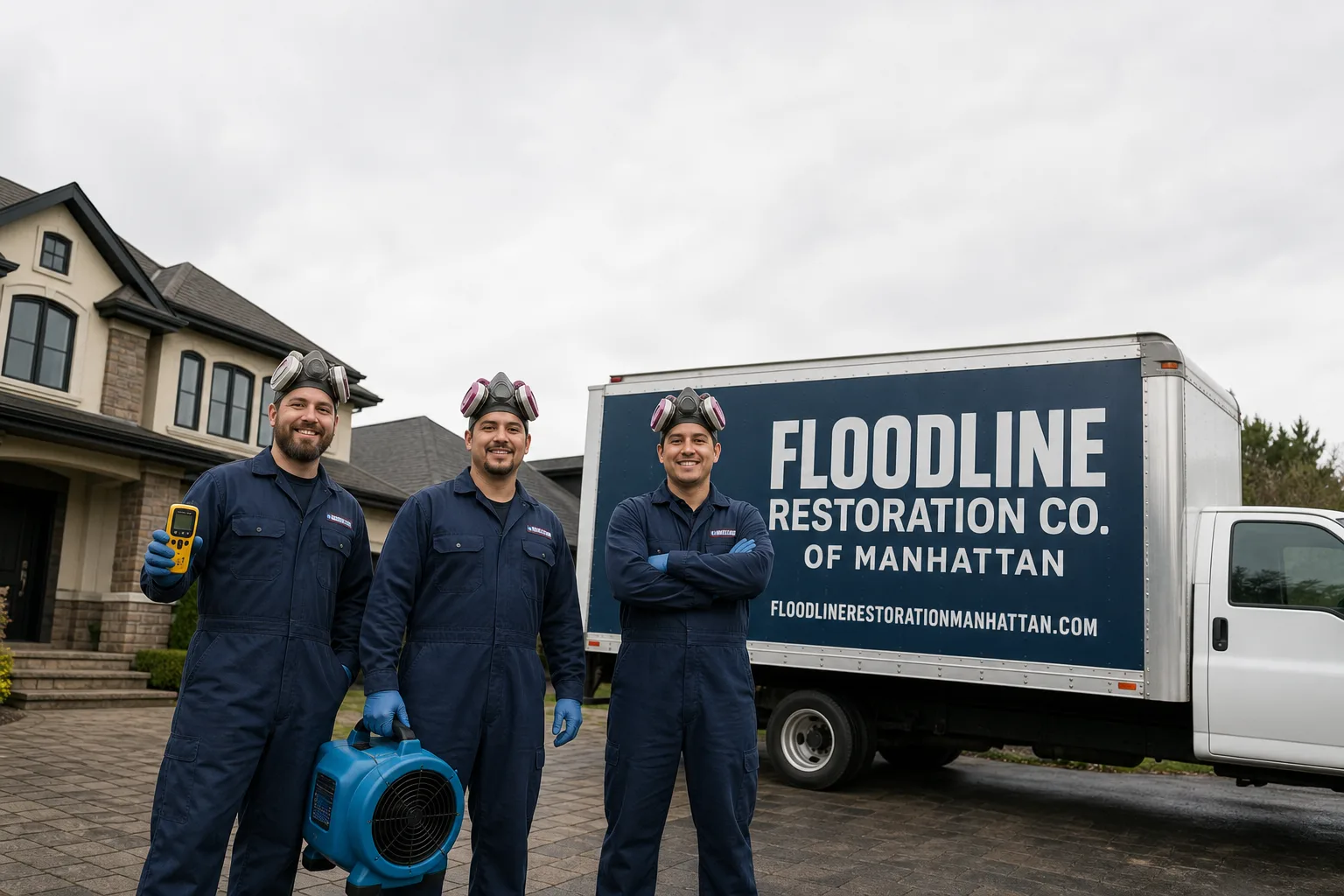
Free visual inspection and a written scope of work before any mitigation begins - photos, moisture readings, and drying logs go in your claim file
The scope we write is the scope we bill. Anything new gets shown to you, in writing, before we touch it.






 Before
 After
After Before
 After
After Before
 After
After24/7 Emergency Storm & Disaster Restoration in Saddle Rock
Storm and disaster restoration in Saddle Rock usually starts with a phone call placed at an hour nobody wants to be awake. You reach a live dispatcher, not a recording, and a certified crew heads toward the village while you’re still on the line. Saltwater from Manhasset Bay or Little Neck Bay doesn’t wait for business hours, and neither do we. If a nor’easter pushed surge into your basement or wind tore a section of roof away, call (917) 924-4221 right now. The first hour determines whether custom plaster walls and oak flooring survive or get cut out and replaced. We have crews stationed to reach Saddle Rock properties fast, assess the damage, and start extraction the same visit. A free visual inspection tells you exactly what you’re facing before any work begins.
Understanding Storm & Disaster Restoration Severity in Saddle Rock Properties
Storm damage in Saddle Rock rarely behaves the way it does a few miles inland. The village sits on a near-peninsula, and when surge comes from both Manhasset Bay and Little Neck Bay, basements fill with Category 3 water: brackish, contaminated, carrying whatever the bays carried. That water moves differently through a 1950s plaster-and-lath wall than through modern drywall. Salt wicks upward through old mortar and concrete block, traveling far beyond the visible waterline, and it keeps moving for days after visible water is gone. We moisture-map every affected room with hygrometers and thermal imaging, because what looks dry to the eye can still be holding 40% moisture inside a wall cavity. Homes built from the 1940s through the 1970s, with original hardwood flooring and custom millwork, demand a slower, more careful structural drying protocol. Rush it, and you get hidden mold behind intact paint, warped flooring, and a claim dispute down the road. Our Storm & Disaster Restoration team reads the moisture map daily and logs readings until the dry standard is met, not before.
Why Saddle Rock Property Owners Choose Floodline Restoration Co. of Manhattan
- 45-minute response commitment: From the moment you call, a uniformed team is dispatched toward Saddle Rock. Extraction starts the same visit for active water or storm intrusion.
- 24/7 live answer, every single call: Curt Bowman built this company around a dispatch board, not a sales desk. A real person answers at 2 a.m., and that person can send a crew.
- IICRC-certified crews: Our technicians hold WRT and ASD certifications, and our mold specialists carry AMRT. Background-checked, uniformed, and trained to RIA and IFA standards.
- Free visual inspection: We assess the damage before you commit to anything. You get a written scope, line by line, so you know what’s necessary and what isn’t.
- Direct insurance billing: We bill your carrier directly and handle adjuster communication. You never play messenger between us and the insurance company.
- One certified crew from start to finish: The same team that extracts the water dries the structure and rebuilds what needs rebuilding. No mid-job handoff to a sub we don’t know.
Our Storm & Disaster Restoration Process
Inspection & Assessment
We arrive, walk the property, and document everything before touching a tool. Thermal imaging identifies moisture behind walls, and one of our supervisors maps the full extent of Category 3 water intrusion. You get the findings in plain language, with a written scope to approve. That scope is our agreement with you, and it doesn’t grow unless you approve the change.
Extraction & Stabilization
Standing water comes out first with truck-mounted and portable extraction units. If wind opened your roof or shattered a window, we tarp and board up immediately so the property doesn’t take on more water overnight. In Saddle Rock, where surge can enter from two directions, stopping active intrusion is the priority before drying ever begins.
Drying & Dehumidification
Dri-Eaz dehumidifiers and XPOWER air movers go in, placed according to a moisture map, not a guess. In older Saddle Rock homes with plaster walls, we run longer drying cycles and take daily readings. Saltwater-damaged materials release moisture slowly, and a wet plaster wall reads dry on the surface long before it’s actually dry inside.
Cleaning & Sanitization
Category 3 water carries contaminants. We clean and disinfect every affected surface, apply antimicrobial treatment where saltwater has wicked into masonry or wall cavities, and remove anything that can’t be saved without becoming a mold risk. HEPA air scrubbers run during this phase to control airborne particulates.
Specialty Saltwater Treatment
Saddle Rock’s vulnerability goes beyond ordinary flooding. Salt-laden surge corrodes copper pipe and steel support columns within 72 hours, even after visible water is gone. We inspect mechanical systems, apply corrosion-inhibiting treatments where salvageable, and flag anything that needs a licensed plumber or electrician before rebuilding begins.
Repairs & Restoration
We rebuild what the storm destroyed: drywall, plaster, flooring, millwork, cabinetry, and structural framing. Material matching matters in Saddle Rock, where custom finishes are the norm, not the exception. The job isn’t done until the moisture log is in your hands and the space looks like the storm never came through.
Need Emergency Storm & Disaster Restoration in Saddle Rock Now?
Crews minutes away, answering live 24 hours a day. The sooner we start, the less it costs.
Working With Your Insurance Company
Insurance claims for storm and flood damage in Saddle Rock are complicated by the village’s coastal exposure. Most homeowners policies exclude flood specifically, but many Saddle Rock residents carry separate flood insurance through the NFIP or a private carrier. What matters is documentation from the first hour. We photograph every room, log moisture readings daily, and write estimates using industry-standard software your adjuster recognizes. When we speak to your carrier, we speak their language. You get copies of everything, and we bill the carrier directly. You didn’t cause this damage, and you shouldn’t have to manage the paperwork while your basement is torn apart.
What We Provide Your Insurer
- Thorough documentation of the loss
- Photos of all damage, room by room
- Moisture readings and drying logs
- A detailed, line-item scope of work
- Direct coordination with your carrier
Built for Saddle Rock’s Loss Calendar
Saddle Rock’s storm season doesn’t follow a tidy calendar. Nor’easters hit from late October through March, pushing Long Island Sound water toward Manhasset Bay and Little Neck Bay simultaneously. The village’s near-peninsula geography means surge arrives from the north and the south at once, overwhelming sump pumps and backwater valves that would handle a single-direction flood. Late summer and early fall bring tropical remnants, which carry more rain and often arrive on top of already-saturated ground. January deep freezes burst supply lines in older homes along Bayview Avenue and the surrounding streets. Spring thaw saturates the ground and finds every crack in a 1950s foundation. In the Harborview section of Saddle Rock, our crew mitigated a finished basement after a nor’easter pushed brackish water through the original 1950s concrete block. Using Dri-Eaz dehumidifiers and XPOWER air movers, we pulled Category 3 saltwater from behind plaster-and-lath walls, then applied an antimicrobial treatment to arrest the salt-driven wicking before it reached the first-floor hardwood. Within five days, moisture readings were back to pre-loss condition and the custom millwork was preserved. That’s the standard every Saddle Rock homeowner should expect.
Storm & Disaster Restoration Across Saddle Rock’s Neighborhoods
Saddle Rock is small, but damage patterns shift block by block. The Harborview section, close to Little Neck Bay, sees the worst bidirectional surge when a nor’easter pushes water down from the Sound and up from the bay simultaneously. These homes often need emergency board-up and temporary shoring before any drying can begin. Properties along Bayview Avenue and the shoreline-facing streets carry the longest saltwater exposure, which means deeper wicking into foundation walls and a higher risk of hidden mold inside finished basements. The interior streets, tucked closer to the center of the village, still show brackish waterline marks in basements after a significant surge event, because storm drains back up and groundwater rises from below. Homes here, built on the same 1940s and 1950s foundations, respond the same way to Category 3 water: slow to dry, unforgiving of shortcuts. Our dispatchers know the approach routes to each section of town, which matters when Bayview floods and the obvious route is impassable. Crews reach all of Saddle Rock from the main arteries without getting stuck behind the same water you’re calling about.
Specialized Storm & Disaster Restoration Services We Offer in Saddle Rock
Storm Damage Cleanup
After a nor’easter or tropical system, Saddle Rock homes are left with wind-driven debris, damaged siding, broken windows, and saturated insulation. We remove the debris, secure the openings, and dry the interior. Cleanup here means more than hauling branches: it means checking for salt residue on every surface the surge touched.
Flood Damage Restoration
Saddle Rock flood damage is a distinct animal. Bidirectional surge from Manhasset Bay and Little Neck Bay deposits brackish Category 3 water into basements that were finished as workshops, guest suites, or storage. We extract, dry, treat for salt-driven corrosion, and restore the space to its pre-loss condition. The salt is the difference. A standard inland flood cleanup misses it, and the homeowner pays for that miss in six months when mold appears behind the wall.
Emergency Board-Up
When wind takes a window, a door, or a section of roof, the interior is exposed to whatever comes next. We board up immediately, using plywood and fasteners rated for storm conditions. In Saddle Rock, where the next tide is always a few hours away, temporary protection isn’t optional.
Roof Tarping
A damaged roof over a 1970s Saddle Rock custom home means water moving through the attic into plaster ceilings below. We tarp the affected area with heavy-duty, weather-rated material, secured to stay put through the next system. The tarp buys you time to file the claim and schedule permanent repairs without absorbing more damage overnight.
Debris Removal
Storm debris in Saddle Rock includes salt-soaked drywall, ruined carpet, damaged furniture, and tree limbs from the older growth canopy. We haul it, following Nassau County disposal rules, and document everything for your claim. You shouldn’t be stacking wet gypsum board at the curb for three weeks while the adjuster decides what to cover.
What happens when you call
- 1
A real person answersNo phone trees - you reach a local pro.
- 2
You get an upfront price rangeHonest numbers before anyone is dispatched.
- 3
A background-checked tech heads outLicensed & insured, dispatched right away.
- 4
You approve before work beginsNothing starts until you say go.
Storm & Disaster Restoration Costs in Saddle Rock, NY
Storm and disaster restoration in Saddle Rock runs on the higher end of the Nassau County market, and the reasons are structural. Flood damage restoration for a finished basement in this village typically runs $4,500 to $18,000 depending on square footage, water volume, and how long the saltwater sat before extraction started. Emergency board-up runs $500 to $1,200 for a typical two-window and one-door job. Roof tarping runs $700 to $2,000 depending on pitch, access, and roof complexity. Debris removal runs $400 to $2,500 based on volume and content type. Saltwater treatment and corrosion inspection add $800 to $3,000 on flood jobs, which inland homes don’t face. Plaster wall drying costs more than drywall drying because it takes longer and demands daily monitoring. Insurance covers most of these costs when the cause is wind, but flood coverage depends on your specific policy. The free inspection gives you a firm, line-item scope before any work starts, so you can make decisions with real numbers, not guesswork.
We Also Serve Cities Near Saddle Rock
Our crews regularly respond to storm and flood calls in Fairview, Harrison, East Bronx, and Hunts Point. Each of those communities has its own exposure patterns, and we approach each one the same way: fast response, documented drying, and a written guarantee.
Serving Saddle Rock, NY - Our Local Coverage Area
We’re based in the Saddle Rock area and know this community well. Use the map below to see our service coverage - if you’re nearby, we can almost certainly help.
Saddle Rock Storm & Disaster Restoration Questions, Answered
Why do Saddle Rock basements show waterline marks even on homes blocks from the shore?
Saddle Rock sits on a near-peninsula with tidal water on multiple sides, and when surge backs up the storm drain system, groundwater rises from below even where surface flooding never reaches. The brackish water wicks through older concrete block and brick foundations, leaving a visible tide line indoors while the actual moisture extends much deeper into the wall. That’s why we moisture-map rather than trusting what the eye can see, and why salt-driven wicking needs antimicrobial treatment, not just drying.
How fast does mold grow in a Saddle Rock finished basement after storm flooding?
Mold colonization can begin within 24 to 48 hours on wet organic materials, and brackish water accelerates the process because salt holds moisture longer than clean water does. In a finished basement with drywall, carpet, and wood studs, an untreated Category 3 intrusion becomes a mold problem inside three days. That’s why the same-visit extraction matters as much as it does. Fast extraction plus professional-grade drying usually stops mold before it starts.
What does category 3 water mean for a Saddle Rock flood restoration job?
Category 3 water is grossly contaminated: storm surge, sewage, bay water, anything carrying bacteria, chemicals, or debris. It requires full personal protective equipment, removal of porous materials, antimicrobial treatment, and containment during the work. Saddle Rock saltwater falls squarely into this category, which is why you can’t just mop it up and run a fan. Anything the water touched needs professional treatment or removal.
Why does Saddle Rock demand longer structural drying than inland Great Neck?
The salt. Saltwater that has wicked into plaster, concrete block, and wood releases moisture more slowly than clean water from a burst pipe, and it holds that moisture at a level where hidden mold thrives. Plus, Saddle Rock homes built from the 1940s through the 1970s have plaster-and-lath walls that absorb more water and dry slower than modern drywall. Extended drying times with daily moisture readings are the only way to hit the dry standard for real.
How do you handle custom woodwork in a Saddle Rock flood restoration?
Custom millwork, original hardwood flooring, and built-in cabinetry are the rule in Saddle Rock, not the exception. We dry salvageable wood in place where possible, using controlled dehumidification rather than tearing it out weeks sooner than necessary. When material matching is required, we source period-appropriate wood and profiles so the repaired area doesn’t announce itself. The goal is restoration, not replacement, whenever the wood is structurally sound and can hit the dry standard.
How fast can someone actually get to my Saddle Rock home?
We commit to a 45-minute response window for emergency storm and flood calls in Saddle Rock, most of the time faster. A live dispatcher answers 24 hours a day, every day of the year, and can send a crew while you’re still on the phone. Extraction starts the same visit in active flooding situations. Call (917) 924-4221 and describe what you’re seeing; we’ll tell you what to do in the next 30 minutes and who’s coming.
Will insurance cover this, or am I paying out of pocket?
Wind damage from a nor’easter or tropical system is typically covered under standard homeowners insurance. Flood damage requires a separate flood policy, which many Saddle Rock homeowners carry given the village’s coastal exposure. We document everything from the first hour, bill your carrier directly, and speak directly with your adjuster. You should call your carrier as soon as the damage occurs, then call us to start the documentation and mitigation. What you pay out of pocket depends on your deductible and coverage, but the free inspection gives you a firm scope before anything is approved.
Should I stay in the house during restoration?
For small, contained jobs, sometimes yes. For Category 3 water intrusion in a finished basement, for any structural damage from wind, or when air scrubbers and dehumidifiers are running throughout the affected area, we usually recommend temporary relocation. We’ll give you a straight answer during the initial inspection. Some Saddle Rock homeowners choose to stay on an upper floor if the damage is contained to the basement, but mold spores and drying equipment noise make the decision easier to make early than late.
Storm damage in Saddle Rock doesn’t improve by waiting. The salt moves, the mold starts, and the custom finishes that make your home what it is become that much harder to save. Call (917) 924-4221 now. A live person answers, a certified crew comes, and the work is documented, dried, and rebuilt to the standard this village expects. Done right, and backed in writing. That’s the 90-Day Done Right Promise, and we put it on every job we do in Saddle Rock.
Written by Curt Bowman, Owner at Floodline Restoration Co. of Manhattan, serving Saddle Rock with certified storm and flood restoration teams.