
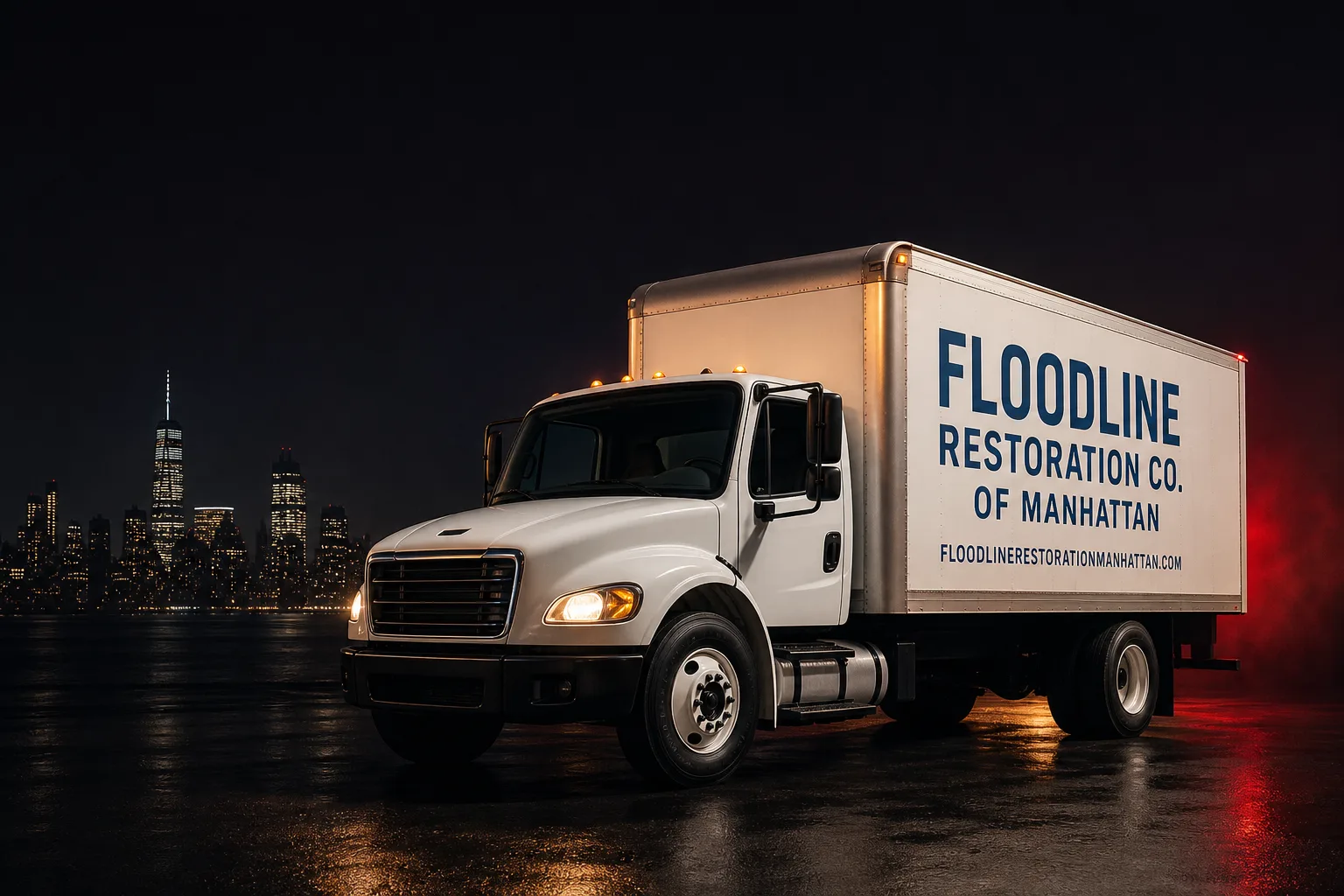
Free visual inspection and a written scope of work before any mitigation begins - photos, moisture readings, and drying logs go in your claim file
The scope we write is the scope we bill. Anything new gets shown to you, in writing, before we touch it.






 Before
 After
After Before
 After
After Before
 After
After24/7 Emergency Storm & Disaster Restoration in Williamsburg
Storm damage in Williamsburg doesn’t wait for business hours, and neither do we. Floodline Restoration Co. of Manhattan answers live at (917) 924-4221 every hour of every day. A real dispatcher picks up, not a recording. We dispatch crews into Williamsburg immediately, because the first hour after water enters a building determines whether you’re facing cleanup or a full gut. When a nor’easter pushes the East River over its banks or a summer thunderstorm backs up the combined sewer, ground-floor units and basements flood fast. The water is already wicking into horsehair plaster, exposed brick, and uninsulated concrete while you’re still looking for the phone number. Call us now. The faster extraction starts, the less gets torn out and the less it costs to put back. We provide a free visual inspection before any work begins, so you know the scope before we touch the building. One call puts a certified crew on the way to Williamsburg, with professional-grade extraction equipment in the truck and a written plan in your hands within the hour.
Understanding Storm & Disaster Restoration Severity in Williamsburg Properties
Not all storm water is equal, and Williamsburg’s building stock makes the distinction matter more than in most places. Category 1 water comes from a broken supply line or rainwater through a roof leak. It’s clean at the source. Category 2 carries contaminants, think sump pump discharge or water that’s sat long enough to breed bacteria. Category 3 is grossly contaminated: sewer backup, East River surge, or street flooding that’s picked up whatever Williamsburg’s streets leave behind. In a post-2005 waterfront loft with exposed concrete and brick, category 2 water behaves like category 3 because there’s no vapor barrier to stop it from wicking sideways through porous assemblies. Our crews moisture-map every affected surface with thermal imaging and hygrometers, then log readings daily until materials hit the dry standard. In 1880s brick tenements along Grand Street or Metropolitan Avenue, horsehair plaster locks moisture in wall cavities for weeks. In Kent Avenue loft conversions, uninsulated poured-concrete floors read wet long after the slab surface looks dry. Severity isn’t just about what the water is. It’s about what it’s soaking into, and Williamsburg has two radically different building types sitting on the same block. Our technicians are trained to IICRC WRT and ASD standards precisely because guessing wrong here means structural rot or mold you can’t see until it’s too late.
Why Williamsburg Property Owners Choose Floodline Restoration Co. of Manhattan
- 45-minute response commitment: when you call from Williamsburg, a crew is dispatched immediately and reaches your property fast, because staging equipment on a Kent Avenue sidewalk or a Bedford Avenue stoop means every minute counts.
- Live answer, 24/7: no auto-attendant, no “leave a message.” A dispatcher picks up at 2 a.m. and walks you through the first steps while the crew is already rolling.
- IICRC-certified crews: our technicians hold WRT and ASD certifications and follow RIA and IFA standards on every Williamsburg job, whether it’s a tenement basement or a waterfront loft.
- Free visual inspection: before any work begins, we assess the damage in person and give you a written scope so you know exactly what’s needed and what it costs. No surprises on the bill, ever.
- Direct insurance billing: we coordinate with your carrier, provide photo documentation and drying logs, and bill them directly. You never play messenger between Floodline and the adjuster.
- One team from extraction to reconstruction: the same certified crew that reads the moisture map on day one handles daily readings, dries the structure, and rebuilds what needs rebuilding. No mid-job handoff to an unknown subcontractor.
Our Storm & Disaster Restoration Process
Inspection & Assessment
We arrive in Williamsburg, walk the property, and identify every affected area with thermal imaging and moisture meters. You get a written scope and a firm price before we start.
Extraction & Stabilization
Standing water comes out first with truck-mounted extraction units and submersible pumps. We stabilize the structure by shoring any damaged areas and removing unsalvageable wet materials that would otherwise spread moisture.
Drying & Dehumidification
Dri-Eaz desiccant dehumidifiers and Phoenix air movers run continuously, positioned according to a moisture map of your specific building type. In Williamsburg’s loft conversions, that means addressing exposed brick and concrete assemblies that wick moisture for weeks. We log readings daily until the dry standard is met.
Cleaning & Sanitization
Contaminated surfaces get antimicrobial treatment. HEPA air scrubbers run during the entire process to capture airborne particulates. In category 3 water events, we perform a full pack-out of affected contents and sanitize them before anything goes back.
Specialty Treatment for Storm Damage
Each Williamsburg building type gets a tailored drying and remediation protocol. Kent Avenue lofts need extended desiccant runs and aggressive mold protocols. 1880s tenements need cavity drying through plaster walls. We adapt the equipment and timeline to the structure, not the other way around.
Repairs & Restoration
Once the structure is dry and clean, the same crew rebuilds. Drywall, flooring, trim, painting. Our 90-Day Done Right Promise applies in writing to every repair and every restoration, so you hold one name accountable for the whole job.
Need Emergency Storm & Disaster Restoration in Williamsburg Now?
Crews minutes away, answering live 24 hours a day. The sooner we start, the less it costs.
Working With Your Insurance Company
Storm and flood claims in Williamsburg involve enough moving parts without you having to broker phone calls between your contractor and your adjuster. From the first hour, we document everything: photos of the damage room by room, moisture readings before and during drying, a detailed line-item scope of work, and daily logs that show exactly what was done and why. Our estimates are written to industry standards your carrier recognizes, which means fewer disputes and faster approvals. We coordinate directly with your adjuster, so you’re not spending your evenings explaining drying protocols or negotiating line items. That’s our job. And because we bill the carrier directly when coverage applies, you’re not fronting thousands of dollars out of pocket and waiting for reimbursement checks. The 90-Day Done Right Promise means that if anything isn’t done right, we make it right, in writing, no arguing. That guarantee extends to the work your insurer paid for, and there’s no paperwork battle to invoke it.
What We Provide Your Insurer
- Thorough documentation of the loss
- Photos of all damage, room by room
- Moisture readings and drying logs
- A detailed, line-item scope of work
- Direct coordination with your carrier
Built for Williamsburg’s Loss Calendar
Williamsburg’s storm losses follow a pattern, and knowing that pattern means we arrive prepared. January and February bring deep freezes that burst supply lines in unheated tenement hallways and warehouse loft conversions where the original pipe routing was never designed for modern insulation standards. March and April thaw brings basement seepage through clay drain pipes as saturated ground water pushes in, and those 1880s foundations were never waterproofed. Summer in Williamsburg means convective thunderstorms that drop two inches of rain in forty minutes, overwhelming the combined sewer and sending category 3 water up through floor drains in ground-floor units along Bedford Avenue and Wythe Avenue. Then there’s nor’easter season, when East River surge pushes into the flood zone AE waterfront and floods basements and crawlspaces in the luxury towers and converted factories alike. Each season has a signature loss pattern in Williamsburg, and our crews arrive knowing what to expect before they open the door. That’s the difference between a crew that’s guessing and a crew that’s been through enough Williamsburg storm cycles to know what Tuesday’s forecast means for your building.
Storm & Disaster Restoration Across Williamsburg’s Neighborhoods
Williamsburg isn’t one neighborhood. It’s a dozen small ones, and storm damage plays out differently in each. On the Northside around Bedford Avenue and McCarren Park, 1890s brick rowhouses with narrow stairwells and 30-inch doorways mean extraction equipment gets staged on the sidewalk and air movers get carried in one at a time. The Southside, east of the BQE along Broadway and South 5th Street, is dense tenement housing where a burst pipe on the fourth floor floods three floors below before anyone notices. Along the East River waterfront, the Kent Avenue corridor and the blocks around Domino Park are glass-and-steel towers and converted warehouse lofts where storm surge from a nor’easter pushes category 3 water into ground-floor retail and below-grade parking. Each area has different access constraints, different building assemblies, and different drying timelines. Our crews know the alleys, the narrow stairwells, and the parking realities of Williamsburg. That local knowledge means faster extraction, less damage, and a lower final bill. Whether you’re in a converted loft on N 11th Street or a fourth-floor walkup off Graham Avenue, we get to you fast and we dry your building the way that building needs to be dried.
Specialized Storm & Disaster Restoration Services We Offer in Williamsburg
Storm Damage Cleanup
When wind and rain tear through Williamsburg, the damage is rarely just water. Tree limbs through windows, wet insulation, soaked drywall, and debris pressed against entryways all need to go before drying can start. Our storm damage cleanup crews handle the full pack-out and debris removal, then run HEPA air scrubbers to clear the particulate that wind-driven rain pushes into the building. For horsehair plaster walls in older buildings, we assess what can be saved and what needs to be cut out, because ripping out original plaster unnecessarily is expensive and avoidable.
Flood Damage Restoration
Flood damage in Williamsburg comes in two flavors: East River surge and sewer backup. Both are category 3 water events that require full antimicrobial treatment, pack-out of affected contents, and aggressive drying. Our flood restoration work in Williamsburg’s flood zone AE waterfront buildings includes extended desiccant runs on uninsulated concrete floors and exposed brick, because those assemblies hold moisture for weeks. We moisture-map everything, log readings daily, and don’t sign off until the dry standard is met and documented.
Emergency Board-Up
A broken ground-floor window in a Williamsburg loft conversion is an invitation to more than rain. Our emergency board-up crews respond fast to secure damaged openings on storefronts, ground-floor units, and upper-floor windows with plywood and weatherproof sealing. For converted industrial buildings with oversized windows along Kent Avenue and Wythe Avenue, we carry the full sheet sizes needed and secure them properly, because a half-measured board-up just lets the next storm finish the job.
Roof Tarping
Williamsburg’s 1880s brick rowhouses have flat or low-slope roofs with original tar-and-gravel or modified bitumen systems that fail under wind uplift and heavy rain. Our roof tarping service covers the breach fast, before water runs down through the building and soaks horsehair plaster walls two floors below. We tarp properly, with battened edges and enough overlap, so the tarp holds through the next storm while you get a permanent repair scoped and priced.
Debris Removal
Storm debris around Williamsburg properties blocks access, traps moisture against foundations, and creates pest issues. We remove fallen limbs, damaged fencing, wet building materials, and storm-carried trash, then clear drains and gutters so the next rain has somewhere to go. For tenement buildings with shared basements, we coordinate debris removal with all affected units so no one gets left with someone else’s wet drywall.
What happens when you call
- 1
A real person answersNo phone trees - you reach a local pro.
- 2
You get an upfront price rangeHonest numbers before anyone is dispatched.
- 3
A background-checked tech heads outLicensed & insured, dispatched right away.
- 4
You approve before work beginsNothing starts until you say go.
Storm & Disaster Restoration Costs in Williamsburg, NY
What does storm restoration actually cost in Williamsburg? The honest answer is that it depends on what got wet and what it got wet into. Fast water extraction and drying of a single flooded room in a tenement might run $1,800 to $3,400. A full basement flood with category 3 water, pack-out, antimicrobial treatment, and structural drying typically runs $5,000 to $9,000. Loft conversions with exposed brick and concrete assemblies run higher, often $7,000 to $14,000, because of extended drying timelines and the labor to move equipment through tight access points. Roof tarping on a typical Williamsburg rowhouse runs $400 to $900 for emergency coverage. Emergency board-up runs $250 to $600 per opening, depending on size. Most storm losses in Williamsburg are insurance-covered events, and we bill your carrier directly. You pay your deductible. We handle the claim. The free visual inspection gives you a firm, line-item scope in writing before we start, so there’s no bait-and-switch and no surprise on the final bill. Call (917) 924-4221 and we’ll walk the property with you, show you what’s wet, and tell you exactly what it costs to fix.
We Also Serve Cities Near Williamsburg
Storm damage doesn’t respect neighborhood boundaries. When Williamsburg residents face a loss, we also serve the surrounding communities: Fairview, Harrison, East Bronx, and Hunts Point. Same live 24/7 answer, same certified crews, same 90-Day Done Right Promise. Wherever the water line is, that’s where we start. Call Storm & Disaster Restoration team today at (917) 924-4221.
Serving Williamsburg, NY - Our Local Coverage Area
We’re based in the Williamsburg area and know this community well. Use the map below to see our service coverage - if you’re nearby, we can almost certainly help.
Williamsburg Storm & Disaster Restoration Questions, Answered
How does Williamsburg’s flood zone AE affect drying times in loft conversions after a storm surge?
Flood zone AE loft conversions in Williamsburg dry slower than standard wood-frame buildings because uninsulated poured-concrete floors and exposed-brick walls have no vapor barrier and wick moisture laterally for weeks. We run Dri-Eaz desiccant dehumidifiers and Injectidry panels continuously, moisture-mapping daily, and we don’t call the building dry until readings hold below the dry standard for three consecutive days. Call (917) 924-4221 for a free inspection of your loft conversion.
What roof tarping challenges are unique to Williamsburg’s 1880s brick rowhouses?
Williamsburg’s 1880s brick rowhouses have flat or low-slope roofs with parapet walls and original roofing systems that fail under wind uplift, making proper tarp anchoring critical. A tarp that isn’t battened and sealed around the parapet will lift in the next nor’easter and expose the building again. We tarp with full overlap and mechanical fastening, and we’re on site fast because water running down through a rowhouse roof soaks horsehair plaster walls two floors below. Call (917) 924-4221 for emergency tarping.
After a sewer backup in a Williamsburg basement, how do you decide what can be dried versus what needs to be torn out?
Category 3 water from a Williamsburg sewer backup means anything porous that got wet, carpet, drywall, insulation, stored cardboard, goes. Non-porous surfaces like concrete and tile get cleaned, antimicrobial-treated, and dried. The deciding factor is material type, not how it looks. In 1880s tenements with clay drain pipes that backed up, wood lath and horsehair plaster walls that wicked sewage water get cut out to dry framing, full stop. Call (917) 924-4221 for an assessment of your basement.
Can you provide emergency board-up for ground-floor units in Williamsburg’s converted industrial lofts?
Yes. Converted industrial lofts in Williamsburg, especially along Kent Avenue and Wythe Avenue, have oversized windows and storefront glass that need full-sheet plywood and proper weather sealing. We carry the large sheet sizes these openings demand and we secure board-up frames so the next storm or a break-in doesn’t turn a water loss into a total loss. Same-visit board-up is available 24 hours a day. Call (917) 924-4221.
What does storm damage cleanup include for Williamsburg tenements with horsehair plaster walls?
Storm damage cleanup in a Williamsburg tenement with horsehair plaster walls starts with a careful assessment of what’s salvageable. Plaster that’s still bonded to the lath and tests dry can often be saved with cavity drying through small access holes. Plaster that’s crumbled, delaminated, or sewage-soaked gets cut out to the framing. We don’t do wholesale plaster removal in historic Williamsburg buildings unless the damage genuinely requires it, because replacing original plaster is expensive and often unnecessary. Call (917) 924-4221 for a free inspection.
What should I do in the first 30 minutes after storm water enters my Williamsburg property?
First, shut off electricity at the panel if water is anywhere near outlets or wiring. Don’t walk through standing water in a flooded basement if the power is still on. Then call (917) 924-4221. Our dispatcher will walk you through immediate steps while a crew is dispatched. Move small valuables and documents to higher ground if it’s safe to do so. Don’t use a shop vac on sewage water. Don’t open walls. Let the crew handle extraction and assessment.
How fast can you actually reach a Williamsburg property in an emergency?
We commit to a 45-minute response time for Williamsburg properties, and in practice we’re often there faster because our crews stage in and around the neighborhood. A live dispatcher answers at (917) 924-4221 and dispatches immediately, any time of day or night. The same visit typically includes assessment, documentation for insurance, and extraction running. That speed is why we can often dry and restore rather than tear out and replace.
Does insurance cover storm and flood damage restoration in Williamsburg?
Storm damage from wind, falling limbs, or a burst pipe is typically covered by standard homeowners insurance. Flood damage from East River surge or sewer backup generally requires flood insurance or a specific endorsement, which matters in Williamsburg’s flood zone AE waterfront. We document everything from the first hour, write estimates to industry standards, and coordinate directly with your adjuster to maximize what gets covered. Call (917) 924-4221 and we’ll help you understand your coverage before any work begins.
Written by Curt Bowman, Owner at Floodline Restoration Co. of Manhattan, serving Williamsburg with certified storm and disaster restoration since 2010. Done right, and backed in writing.