
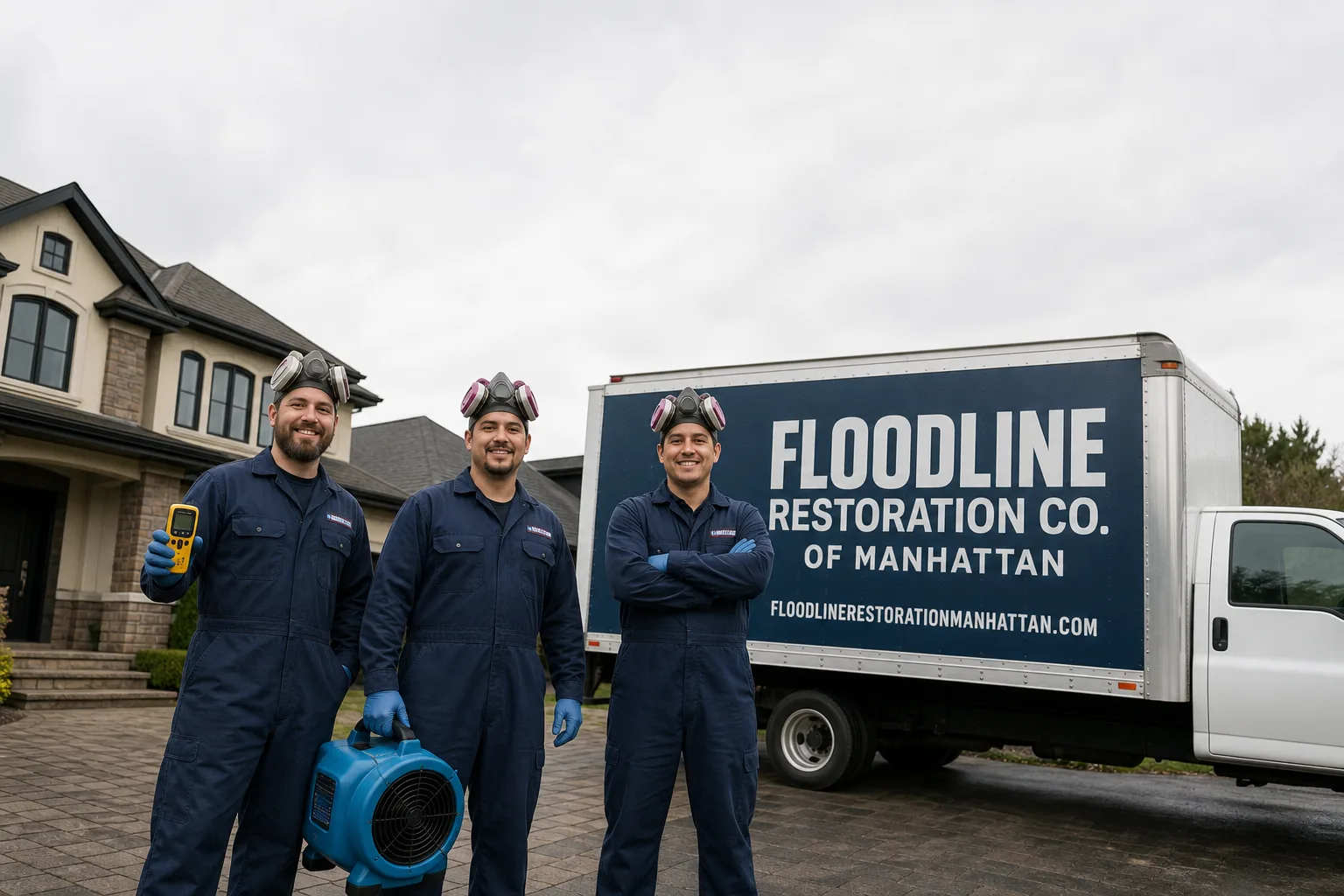
Free visual inspection and a written scope of work before any mitigation begins - photos, moisture readings, and drying logs go in your claim file
The scope we write is the scope we bill. Anything new gets shown to you, in writing, before we touch it.






 Before
 After
After Before
 After
After Before
 After
After24/7 Emergency Storm & Disaster Restoration in Yonkers
Storm and disaster restoration in Yonkers typically runs $1,800 to $7,500 for a full basement flood cleanup, and our crews are on the ground inside 45 minutes when you call (917) 924-4221. The first hour after floodwater enters a pre-war Yonkers basement is when the damage spreads fastest: Category 2 water migrating through plaster walls, saturating original hardwood, and starting the clock on mold. We answer live at two in the morning, a real person, not a recording, and the crew that arrives at your door in Yonkers is the same one that handles extraction, drying, and the rebuild. No mid-job handoff to a subcontractor you’ve never met.
Understanding Storm & Disaster Restoration Severity in Yonkers Properties
Most Yonkers storm damage calls involve water, and water has three categories that change the scope entirely. Category 1 is clean supply water, usually from a burst pipe or an overflowed tub. Category 2 is gray water with some contamination, what you get when a washing machine drain backs up or a sump pump fails. Category 3 is black water, what comes up from sewers, street runoff, and the buried Saw Mill River culvert when it overwhelms the stormwater system around Getty Square and Larkin Plaza. Category 3 water carries sewage, bacteria, and whatever the streets washed in. Our crews hold IICRC WRT and FSRT certifications and treat Category 3 as a hazmat job from the first cut: full containment, antimicrobial treatment, and disposal of porous materials that absorbed contaminated water. Yonkers’s pre-1940 brick and masonry row houses complicate this because original plaster wicks water upward and holds it, often hiding moisture behind finished surfaces long after the visible wetting is gone. We moisture-map with thermal imaging and hygrometers to find what the eye can’t.
Why Yonkers Property Owners Choose Floodline Restoration Co. of Manhattan
- 45-minute emergency response to Yonkers. Our crews stage from the New York City office and know the Saw Mill River Parkway, Nepperhan Avenue, and Central Avenue routes cold. You call, a live dispatcher confirms the address, and we’re rolling.
- A real person answers, 24/7. No automated system, no “leave a message and we’ll get back to you.” At 2 a.m. on a Sunday during a nor’easter, you get Curt Bowman’s dispatch board, not a voicemail.
- IICRC-certified crews, uniformed and background-checked. Every technician carries WRT, FSRT, or AMRT certification and arrives in a marked Floodline uniform. You know who’s in your home.
- Free visual inspection before any work starts. We assess the damage, explain what we found in plain terms, and hand you a written scope. You approve it before a single tool comes off the truck.
- Direct insurance billing, no messenger work. We document from hour one, bill your carrier directly, and talk to the adjuster so you don’t have to translate mitigation language.
- One team from first extraction to finished rebuild. The same crew that sets up Dri-Eaz air movers on day one also hangs the new drywall. Nobody inherits a half-done job.
Our Storm & Disaster Restoration Process
Inspection & Assessment
We arrive, walk the property with a thermal imaging camera and moisture meter, and map every affected surface. Old tide lines behind 1940s plaster tell us this isn’t the first flood, which changes how we document the claim.
Extraction & Stabilization
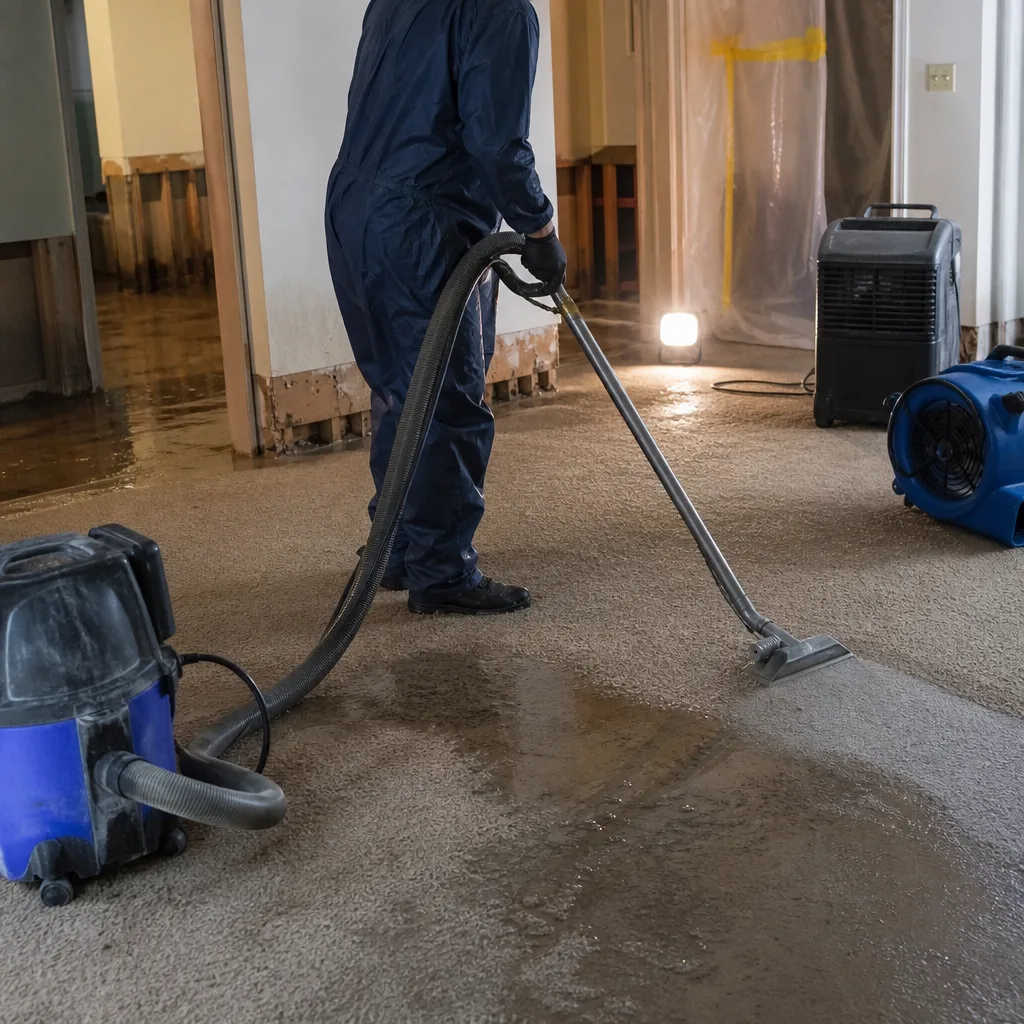
Standing water comes out first with truck-mounted and portable extractors. If the roof opened up, we tarp it. If a window blew out, we board it. The property gets stable before drying starts.
Drying & Dehumidification
Dri-Eaz air movers and Phoenix dehumidifiers go in, positioned based on the moisture map, not guesswork. In Yonkers’s dense attached housing, we also monitor neighboring units when water migrated through a party wall.
Cleaning & Sanitization
Category 3 water jobs get full antimicrobial treatment. We use HEPA air scrubbers during demolition and cleaning, and we handle asbestos floor tile and lead paint protocols on pre-1940 buildings the right way, not the cheap way.
Storm-Specific Structural Treatment
Wind damage gets sheathing and framing assessed for hidden cracks. Roof tarping gets inspected after the next rain, not just installed and walked away from. Freeze-thaw pipe bursts get checked for secondary damage in chase walls and under floors.
Repairs & Restoration
The same crew that did the mitigation hangs the drywall, matches the plaster profiles where needed, and rebuilds what was cut away. A moisture log documents every reading from day one to the dry standard, and you get a copy in your hands.
Need Emergency Storm & Disaster Restoration in Yonkers Now?
Crews minutes away, answering live 24 hours a day. The sooner we start, the less it costs.
Working With Your Insurance Company
We’ve been doing Storm & Disaster Restoration long enough to know that the adjuster is part of the job. From the first hour, our crew photographs every room, logs every moisture reading, and writes a line-item scope that matches industry-standard estimating software. You don’t negotiate from a stack of receipts. We talk to the carrier directly, provide drying logs and photos on request, and answer the adjuster’s questions in their language. If the claim is underpaid, we go back with documentation. If the carrier needs a second inspection, we’re there. The homeowner’s job is to make one call. Ours is to handle the rest.
What We Provide Your Insurer
- Thorough documentation of the loss
- Photos of all damage, room by room
- Moisture readings and drying logs
- A detailed, line-item scope of work
- Direct coordination with your carrier
Built for Yonkers’s Loss Calendar
Yonkers takes its worst hits differently month to month. January and February bring deep freezes that burst supply lines in exterior walls, especially in pre-war attached brick buildings along South Broadway and Warburton Avenue where original galvanized piping runs through uninsulated masonry. Category 2 water migrates through multiple units before anyone notices the ceiling stain. Spring thaw saturates the ground and finds every crack in a fieldstone foundation, pushing seepage into basements from Ludlow to Dunwoodie. Summer thunderstorms hit fast and hard, and the buried Saw Mill River culvert under Getty Square can’t take the volume, so stormwater backs up into the lowest blocks. Fall nor’easters ride the Hudson River Valley corridor, delivering wind that peels roofing on exposed ridge lines and drives rain sideways into masonry. Four separate seasons, four separate failure modes, one phone number.
Storm & Disaster Restoration Across Yonkers’s Neighborhoods
Response routes matter when water is rising. Our crews come down Nepperhan Avenue into the Getty Square and Larkin Plaza blocks fastest, which matters because that’s the buried culvert flood zone, the part of Yonkers where stormwater backs up before the system can carry it to the Hudson. Around Park Hill and Nodine Hill, we see three-story walkups with basement apartments where Category 3 water pushes up through floor drains during heavy rain. The attached row houses off South Broadway in the Ludlow and Lawrence Park areas share party walls, so water from one erupted supply line migrates sideways before it shows up; we check the neighbor’s side as standard practice. Up on the east plateau, the Dunwoodie and Lincoln Park hills change the damage pattern entirely: gravity sluices surface water downhill fast, so it’s window wells, garage floors, and lower-level entries that take water, while the hilltop streets get away with wind damage. Each neighborhood has its own rhythm, and a crew that knows Yonkers reads the difference fast.
Specialized Storm & Disaster Restoration Services We Offer in Yonkers
Flood Damage Restoration
In the Getty Square and Larkin Plaza flood zone, water comes up before it comes in. Our crews hold IICRC FSRT certification and treat every basement flood as potentially Category 3 until testing and history say otherwise. That means full PPE, containment, and antimicrobial treatment on the first visit. A Yonkers pre-war basement with original concrete and fieldstone walls dries differently than modern poured foundations, and we account for that in the drying plan.
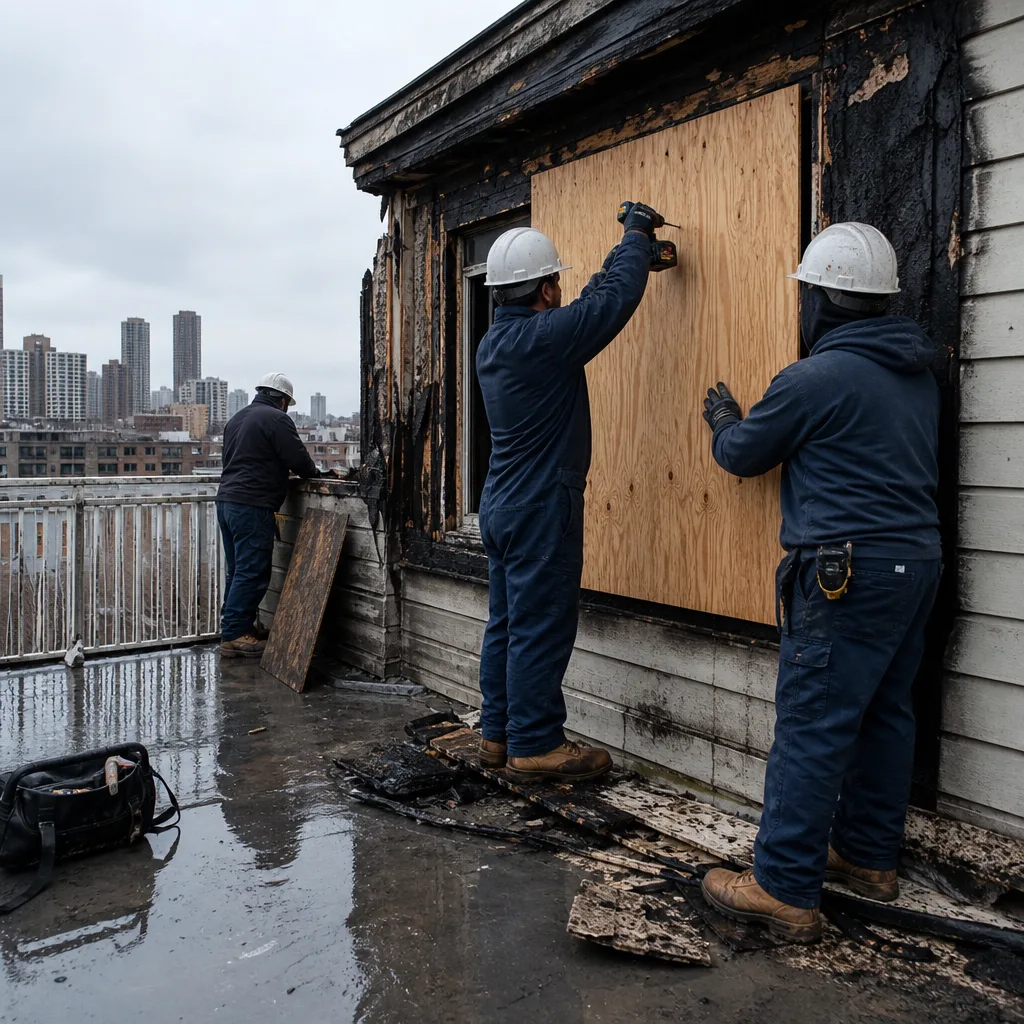
Emergency Board-Up
Storm-blown windows in Yonkers’s attached brick buildings leave openings that expose three floors of finished space, not just one room. We board and seal immediately, using fasteners that won’t further damage 1940s lintels or original wood frames. Security matters here: an open ground-floor window on a quiet Nodine Hill block is an invitation, and a tarped window should still lock.
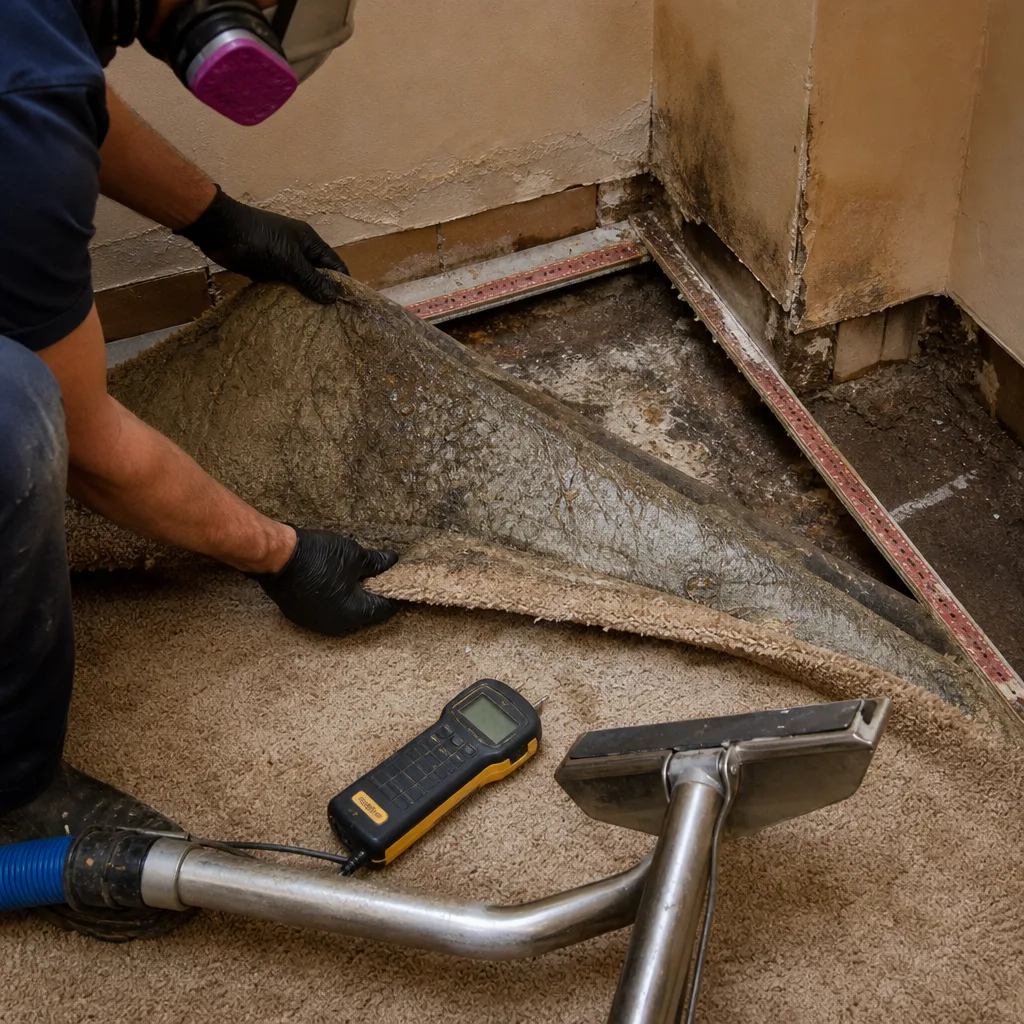
Roof Tarping
Nor’easter wind peels roofing off Yonkers ridge lines every fall. We tarp the same day the call comes in, using weighted and fastened tarps that hold through the next storm, not just the next morning. On flat-roofed pre-war apartment blocks along Warburton Avenue, we also check roof drains and scuppers while we’re up there, because a blocked drain turns a small leak into a three-story interior flood overnight.
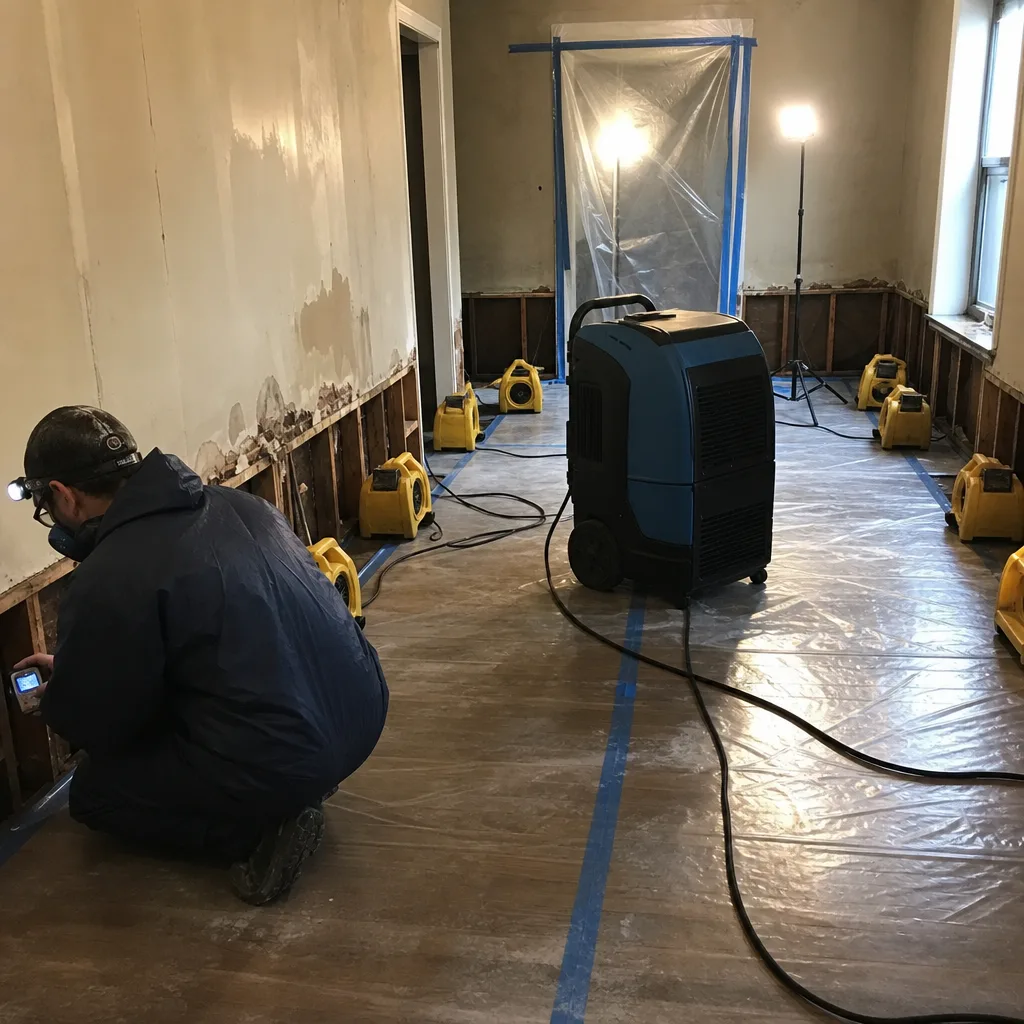
Storm Damage Cleanup
Downed limbs, broken glass, clogged yard drains, and wind-scattered debris all need to come off the property before they cause more damage. We handle debris removal as part of the stabilization visit. A limb resting on a garage roof in Dunwoodie gets removed before the next rain, not after it starts leaking.
Wind Damage Repair
Yonkers’s older masonry buildings handle wind better than modern stick framing, but original wood windows, cornices, and parapet caps take the brunt of nor’easter gusts. We assess wind damage as a structural question first: is the envelope compromised, or just cosmetic? The answer determines whether we tarp and document or open the wall that same day.
What happens when you call
- 1
A real person answersNo phone trees - you reach a local pro.
- 2
You get an upfront price rangeHonest numbers before anyone is dispatched.
- 3
A background-checked tech heads outLicensed & insured, dispatched right away.
- 4
You approve before work beginsNothing starts until you say go.
Storm & Disaster Restoration Costs in Yonkers, NY
Yonkers pricing runs specific to its housing stock. A flood cleanup in a pre-war row house basement typically runs $2,200 to $5,800, depending on the water category and how much plaster and original flooring has to come out. Category 3 black water pushes toward the high end because of hazmat protocols, containment, and disposal. Roof tarping runs $650 to $1,800 depending on roof height, pitch, and how much ladder work the crew has to do around tight Yonkers setbacks. Emergency board-up runs $350 to $900 per opening. Full reconstruction after a storm loss runs $12,000 to $45,000, and that’s scoped and priced in writing before work starts, like any real rebuild. Insurance covers most storm damage, and we bill the carrier directly. The fastest way to a firm number is the free visual inspection: we look, we measure, and we hand you a written scope. Call (917) 924-4221 and we’ll be there inside 45 minutes.
We Also Serve Cities Near Yonkers
Our crews serve Storm & Disaster Restoration in Yonkers and the surrounding Westchester communities, including Bronxville, Tuckahoe, Mount Vernon, and Eastchester. Same live dispatch, same 45-minute response commitment, same crew from first extraction to finished rebuild.
Serving Yonkers, NY - Our Local Coverage Area
We’re based in the Yonkers area and know this community well. Use the map below to see our service coverage - if you’re nearby, we can almost certainly help.
Yonkers Storm & Disaster Restoration Questions, Answered
Why do Yonkers basements flood even without a nearby river?
Because the Saw Mill River is closer than most people realize. It runs in a buried culvert directly beneath the Getty Square and Larkin Plaza blocks, and when heavy rain overwhelms the stormwater system, that underground river backs up into the surrounding basements. A property can be six blocks from any visible waterway and still sit in the culvert’s flood influence zone. Combined with Yonkers’s steep drop from the eastern plateau to the Hudson, stormwater hits the low blocks with nowhere to go but into the drainage system, and when that system is full, into the lowest floors. Call (917) 924-4221 if your basement took water that smells like street runoff or sewage.
How does Yonkers’s pre-1940 brick and masonry housing stock change a flood restoration scope?
It adds hazmat protocols almost every time. Pre-war Yonkers buildings commonly have asbestos floor tiles, lead paint, and original plaster over wood lath, and cutting into wet walls exposes all of it. That means containment, proper disposal, and licensed handling, which adds cost and time that newer construction never faces. It also means the drying plan is slower: original plaster holds moisture longer than modern gypsum board, and brick wicks water upward from a flooded basement into the first floor. We moisture-map every affected surface and run drying logs daily until the dry standard is met.
Why do we keep getting water in our attached row house even after drying?
The most common reason in Yonkers is a failed previous remediation. In the Getty Square and Larkin Plaza blocks especially, our crews have opened walls and found old tide lines, improperly dried framing, and prior flood cuts that were sealed up without full drying. If the property was never dried to the dry standard, moisture stays in the materials and reactivates with every new rain. The fix is a proper inspection: thermal imaging, moisture mapping to find what’s still wet, and a written scope that addresses the actual problem, not just the visible stain. Call (917) 924-4221 for a free visual inspection.
Which Yonkers neighborhoods have the highest repeat flood risk?
The blocks directly over and downhill from the buried Saw Mill River culvert are the worst: Getty Square, Larkin Plaza, and the surrounding low-lying streets off Nepperhan Avenue and South Broadway. Secondary risk areas include the lower blocks of Nodine Hill and Park Hill where gravity pulls stormwater down from the plateau. Properties on the eastern hills, like Dunwoodie and Lincoln Park, face less flood risk but take more wind damage during nor’easters. If you’re buying or renovating in the low blocks, ask for the flood history, and check the basement walls before you sign.
Can mold really start that fast in a Yonkers wet basement?
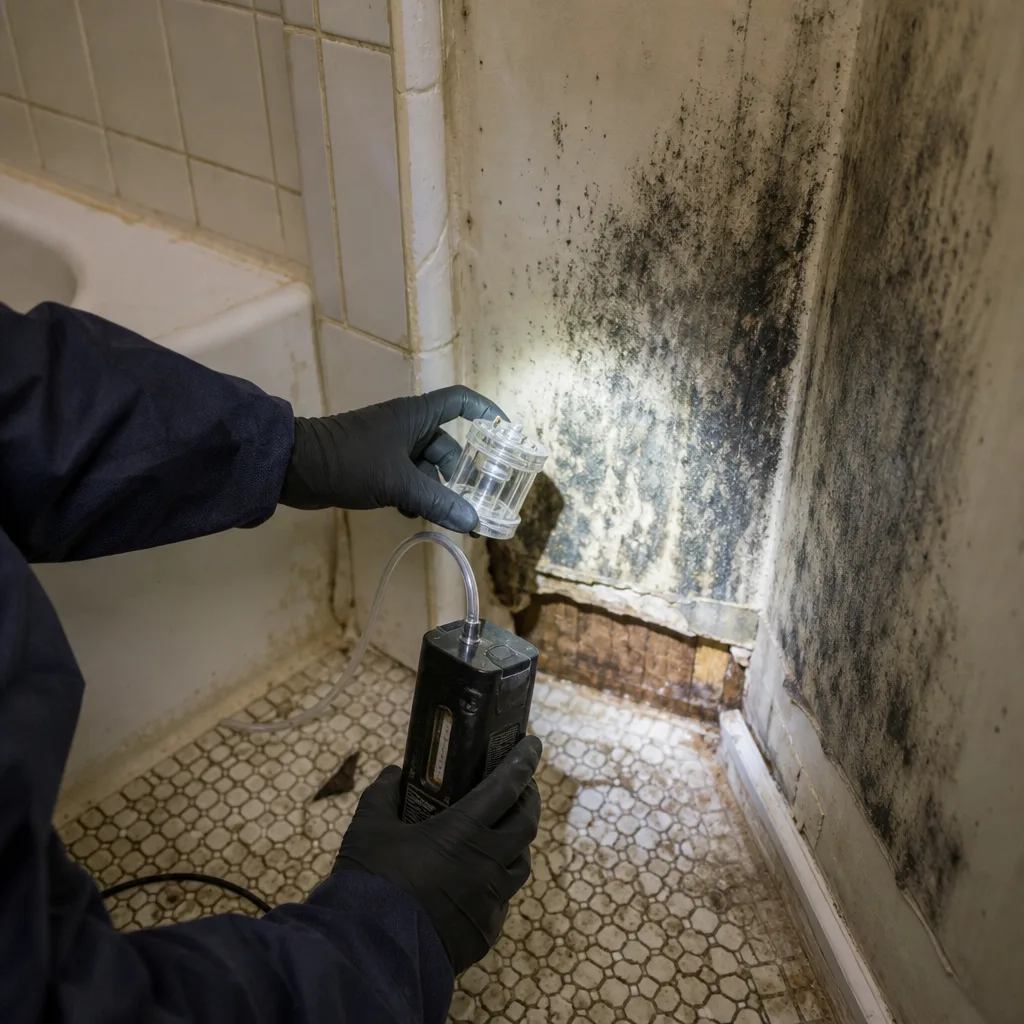
Yes. In Yonkers’s Hudson River Valley climate, the air carries enough moisture that mold colonization can begin in 24 to 48 hours on wet drywall, carpet, and especially on old plaster that has never been fully dried from a previous event. The safe response window is shorter here than in a drier climate. That’s why our crews are on the road inside 45 minutes and extraction is running the same visit. If the basement has been wet for more than two days, call (917) 924-4221 and we’ll assess whether drying alone is still enough or if antimicrobial treatment and material removal are needed.
How fast can you actually get to Yonkers?
Inside 45 minutes for most Yonkers addresses. The crews stage from the New York City office and know the fastest routes: Saw Mill River Parkway, Central Avenue, Nepperhan Avenue, and the cross streets off South Broadway. During nor’easters and heavy traffic, times can stretch, but a live dispatcher tells you the real ETA when you call, not an optimistic guess. If it’s an active flood, get the water shut off at the main if it’s safe, then call (917) 924-4221 and we’ll roll.
Is storm and flood damage typically covered by homeowners insurance in Yonkers?
Storm damage from wind, rain entering through a roof breach, and burst pipes is generally covered under standard homeowners policies. Flood damage from rising groundwater, sewer backup, or the Saw Mill River culvert overwhelming the stormwater system often requires a separate flood or sewer backup endorsement, which many Yonkers homeowners in the low blocks carry specifically because of the repeat risk. The best answer for your specific situation comes from a direct conversation after we document the loss. We bill the carrier directly and provide the documentation the adjuster needs. Call (917) 924-4221 and we’ll start that paperwork from hour one.
What should I do in the first 30 minutes after storm water enters my Yonkers home?
Shut off the power to the affected area if you can reach the breaker without stepping in water. Kill the main water supply if a pipe is involved. Then call (917) 924-4221. Don’t wade through the water to move furniture, don’t start vacuuming with a household vacuum, and don’t open walls yourself, especially in a pre-1940 Yonkers building where asbestos and lead paint may sit behind the plaster. If the water smells like sewage or street runoff, treat it as Category 3 and stay out of it entirely. Get the people and pets safe, and let the crew in masks and PPE do the rest.
Water doesn’t wait, and in Yonkers it doesn’t have to. Call (917) 924-4221 for a free visual inspection and a written scope. Live dispatch answers 24 hours a day, crews are inside 45 minutes, and the work is backed by the 90-Day Done Right Promise in writing. The line the water left is where we start.
Written by Curt Bowman, Owner at Floodline Restoration Co. of Manhattan, serving Yonkers and Westchester County.