
Free visual inspection and a written scope of work before any mitigation begins - photos, moisture readings, and drying logs go in your claim file
The scope we write is the scope we bill. Anything new gets shown to you, in writing, before we touch it.






 Before
 After
After Before
 After
After Before
 After
After24/7 Emergency Water Damage Restoration in Battery Park City
Water damage restoration in Battery Park City typically costs $2,800-$7,500 for a standard residential loss, with emergency extraction alone running $850-$1,900. We answer live at (917) 924-4221 any hour, and a Floodline Restoration Co. crew can reach most Battery Park City addresses within 45 minutes. The first hour matters more here than almost anywhere in Manhattan: salt-laden water from storm surge or a backed-up drain starts corroding rebar and wicking into concrete block within hours, not days. Call the moment you see standing water, a wet ceiling, or a musty smell that wasn’t there yesterday. Our Water Damage Restoration team arrives with truck-mounted extraction units, moisture-mapping tools, and the drying equipment to stop the loss before it spreads through a building’s shared mechanical spaces.
Understanding Water Damage Restoration Severity in Battery Park City Properties
Not all water behaves the same way inside a building, and Battery Park City’s high-rise stock makes the distinctions sharper than they would be in a single-family house. We classify every job by water category before we touch anything. Category 1 is clean water from a burst supply line or an overflowing tub. Category 2 carries significant contamination from a washing machine or sump failure. Category 3, the most serious, is grossly contaminated: storm surge, sewer backup, or river water. Most water damage restoration calls in Battery Park City involve Category 2 or 3 water, because the neighborhood’s below-grade floors sit at or beneath the Hudson River’s tideline. That means extraction is never enough. The structure itself, usually concrete block or poured concrete with drywall furring, holds moisture for weeks unless we run professional dehumidification and daily moisture readings. In a typical South End Avenue tower, a Category 2 pipe break in a mechanical room will saturate the CMU walls, the elevator pit, and any adjacent storage. We map the affected area with thermal imaging and hygrometers, set a drying goal based on the dry standard for unaffected materials in the same space, and log readings every day until we hit that number. No exceptions.
Why Battery Park City Property Owners Choose Floodline Restoration Co. of Manhattan
- 45-minute response commitment to Battery Park City. A live dispatcher confirms the address and dispatch time while you’re still on the phone. We reach most buildings in the neighborhood within 45 minutes, including Gateway Plaza, the Rector Place corridor, and South End Avenue addresses.
- Live answer at 2 a.m., every day of the year. A real person picks up at (917) 924-4221. Not a menu tree, not a voicemail. The dispatcher knows which crews are nearest Battery Park City and sends them immediately.
- IICRC-certified technicians on every job. Our crews carry WRT, FSRT, and AMRT certifications and follow the IICRC S500 standard for water damage. Uniformed, background-checked, and trained to work in occupied high-rise buildings without disrupting neighbors.
- Free visual inspection with a written scope. We look at the damage, take moisture readings, and hand you a line-item scope before any work begins. No guesswork, no pressure to sign for more than the building actually needs.
- Direct insurance billing. We work with your carrier from day one, submit the full documentation package, and bill them directly for covered work. You never play messenger between us and an adjuster.
- One crew, from extraction to reconstruction. The same Floodline Restoration Co. team that runs the extraction and drying also handles drywall replacement, paint, and rebuild. No mid-job handoff to a subcontractor you didn’t choose.
Our Water Damage Restoration Process
Inspection & Assessment
We identify the water category, map the affected area with thermal imaging, and document everything for the insurance file. In Battery Park City buildings, we also check for post-Sandy flood-proofing retrofits so we don’t waste time looking for equipment that’s been relocated above grade.
Extraction & Stabilization
Truck-mounted or portable extraction removes standing water from floors, elevator pits, and below-grade rooms. We set up containment immediately for Category 3 water to keep contaminated air from reaching common areas and occupied floors.
Drying & Dehumidification
Dri-Eaz and Phoenix dehumidifiers run alongside XPOWER air movers positioned from a moisture map taken on day one. In Battery Park City’s concrete-heavy construction, we hold daily readings until the dry standard is met, not a day sooner.
Cleaning & Sanitization
After drying, we treat affected surfaces with an antimicrobial agent. For saltwater events, this includes desalination of masonry where salt crystals remain in the block. We also run HEPA air scrubbers during work and before we remove containment.
Saltwater & Masonry Treatment
Battery Park City losses often require an extra step most restoration crews skip: removing salt-saturated drywall, testing concrete for retained chlorides, and treating surfaces to stop efflorescence and spalling from recurring months later.
Repairs & Restoration
We replace drywall, restore baseboards and flooring, and rebuild mechanical-room finishes to pre-loss condition. A photo documented scope goes to your insurer before we start, and repairs are backed by the 90-Day Done Right Promise in writing.
Need Emergency Water Damage Restoration in Battery Park City Now?
Crews minutes away, answering live 24 hours a day. The sooner we start, the less it costs.
Working With Your Insurance Company
We start building the claim file the moment we walk in. The first photos we take show the exact line the water left on the wall, before any tear-out changes the scene. We document everything room by room, take moisture readings during every visit, and produce an industry-standard estimate that mirrors your policy’s coverage language. Our team communicates directly with your adjuster, so you’re not forwarding emails or re-explaining the loss on a recorded line. By the time we finish drying and scope the repair, every document the carrier needs is already in their hands. Curt Bowman founded Floodline Restoration Co. in 2010 specifically around this promise: nobody gets stuck as a messenger between a homeowner and an insurance company. We bill the carrier directly for covered work, and if anything comes back denied or short-paid, we’ll walk you through exactly what your policy says.
What We Provide Your Insurer
- Thorough documentation of the loss
- Photos of all damage, room by room
- Moisture readings and drying logs
- A detailed, line-item scope of work
- Direct coordination with your carrier
Built for Battery Park City’s Loss Calendar
Water damage in Battery Park City doesn’t happen on a random schedule; it follows the weather and the age of the building’s systems. January deep freezes break supply lines in exterior walls, and the water travels down through multiple floors before anyone notices. Spring brings nor’easter-driven storm surge, and any building with a parking level or mechanical room below grade is at risk of water entering through vents, ramps, or floor drains. Summer thunderstorms can overwhelm roof drains on high-rise towers, sending water down through elevator shafts and interior corridors. And September to November is Atlantic hurricane season, which is when Battery Park City’s post-Sandy awareness peaks. We plan our crew schedules around this calendar. A live dispatcher answers the phone during a January pipe-burst blitz at 2 a.m. the same way they do on a quiet Tuesday afternoon. When a nor’easter is forecast, we pre-position crews near lower Manhattan so we’re not fighting bridge traffic while water rises in a Gateway Plaza basement. The neighborhood’s flood risk is not theoretical. It’s a repeating pattern, and the restoration crews who do well here are the ones who respect it.
Water Damage Restoration Across Battery Park City’s Neighborhoods
Battery Park City runs from Chambers Street down to the Battery, bounded by the Hudson River on the west and West Street on the east. It’s a compact area, but response routes and building access vary enough that we think about it block by block. North Battery Park City, including the towers near Chambers Street and Stuyvesant High School, has several large residential buildings with loading docks and freight elevators, which helps our crew move equipment fast, but also means we’re coordinating with building staff and working around scheduled deliveries. The South End Avenue corridor has some of the neighborhood’s densest residential blocks, many with below-grade parking entrances. Those ramps are where storm water and sewage backups enter first, and we’ve spent more hours in South End Avenue elevator pits than anywhere else in the city. The Rector Place area and buildings near the Esplanade face direct exposure to Hudson River spray during winter storms, which can drive water into vent openings and mechanical louvers even without a surge event. Residential towers around Rockefeller Park tend to be newer builds with more of the post-Sandy flood-proofing retrofits already in place, but that also means their below-grade mechanical layouts often differ from original blueprints. Our crews know to verify where the boilers and switchgear actually are before assuming anything. Battery Park City is a neighborhood where the building is the patient as much as the apartment is. Any restoration contractor working here has to think in terms of shared systems and common infrastructure, not just one unit’s drywall.
Specialized Water Damage Restoration Services We Offer in Battery Park City
Emergency Water Extraction
Standing water in a Battery Park City building starts damaging concrete and steel within hours. We pull it out with truck-mounted extraction units that remove thousands of gallons per hour, then set containment before the water has time to wick into walls and travel to occupied floors above.
Structural Drying & Dehumidification
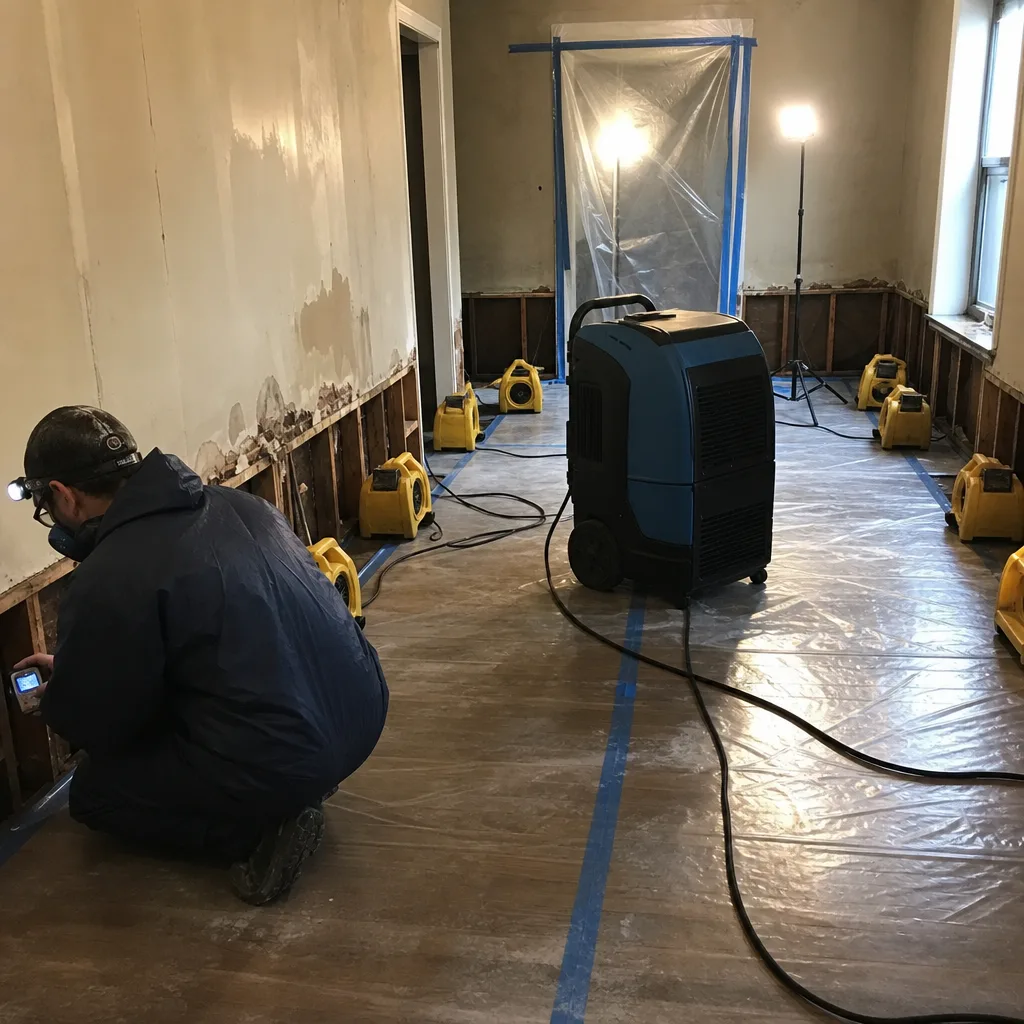
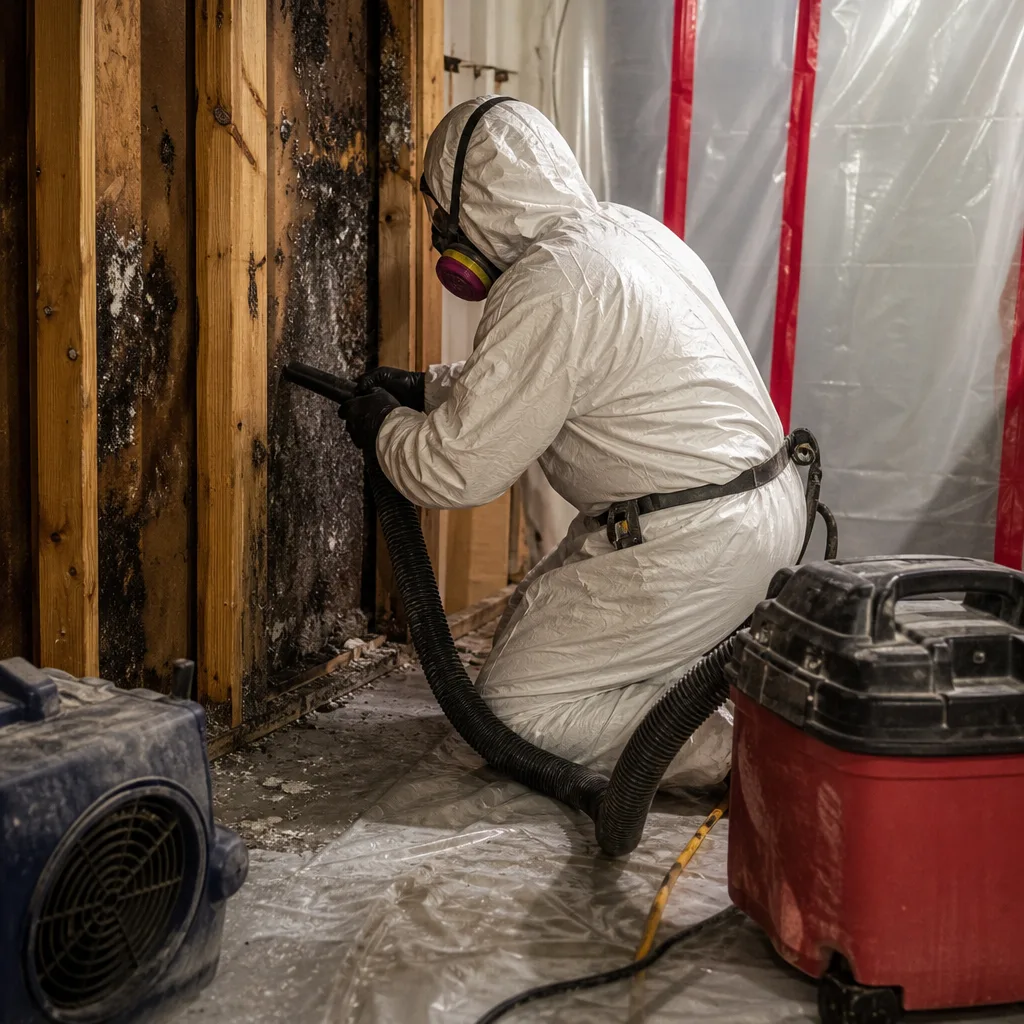
Battery Park City’s poured-concrete and CMU walls hold moisture like a sponge. Dri-Eaz and Phoenix dehumidifiers run on a moisture map taken the first day, and we return daily with hygrometers until the dry standard is met and logged. Skipping readings here means reopening walls three months later for mold.
Flood Cleanup
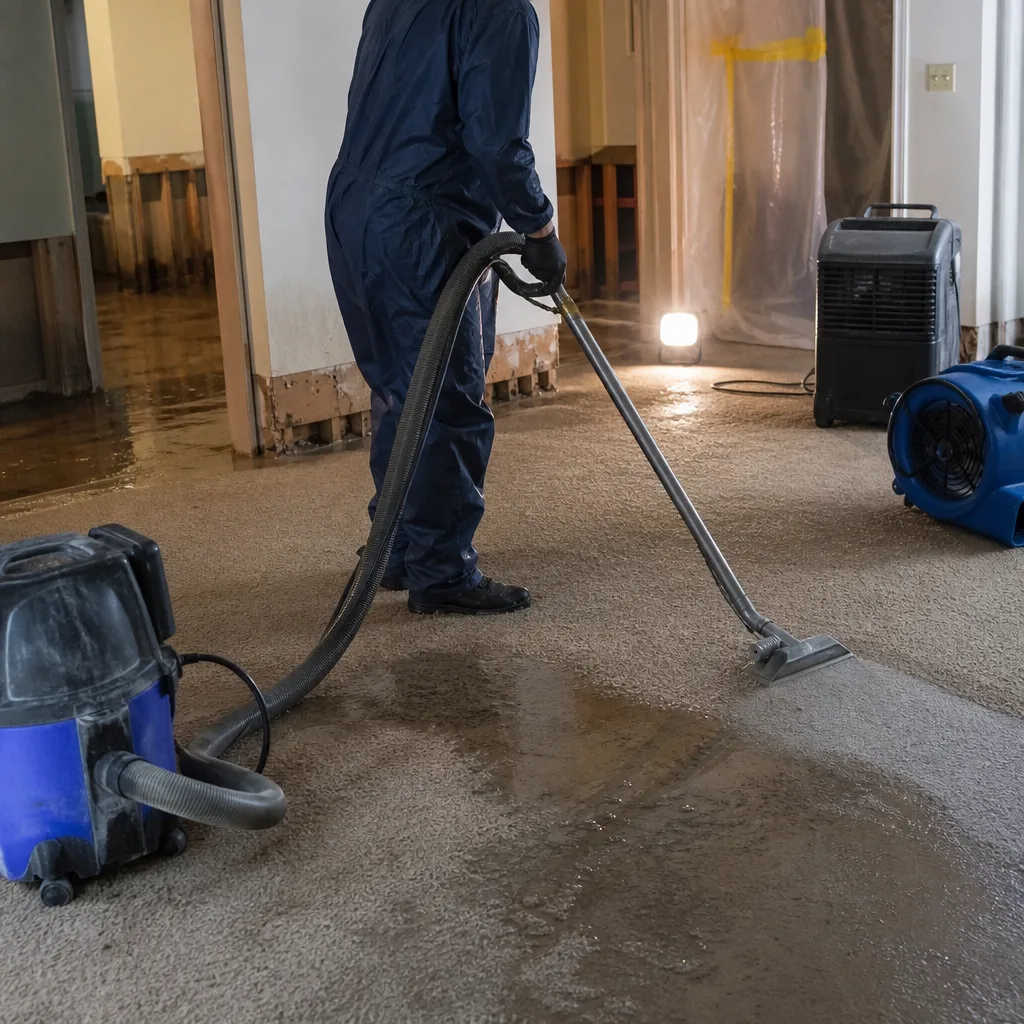
Saltwater flood cleanup in Battery Park City is a different job than freshwater cleanup anywhere else in Manhattan. We test for retained chlorides, remove salt-saturated drywall, treat masonry to stop efflorescence, and document everything for the carrier. Storm surge water is Category 3, so containment and full sanitization are non-negotiable.
Burst Pipe Restoration
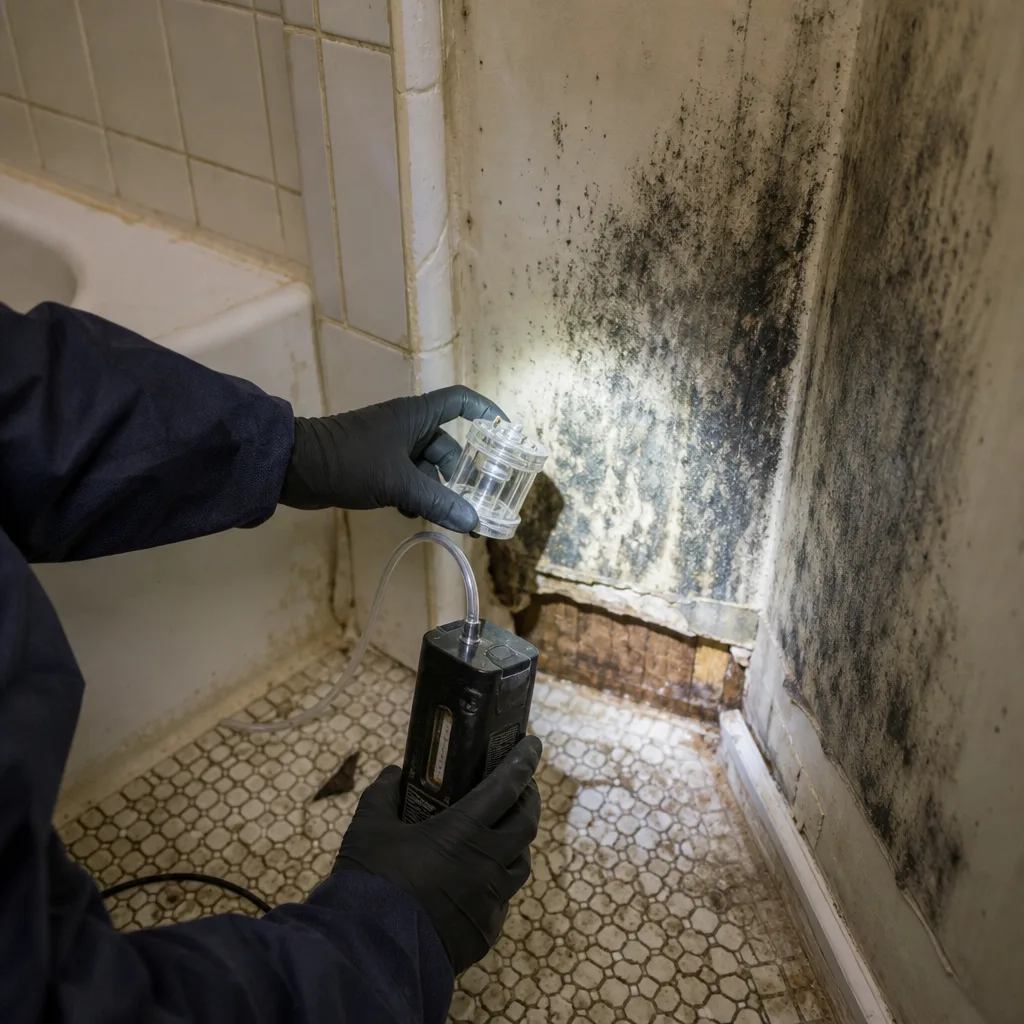
A frozen supply line in an exterior wall can feed water through a chase and into units several floors below before anyone sees it. We trace the water path, extract, dry, and then rebuild the wall cavity properly. Often the pipe itself needs repair, which our crews handle in the same visit.
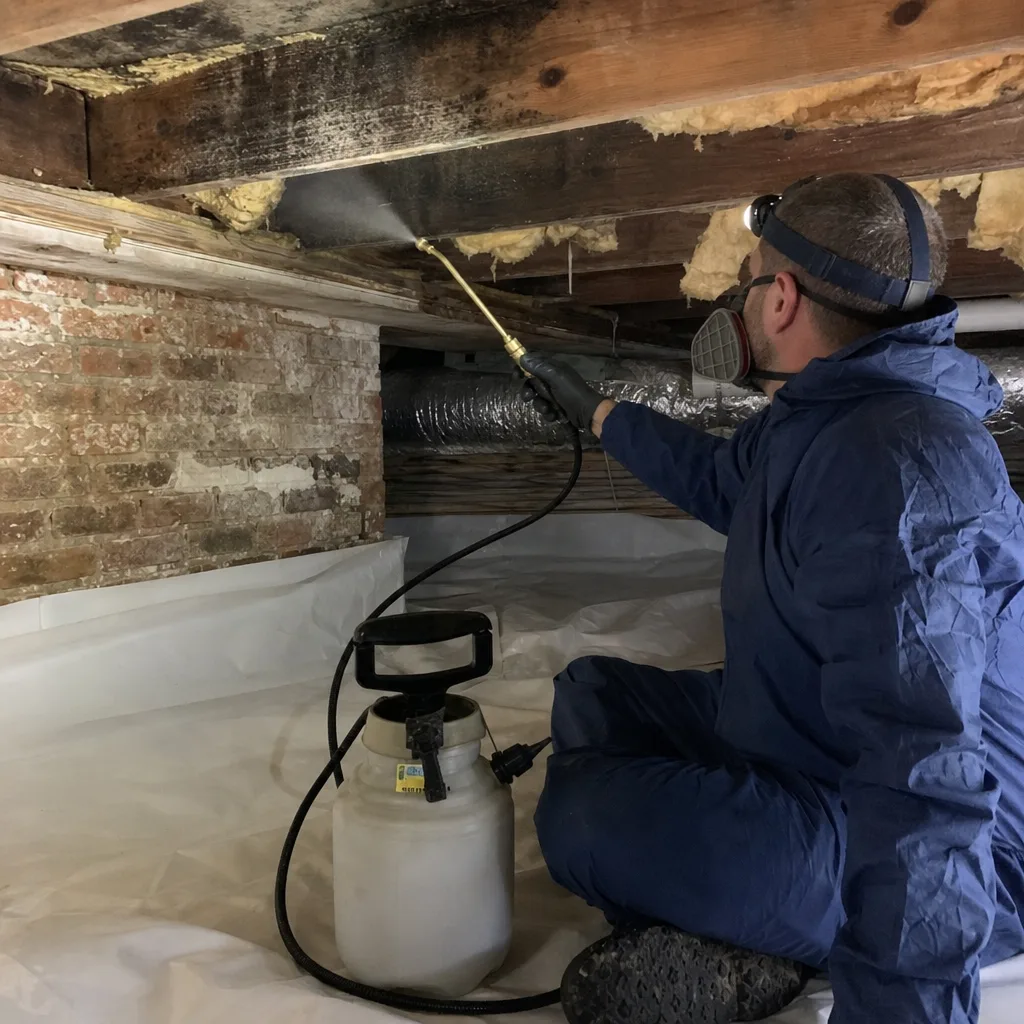
Basement Water Removal
Below-grade spaces in Battery Park City, from parking levels to storage rooms to mechanical floors, are the first place water shows up and the last place it leaves. We pump standing water, treat saturated concrete, and run dehumidifiers until a moisture meter reads dry, not damp. These are the jobs where the 90-Day Done Right Promise matters most, because a rushed basement dry-out is exactly how recurring mold starts.
What happens when you call
- 1
A real person answersNo phone trees - you reach a local pro.
- 2
You get an upfront price rangeHonest numbers before anyone is dispatched.
- 3
A background-checked tech heads outLicensed & insured, dispatched right away.
- 4
You approve before work beginsNothing starts until you say go.
Water Damage Restoration Costs in Battery Park City, NY
Every job is priced from a written scope, not a square-foot multiplier, so here’s what you’re actually looking at. Emergency water extraction in Battery Park City runs $850-$1,900 for a typical below-grade or unit-level event. Structural drying for a one-room or hallway loss runs $1,400-$3,200 depending on how many days of daily monitoring and dehumidifier runtime the drying standard requires. A full flood cleanup with Category 3 containment, saltwater treatment, and sanitization runs $4,500-$9,500 for a parking level or mechanical room. Burst pipe restoration in a residential unit, including drywall replacement and paint, runs $2,800-$6,000. Basement water removal with masonry treatment and rebuild typically lands between $3,500 and $8,000. The variables that move your price are the water category, the number of affected rooms or floors, and whether framing or concrete needs to be opened for drying. Insurance covers most of these losses under standard homeowner or building policies, minus your deductible. Floodline Restoration Co. offers a free visual inspection with moisture readings and a line-item scope before any work starts. Call (917) 924-4221 and we’ll be there when we say.
We Also Serve Cities Near Battery Park City
Floodline Restoration Co. crews respond to Fairview, Harrison, East Bronx, and Hunts Point from the same live-dispatch desk that covers Battery Park City. The same certified technicians, the same 90-Day Done Right Promise, and the same direct insurance billing apply across the region.
Serving Battery Park City, NY - Our Local Coverage Area
We’re based in the Battery Park City area and know this community well. Use the map below to see our service coverage - if you’re nearby, we can almost certainly help.
Battery Park City Water Damage Restoration Questions, Answered
How does saltwater from a Battery Park City storm surge change the water damage restoration process compared to a simple pipe break?
Saltwater changes everything. After a surge event, sodium chloride remains behind in concrete block, CMU walls, and porous masonry even after the visible water is gone. That salt keeps pulling moisture out of the air, which means your building can read dry on day three and wet again on day ten. We remove salt-saturated drywall, test concrete for retained chlorides, and desalinate or replace affected masonry before any rebuild begins. A Category 1 pipe break never requires this step. Call (917) 924-4221 if you suspect saltwater has touched any below-grade surface.
Why do I see dehumidifiers running for so long in Battery Park City basements after a flood?
Concrete holds moisture far longer than wood framing, and Battery Park City is built almost entirely of concrete and masonry. A stud-framed wall in a single-family house might dry in four days; a CMU wall in a South End Avenue basement can take nine to fourteen days under continuous Dri-Eaz and Phoenix dehumidification. If we shut the equipment down before the dry standard is met, the trapped moisture migrates back into the wall and you’re looking at mold inside the cavity. The longer runtime is the correct timeframe, not a billing tactic. We log every reading and hand the drying log to you and your carrier.
What should I check first after water enters my Battery Park City building’s basement mechanical room?
Check for standing water around electrical switchgear, boilers, and elevator equipment. Do not walk into water that may be in contact with live electrical systems. Cut power to the affected area at the breaker if you can do so safely from a dry location, then call us at (917) 924-4221. Water in a mechanical room is a life-safety issue before it’s a restoration issue, and the first hour determines whether the building’s equipment survives. Do not attempt to operate any submerged equipment.
Can mold really start growing before a restoration crew arrives in Battery Park City?
Yes. In Battery Park City’s humid, river-adjacent climate, mold colonization on wet drywall and organic materials can begin in 24 to 48 hours, and sometimes faster inside a warm mechanical room. Category 3 water accelerates this dramatically. That’s why we respond within 45 minutes and start extraction on the first visit. If you see water, don’t wait to see whether it recedes. Call (917) 924-4221 as soon as you notice it.
Does Battery Park City require special permits or approvals for water damage restoration in residential towers?
Most building restoration work inside Battery Park City residential towers requires coordination with building management and may require work-authorization approval from the building’s board or managing agent. Structural changes, including opening walls in fire-rated assemblies, are subject to NYC building codes and may require a permit. We handle this documentation as part of the scope we prepare. Your only job is calling us. The building staff usually know us already; we work in Battery Park City towers regularly.
How fast can a crew actually get to my Battery Park City building?
We commit to a 45-minute response time for addresses throughout Battery Park City. A live dispatcher confirms the exact arrival window when you call, and the crew calls again when they’re on approach. In a storm-surge event or a January pipe-burst night when multiple buildings are calling, we pre-position trucks near lower Manhattan to keep wait times down. The phone number is (917) 924-4221, and it’s answered live around the clock.
Will my insurance cover water damage restoration in Battery Park City?
Most standard homeowners and building policies cover sudden and accidental water damage, including burst pipes, plumbing failures, and appliiance overflows. Storm surge and river flooding are only covered if you carry a separate flood policy, typically through the NFIP or a private carrier. We document the cause of loss clearly and submit directly to your insurer with all photos, moisture readings, and the drying log. If a claim is disputed, we’ll walk you through your policy language and adjuster communication. Call (917) 924-4221 after any water loss, and we’ll start the file immediately.
What should I do in the first 30 minutes after discovering water damage in Battery Park City?
Shut off the water at the fixture or main valve if you can identify the source. Move valuables and electronics out of the water path. Photograph everything with your phone before towels or mopping. Then call us at (917) 924-4221. Do not use a shop vac on Category 2 or Category 3 water, and do not enter standing water near electrical panels or equipment. The earlier extraction starts, the less the restoration costs and the fewer materials we have to remove.
Written by Curt Bowman, Owner at Floodline Restoration Co., serving Battery Park City since 2010.