
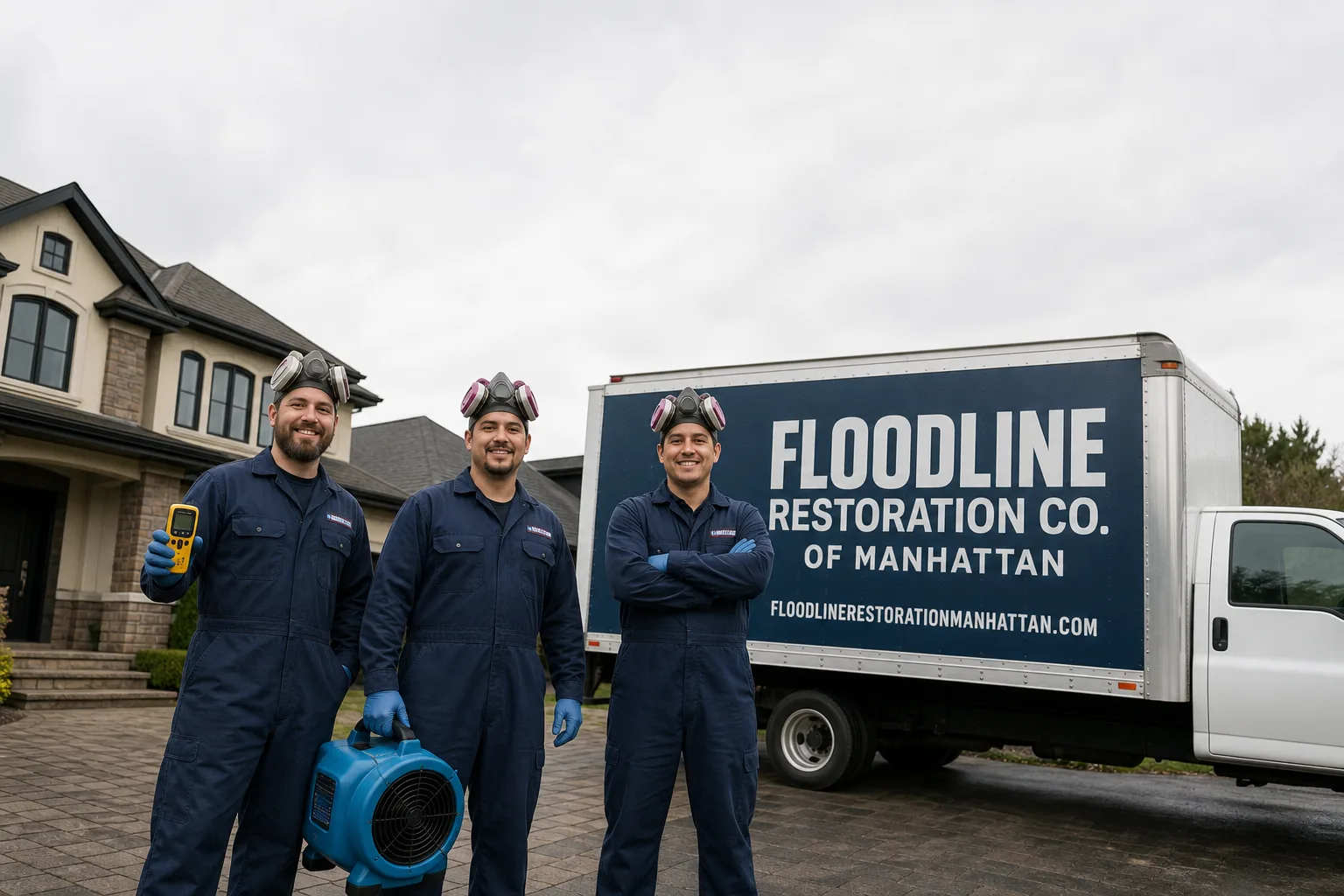
Free visual inspection and a written scope of work before any mitigation begins - photos, moisture readings, and drying logs go in your claim file
The scope we write is the scope we bill. Anything new gets shown to you, in writing, before we touch it.






 Before
 After
After Before
 After
After Before
 After
After24/7 Emergency Fire & Smoke Damage Restoration in White Plains
A kitchen fire in a White Plains high-rise at 2 a.m. needs a crew that can walk into a building with security protocols, property manager sign-off requirements, and five affected units on different floors. That’s what we do. Floodline Restoration Co. answers live around the clock at (917) 924-4221, and we dispatch certified fire restoration crews into White Plains immediately, not after a callback. Smoke moves through shared HVAC shafts and plumbing chases in hours, not days. The first call you make determines whether soot etches into corridor finishes or gets lifted while it’s still recoverable. You may call us before you call the building superintendent. We keep records from the first hour, which matters when three different insurance adjusters need documentation for what is physically one contiguous loss.
Understanding Fire & Smoke Damage Restoration Severity in White Plains Properties
Fire damage in White Plains follows patterns specific to the city’s dual housing stock: pre-WWII single-family homes in Battle Hill and the Highlands, and 1970s-1990s high-rise towers downtown. In older single-family homes, lath-and-plaster walls and balloon framing create vertical channels that carry smoke residue from a basement fire into attic spaces over the course of hours. In downtown towers, the issue is horizontal migration through drop-ceiling assemblies, shared mechanical shafts, and corridor returns. Soot residue falls into three categories we treat differently: dry soot from paper and wood fires (removable with HEPA vacuuming and dry-sponge methods), protein soot from kitchen fires (nearly invisible but aggressively adhesive, requiring specialized degreasing agents), and oily soot from burning plastics and synthetics common in modern furnishings (requiring wet-cleaning and odor sealing). White Plains’s tower stock, much of it built 1970s-1990s with original HVAC ducting, tends to hold smoke odor in insulation and drop-ceiling cavities for weeks unless containment is established early. That’s the technical reason we get HEPA air scrubbers and containment barriers running before anyone starts wiping walls. Soot left untreated on high-rise corridor finishes bonds chemically within 72 hours. After that, it’s a replacement job, not a cleaning job.
Why White Plains Property Owners Choose Floodline Restoration Co. of Manhattan
- 45-minute response commitment. Crews are dispatched from the New York City office and reach White Plains within 45 minutes of your call, on average. The clock starts when a live person picks up, not when a voicemail gets checked.
- Live answer, 24 hours a day. A real dispatcher answers at 2 a.m., every day. Not an automated system, not a call center that takes a message. A person who can dispatch a certified crew to White Plains immediately.
- IICRC-certified crews. Our technicians hold IICRC FSRT (Fire & Smoke Restoration Technician) and WRT (Water Restoration Technician) certifications, plus RIA and IFA training. They arrive background-checked and uniformed, with ID you can verify.
- Free visual inspection. We do not charge to walk the property, assess the damage, and give you a written scope of work. You decide with facts in hand, not pressure.
- Direct insurance billing. We bill your carrier directly and document everything. You never carry a clipboard of papers between us and your adjuster.
- One team from containment to reconstruction. The same crew that sets containment on day one handles odor removal, contents cleaning, and rebuild. No mid-job handoff to a sub you’ve never met.
Our Fire & Smoke Damage Restoration Process
Inspection & Assessment
We document every affected surface, map smoke migration through ducts and chases, and test soot types before touching anything. In White Plains high-rises, this includes walking corridors and adjacent units with the superintendent to establish the true footprint of the loss.
Extraction/Stabilization
Water from fire suppression gets extracted immediately using Dri-Eaz and Phoenix equipment. Standing water is Category 1 on day one but degrades within 48 hours. In tower units with drop ceilings, we check cavities above fire-damaged areas before they bloom.
Drying & Dehumidification
Desiccant and refrigerant dehumidifiers, plus air movers sized to tight White Plains tower units and narrow alley-load doors. Daily moisture readings are logged and given to you and your carrier until the dry standard is met.
Cleaning & Sanitization
Soot type determines method: HEPA vacuuming for dry soot, degreasing for protein soot, wet-cleaning and sealing for oily synthetic soot. We clean surfaces before we deodorize, never the reverse. Corridor finishes in downtown towers get priority before soot has time to etch.
Odor Removal & Deodorization
Thermal fogging, ozone treatment in sealed spaces, and hydroxyl generators for occupied areas. In high-rises, we treat shared HVAC returns and plumbing chases because smoke travels along those paths into units far from the original fire. Odor complaints in a unit two floors up are not a separate problem, they’re the same one.
Repairs & Restoration
Structural fire repair, drywall replacement, finish matching, and final clearances. The same Floodline crew that did the mitigation handles reconstruction, so features that were difficult to access or match during cleanup are already documented. The 90-Day Done Right Promise covers the result in writing.
Need Emergency Fire & Smoke Damage Restoration in White Plains Now?
Crews minutes away, answering live 24 hours a day. The sooner we start, the less it costs.
Working With Your Insurance Company
Fire losses in White Plains towers routinely involve multiple insurers: yours, the building’s, and sometimes the unit owner below or above. From the first hour, we photograph every affected surface, log moisture readings daily, and generate line-item scopes of work in industry-standard format. Our team communicates directly with adjusters, so you never play messenger between us and your carrier. We have documentation from the first visit, when the soot was still fresh and the water was still standing, and that documentation is what makes claims move without dispute. When a single riser or unit fire affects five units, we present five separate documentation packets, each built for a different adjuster.
What We Provide Your Insurer
- Thorough documentation of the loss
- Photos of all damage, room by room
- Moisture readings and drying logs
- A detailed, line-item scope of work
- Direct coordination with your carrier
Built for White Plains’s Loss Calendar
White Plains’s inland valley position in central Westchester creates a distinct loss calendar. January deep freezes burst supply lines in aging high-rise risers and pre-war single-family homes alike, and the water from fire suppression during those cold months compounds quickly inside enclosed tower units. Late-summer convective storms dump heavy rain on the Bronx River corridor, spiking ground-floor and basement water intrusion events that turn electrical fires from sump pumps and dehumidifiers into multi-layer water-and-fire losses. Nor’easters in the shoulder seasons push wind-driven rain into flat and membrane roofs on 1970s-1990s towers, and roof leaks near electrical boxes become smoke events waiting to happen. White Plains also has a heavier concentration of restaurant and commercial kitchen fires than surrounding suburbs, given the downtown core’s density. Those fires carry grease and protein soot that migrates through shared ductwork into residential units above. Spring thaw after hard Freeze cycles in the Highlands and Battle Hill neighborhoods tests cast-iron drains and inadequately insulated exterior chases, and when a drain fails in a finished basement, the water reaches outlets and appliances before anyone sees it. For property owners, this means fire and smoke damage in White Plains is rarely one isolated event. It arrives tied to water, weather, and building age.
Fire & Smoke Damage Restoration Across White Plains’s Neighborhoods
Downtown White Plains, the urban core around Mamaroneck Avenue and Main Street, is where we work with building superintendents and security staff on every visit. High-rise units require service-elevator scheduling, sign-off at the front desk, and equipment sized for alley-load entrances that do not fit full-size air movers through standard unit doors. We bring compact professional-grade Dri-Eaz dehumidifiers and XPOWER air movers that clear those doors with room to spare.
Battle Hill, on the north side, is pre-war and postwar single-family housing stock, much of it with original plaster walls and hardwood floors. Smoke from a kitchen fire here moves upward through wall cavities into bedrooms, and plaster holds odor differently than drywall. We treat those surfaces with methods that do not blow out old plaster.
The Highlands, east of downtown toward the Hutchinson River Parkway, sees freeze-thaw burst pipes in older supply lines, and those losses often start with water from fire suppression or a failed sump pump that arcs. The damage pattern is mixed water-and-smoke, and we handle both with one crew.
Near the White Plains Train Station and the commercial strips off Westchester Avenue, we service restaurants and retail spaces where protein soot and grease fires require degreasing protocols and odor sealing before spaces can reopen. These jobs run after-hours, coordinated with property managers and building security.
Specialized Fire & Smoke Damage Restoration Services We Offer in White Plains
Smoke & Soot Removal
Smoke and soot removal in a White Plains tower unit is not a wipe-down job. Soot from synthetic materials bonds to corridor finishes, ceiling tiles, and painted surfaces within 72 hours. We identify the soot type first, then clean with the method that lifts it without grinding the residue deeper. In high-rises, we treat elevator lobbies, shared stairwells, and the hallway outside the affected unit, because those finishes are expensive to match and smoke moves along those paths.
Odor Removal & Deodorization
Odor from a fire in one White Plains unit travels through shared HVAC returns, plumbing chases, and the gap around riser penetrations. Unit owners two floors up complain of smoke smell days after the fire is out. We treat these shared voids with thermal fogging and hydroxyl generators, sealed per floor as needed. The goal is not to mask odor. The goal is to remove the odor source so the complaint does not come back in three weeks.
Emergency Board-Up & Tarping
In Battle Hill and the Highlands, where single-family homes have street-facing windows and visible entry points, board-up and tarping happen within hours of the fire. Downtown, the work shifts to securing damaged unit windows and sealing penetrations so weather does not push rain into the building through a burned-out window on the tenth floor. We coordinate with property management on every penetration we open or close.
Fire Damage Cleanup
Cleanup means more than soot. It includes water extraction from suppression, removal of unsalvageable building materials, and organizing contents for pack-out or disposal. In White Plains apartments with limited storage, we provide pack-out services and document every item. The inventory list is what your adjuster uses to settle contents coverage.
Contents Cleaning & Pack-Out
High-rise units rarely have space to store furniture while we clean the apartment. We pack out smoke-damaged contents, clean them off-site, store them, and return them when the unit is restored. We photograph everything before it moves. For condo boards, we provide a contents manifest per unit so each owner’s adjuster can settle without disputes.
Structural Fire Repair
Framing, drywall, insulation, and finish work after fire and smoke damage. In downtown White Plains towers, structural fire repair means matching corridor finishes that were specified decades ago and working through building management for access and materials staging. In single-family homes, it means restoring a kitchen or a basement to the condition it was in before the fire, with the same crew that did the mitigation.
What happens when you call
- 1
A real person answersNo phone trees - you reach a local pro.
- 2
You get an upfront price rangeHonest numbers before anyone is dispatched.
- 3
A background-checked tech heads outLicensed & insured, dispatched right away.
- 4
You approve before work beginsNothing starts until you say go.
Fire & Smoke Damage Restoration Costs in White Plains, NY
A typical smoke and soot removal job in a White Plains apartment runs $1,200-$3,500 depending on affected square footage and soot type. Odor removal and deodorization for a single unit with shared HVAC involvement runs $800-$2,400. Emergency board-up and tarping in White Plains runs $400-$1,200, with high-rise window penetrations at the upper end due to access and coordination. Contents pack-out and cleaning for a one-bedroom unit typically runs $2,000-$6,000. Full fire damage restoration including structural repair for a kitchen fire in a White Plains single-family home commonly runs $12,000-$35,000. What moves the price: soot type (protein and oily soot cost more to treat than dry soot), number of affected units in a tower loss, accessibility of shared mechanical spaces, and whether corridor or elevator finishes require restoration. Most White Plains fire losses are insurance-covered. Our free visual inspection gives you a firm written scope before any work starts, so you know the number before you commit. Call (917) 924-4221.
We Also Serve Cities Near White Plains
We serve fire and smoke damage restoration in White Plains and surrounding Westchester communities including Hartsdale, Elmsford, Scarsdale, and Valhalla. Response to those areas follows the same live-dispatch model: a person answers, a crew is on the way.
White Plains Fire & Smoke Damage Restoration Questions, Answered
How does fire restoration in a White Plains high-rise differ from a single-family home in Westchester?
In a high-rise, smoke travels through shared HVAC shafts, plumbing chases, and corridor returns, so a kitchen fire in one unit becomes an odor problem in units two and three floors away. Restoration requires containment on multiple floors, property manager sign-off for every entry, and separate documentation packets for each affected unit’s insurer. A single-family home loss is easier to isolate but harder to ventilate, especially in older plaster-walled houses in Battle Hill or the Highlands.
Can you work in White Plains downtown towers with tight service entrances and security requirements?
Yes. We coordinate with building superintendents and security staff before arrival, schedule service elevators, and bring compact Dri-Eaz dehumidifiers and XPOWER air movers sized for alley-load doors and standard unit entries. Our technicians carry ID and check in at the front desk on every visit. We have done this work in White Plains high-rises off Mamaroneck Avenue and Main Street for years.
What documentation do you provide to White Plains condo boards when multiple units are affected by one fire?
We provide a separate documentation packet per unit: photos, moisture readings, drying logs, and a line-item scope of work. Each packet is formatted for that owner’s insurer. The building’s property manager gets a summary that maps the full affected footprint, including shared mechanical spaces and corridor finishes. This is what allows five adjusters to settle one contiguous loss without disputes.
How quickly can you board up and tarp after a fire in the Highlands or Battle Hill neighborhoods?
Emergency board-up and tarping in White Plains typically happens within hours of your call, not the next day. We secure street-facing windows and entry points in single-family homes immediately. For high-rise units, we seal damaged windows and penetrations the same day, coordinated with property management. Call (917) 924-4221 and a live dispatcher starts the process.
Does your fire damage cleanup include pack-out services for White Plains apartments with limited storage?
Yes. We pack out smoke-damaged contents, photograph and inventory every item, clean what can be cleaned off-site, store it, and return it when the unit is restored. For apartments with no storage space, this is often the only way to get furniture out so the unit can be properly deodorized. The inventory list goes directly to your adjuster.
Will insurance cover fire and smoke restoration in White Plains?
Most White Plains fire losses are covered under the homeowner’s or condo owner’s policy, and building-wide losses go through the building’s master policy plus each affected unit owner’s policy. We bill carriers directly and provide the photo documentation, moisture logs, and scopes of work that adjusters need. For multi-unit losses, we prepare separate packets per insurer, which removes most of the friction from the claim.
What certifications do your fire restoration technicians hold?
Our crews hold IICRC FSRT (Fire & Smoke Restoration Technician) and WRT (Water Restoration Technician) certifications, with additional training through RIA and IFA. Technicians are background-checked, uniformed, and arrive with identifiable company ID. The same certified crew handles mitigation and reconstruction; we do not hand the job off to uncertified subs.
What should I do in the first 30 minutes after a fire in White Plains?
Call (917) 924-4221 first. Then, do not touch or wipe soot from any surface; wiping smears oily soot and grinds it into finishes. Do not run your HVAC system if you can avoid it; that pushes smoke through shared ducts and chases. Keep doors closed to unaffected rooms if possible. Take photos on your phone of visible damage, but do not walk through standing water. We will tell you the rest when we are on the line.
Serving White Plains, NY - Our Local Coverage Area
We’re based in the White Plains area and know this community well. Use the map below to see our service coverage - if you’re nearby, we can almost certainly help.
The Floodline Restoration Co. Standard in White Plains
In White Plains, a single riser fire in a downtown high-rise often means presenting scopes of work to multiple unit owners and insurers simultaneously, a coordination burden that simply doesn’t exist in neighboring single-family suburbs like Scarsdale or Harrison. We learned this years ago. After a kitchen fire in a 1980s high-rise off Mamaroneck Avenue, our crew worked with the building superintendent to establish containment on two floors, ran HEPA air scrubbers and Dri-Eaz dehumidifiers in tight drop-ceiling cavities, and coordinated pack-out of smoke-damaged contents for five separate units, each with a different adjuster, while security staff escorted us through alley-loaded service entrances. That is what Fire & Smoke Damage Restoration looks like in White Plains.
We are Floodline Restoration Co., founded by Curt Bowman in 2010. Every job is backed by the 90-Day Done Right Promise, our written guarantee that if it is not done right, we make it right. No arguing, no paperwork battles. The same promise applies whether we are restoring a one-bedroom apartment downtown or a four-bedroom home in the Highlands. We answer the phone with a person at 2 a.m., we send background-checked, IICRC-certified technicians to your door in White Plains, and we stand behind the result in writing. Standing offers: $50 off any repair over $250, $89 seasonal tune-up, and a 5% discount for seniors and veterans, always.
Call (917) 924-4221 for a free visual inspection and a written scope of work before anything starts.
Written by Curt Bowman, Owner at Floodline Restoration Co. of Manhattan, serving White Plains and Westchester County since 2010.