
Free visual inspection and a written scope of work before any mitigation begins - photos, moisture readings, and drying logs go in your claim file
The scope we write is the scope we bill. Anything new gets shown to you, in writing, before we touch it.






 Before
 After
After Before
 After
After Before
 After
After24/7 Emergency Storm & Disaster Restoration in Bensonhurst
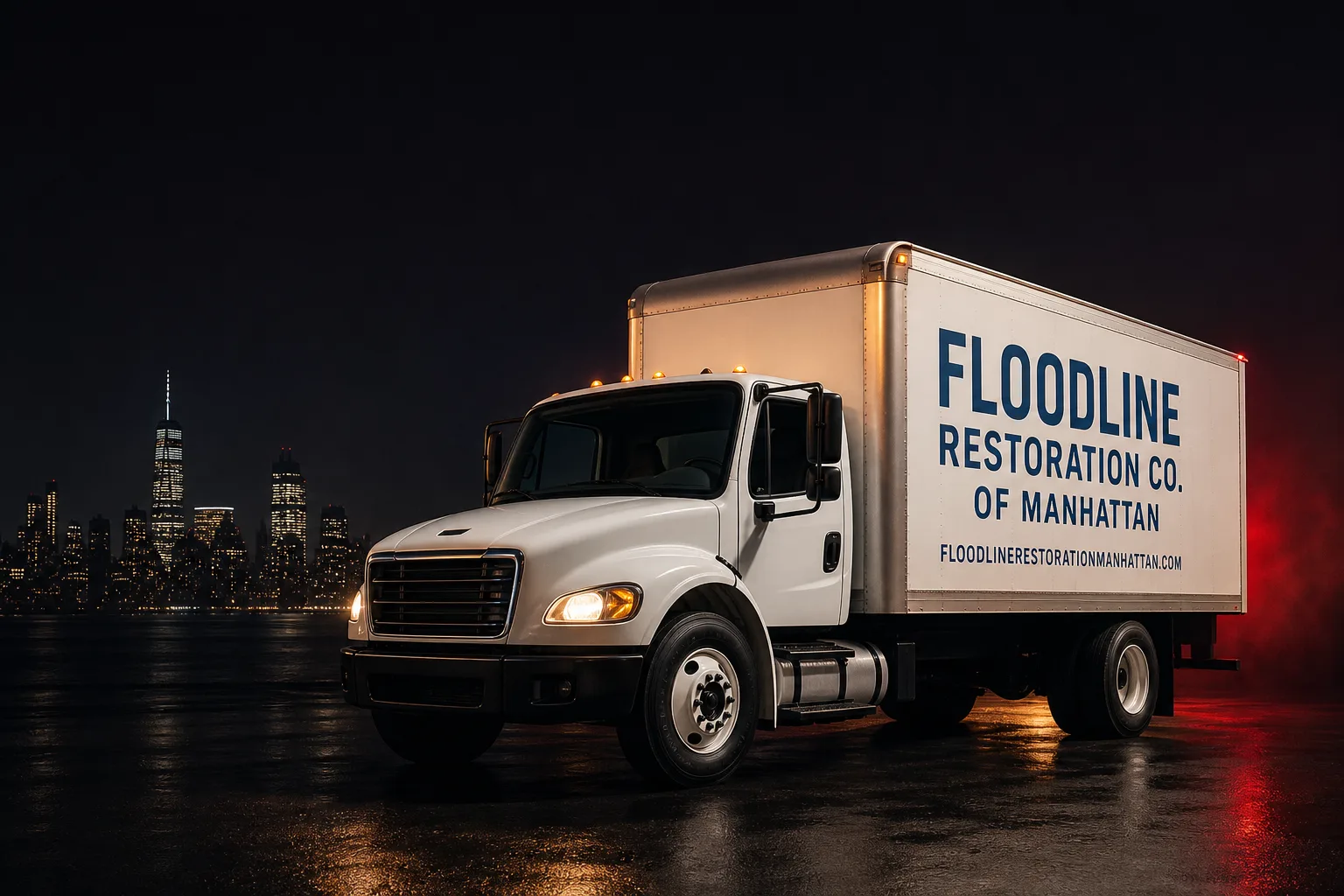
Storm and disaster restoration in Bensonhurst means answering the phone at 2 a.m. when a nor’easter pushes Gravesend Bay over its banks, or when a thunderstorm overwhelms the combined sewers and Category 3 water comes up through a row house floor drain. We answer live, every time, because we know the difference between a midnight call and a morning insurance headache is how fast certified crews start extraction. Call (917) 924-4221 now and a Floodline Restoration Co. of Manhattan crew dispatches from our New York City office to Bensonhurst immediately. Free visual inspection, direct billing to your carrier, and a written scope before any work begins.
Understanding Storm & Disaster Restoration Severity in Bensonhurst Properties
Bensonhurst’s two- and three-family brick row houses, most built between 1925 and 1955, handle stormwater differently than newer construction. The shared rubble-stone foundations between attached units mean water that enters one basement doesn’t always stay there. We classify every intrusion: Category 1 is clean water from a supply line or sump failure. Category 2 carries detergents or biological contaminants. Category 3 is sewage, storm surge, or whatever the combined sewer pushed back through the floor drain; it requires antimicrobial treatment, controlled demolition of saturated plaster-and-lath, and often containment on both sides of a shared foundation wall. Our crews moisture-map every affected wall cavity with thermal imaging and hygrometers so we know where the water actually traveled, not just where it pooled. That matters in Bensonhurst because cast iron drain stacks and clay tile laterals from the 1930s and 1940s don’t fail in isolation. They fail into the next unit.
Why Bensonhurst Property Owners Choose Floodline Restoration Co. of Manhattan
- 45-minute response commitment across Bensonhurst. We dispatch from our New York City office and know the corridors: 86th Street, 18th Avenue, Bay Parkway, New Utrecht Avenue. When we say we’ll be there, we’ll be there.
- A live person answers, 24/7. Not a recording, not a third-party answering service. A dispatcher who knows the difference between a burst supply line and a sewer backup, every hour of every day.
- IICRC-certified crews, trained to WRT and FSRT standards. Our technicians carry the Water Restoration Technician and Fire & Smoke Restoration Technician certifications, plus RIA and IFA training. Uniformed. Background-checked. They show up ready to work and explain what they’re doing in plain English.
- Free visual inspection before you commit. We walk the property, scope the damage, and give you a written explanation of what needs to happen. No pressure, no upselling.
- Direct insurance billing. We work from your carrier’s claimed loss, not against it. Photo documentation starts in the first hour and continues through final reconstruction.
- One team from extraction to rebuild. The same crew that reads the moisture map on day one handles daily readings, hands the log to you and your adjuster, and rebuilds what needs rebuilding. No mid-job handoff, no inherited crew.
Our Storm & Disaster Restoration Process
Inspection & Assessment
We arrive, walk the entire affected property, and classify the water or storm damage. Thermal imaging and moisture probes tell us where water migrated through shared walls, under finished basements, and into cavities we can’t see. You get a written scope before any work starts.
Extraction / Stabilization
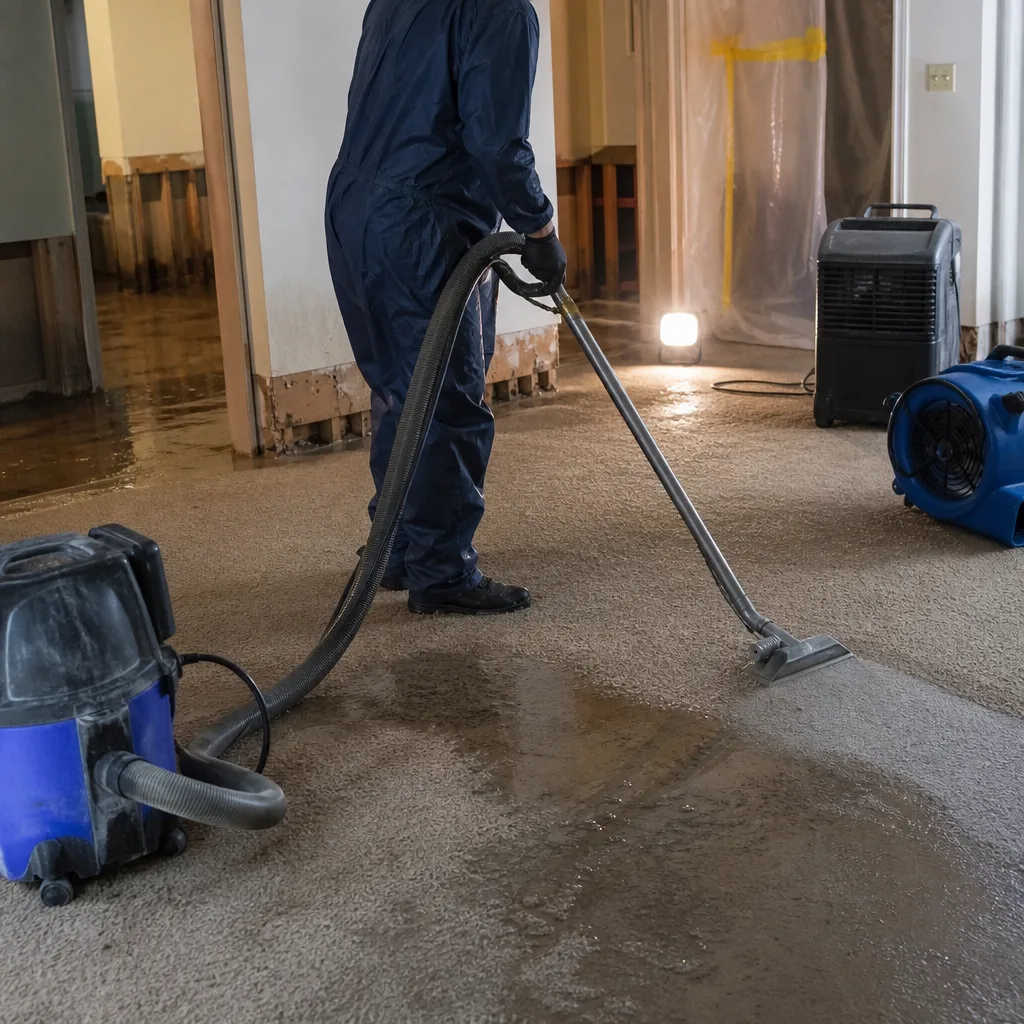
Professional-grade extraction pumps and truck-mounted units remove standing water. For storm damage, this includes emergency board-up of broken windows and roof tarping to stop further intrusion. We stabilize first so the damage stops spreading.
Drying & Dehumidification
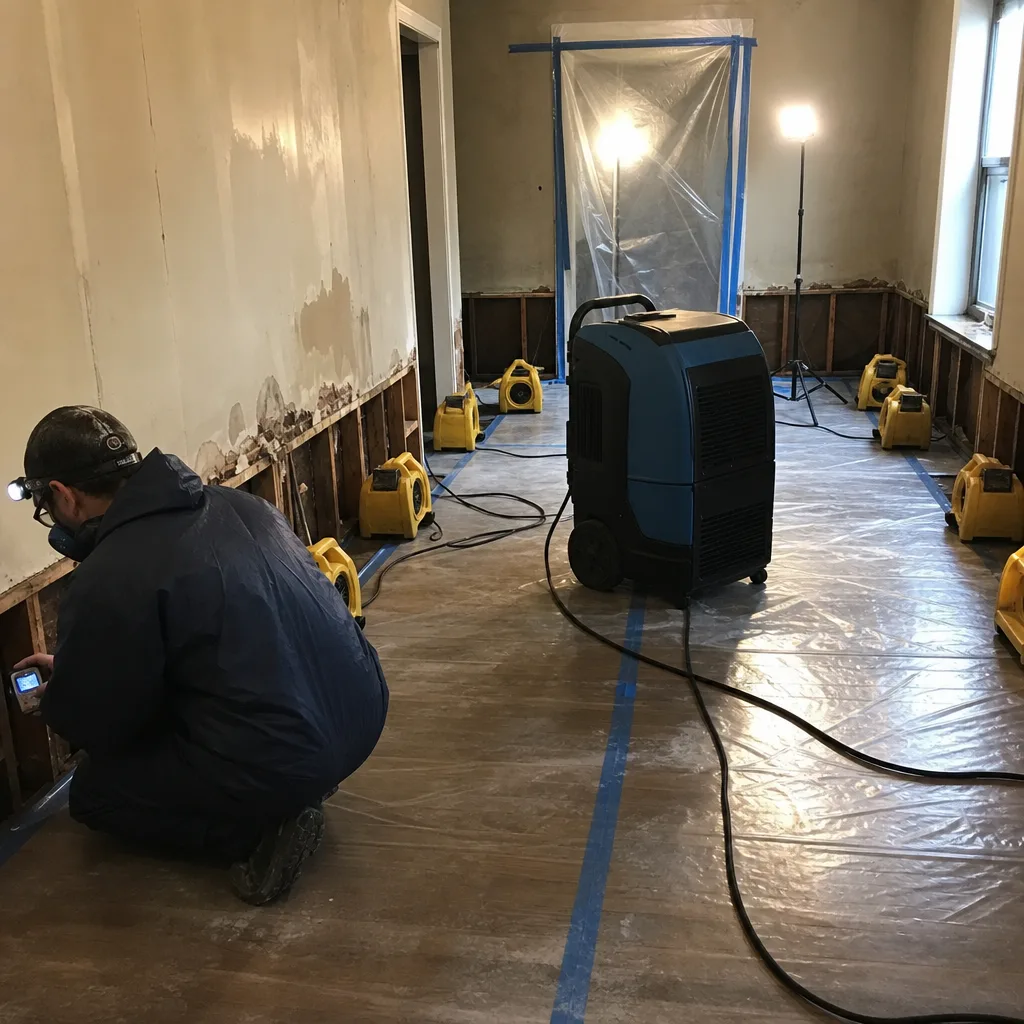
Dri-Eaz dehumidifiers and XPOWER air movers go to work, positioned based on a measured drying plan, not guesswork. In plaster-and-lath Bensonhurst row houses, drying is deliberately slower. Daily moisture readings track progress until we hit the dry standard.
Cleaning & Sanitization
For sewage and storm surge, this means antimicrobial treatment on every surface the water touched, including wall cavities behind plaster. HEPA air scrubbers run during cleanup to control airborne contaminants. Contaminated porous materials get cut out and bagged.
Testing & Specialty Treatment
In 1920s through 1950s row houses, we test for asbestos in flooring, pipe insulation, and joint compound before any demolition. Mold from latent moisture gets contained, removed, and clearance-tested. The goal is a dry, clean, safe building shell.
Repairs & Restoration
We rebuild what was removed: drywall where drywall was, plaster repair where the structure calls for it, flooring, trim, paint. The same crew that started the job finishes it, and the 90-Day Done Right Promise covers the work in writing.
Need Emergency Storm & Disaster Restoration in Bensonhurst Now?
Crews minutes away, answering live 24 hours a day. The sooner we start, the less it costs.
Working With Your Insurance Company
Floodline Restoration Co. of Manhattan has handled hundreds of Bensonhurst storm and sewer claims. We understand how carriers evaluate Category 3 basement flood damage in attached row houses, including the cross-boundary complications that happen when moisture migrates through shared foundations. From the first hour, we photograph every affected area, log moisture readings daily, and document the complete scope of work in the format your adjuster expects. You never play messenger between us and your carrier. We call the adjuster, we walk the claim together, and we bill directly. That’s the square deal.
What We Provide Your Insurer
- Thorough documentation of the loss from the first day
- Photos of all damage, room by room, including the neighboring property where applicable
- Moisture readings and drying logs with dates, times, and equipment placement
- A detailed, line-item scope of work in industry-standard format
- Direct coordination with your carrier throughout the claim
Built for Bensonhurst’s Loss Calendar
Bensonhurst’s storm damage pattern follows the seasons, and we prepare for each one. Winter brings deep freezes that burst supply lines in unheated entry vestibules and crawl spaces, especially in pre-war row houses with original plumbing. Spring snowmelt and moderate rain events overwhelm NYC’s combined sewers, pushing Category 3 water back through basement floor drains along 79th Street, 80th Street, and the numbered avenues. Summer thunderstorms drop two inches in an hour, flooding low-lying intersections and basement entrances on streets that slope toward Gravesend Bay. Fall nor’easters drive wind-driven rain into brick facade gaps and flat roof drains, soaking top-floor apartments through shared firewall seams. Hurricane Sandy’s lesson never left this neighborhood: storm surge from Lower New York Bay is a real threat, and basements that were only partially remediated in 2012 still carry latent moisture behind finished walls. Our crews know the seasonal rhythm. We stock equipment for it. We answer the phone for it.
Storm & Disaster Restoration Across Bensonhurst’s Neighborhoods
Bensonhurst stretches from 14th Avenue east to McDonald Avenue and from 60th Street south to the Belt Parkway, and storm damage doesn’t look the same in every part. Along Bay Parkway and 86th Street, commercial first floors with residential above present mixed-use restoration challenges: a flooded storefront means a flooded basement below a family’s living room, and we have to work around business hours and health code requirements. West of 18th Avenue toward Gravesend Bay, older two-family brick row houses sit closer to the water table, which means basement seepage and sewer backup come earlier in a storm and linger longer. Around New Utrecht Avenue, attached homes built in the 1930s share walls and foundation lines, so a single flood call often becomes two: the unit where the water entered, and the attached neighbor whose finished basement absorbed moisture through the party wall. South of 65th Street near the Belt, wind damage is the bigger story: roof flashing, parapet caps, and older flat roof membranes get torn up in nor’easters, and emergency board-up and tarping happens before water has a chance to follow. Our dispatchers know these corridors. When you call, we know which crew to send and what equipment they’ll need before they knock.
Specialized Storm & Disaster Restoration Services We Offer in Bensonhurst
Flood Damage Restoration
Flood damage in Bensonhurst almost always means sewer backup or storm surge, not a clean-water pipe break. We start with classification: if Category 3 water has touched it, porous materials come out, and the remaining structure gets antimicrobial treatment. Our Storm & Disaster Restoration team handles the full cycle from extraction through rebuild, with daily drying logs and a written scope.
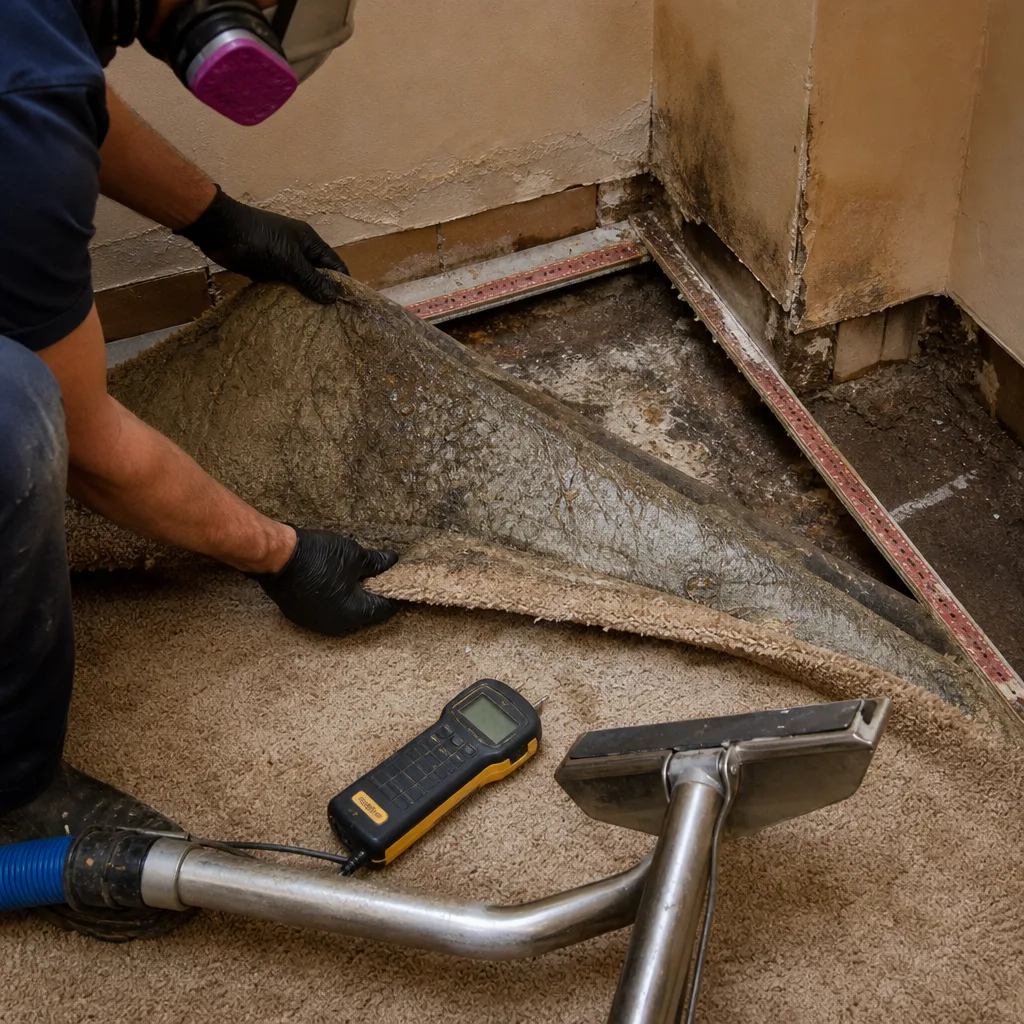
Storm Damage Cleanup
After a nor’easter or thunderstorm, the first job is clearing what the storm left behind: downed tree limbs, debris, damaged drywall, soaked insulation. We remove it, document it for your insurer, and get the structure ready for drying and repair. The cleanup isn’t the end of the job. It’s the beginning of a dry, stable, rebuilt home.
Emergency Board-Up
In Bensonhurst’s attached row houses, a broken window or compromised entry door affects more than one unit. Wind-driven rain through a single gap can soak a stairwell, a ceiling, and the neighbor’s wall cavity. We board up with proper plywood and fastening, tarp flat roofs and damaged parapets, and stop the intrusion before it spreads. This is stabilization work, not a temporary fix.
What happens when you call
- 1
A real person answersNo phone trees - you reach a local pro.
- 2
You get an upfront price rangeHonest numbers before anyone is dispatched.
- 3
A background-checked tech heads outLicensed & insured, dispatched right away.
- 4
You approve before work beginsNothing starts until you say go.
Storm & Disaster Restoration Costs in Bensonhurst, NY
Sticker price always depends on the damage, but Bensonhurst homeowners should know the ranges before anyone knocks. A basic storm damage cleanup with extraction and drying in a typical two-family row house basement runs $3,500 to $7,800. Full Category 3 sewer backup remediation, including containment, antimicrobial treatment, removal of contaminated plaster-and-lath, and structural drying, typically runs $9,000 to $18,500 in Bensonhurst, depending on how far the water migrated and whether the shared foundation pulled in the attached neighbor. Emergency board-up and roof tarping starts around $450 to $1,200. If asbestos testing and abatement are required, that adds $2,000 to $6,000 depending on scope. Most of these costs are covered by homeowners insurance when the cause is sudden and accidental. Call (917) 924-4221 for a free visual inspection and a firm written scope before you commit to anything.
We Also Serve Cities Near Bensonhurst
Our teams regularly respond across the wider area, including Bensonhurst, Fairview, Harrison, East Bronx, and Hunts Point. If you’re in a neighboring community and facing storm, flood, or sewer backup damage, call the same live line and we’ll dispatch the nearest available crew.
Bensonhurst Storm & Disaster Restoration Questions, Answered
Why does a sewer backup in my Bensonhurst basement affect my attached neighbor’s house, and who handles that?
Moisture from a Category 3 backup migrates through the shared rubble-stone foundation into the attached unit’s basement and wall cavities. We scope both properties, coordinate two separate insurance claims, and run drying and remediation on both sides before declaring either job done.
My 1930s row house basement flooded with sewer water. Can I dry it out myself, or is professional antimicrobial treatment required?
Category 3 water contains pathogens, and drying alone won’t remove them. Porous materials saturated with sewage need to be removed, and remaining surfaces need antimicrobial treatment under containment. This is not a shop-vac job. Call us at (917) 924-4221 for a free inspection and a written scope.
How long does structural drying take in a Bensonhurst row house with plaster walls and cast iron drains?
Plaster-and-lath walls and dense brick construction dry slower than modern drywall assemblies. A typical basement flood in Bensonhurst takes three to five days of continuous drying with professional dehumidifiers and air movers, with daily moisture readings to confirm when the dry standard is met.
If my neighbor’s flooded basement is causing mold in my attached row house, can I file my own claim and start restoration immediately?
Yes. You file against your own policy for damage to your property. Document what you see, call your carrier, and call us. We will scope your side independently, coordinate with the neighbor’s adjuster if needed, and start remediation on your unit without waiting for the other claim to resolve.
Does Emergency Board-Up matter for my Bensonhurst row house after a storm, or is that just for detached homes?
Board-up matters more in attached row houses because a single broken window or roof breach can introduce water into a shared wall cavity that affects the unit next door. Stabilizing the opening in the first hours prevents a wind-driven rain event from becoming a two-unit mold problem.
How fast can a crew actually get to my Bensonhurst home?
We commit to a 45-minute response for emergency work in Bensonhurst. Our dispatchers know the neighborhood corridors, and our crews carry extraction and drying equipment on the truck so work starts on the first visit, not the second.
Will my insurance cover storm damage and sewer backup in Bensonhurst?
Most homeowners policies cover sudden and accidental storm damage, including wind and falling debris. Sewer backup requires a specific endorsement, which many Bensonhurst homeowners have added after Sandy. We bill your carrier directly and document everything so the claim moves without you playing middleman.
What should I do in the first 30 minutes after a storm or flood in my Bensonhurst home?
Kill power to the affected area if water is present near outlets. Move valuables and furniture up if you can do so safely. Call us at (917) 924-4221 so an emergency crew can get dispatched while you document the scene. Do not enter standing water that may contain sewage, and do not run appliances or pumps that may be damaged.
Serving Bensonhurst, NY - Our Local Coverage Area
We’re based in the Bensonhurst area and know this community well. Use the map below to see our service coverage - if you’re nearby, we can almost certainly help.
Bensonhurst’s Shared Foundations: What Other Restoration Pages Won’t Tell You
Bensonhurst’s attached brick row houses share rubble-stone foundation walls, and that changes everything about storm restoration here. When a sewer backup floods the basement of a two-family home on 79th Street, the water doesn’t respect the property line. It wicks through the shared masonry, into the attached neighbor’s crawl space or finished basement, and stays there long after the original unit looks dry. We see it every season: a homeowner calls us for a flooded basement, and our moisture mapping shows elevated readings on the other side of the foundation wall, where the neighbor has no idea anything happened. That moisture feeds mold behind plaster-and-lath, quietly, for months. If we dry only the flooded unit and walk away, we haven’t actually fixed anything. We have just moved the problem next door.
That cross-boundary situation is the single biggest restoration complication in this neighborhood, and it is why Bensonhurst jobs routinely involve two insurance claims, two adjusters, and one unified scope of work. On 79th Street near 18th Avenue, our crew arrived for a reported basement flood in a two-family brick row house and found Category 3 water from a collapsed clay tile sewer lateral had backed up through the floor drain. Using moisture mapping, we traced elevated readings through the shared foundation wall into the attached neighbor’s finished basement, where latent moisture from the same event was already feeding mold behind plaster-and-lath. Because the original cast iron drain stack was compromised and asbestos-containing floor tiles were present, we set up containment on both properties, coordinated a single scope of work across two insurance claims, and completed structural drying with Dri-Eaz dehumidifiers and XPOWER air movers before any demolition began. Both homeowners got written documentation. Both carriers got the same daily drying log. Neither one paid a penny out of pocket for the coordination.
This page exists because that scenario happens in Bensonhurst more than anywhere else we work. A generic storm damage page will tell you about tarps and sump pumps. It won’t tell you that the smell of mold in your basement might be coming from the neighbor’s flood, or that ignoring it for six months will turn a $6,000 drying job into a $30,000 remediation and rebuild. Call (917) 924-4221 when you see water, smell must, or notice a damp spot on a shared wall. We will scope both sides, coordinate the claims, and do the job right the first time. Done right, and backed in writing.
Written by Curt Bowman, Owner at Floodline Restoration Co. of Manhattan, serving Bensonhurst with full-cycle restoration since 2010.