
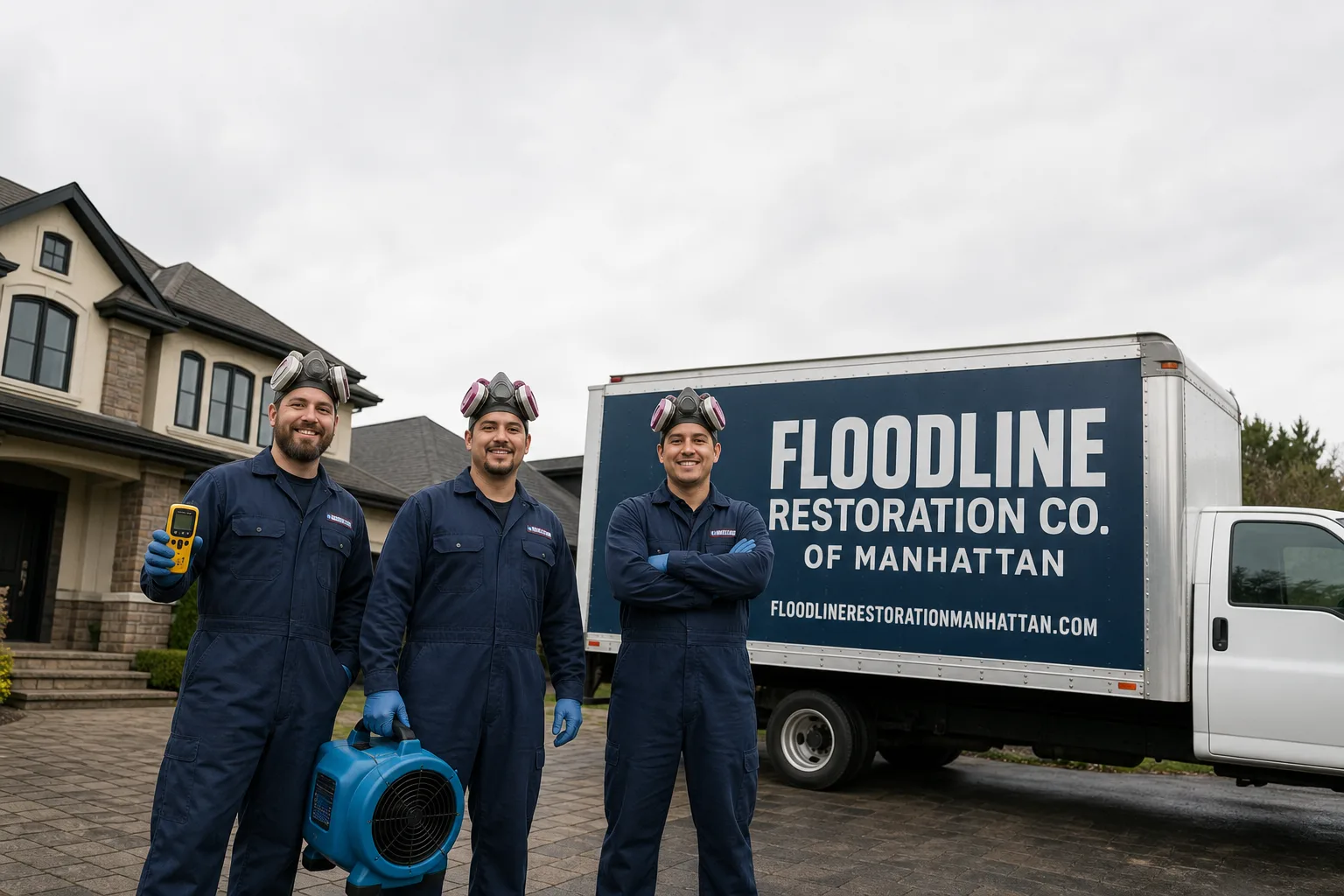
Free visual inspection and a written scope of work before any mitigation begins - photos, moisture readings, and drying logs go in your claim file
The scope we write is the scope we bill. Anything new gets shown to you, in writing, before we touch it.






 Before
 After
After Before
 After
After Before
 After
AfterBest Sewage Cleanup When Manhattan Homeowners Need It Most
When sewage backs up through a floor drain in a pre-war co-op on West 86th Street, the clock starts before you even notice the smell. Manhattan’s cast iron waste lines, some installed before World War II, fail in predictable ways, and the consequences are anything but small. Floodline Restoration Co. of Manhattan has handled sewage cleanup in this borough long enough to know that the difference between a contained mess and a building wide disaster often comes down to which company answers the phone.
What Makes a Sewage Cleanup Company the Best in Manhattan?
Choosing a sewage cleanup company here isn’t the same as choosing one in the suburbs. The building stock, the density, and the number of people who have a say in the work all change what “best” means. Here’s what separates a company you can trust from one that will make your situation worse.
- State licensing and full insurance. Any legitimate sewage cleanup company in New York operates with state licensing and carries both liability insurance and workers’ compensation. Without this, you are personally exposed if a technician gets hurt in your unit or if the drying work falls short and mold follows. Floodline Restoration Co. of Manhattan is state-licensed and insured & bonded, and we never send a crew into a Manhattan building without proper coverage documentation available for the managing agent.
- Real local experience with Manhattan’s building systems. Sewage cleanup in a stand-alone house is a different job from sewage cleanup in a pre-war elevator building with original cast iron stacks. We have worked in co-ops and condos from the Upper East Side down to the Financial District, and we understand what building supers, managing agents, and co-op boards need to see before work can start. That matters when you need approval fast.
- Proper equipment, not just shop vacs and fans. Sewage water is Category 3 water, and it requires more than extraction. The best companies run professional-grade air movers and dehumidifiers, HEPA air scrubbers, and moisture meters that can read inside plaster walls, not just on the surface. We use Dri-Eaz and Phoenix drying equipment because these are the machines trusted on large commercial losses, and they are what a pre-war Manhattan unit demands.
- A written scope before the work begins. If a company won’t put the scope, the drying plan, and the price in writing before starting, walk away. Bait-and-switch pricing is real, and it preys on people in emergencies. Curt Bowman, who leads Floodline Restoration Co. of Manhattan, insists on a written scope agreed to before any crew starts work. You know what you are paying for, and what you are not.
- Speed without shortcuts. Raw sewage in a Manhattan apartment is an active health threat, and the best companies treat it as an emergency. We respond quickly because every hour of sitting water pushes contamination deeper into plaster, subfloors, and the units below. But speed means nothing if the drying is incomplete. We would rather be thorough than fast in a way that leaves a hidden problem behind the wall.
Floodline Restoration Co. of Manhattan’s Credentials & Proof
Here is what you get when you call us, and here is what you can verify for yourself.
- Licensing: State-licensed to perform sewage cleanup and water damage restoration in New York. We will provide documentation to your co-op board or managing agent on request.
- Insurance: Insured & bonded. Our coverage protects you and your building, not just our crew. Documentation is available before work starts.
- Local experience: Years of hands-on sewage and water damage work across Manhattan, from the vertical cascade damage in elevator buildings to cellar flooding in the Financial District and surrounding flood-prone areas.
- Reputation: A strong local reputation built on written scopes, honest pricing, and work that meets the standards of the pickiest co-op boards in the city.
- Leadership: The company is led by Curt Bowman, who has built the business around doing sewage cleanup the right way in buildings where a bad job gets noticed fast.
We don’t ask you to take our word for any of this. We ask you to check. Ask your building’s managing agent. Ask your neighbors. Ask us for documentation. The best companies welcome the scrutiny.
What Manhattan Customers Say
Real feedback from Manhattan homeowners and building residents reflects what matters here: speed, honesty, and respect for the building’s rules.
“Our co-op board would not let anyone into the building without proof of insurance and a detailed scope. Floodline Restoration Co. of Manhattan had both ready the same day, and the board approved the work without the usual back-and-forth.” A Manhattan homeowner, Upper West Side
“We had sewage backing up into a ground-floor unit in a landmark district. The crew understood immediately that we had DOB permitting constraints and historical material requirements. They worked within the rules instead of fighting them.” A property manager, Greenwich Village
“Curt was direct about what needed to happen and what it would cost. No upselling, no fearmongering. The written scope matched the final invoice.” A Manhattan homeowner, East Harlem
How We Compare to Other Sewage Cleanup Companies in Manhattan
A bad sewage cleanup company in Manhattan has a few telltale signs. They quote a low number over the phone, then add charges once the crew is inside and the damage is exposed. They use residential-grade equipment that cannot dry plaster-over-lath walls or the spaces between joists in an old building. They do not carry proper insurance, or they hesitate when your managing agent asks for proof. They promise a fast dry-out and disappear when the moisture readings come back high two weeks later.
A good company does the opposite. Floodline Restoration Co. of Manhattan quotes honestly, puts the scope in writing, and documents the work with photos and moisture readings throughout the job. We carry the insurance that Manhattan buildings require, and we submit that paperwork without being chased. We run professional drying equipment sized for the actual structure, not the square footage on a lease. And we don’t consider the job done until the moisture levels say it’s done, not when the calendar says it’s been enough days.
If you’re comparing companies, ask each one the same five questions: Can I see your insurance certificate? Will you provide a written scope before starting? What drying equipment will you actually put in my unit? Who will speak to my managing agent or co-op board? And who do I call if something goes wrong after the job? The way a company answers those five questions tells you almost everything you need to know.
Common Sewage Scenarios We See in Manhattan
These are not hypothetical situations. They are the calls we answer regularly, and they shape how we approach every job.
The Upper-Floor Backup in a Pre-War Elevator Building
A line backs up in a seventh-floor unit, and before anyone notices, emergency sewage cleanup in Manhattan, NY becomes necessary as water has traveled down the stack and into the units below. In buildings with original cast iron drain stacks, the problem is often a partial clog compounded by decades of scale inside the pipe. The contamination is not contained to one apartment, and neither is the liability. We coordinate with the building super, the managing agent, and the affected unit owners, because everyone needs to know what we found and what the drying plan is. The goal is to dry the structure completely so this does not become a mold claim for the building six months from now.
The Cellar Flood in the Financial District
Lower Manhattan sits inside FEMA designated high-risk flood zones, and heavy rain events like the remnants of Hurricane Ida showed exactly how fast water can rise in a below-grade space. When that water is mixed with sewage from a backflow event, the contamination level demands full Category 3 protocols. We handle the extraction, the sanitizing, and the drying, but we also document everything for the insurance carriers involved, because a flood claim in FiDi almost always involves questions about whether the sewer system was actually surcharged.
The Hidden Sewage Leak Behind Plaster
Sometimes there’s no dramatic backup. There’s just a persistent smell, or a soft spot in a wall, or a stain that keeps coming back. In pre-war buildings with plaster-over-lath construction, sewage leaks from cracked waste lines can hide for weeks or months. By the time it’s found, the contamination has soaked into the lath and the wooden studs behind it. We use moisture meters that read through plaster, and we cut only what needs to be cut. The goal is finding the full extent of the contamination the first time, because a partial repair in this kind of building just means doing the job twice.
Why Manhattan’s Building Stock Makes Sewage Cleanup Different
Manhattan is dominated by pre-war multi-family buildings, many of them 80 to 120 years old, with original cast iron drain stacks, aging galvanized supply lines, and steam heating systems. That housing stock changes how sewage cleanup works. The materials are different. The access is different. The number of people who need to approve the work is different. And when a pipe fails on an upper floor in one of these buildings, the water does what water does: it follows gravity through every floor below.
No other US city combines this level of vertical water-damage cascading with multi-party governance complexity at such scale. In a single incident, you can have ten affected units, three insurance carriers, a co-op board, a managing agent, and a building super, all of whom need information and all of whom need to authorize work before a restoration crew can start drying. We know how to operate inside that system because we have been doing it in Manhattan for years. We prepare the documentation your board needs, we communicate with your managing agent directly, and we give every affected party the information they need to approve the work without delay.
Landmark-designated buildings in districts like Greenwich Village, the Upper West Side, and Harlem add another layer. DOB permitting requirements and material-matching obligations can extend project timelines considerably, and a restoration company that doesn’t understand those rules will make costly mistakes. We plan for the permit process from the start, because in a landmark building, the clock is always controlled by the approval timeline, not by how fast the crew can work.
Frequently Asked Questions - Best Sewage Cleanup in Manhattan
The strongest evidence is documentation: we are state-licensed, insured & bonded, led by Curt Bowman, and we provide a written scope before any work starts. Ask us for insurance certificates. Ask your building’s managing agent. Compare the answers against any other company you’re considering. The best companies don’t hide behind verbal promises; they hand you the paperwork.
In most cases, no, because we prepare for the approval process before we arrive. We provide insurance certificates, a written scope, and direct communication with your managing agent and board. Manhattan co-ops and condos are rightfully strict, and we are used to meeting their documentation standards. If your building has specific requirements, tell us on the first call and we will handle them.
We treat active sewage backups as emergencies and respond with same day sewage cleanup in Manhattan, NY. Call (917) 924-4221 and we’ll give you a straight answer on timing. Every hour of sitting sewage pushes contamination deeper into plaster and subfloors, so we don’t pad our schedule or make you wait through a corporate call tree.
Sewage water is Category 3 water, which means it contains pathogens and bacteria that pose a health risk. Cleaning the visible surface does not address the contamination that has soaked into the subfloor, the drywall, or the lath behind the plaster. A proper sewage cleanup includes extraction, sanitizing, and structural drying, with moisture readings to confirm the work is complete. Anything less leaves a hidden problem that gets worse, and more expensive, over time.
Sewage backup coverage varies by policy, and some carriers treat it differently depending on whether the backup originated inside the building or from the municipal sewer line. We document everything with photos and moisture readings throughout the job, and we work directly with your adjuster to make sure the claim has what it needs. You should not have to be the middleman between your restoration company and your insurance carrier. Call (917) 924-4221 for an honest conversation about what your policy likely covers.
Get the Best Sewage Cleanup Service in Manhattan - Free Estimate
If sewage has already backed up, don’t wait. Call (917) 924-4221 now and we’ll talk through what’s happening, what it will take to fix it, and what you should do in the next hour. If you’re comparing companies before a problem starts, call us too. We’ll answer your questions honestly and send documentation for your building’s review. The estimate is free, and there’s no pressure.
Written by Curt Bowman, Owner at Floodline Restoration Co. of Manhattan, serving Manhattan’s co-ops, condos, and commercial buildings with professional sewage cleanup and water damage restoration.
What Our Customers Say
"Another company told me the whole attic needed mold remediation at a terrifying price. These guys tested, showed me it was surface growth on one sheet of plywood, and charged me for a cleaning instead. That kind of honesty buys a customer for life."
- Duane Pickett"Second property they have dried out for us. Same process both times, meter readings logged on every visit and the log handed over at the end. Our adjuster said it was the cleanest file he had seen all year."
- Grant Ostrowski"Water heater flooded the finished side of the basement at two in the morning. A person answered, not a machine, and a crew was pulling water before sunrise. Everything got photographed before they moved a thing, which made the insurance claim painless."
- Terrence Fowler