
Emergency Water Damage Restoration Near Me: What Manhattan Homeowners Should Do First
If water is rising in your Manhattan home, the first thing to do is identify what kind of water you’re dealing with, because clean water and sewage backup require completely different immediate actions, and treating one like the other can void your insurance coverage. After that, cut power to affected zones at the breaker, document everything with your phone, and call a restoration company with a live dispatcher. If you’d rather not sort through this alone at 2 a.m., call Floodline Restoration Co. of Manhattan at (917) 924-4221 and a certified crew will be on the way while you’re still reading the next sentence.
Most Manhattan homeowners have never thought about water categories until a pipe lets go. That’s normal. But the first 60 minutes after water enters a home determine whether the job costs $4,000 or $40,000, and most of what goes wrong in that window happens before anyone calls for help. This piece walks through the sequence we’ve learned over 42 years of answering emergency calls in Manhattan, step by step, in the order that actually matters.
Step One: Identify the Water Category Before You Touch Anything
Turning off the water supply is not the first step. Identifying the water source category is, because the category dictates every action that follows, and getting it wrong can turn a $4,000 cleanup into a $40,000 contamination job that your insurance carrier refuses to cover.
Restoration crews sort water damage into three categories, and the distinction matters as much to your claim as it does to your safety:
- Category 1: Clean water. This comes from a supply line, a faucet left running, a water heater tank, or rainwater that hasn’t touched the ground. It’s safe to touch, safe to walk through, and safe to extract yourself if you move quickly. In Manhattan apartments and brownstones, a failed supply line under a kitchen sink is the most common Category 1 event we see.
- Category 2: Grey water. This is used water: washing machine discharge, dishwasher overflow, sump pump failure, or clean water that sat for a day or more. It carries bacteria and should not be handled without gloves and eye protection. Drywall and carpeting soaked in Category 2 water usually need cutting out, not drying in place.
- Category 3: Black water. This is sewage, floodwater from the street, or anything that contains human waste or pathogens. It is a biohazard. Do not touch it, do not walk through it, do not try to extract it. Shut the door to that room, close off the area, and call a certified crew immediately. In Manhattan, we see Category 3 water after storm surge, sewer backups in older buildings, and toilet overflows that sat overnight.
Here’s the practical problem: a Category 1 issue can become Category 2 within 24 to 48 hours, and Category 2 can degrade to Category 3. The clock starts the moment the water stops being clean. That’s why the source matters before you grab a mop.
The First Five Minutes: Safety Actions That Actually Matter
Once you know the category, the first five minutes are about protecting people and the structure, not about drying anything out. Here’s the sequence we teach homeowners:
- Shut off the water source if you can do so safely. For a burst supply line, the shutoff valve is usually behind or under the fixture. For a water heater, the valve sits on top of the unit. If the source is sewage backup or street flooding, do not wade in to find a valve. Call the city or building management and start evacuation from the affected area.
- Cut power to the affected zones at the breaker panel. Water and electricity do not negotiate. If the panel is dry and accessible, flip the breakers for the affected rooms before you step into standing water. If the panel is wet or you can’t reach it without walking through water, do not touch it. Call an electrician or your restoration crew, who can isolate power safely.
- Move furniture and valuables off wet carpet. Wood furniture legs wick water upward within hours. Foil blocks under legs slow the staining, but moving furniture entirely is better. Lift rugs and move them to a dry area if the water is Category 1. For Category 2 or 3, leave contaminated items in place and let the restoration crew handle removal and disposal.
- Take photos before you move or extract anything. This one protects your insurance claim. We cover exactly what to document below.
One thing Manhattan homeowners don’t always realize: the building’s super or management company may have their own emergency response protocol. For co-ops and condos, water in your unit often triggers a building-wide assessment. Cooperate with them, but remember that their responsibility ends at the building envelope. The inside of your unit is yours, and the extraction, drying, and rebuild are your call.
What to Document With Your Phone Before Any Water Moves
Your phone is the most valuable tool in the first hour, and the photos you take before a restoration crew arrives are often the difference between a smooth claim and a fight with the carrier. Here’s what we tell Manhattan homeowners to capture, and we’ve seen these exact shots hold up in adjuster reviews:
- Wide shots of every affected room from at least two angles. Stand in the doorway and shoot the room from corner to corner. Then shoot the same room from the opposite side. You want a record of how high the water reached, which walls are wet, and what was sitting on the floor.
- Close-ups of the water line on walls and baseboards. The line the water left is where restoration starts. A sharp close-up with a ruler or tape measure held against the wall gives the adjuster a permanent measurement of saturation height.
- Time-stamped photos of the source. The burst pipe, the leaking water heater, the overflowing toilet. If you can safely photograph the source before anyone moves it, do it. This is the single most persuasive piece of evidence in a claim.
- Photos of standing water depth. A ruler or a coin held at the water’s edge gives scale. Adjusters use these photos to assess extraction volume and drying time.
- Photos of contents before removal. Rugs, furniture, electronics, anything sitting in water. If it gets thrown away, you’ll want proof it was there and what condition it was in.
- Photos of the exterior if the water came from outside. Manhattan storm water, flooding, a window leak from heavy rain. Exterior shots show the adjuster the entry point.
Do not run box fans near grey or black water. Do not use a wet-vac on sewage-affected flooring. Both actions spread contaminated droplets through the air and into wall cavities, and they can destroy the claim value of the damage by cross-contaminating clean areas. The instinct to start drying things out is strong, but the first hour is about containment and documentation, not restoration.
What to Listen For When You Call a Restoration Company at 2 a.m.
When you call a Manhattan restoration company at 2 a.m., you’re not just asking for help. You’re interviewing a contractor under pressure, and the questions the dispatcher asks reveal more about the company than any website ever will. Here’s what a qualified dispatcher should ask before rolling a truck:
- “Where is the water coming from, and is it clean or dirty?” A dispatcher who doesn’t ask the category question is a dispatcher who doesn’t understand the job. The category determines the equipment, the safety protocol, and the insurance documentation from minute one.
- “Is there standing water, and if so, how deep?” Depth tells the crew which extraction equipment to load: a high-volume extractor for standing water, or injection drying for soaked walls behind trim.
- “Has the power been shut off to the affected rooms?” A good dispatcher asks this before you do, because sending a crew into a flooded room with live outlets is a safety hazard.
- “Have you contacted your insurance carrier?” The answer doesn’t change whether the crew comes out, but it tells the dispatcher whether to bring documentation gear for adjuster coordination.
- “Are you in a house, a walk-up, a high-rise, or a basement unit?” Manhattan restoration is not the same as suburban restoration. A Park Avenue high-rise with a freight elevator requires different equipment logistics than a walk-up in the East Village. A good dispatcher knows this.
Listen for how the dispatcher handles the call itself. At Floodline Restoration Co. of Manhattan, a live person answers the phone at 2 a.m., not a recording. We’ve built the company around a dispatch board, not a sales desk, and the person who picks up should be asking questions, not reading from a script.
The 72-Hour Mold Window: Why Drying Logs Matter
Mold spores are already in your Manhattan home. They ride in on shoes, on clothing, through open windows. What they need is moisture and time, and the clock starts the moment water sits. The restoration industry standard is that mold can begin to colonize within 24 to 72 hours on wet organic materials, and once it takes hold, the remediation job is larger, longer, and more expensive than the drying job would have been.
The problem is that mold often grows inside wall cavities, under baseboards, and behind kitchen cabinetry, where you can’t see it. By the time visible mold appears on the surface, the colony in the wall has often been growing for weeks. This is why a certified crew’s drying log matters. Technicians certified to IICRC standards take moisture readings daily, map the affected areas, and document the drying curve until the materials reach the dry standard. That log is your protection if mold is discovered later: it proves that the drying was done right, with validated measurements, not left to chance.
We pulled a water heater out of a basement unit on the Upper West Side last month where the homeowner had called another company first. That crew extracted the standing water, placed two box fans, and left. No moisture readings, no log, no follow-up. Three weeks later, the homeowner called us because the baseboards had started to warp and the smell was climbing up the walls. By then, the mold had colonized behind the drywall in three rooms. The job went from a $3,500 dry-out to a full remediation and rebuild. A drying log would have made the first company answerable. Instead, the homeowner paid twice.
That’s what we mean when we say done right, and backed in writing. The 90-Day Done Right Promise we give on every job is not a marketing slogan. It’s a written commitment tied to a specific standard: if it’s not done right, we make it right. No arguing, no paperwork battles. The K.E.Y.S. values code behind it, Krafted right, Every time, Your home first, Standing behind it, is the closest thing to a handshake we know how to print.
When to call a pro: if the water has touched drywall, sat for more than a few hours, carries any odor, or came from anything other than a clean supply line, call a certified crew. Manhattan buildings are tightly packed, and water moves between units through floor joists and pipe chases. A small leak in your bathroom can soak the ceiling of the apartment below within a day. The sooner a technician with a moisture meter and a drying plan gets on site, the less likely the job spreads.
Related services in Manhattan: Water Damage Restoration in Byram covers the full extraction and drying sequence, while Mold Remediation in Byram handles what happens when water has sat too long or a previous dry-out fell short. For Fire & Smoke Damage Restoration in Byram, the same full-cycle approach applies: one crew from first response to finished rebuild, no mid-job handoffs.
What a Certified Crew Actually Does in the First Visit
A lot of Manhattan homeowners are surprised by how much happens in the first two hours after a restoration crew arrives. Here’s the sequence you should expect from a company that does this the right way:
- Assess and document. The lead technician walks the affected area with a moisture meter, maps the water migration, and photographs everything. This becomes the baseline for the drying plan and the insurance claim.
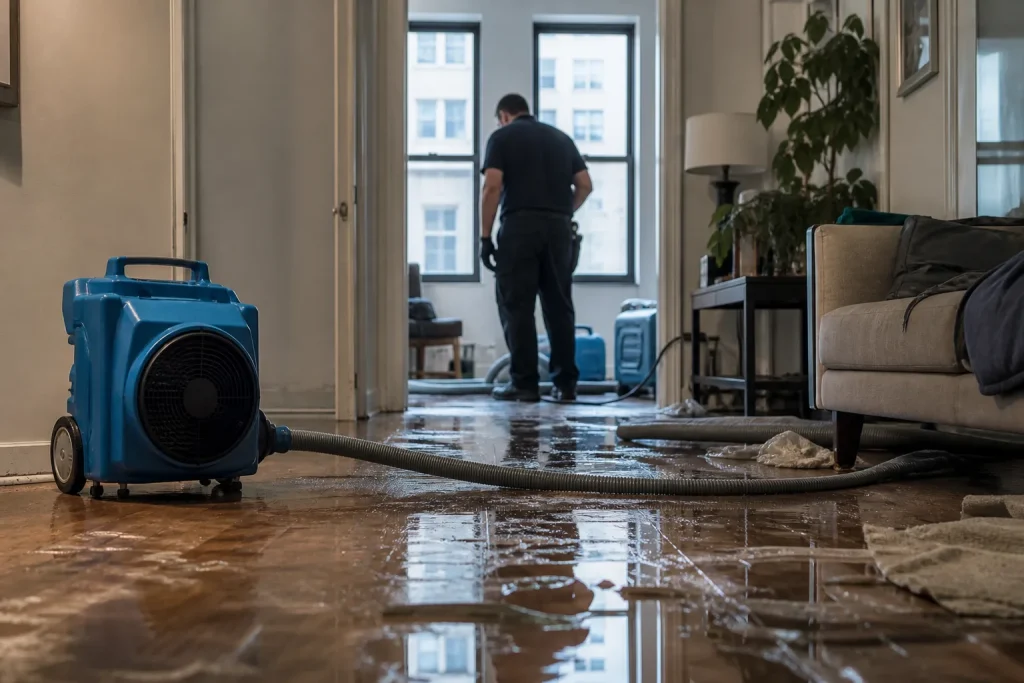
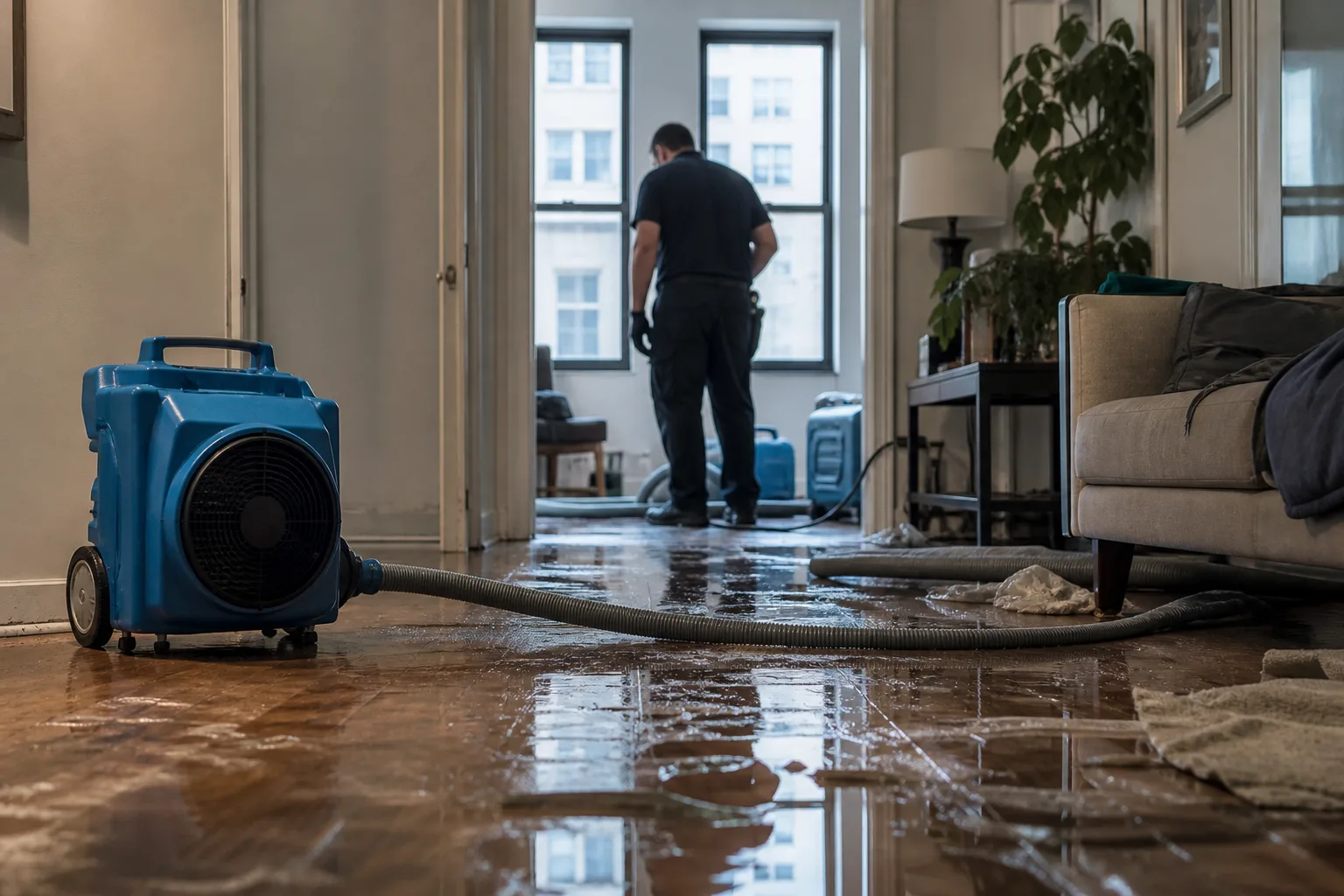
- Extract standing water. Professional-grade extraction equipment, Dri-Eaz and XPOWER units in our case, pulls water out of carpet, padding, and hard surfaces within the first hour. The longer water sits, the more it wicks into walls and subfloor.
- Set up drying equipment. This is where certified training matters. Air movers, dehumidifiers, and injection systems like Injectidry get positioned based on the moisture map. The goal is not to dry the surface. It’s to dry the materials behind the surface: the drywall, the framing, the spaces under cabinets and behind trim.
- Take initial moisture readings. Every affected material gets a reading: walls, floors, ceilings, trim. These numbers start the drying log and tell the technician which areas need more or less equipment.
- Return daily for readings and adjustments. A certified crew does not leave box fans running and call it a day. Technicians certified to IICRC, RIA, and IFA standards return daily, take new readings, move equipment as the drying curve shifts, and hand you and your carrier the log once the dry standard is met.
Most jobs are completed in a single visit for the extraction and equipment setup. The drying itself takes days, but the crew handles it from that first visit through the final reading, and then rebuilds what needs rebuilding. That full-cycle approach, same crew on day one and day fourteen, is the difference between a square deal and a finger-pointing contest between the water damage company and the carpentry company.
Insurance: Who Talks to the Adjuster, and What Protects You
Insurance is almost always in the room after water damage, even when nobody says it out loud. The homeowner’s first fear is the damage spreading while they wait. The second is being oversold once the crew is inside. Both fears are real, and both have the same answer: a written scope agreed before work starts, photo documentation, and direct carrier communication.
At Floodline Restoration Co. of Manhattan, we bill the carrier directly. The homeowner never plays messenger between us and the adjuster. We photograph everything, hand over the moisture log, and provide a written scope before any work begins. No surprises on the bill, no add-ons after the fact. The adjuster gets the documentation they need, and the homeowner gets a single point of contact from first extraction to finished rebuild.
Our standing offers apply to restoration and repair work in Manhattan: $50 off any repair over $250, the $89 seasonal tune-up, and a 5% discount for seniors and veterans, always. These aren’t limited-time promotions designed to pressure a decision. They’re just the pricing we use.
The Bottom Line
The first 60 minutes after water enters your Manhattan home determine whether you pay $4,000 or $40,000. The steps are simple: identify the water category, cut power safely, document everything with your phone, and call a restoration company with a live dispatcher who asks the right questions. Do not run fans near grey or black water, do not wet-vac sewage, and do not skip the moisture log. That log is your protection if mold appears later, and it’s the difference between a drying job done right and a second bill three weeks down the road.
If you’re in Manhattan and need help, Floodline Restoration Co. of Manhattan home services every stage of the job, from first extraction to finished rebuild, with the same certified crew and the 90-Day Done Right Promise in writing. Call (917) 924-4221 for a free estimate. The line the water left is where we start.
Frequently Asked Questions
With live 24/7 dispatch at Floodline Restoration Co. of Manhattan, a real person answers the phone at any hour and a certified crew is dispatched immediately. In most parts of Manhattan, we arrive the same visit, and extraction is running within the first hour on site. Call (917) 924-4221 and we’ll give you a straight arrival estimate.
Most homeowner policies in Manhattan cover sudden and accidental water damage, such as a burst pipe or a failed water heater, but the coverage depends on the source category and the documentation. Sewage backup and floodwater may require separate riders. This is why we photograph everything before work starts, provide a written scope, and bill your carrier directly with the documentation they need.
If the water is Category 1 and the affected area is small, in some cases you can dry it with household fans and dehumidifiers. But water that has touched drywall, sat for more than a few hours, or carries any odor needs certified drying with professional-grade equipment and a moisture log. Without the log, mold that appears later is almost impossible to trace to the original event.
It’s a written guarantee on every job Floodline Restoration Co. of Manhattan completes in Manhattan. If it’s not done right, we make it right, with no arguing and no paperwork battles. The promise is tied to the K.E.Y.S. values code: Krafted right, Every time, Your home first, Standing behind it. If something fails within 90 days of completion, call us and we’ll be there.
Written by Curt Bowman, Owner at Floodline Restoration Co. of Manhattan, serving Manhattan since 2010.
Need Damage Restoration Help?
Call Floodline Restoration Co. of Manhattan - licensed & insured, available 24/7 in Manhattan.
(917) 924-4221