
IICRC Water Damage Restoration in Manhattan: A Homeowner’s Guide
IICRC certification means a restoration crew is trained to follow the S500 Standard for professional water damage restoration, which dictates exactly how water must be classified, measured, and dried. In Manhattan, where prewar buildings share walls and floors between units, following those protocols is the difference between drying one apartment and defending a claim that involves three neighbors. If you’d rather not wade through the details yourself, call (917) 924-4221 and we’ll walk you through the process from the first moisture reading.
What the IICRC S500 Standard Actually Requires on the Job
Most homeowners in Manhattan hand their keys over to whoever answers the phone first. Here’s what a crew following S500 protocols should actually do on your property, and what you can ask to see:
- Moisture mapping before equipment placement. Technicians take baseline readings using penetrating and non-penetrating moisture meters. They should document readings at specific wall depths, not just surface swipes. In Manhattan apartments with lath-and-plaster walls, surface readings alone are almost useless. The plaster dries while the lath behind it stays wet.
- A written drying plan. The S500 requires a documented plan that includes the class of water damage, the category of water, the equipment layout, and the target dry standard. If a crew can’t show you a drying plan, they don’t have one.
- Daily monitoring with logged readings. Equipment runs for days, sometimes a week or more. The standard requires daily moisture readings taken at the same points each time and recorded. A moisture log isn’t a courtesy. It’s the document that proves the job was done to standard.
- Drying to a specific target, not to a guess. The dry standard compares affected materials to an unaffected reference point in the same building. In Manhattan, that reference matters because ambient humidity varies block by block, building by building. Drying to an arbitrary number is how you get hidden wet framing and mold inside 72 hours.
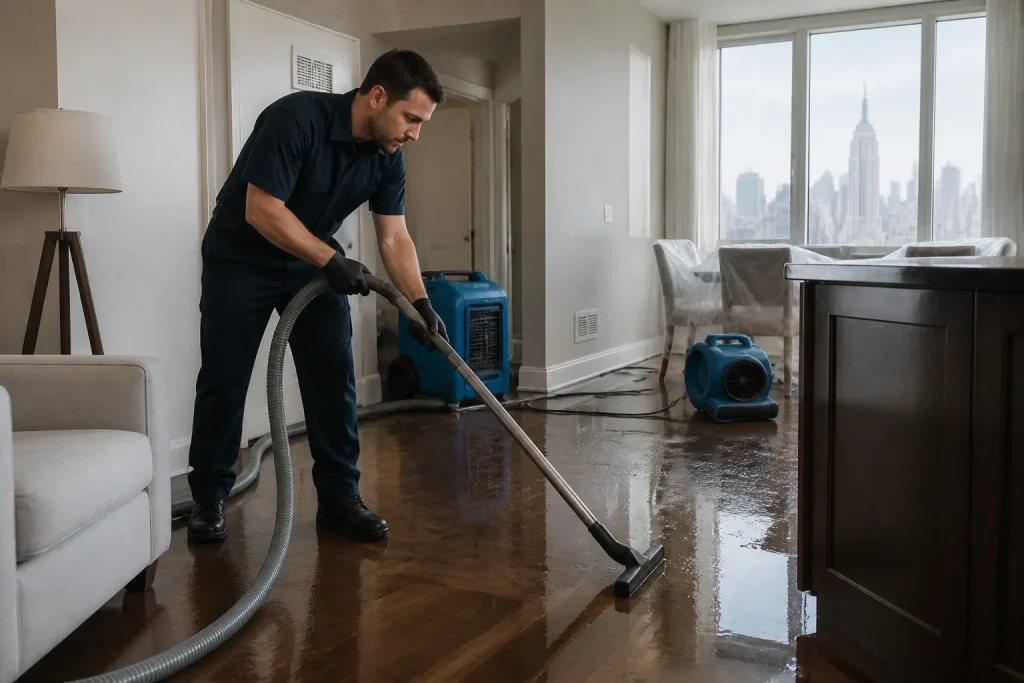
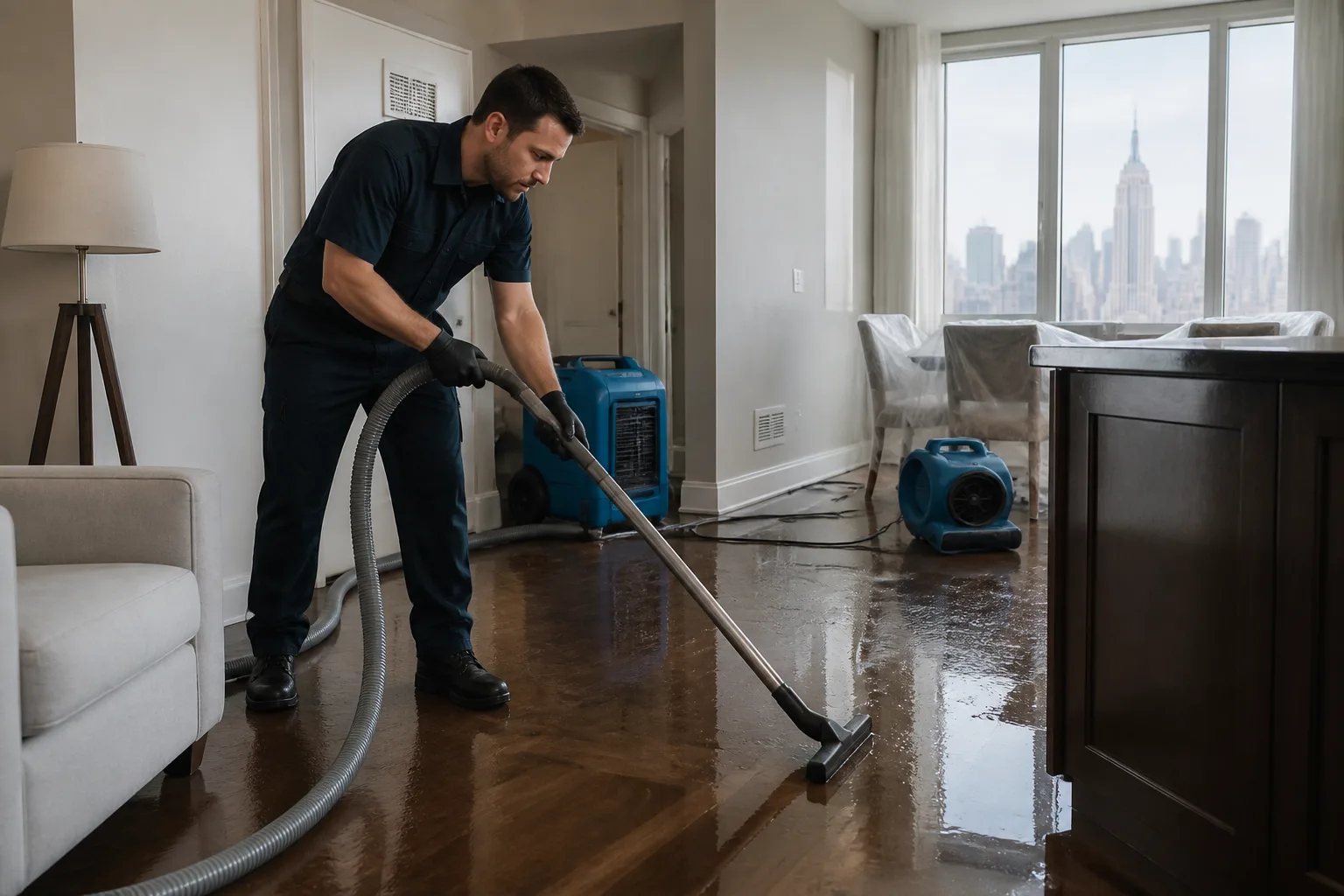
We use Dri-Eaz and Phoenix equipment on our jobs, with moisture mapping from the first visit and daily readings logged until the dry standard is met. We hand the log to the homeowner and to the adjuster. Nobody should ever have to wonder whether the walls are actually dry.
The Three IICRC Water Damage Categories and What They Mean for a Manhattan Home
Before any drying begins, the S500 standard requires the water to be classified into one of three categories. This isn’t paperwork. The category determines what must happen before equipment goes in.
- Category 1: Clean water. This comes from a supply line, a faucet, or a broken pipe feeding clean water. In Manhattan, a failed riser in an older building typically starts as Category 1, though it may not stay that way for long once it passes through building materials.
- Category 2: Grey water. This is water with some contamination, short of sewage. Dishwasher discharge, washing machine overflow, a sump pump failure, or a water bed leak all fall here. Grey water supports microbial growth and must be cleaned before or during drying, not just extracted.
- Category 3: Black water. Sewage, flood water, or any water that has been sitting long enough to support pathogens. It requires containment, removal of affected porous materials, and disinfection of what remains before drying starts.
The legal distinction matters in Manhattan because of how close units sit to one another. A Category 3 loss in one apartment can push contaminated humidity into a neighboring unit through a shared chase. A proper crew sets containment and handles the category correctly from the start, which is a big part of keeping a single apartment’s water problem from becoming a three-unit insurance mess.
Why Category 2 Grey Water Is the Most Commonly Misclassified Damage in Manhattan
In our experience, the dishwasher overflow or washing machine leak is the job most likely to be under-treated. The water looks mostly clear. The homeowner mops it up. A handyman sets a box fan. And nobody thinks about the inside of the cabinet base or the subfloor until the smell starts.
Grey water isn’t safe water. It contains soaps, food particles, fabric fibers, and whatever else drains from the appliance. Once it sits in warm, dark spaces, like the cavity under a Manhattan kitchen sink or beneath a stacked washer-dryer in a closet, microbial growth begins quickly. The S500 standard says Category 2 water requires thorough extraction, removal of affected porous materials that can’t be properly dried or cleaned, and antimicrobial treatment on retained materials before reconstruction. Skipping any of those steps leaves a problem the homeowner pays for twice, and the second bill is always bigger than the first.
This is also where direct insurance billing matters. An adjuster who sees a misclassified Category 2 job will deny the resulting mold claim. A crew that documents the category correctly on day one, with photos and a written scope, gives the adjuster no room to argue.
How to Verify a Technician’s IICRC Certification in Real Time
A sticker on the van means nothing. The IICRC maintains a public registry of certified technicians and firms. You can ask a technician for their name and certification number and check it on the IICRC website while they’re standing in your hallway in Manhattan.
Here’s what to look for:
- Ask for the certification number, not the logo. A legitimate technician can produce it without pause. If they fumble or offer to text it later, slow down.
- Check the registry yourself. The IICRC site lists certified individuals and firms. Type the number in. If it’s not there, it’s not current.
- Look for Water Restoration Technician (WRT) at minimum. WRT is the baseline for water damage work. Applied Structural Drying (ASD) means additional training in the drying science itself. A company sending a WRT and ASD certified technician to a Category 3 job is different from one sending a WRT with no ASD backup.
- Ask about the firm’s certification too. A firm can carry IICRC certification separate from individual technicians. Both should be in order.
Our technicians are trained to IICRC, RIA, and IFA standards. Background-checked and uniformed. We don’t mind if you ask for the certification number. We’d rather you check it than wonder.
What a Proper Moisture Log Looks Like and Why the Adjuster Cares
The moisture log is the single most important document you’ll hold when the insurance adjuster visits. It’s the proof that the drying was done to standard, not a guess.
A proper log includes:
- Dated readings from the same points every day. If the technician reads the baseboard Tuesday and the ceiling Wednesday, the log doesn’t show a trend. It shows nothing.
- Measurements at multiple depths. Surface readings verify the top layer is dry. Penetrating readings tell you what’s happening inside the wall cavity. In Manhattan buildings with old plaster over brick, skip the penetrating readings and you’re flying blind.
- Equipment placement and settings. Which dehumidifier, where, what it was set to. If the equipment changes, the log should say why.
- The dry standard measured against a reference point. The technician should record an unaffected area’s moisture content in the same building and state the target. Drying is considered complete when affected areas return to within a few points of that reference.
- Daily sign-offs. A technician initials the log each day. An adjuster wants to see a name attached to the readings.
We pulled one out of a garage over in Murray Hill last year where the homeowner had been running a rental dehumidifier for three weeks and the subfloor was still wet. No log, no baseline, no reference point. The adjuster denied the additional damage claim because there was no documentation. A moisture log with daily readings would have paid for itself in that single moment. That’s not a pitch. It’s just what a real drying standard requires.
If you’re in Manhattan and dealing with water damage right now, don’t wait to see what happens. Water moves fast, especially in shared-wall buildings. Call a pro who can get extraction running the same visit and document every step of the way.
When to Call a Pro
You should call a professional restoration company in Manhattan when the water event covers more than a few square feet, when it came from anything other than a clean supply line, or when you can see water wicking up walls or across flooring. Small clean-water spills on tile can be handled with towels and a fan. Anything more than that deserves proper moisture mapping.
Specifically, call immediately if:
- The water came from a dishwasher, washing machine, or any drain line.
- Water has been sitting for more than 24 hours.
- Materials like drywall, hardwood, or laminate are soaked.
- The affected area is inside a cabinet, wall cavity, or floor assembly you can’t open.
- Sewage is involved. Do not attempt to clean that yourself. It’s a health hazard, not a cleanup project.
Floodline Restoration Co. handles Water Damage Restoration in Byram from first extraction to finished rebuild, all under one roof and one crew. Our Mold Remediation in Byram work follows the same documentation standard, and if the water led to a fire or smoke loss, Fire & Smoke Damage Restoration in Byram is the same answer: document the damage, fix it correctly, stand behind it.
The Bottom Line
IICRC certification is only as good as the technician applying the S500 standard on your specific job site. Ask to see the drying plan. Ask for the certification number and verify it. Insist on a moisture log with daily readings and a dry standard measured against an unaffected reference point in your building. In Manhattan, where water doesn’t stay put and neighbors share walls, the documentation is what protects you when the adjuster arrives.
If you’re in Manhattan and need help, Floodline Restoration Co. of Manhattan home offers free estimates. Call (917) 924-4221 and a live dispatcher will answer, day or night. We’ve been serving Manhattan since 2010, and we stand behind the work in writing with the 90-Day Done Right Promise. If it’s not done right, we make it right. No arguing.
Frequently Asked Questions
It means the technician has completed training and passed exams from the Institute of Inspection, Cleaning and Restoration Certification, specifically in the S500 Standard for water damage restoration. That standard dictates the procedures for water classification, moisture measurement, drying methods, and documentation. In Manhattan, asking for proof of IICRC certification before work begins is reasonable and should be expected.
Floodline Restoration Co. of Manhattan answers the phone with a live dispatcher 24/7. In most cases, a certified crew can be on site the same visit and extraction running before the end of that first call. Water damage in Manhattan apartment buildings spreads through shared walls and floor assemblies fast, so speed matters as much as who shows up.
That depends on the source of the water and the specific policy. But proper documentation, starting with the moisture log and the category classification, is what gives you the best chance of a clean claim. Floodline Restoration Co. of Manhattan bills the carrier directly and provides photo documentation and daily logs so you don’t have to play messenger between the adjuster and the crew. Call (917) 924-4221 and we’ll explain what your policy likely covers after hearing what happened.
Fans and a consumer dehumidifier can handle very small clean-water spills on non-porous surfaces. Once water gets into drywall, flooring, or wall cavities, professional equipment changes the math. Dri-Eaz and Phoenix dehumidifiers move air and pull moisture at rates a rental unit can’t match. Without penetrating moisture readings, you won’t know when the interior is actually dry, and the mold that follows inside 72 hours will cost more than the professional drying would have. Call (917) 924-4221 for a free estimate before committing to the DIY route.
Written by Curt Bowman, Owner at Floodline Restoration Co. of Manhattan, serving Manhattan since 2010.
Need Damage Restoration Help?
Call Floodline Restoration Co. of Manhattan - licensed & insured, available 24/7 in Manhattan.
(917) 924-4221