
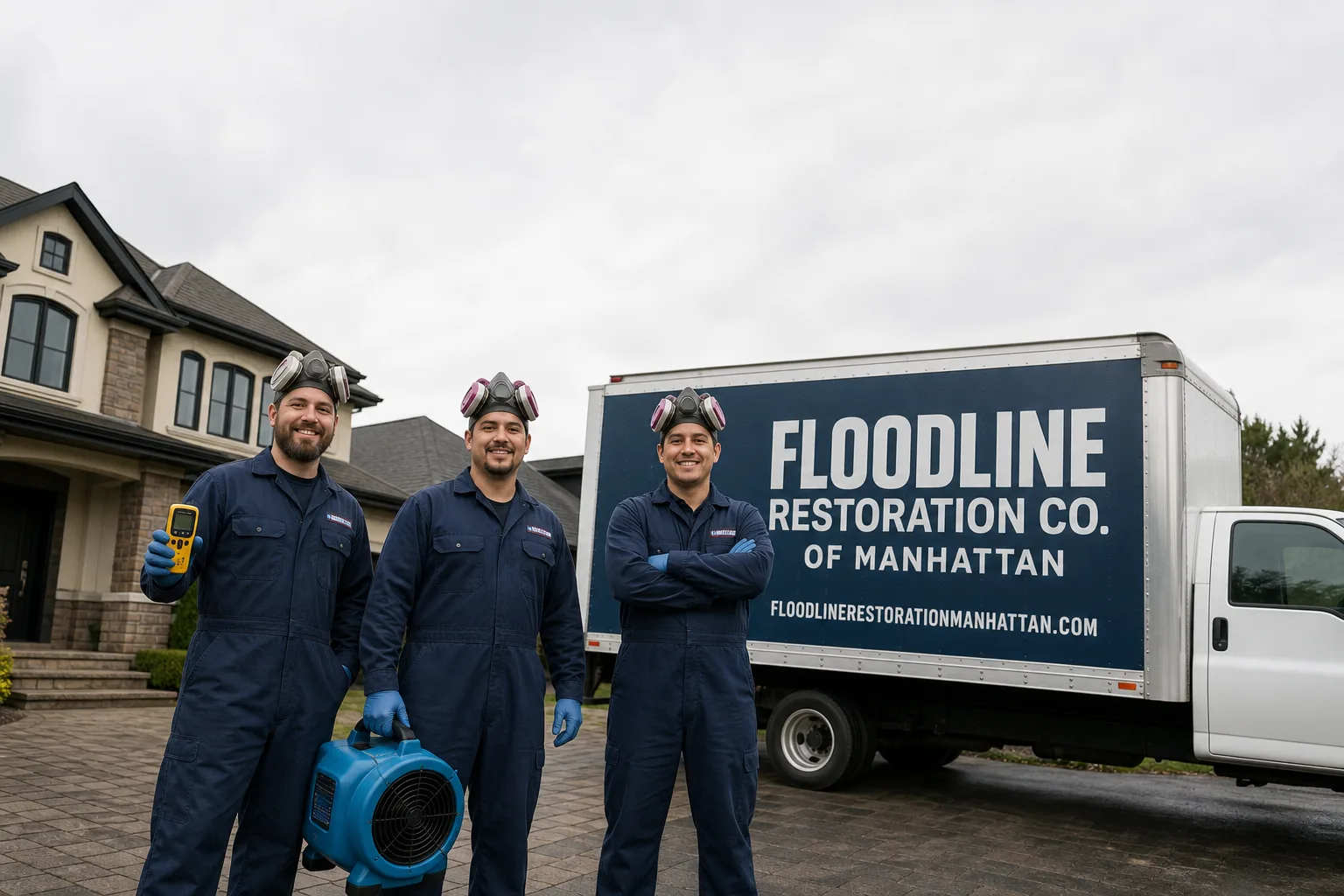
Free visual inspection and a written scope of work before any mitigation begins - photos, moisture readings, and drying logs go in your claim file
The scope we write is the scope we bill. Anything new gets shown to you, in writing, before we touch it.






 Before
 After
After Before
 After
After Before
 After
After24/7 Emergency Commercial Restoration in Little Ferry
When a nor’easter pushes Hackensack River surge past your overhead doors or a frozen supply line lets go on the third floor of a Route 46 office building, you need a crew that answers the phone and moves. Floodline Restoration Co. of Manhattan dispatches certified commercial restoration teams into Little Ferry around the clock, every day of the year. Call (917) 924-4221 and you’ll speak to a live dispatcher, not a recording. We schedule a free visual inspection immediately, and in most cases our crew reaches your property within 45 minutes of your call. The first hour after a commercial water or storm event determines whether you’re dealing with cleanup or a long-term closure. Saltwater from the Hackensack River begins corroding electrical components, wicking into drywall, and saturating subfloor assemblies within minutes, not hours. That’s why our trucks are stocked, our crew is on call, and why we treat every Little Ferry commercial loss as a live emergency until the moisture map reads dry.
Understanding Commercial Restoration Severity in Little Ferry Properties
Little Ferry commercial buildings sit at near-sea-level elevation, directly against the tidal Hackensack River and its surrounding Meadowlands wetlands. That geography doesn’t just make flooding more likely. It changes what kind of damage you’re dealing with. Storm surge and river backup bring category 3 water into your facility, the classification for water that’s been in contact with sewage, saltwater, and whatever the tide carried in. That’s not a mop-and-fan situation. It requires full extraction, controlled demolition of saturated materials, antimicrobial treatment, and structural drying with professional-grade equipment like Dri-Eaz and Phoenix air movers and dehumidifiers.
Then there’s what we find behind the drywall. Little Ferry’s commercial stock, much of it built in the 1940s through the 1960s, took a beating during Hurricane Sandy in 2012. Many buildings were remediated on a budget back then, or not fully remediated at all. When we open a wall after a 2024 nor’easter, we routinely find the old flood line still there, hiding salt deposits, compromised framing, and mold colonies that have been growing undisturbed for a decade. That layered damage history is the single biggest reason Little Ferry commercial restoration jobs consistently cost more and take longer than the insurance adjuster’s first estimate. It’s also the reason we document everything with moisture mapping and photo evidence from the first hour.
Why Little Ferry Property Owners Choose Floodline Restoration Co. of Manhattan
- 45-minute response commitment: We staff crews specifically for Bergen County commercial dispatch, so a certified team is rolling toward Little Ferry within minutes of your call, not hours later.
- 24/7 live answer, never an automated system: A real dispatcher picks up at 2 a.m. on a Sunday. You tell us what’s happening, we tell you what we’ll do, and then we do it.
- IICRC-certified crews: Our technicians hold WRT, FSRT, and AMRT certifications and train to IICRC, RIA, and IFA standards. They know the difference between drying a carpet and remediating saltwater-saturated concrete.
- Free visual inspection: You get a clear, documented assessment of the damage with a written scope of work before any money changes hands. No pressure, no vague hand-waving.
- Direct insurance billing: We bill your carrier directly and coordinate with your adjuster from day one. You’re never the messenger between us and the insurance company.
- One team from extraction to reconstruction: The same background-checked, uniformed crew that extracts the water reads the moisture meters daily, handles the rebuild, and hands you the finished space. No mid-job handoff to a subcontractor you’ve never met.
Our Commercial Restoration Process
Inspection & Assessment
We arrive, walk the entire affected area, and document the loss with thermal imaging and moisture meters. Our lead technician identifies the water category, maps the damage on a room-by-room basis, and builds a written scope that includes any pre-existing conditions like old flood lines or prior mold.
Extraction & Stabilization
High-volume extraction units pull standing water from floors, dock areas, and wall cavities. We stabilize the structure, board up any compromised openings, and remove unsalvageable materials. For saltwater events, this includes flushing affected areas to dilute corrosive salt concentrations before drying begins.
Drying & Dehumidification
Dri-Eaz and Phoenix air movers and commercial dehumidifiers run around the clock, with daily hygrometer readings logged until every affected material hits the dry standard. We don’t pack up and leave just because the surface feels dry. We prove it with numbers.
Cleaning & Sanitization
HEPA air scrubbers run throughout the affected zone to capture airborne contaminants. We clean and sanitize all salvageable surfaces, treat for bacteria and odor, and apply antimicrobial agents where category 3 water or mold has been present.
Specialty Commercial Treatment
Depending on what we find, this step includes mold containment and removal behind walls, document and inventory recovery from wet storage areas, and structural drying of subfloors and framing that absorbed saltwater years ago. We coordinate with your IT team for any electronics affected by moisture.
Repairs & Restoration
Our crew rebuilds what we removed. Drywall, flooring, overhead door panels, trim, paint, and any structural repairs are all done by the same team that started the job. We finish with a clearance check and hand you a documentation package for your insurer and your records.
Need Emergency Commercial Restoration in Little Ferry Now?
Crews minutes away, answering live 24 hours a day. The sooner we start, the less it costs.
Working With Your Insurance Company
Commercial restoration claims in Little Ferry come with a specific complication: flood insurance is often a separate policy from standard commercial property coverage, and after Sandy, many carriers scrutinize flood claims line by line. We’ve handled enough of these to know what your adjuster needs and when they need it. Our documentation starts on the first visit with photo evidence, moisture readings, and a written scope that distinguishes between new damage and pre-existing conditions. We use industry-standard estimating software, so our numbers match the format your carrier expects. We communicate directly with your adjuster, answer their questions, and provide the drying logs and before/after documentation they require. You stay informed, but you don’t have to broker every phone call.
What We Provide Your Insurer
- Thorough documentation of the loss from hour one
- Photos of all damage, room by room, with time stamps
- Moisture readings and daily drying logs
- A detailed, line-item scope of work
- Direct coordination with your carrier, including FEMA Write-Your-Own flood claim documentation
Built for Little Ferry’s Loss Calendar
Little Ferry’s commercial restoration needs follow a pattern that any local property owner can recognize. January and February bring deep freezes that burst supply lines in unheated storage areas, sprinkler rooms, and exterior wall cavities. When a pipe lets go in an empty office overnight, water runs for hours before anyone notices. Spring thaw and heavy rains send groundwater up through slab foundations and into shallow crawl spaces, and the Meadowlands water table doesn’t need much encouragement. Summer thunderstorms dump inches of rain in an hour, overwhelming drainage and sending water under dock doors and into ground-level retail spaces. Then comes the fall nor’easter season, when king tides push the Hackensack River back up through storm drains and into parking lots off Route 46. Each season has its own signature loss, and we’ve handled all of them in Little Ferry enough times to know exactly what we’ll find when we arrive. The one constant is this: water moves fast through commercial buildings, and every hour of delay makes the restoration more expensive.
Commercial Restoration Across Little Ferry’s Neighborhoods
Commercial properties along Route 46 in Little Ferry face a distinct set of risks. This corridor sits just off the Hackensack River, and when surge water breaches the roadside, it pools against building foundations and pushes through overhead doors and loading docks faster than any sump pump can handle. We’ve responded to retail bays, auto service shops, and distribution warehouses along this stretch where water entered through wind-damaged door panels that were already compromised before the storm hit.
The Meadowlands-adjacent industrial district south of Washington Avenue and along Redneck Avenue deals with a slower, more insidious problem: groundwater that rises during sustained wet periods and seeps under slab foundations. Buildings here often have years of hidden moisture in wall cavities, and when we open things up for a “new” claim, we routinely find the old flood line from Sandy still present behind the drywall.
Over by the Little Ferry Civic Center and the residential-adjacent commercial strips near Main Street, we see smaller retail and office spaces with shallow crawl spaces that become collection basins during king tides. The crawl space floods, the building doesn’t, but the resulting humidity and hidden mold cause problems that surface months later. Our crews know these buildings, know the access points, and know what the moisture maps should look like when they’re dry.
Commercial properties near Teterboro Airport’s perimeter and the Industrial Avenue corridor tend to be larger footprint structures with flat roofs and significant square footage. These buildings generate large-loss claims when roof drainage fails during heavy rain or when significant storm surge overwhelms site drainage. That’s where our large-loss response team earns its keep, with multiple crews, additional equipment, and the capacity to dry tens of thousands of square feet simultaneously.
Specialized Commercial Restoration Services We Offer in Little Ferry
Office & Retail Restoration
Storefronts and offices in Little Ferry often occupy older buildings with original plumbing and electrical systems. When a supply line fails or a roof drain backs up, every hour of closure costs revenue. We extract, dry, and restore these spaces with minimal disruption, and we stage the work so you can reopen sections of your business while we finish the rest.
Multi-Unit & HOA Restoration
Condominium associations and multi-unit commercial buildings present a coordination challenge: one water event affects multiple tenants, multiple insurance policies, and a shared building envelope. We handle the restoration work and the documentation for the entire building, not just the unit where the leak started. That means one scope of work, one point of contact, and dry readings for every affected space.
Industrial Facility Cleanup
Warehouses, machine shops, and industrial spaces near the Meadowlands have concrete floors, open ceiling structures, and large overhead doors that let storm surge in fast. We bring industrial-class extraction equipment, high-capacity dehumidifiers, and the manpower to dry these big-box buildings quickly. Saltwater from the Hackensack River requires additional flushing and corrosion control measures that we handle as standard practice here.
Large-Loss Response
When a nor’easter floods a commercial building from the dock doors to the front lobby, you need more than one truck and two technicians. Our large-loss response team scales up fast with additional crews from our New York City dispatch hub, commercial drying equipment, and a project manager who coordinates directly with your insurance carrier from the first day.
Business Interruption Minimization
Every hour your doors are closed is revenue lost. That’s why we work with your insurance carrier to document the entire loss precisely and stage our restoration so you can resume partial operations as soon as it’s safe and dry. We also coordinate with your electrician and HVAC contractor to get systems back online faster, because a fully dried building with no power still can’t reopen. This commercial restoration work is what our firm was built around.
What happens when you call
- 1
A real person answersNo phone trees - you reach a local pro.
- 2
You get an upfront price rangeHonest numbers before anyone is dispatched.
- 3
A background-checked tech heads outLicensed & insured, dispatched right away.
- 4
You approve before work beginsNothing starts until you say go.
Commercial Restoration Costs in Little Ferry, NJ
Water extraction and drying for a small office or retail space in Little Ferry typically runs $2,500 to $5,000 when the damage is single-room and category 1 or 2 water, like a burst supply line. Category 3 water from Hackensack River flooding or sewage backup runs higher, usually $5,000 to $12,000 for a moderate commercial space, because it involves controlled demolition, disposal of contaminated materials, antimicrobial treatment, and full containment. Large-loss commercial flood restoration in Little Ferry’s bigger buildings, the warehouses and multi-tenant structures where surge water sat for hours, ranges from $15,000 to $50,000 or more depending on square footage, what was stored inside, and how long the water sat before extraction. A documented pre-existing condition, like the old Sandy flood line we so often find behind newer drywall, adds to the scope because insurance carriers require professional documentation and remediation before the new claim can be fully settled. The fastest way to a firm number is the free visual inspection. We’ll write a line-item scope, you’ll know exactly what it costs, and your insurer pays us directly on covered claims. No surprises on the bill, and everything backed by our 90-Day Done Right Promise in writing.
We Also Serve Cities Near Little Ferry
Our commercial restoration crews serve Little Ferry and the surrounding Bergen County communities. We respond daily to properties in South Hackensack, Ridgefield Park, Moonachie, and Teterboro, plus the rest of the Meadowlands corridor. Call (917) 924-4221 and we’ll tell you honestly how fast we can reach your address.
Serving Little Ferry, NJ - Our Local Coverage Area
We’re based in the Little Ferry area and know this community well. Use the map below to see our service coverage - if you’re nearby, we can almost certainly help.
Little Ferry Commercial Restoration Questions, Answered
Does Little Ferry require wind-rated or impact-rated doors on commercial buildings, and how does that affect restoration after a storm?
Little Ferry enforces New Jersey’s state building codes, which require wind-rated and impact-rated doors on commercial structures in flood zones and wind zones near the Hackensack River. After a storm, damaged or failed overhead doors are a primary entry point for surge water. Our restoration scope always includes inspection and repair or replacement of these doors as part of the overall claim, because a building that’s dried but still has a compromised door will flood again at the next king tide.
What does a failing overhead door mean for a commercial property before a nor’easter hits Little Ferry?
A failing overhead door with bent tracks, worn panels, or failed weather seals is a standing invitation for storm surge. In Little Ferry, where the Hackensack River backs up during nor’easters, water doesn’t need a catastrophic failure to enter. It finds the gaps. We recommend property owners have overhead doors inspected before storm season and include any necessary repairs in their pre-loss maintenance. If the damage has already happened, our crew can stabilize the door opening as part of emergency response, and we’ll document the pre-existing condition for your insurer. Call (917) 924-4221 after the storm and we’ll get there fast.
How does saltwater from Hackensack River flooding change the restoration process for Little Ferry commercial spaces?
Saltwater is corrosive and conductive, which means two things for restoration. First, the water must be flushed from affected surfaces with fresh water before drying begins, or the salt crystals will remain and continue corroding metal framing, electrical components, and concrete. Second, saltwater-soaked materials almost always require removal rather than drying, because salt attracts moisture and prevents any material from ever truly reaching the dry standard. Our crews handle this as standard practice on any category 3 water loss in Little Ferry.
Our records show a flood line from 2012 behind newer drywall-do we need to document that for insurance?
Yes. That pre-existing flood line is exactly the kind of condition that insurance adjusters look for when they evaluate a new claim. If it’s not documented, the carrier may attribute some or all of the new damage to the old event and reduce your settlement. We photograph it, map it, and clearly distinguish it from the current loss in our written scope. That documentation protects your claim and ensures the carrier understands exactly what happened when.
After heavy rain, the Hackensack River backs up into our parking lot and seeps under our dock doors. Is that covered by a standard commercial restoration protocol in Little Ferry?
Yes. This is one of the most common loss patterns we see in Little Ferry, especially in buildings along Route 46 and Redneck Avenue. River backup and groundwater seepage fall under flood insurance rather than standard commercial property coverage, but the restoration process is the same: extract, document, dry, and remediate. We handle the restoration work and provide the documentation your flood carrier requires, including FEMA Write-Your-Own claim support when applicable.
How fast can a crew actually reach my Little Ferry commercial property after I call?
In most cases, within 45 minutes. We maintain crews on call specifically for Bergen County dispatch, and our live dispatchers coordinate the nearest available team the moment you call (917) 924-4221. During major storm events when demand spikes across the region, response times can stretch, but we’ll tell you honestly when we’ll arrive and we won’t leave you waiting without information.
Will my insurance cover commercial restoration after a Little Ferry flood or storm?
It depends on your policy. Flood damage from the Hackensack River requires flood insurance, typically through FEMA’s Write-Your-Own program or a private carrier. Storm damage caused by wind, falling trees, or rain entering through a compromised roof or door is usually covered under standard commercial property policies. We coordinate directly with whichever carrier applies and bill them directly so you’re not fronting the cost while you wait for reimbursement.
What should I do in the first 30 minutes after water enters my Little Ferry commercial building?
Shut off the power to the affected area if you can do so safely, and call us at (917) 924-4221. Don’t walk through standing water in a commercial building until you know the power is off. Don’t open walls or remove materials yourself, because doing so can compromise your insurance claim. Take photos from a safe distance, keep a phone with you for our call, and let our crew handle the extraction and documentation from there.
Written by Curt Bowman, Owner at Floodline Restoration Co. of Manhattan, serving Little Ferry with 24/7 commercial restoration and full-cycle rebuilding backed by the 90-Day Done Right Promise.