
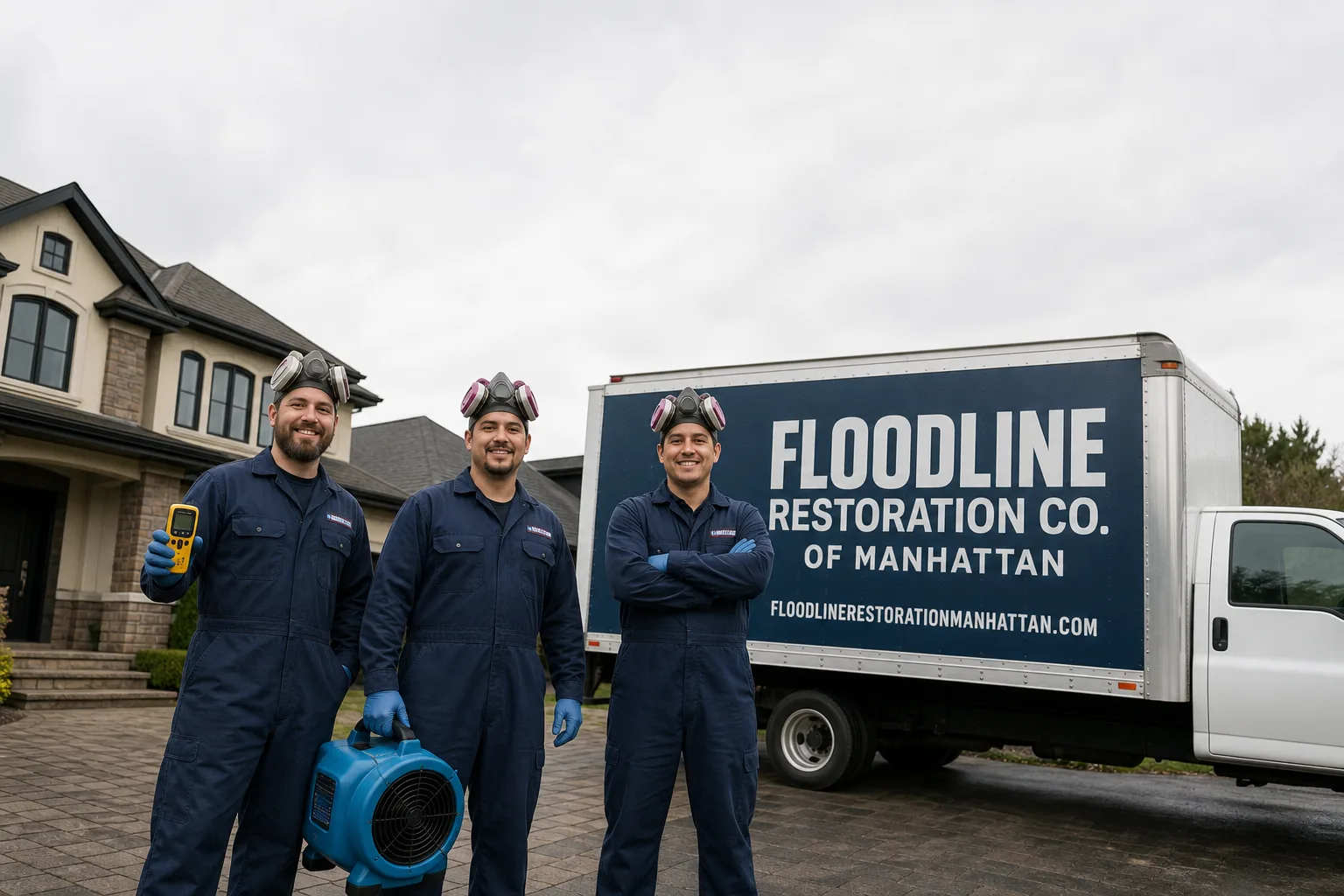
Free visual inspection and a written scope of work before any mitigation begins - photos, moisture readings, and drying logs go in your claim file
The scope we write is the scope we bill. Anything new gets shown to you, in writing, before we touch it.






 Before
 After
After Before
 After
After Before
 After
AfterEmergency Mold Remediation When Manhattan Homeowners Need It Most
Call (917) 924-4221 right now. We answer 24/7, and a live person picks up – not a voicemail tree. If water has been sitting in your apartment for more than 24 hours, mold is already starting to grow inside walls, under floors, and behind plaster. Floodline Restoration Co. of Manhattan dispatches Same Day Mold Remediation in Manhattan, NY crews across Manhattan the same day you call, including nights and weekends.
In Manhattan, the clock moves faster because the buildings are stacked. A leak on the 14th floor doesn’t just wet one unit. Water follows pipe chases, elevator shafts, and cast iron drain stacks straight down through ten or more apartments. By the time you see the first dark patch on your ceiling, the unit above you and the unit below you may already have hidden growth. Curt Bowman, who leads our Manhattan team, built Floodline specifically around this kind of vertical damage.
Available 24/7 for Mold Remediation Emergencies in Manhattan
Call (917) 924-4221 any hour. We run true 24 Hour Mold Remediation in Manhattan, NY emergency dispatch for Manhattan mold jobs, and there is no extra charge for nights, weekends, or holidays. A burst supply line at 2 a.m. on a Sunday gets the same crew response as a Tuesday afternoon leak.
What counts as an emergency in our book: standing water you can’t extract yourself, visible mold spreading across more than a few square feet, a musty odor you can smell but can’t locate, ceiling stains after an upstairs leak, or any water event involving a sprinkler head or steam pipe. If you have a baby, a pregnant resident, an elderly family member, or anyone with asthma or immune issues in the unit, treat every water event as an emergency. Mold colonies can establish inside wall cavities within 48 hours in Manhattan’s radiator-heated apartments, where interior humidity runs higher than most people realize.
While you wait for us, do these three things. First, shut off the water source if you can locate the valve safely. Second, move furniture, rugs, and personal items away from the wet area. Third, do not run fans or your HVAC system – circulating air can spread mold spores into rooms that were dry. We’ll bring commercial drying equipment from Dri-Eaz and Phoenix that’s engineered for this exact situation.
Most Manhattan emergency calls we handle involve steam radiator condensation that has been quietly feeding mold inside a wall cavity for months. By the time a tenant notices the smell, the colony is established. That’s not an exaggeration – pre-war plaster absorbs moisture like a sponge and releases almost none of it until the wall is opened.
Emergency Mold Remediation We Handle in Manhattan
These are the four calls we get most often from Manhattan residents. Each one needs fast action, and each one has a clear remediation path.
- Burst pipe flooding in stacked units. A supply line or drain stack fails on an upper floor and water cascades through multiple apartments. We set containment on every affected floor, extract standing water, open wet wall cavities, and run commercial dehumidifiers. The mold that grows after this kind of event spreads laterally between units, so we treat the whole column, not just the unit where the pipe broke.
- Steam radiator condensation mold behind plaster. This is the most common hidden mold source in Manhattan co-ops and pre-war rentals. Steam pipes sweat inside wall chases year-round, and the plaster never dries out. We open a small access panel at the base of the wall, inspect with moisture meters, and remove only the affected plaster and lath. Then we dry the cavity, clean the framing, and treat it so the colony doesn’t return.
- Sprinkler head activation in a high-rise. One triggered sprinkler in a Manhattan corridor or apartment can release hundreds of gallons in minutes, and that water doesn’t stay on one floor. We coordinate directly with the building super, managing agent, and co-op board so our crew can begin work without waiting on approvals the same day. We document everything photographically for the carrier and the board.
- Cellar and basement flooding in flood-zone buildings. Portions of Lower Manhattan, the Financial District, and FiDi-adjacent areas sit inside FEMA high-risk flood zones. Storm surge and sewer backup bring contaminated water into cellars and sub-levels. We treat this as a Category 3 water loss, which means full containment, HEPA air scrubbers, antimicrobial cleaning on all affected surfaces, and disposal of porous materials that can’t be dried and cleaned. Our technicians are IFA-certified and follow IICRC protocols for contaminated water.
If what you’re dealing with isn’t on this list, call (917) 924-4221 and describe it. We’ll tell you honestly whether it’s an emergency or something that can wait until regular business hours.
Our Emergency Response Process
You call (917) 924-4221. A real person answers and asks you five questions: your cross streets, what floor you’re on, when the water started, where it’s coming from, and whether anyone in the unit has health conditions we should know about. That last question isn’t small talk – it changes how aggressively we recommend containment and air scrubbing.
Within the hour, a project manager calls you back to confirm crew size and equipment load-out based on what you described. We send the team with the right gear the first time: HEPA air scrubbers, moisture meters, infrared cameras, containment sheeting, and Dri-Eaz or XPOWER drying equipment sized for your apartment’s square footage.
On site, our lead tech does a full moisture survey before anything else. We map every affected wall, floor, and ceiling cavity. Then we set containment, establish negative air pressure, and begin extraction. For water-damaged Manhattan plaster over lath, we open carefully along stud lines so reconstruction is straightforward later. We remove wet or moldy material, dry the framing, clean what can be saved, and treat the cavity. You get a written scope of work before we do anything beyond emergency mitigation, and a photo-documented report at the end for your insurance carrier, your co-op board, or your landlord.
Most emergency mitigation jobs take 2 to 5 days for full drying and cleaning. Reconstruction, if needed, is scheduled separately and priced in writing – we never fold surprise rebuild costs into a mitigation bill.
Emergency Mold Remediation Cost in Manhattan
Mold Remediation emergencies in Manhattan typically run $1,800 to $6,500 for a single apartment, depending on how many rooms are affected, whether we’re dealing with contaminated water, and how much plaster and flooring must be removed. Multi-floor cascading events in pre-war elevator buildings can run $15,000 to $45,000 or more because of the containment, documentation, and coordination work involved.
Here’s what you’re paying for on a typical emergency job:
- Emergency dispatch and after-hours crew: included in the base rate, no surcharge for nights or weekends
- Initial assessment and moisture mapping: free with any remediation we perform
- Containment and HEPA air scrubbing: $800 to $2,200 depending on square footage
- Water extraction and structural drying: $1,200 to $3,800 for a typical apartment
- Mold removal, cleaning, and cavity treatment: $900 to $4,500 per affected room depending on material type and contamination level
- Plaster removal and bagged disposal: $300 to $900 per linear foot of opened wall
- Photo documentation and written report for insurance: always included
We give you a written scope before work begins. No hidden line items, no surprise change orders mid-job. If your co-op board or managing agent needs to approve the cost, we’ll send the estimate to them within the hour. Call (917) 924-4221 and we’ll assess your situation at no charge.
Frequently Asked Questions - Emergency Mold Remediation in Manhattan
Most Manhattan calls receive an on-site crew within 2 to 4 hours, including nights and weekends. We dispatch from within the borough, so we don’t fight bridge or tunnel traffic. For an emergency in progress – an active leak or spreading water – call (917) 924-4221 and we’ll prioritize you immediately.
Most Manhattan homeowners and co-op policies cover mold remediation when it results from a sudden and accidental water event, like a burst pipe or a sprinkler activation. Coverage gets murkier with long-term condensation from steam radiators, which insurers often classify as maintenance-related. We photograph everything, write a scope that matches your policy’s language, and deal directly with your adjuster so you don’t have to translate contractor-speak. Bring us in early and we’ll help you document the cause while it’s still visible.
Yes. We work with Manhattan co-op boards, managing agents, and building supers on a daily basis, including landmark-designated buildings in Greenwich Village, the Upper West Side, and Harlem. We’ll provide a written scope, insurance certificate, and access requirements in the format your board needs, often the same day. For active leaks, most boards approve emergency mitigation quickly because the alternative – water spreading to neighboring units – creates liability for the entire building.
No. Bleach does not kill mold on porous surfaces like plaster, lath, or drywall, and scrubbing visible mold releases spores into the air. In Manhattan apartments with shared walls and stacked units, DIY mold cleaning can push spores through wall cavities into neighboring apartments and create a bigger problem for the whole building. We use containment, HEPA filtration, and EPA-registered antimicrobials applied by trained technicians. If you’ve already tried cleaning and the smell came back, the colony is inside the wall cavity, not on the surface.
A leak usually shows up as a stain or damp patch that appears and grows quickly, often with a water trail above it. Steam radiator condensation mold grows slowly behind the wall, typically near the radiator pipe chase, and often smells musty before you ever see anything. In pre-war Manhattan buildings, we routinely find hidden mold colonies behind steam risers that have never had a visible leak. If you smell it but can’t see it, call (917) 924-4221. We’ll find it with moisture meters and infrared cameras before it spreads further.
Call for Emergency Mold Remediation in Manhattan - We Answer 24/7
Water is still moving through your walls right now. Every hour you wait, the colony grows and the remediation gets more invasive and more expensive. Call (917) 924-4221. We answer around the clock, dispatch Manhattan crews the same day, and show up with the right equipment the first time. Curt Bowman and the Floodline Restoration Co. team have handled thousands of Manhattan water and mold emergencies, earning our reputation for the Best Mold Remediation in Manhattan, NY. We’ll handle yours too.
Written by Curt Bowman, Owner at Floodline Restoration Co. of Manhattan, serving Manhattan since 2009.
What Our Customers Say
"Second property they have dried out for us. Same process both times, meter readings logged on every visit and the log handed over at the end. Our adjuster said it was the cleanest file he had seen all year."
- Grant Ostrowski"Water heater flooded the finished side of the basement at two in the morning. A person answered, not a machine, and a crew was pulling water before sunrise. Everything got photographed before they moved a thing, which made the insurance claim painless."
- Terrence Fowler"Sewage backed up into the downstairs bathroom on a holiday weekend. The crew arrived in full protective gear, took out everything porous, bagged it, and sanitized the space twice. They treated a disgusting job like it was routine, which for them I suppose it is."
- Farrah Nassar