
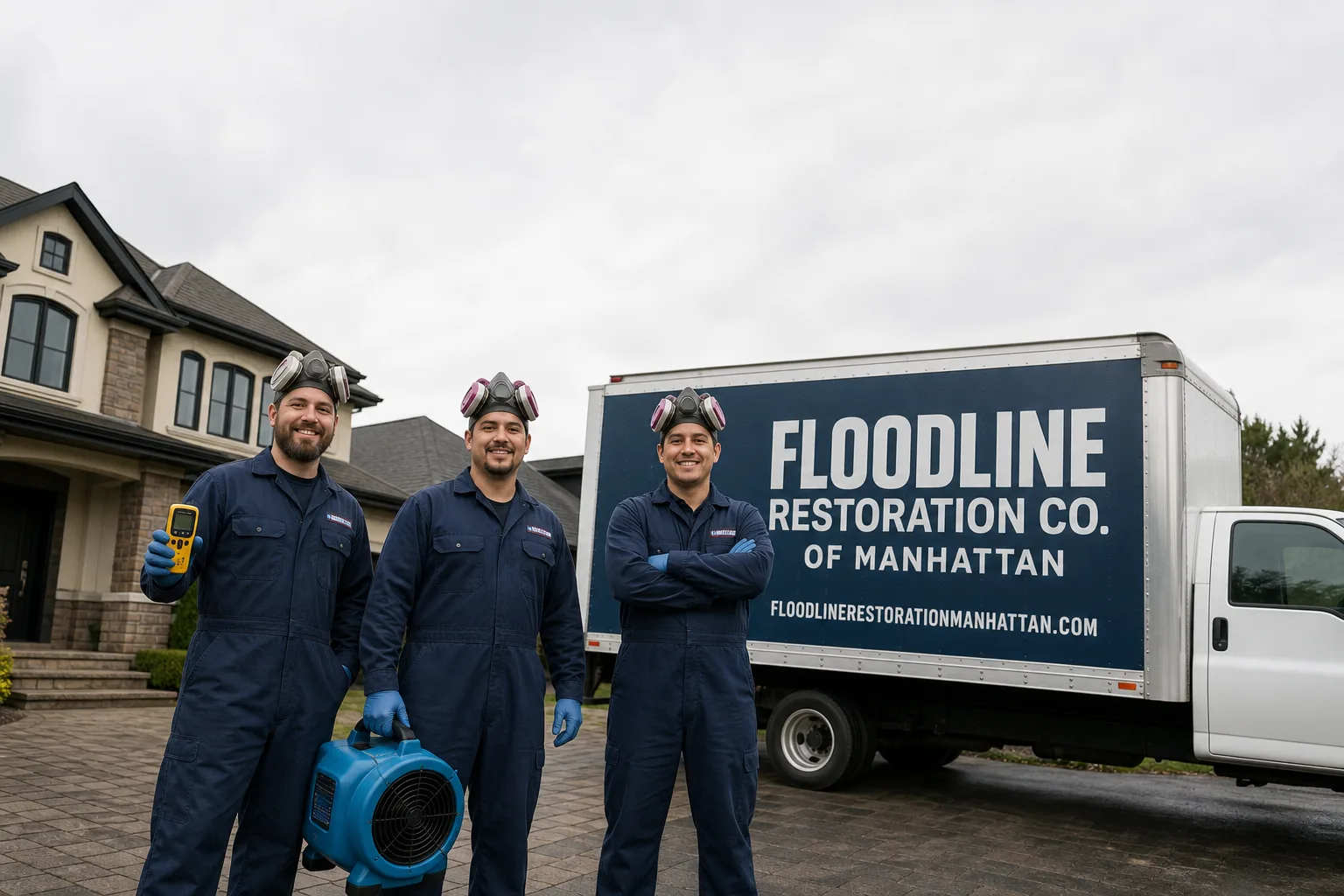
Free visual inspection and a written scope of work before any mitigation begins - photos, moisture readings, and drying logs go in your claim file
The scope we write is the scope we bill. Anything new gets shown to you, in writing, before we touch it.






 Before
 After
After Before
 After
After Before
 After
After24/7 Emergency Mold Remediation in Elmwood Park
Mold doesn’t wait for business hours, and neither do we. If you’ve found mold or smell that damp, earthy odor in your Elmwood Park home, call (917) 924-4221 right now. A live dispatcher answers at 2 a.m. the same way they answer at 2 p.m., and we’ll have a certified crew en route to your neighborhood within 45 minutes. The first hour matters because mold colonies on damp drywall double every 24 to 48 hours. What starts as a small patch behind a baseboard becomes a full wall cavity job if it sits through a weekend. We offer a free visual inspection with no obligation, so you’ll know exactly what you’re dealing with before any work begins. If you’re in Elmwood Park, Garfield, Saddle Brook, or anywhere else in the area, we’re already close.
Understanding Mold Remediation Severity in Elmwood Park Properties
Mold remediation severity breaks down into three practical tiers, and Elmwood Park’s housing stock determines which tier you’re likely facing. A surface-level issue means mold on non-porous surfaces like tile, glass, or sealed concrete, usually from condensation or a minor leak. This responds well to antimicrobial cleaning and usually doesn’t require containment or demolition. A porous-material intrusion means mold has colonized drywall, carpet, or insulation. Because mold roots penetrate porous materials, the industry standard is removal and replacement, not surface cleaning. This requires full containment with 6-mil poly sheeting, negative air pressure, and HEPA air scrubbing during the job. The third tier, structural or multi-unit spread, is what we see most often in Elmwood Park’s attached and semi-detached homes. When mold travels through a shared wall cavity or floor assembly into a neighboring unit, the scope expands immediately: containment on both sides, coordinated access with both owners, and a drying and treatment plan that accounts for the entire shared assembly, not just the visible patch. Homes built in the 1940s through 1960s with original cast-iron drains and galvanized supply lines are especially prone to this tier, because the leak source is often hidden inside a wall or below a slab and has been feeding mold for months before anyone sees staining.
Why Elmwood Park Property Owners Choose Floodline Restoration Co. of Manhattan
- 45-minute response commitment. When you call about mold in Elmwood Park, we commit to having a certified tech on-site within 45 minutes. Not “sometime today” – a real window we hold ourselves to.
- 24/7 live answer, never an automated system. A real person picks up the phone every hour of every day. You’ll never press 1 for billing or leave a voicemail that disappears into a queue.
- IICRC-certified crews on every job. Our technicians hold IICRC certifications including AMRT (Applied Microbial Remediation Technician) and WRT (Water Damage Restoration Technician). They know the standards because they’re tested to them.
- Free visual inspection. Before any work is scoped, we walk the property with you and show you what we’re seeing. You get a straight explanation, not a sales pitch.
- Direct insurance billing. We bill your carrier directly and handle the adjuster communication. You don’t play messenger between us and your insurance company.
- One team from first leak to final coat of paint. The same certified crew that maps the moisture handles the tear-out, drying, treatment, and rebuild. No handoffs, no inherited crews, no finger-pointing.
Our Mold Remediation Process
Inspection & Assessment
We start with thermal imaging and moisture meters to find the water source feeding the mold, even when it’s hidden inside a wall cavity or under flooring. In Elmwood Park’s older two-families, that source is often a corroded galvanized supply line or a cast-iron drain that’s been leaking slowly for months. We document everything with photos and moisture readings before any work begins.
Containment & Source Control
Before we touch any mold, we seal the affected area with 6-mil polyethylene sheeting and establish negative air pressure so spores can’t spread to clean rooms. In attached and semi-detached homes, we assess the shared wall or floor assembly on both sides before establishing containment, because a one-sided job fails every time in tight-lot construction.
Drying & Dehumidification
Using professional-grade Dri-Eaz and Phoenix dehumidifiers plus high-velocity air movers, we dry the structure to the IICRC dry standard. Daily moisture readings are logged and shared with you and your carrier. We don’t declare the job dry until the numbers say so.
Cleaning & Antimicrobial Treatment
Affected surfaces are HEPA-vacuumed, scrubbed with professional antimicrobial agents, and treated to prevent regrowth. Soft goods that can be salvaged go through pack-out and specialized cleaning. Anything too far gone gets documented and removed.
Crawl Space & Humidity Treatment
For Elmwood Park Capes and split-levels, the crawl space is often where the mold problem starts even when the visible mold is upstairs. We treat the crawl space with antimicrobial applications, address vapor barriers, and correct ventilation or humidity issues so the mold doesn’t come back with the next rain event.
Repairs & Restoration
Once the structure is dry and treated, the same crew rebuilds what we removed. That means new drywall, mold-resistant board where it counts, trim, paint, and flooring. We don’t hand you a stripped room and a referral to a contractor. We finish the job, and the 90-Day Done Right Promise covers it in writing.
Need Emergency Mold Remediation in Elmwood Park Now?
Crews minutes away, answering live 24 hours a day. The sooner we start, the less it costs.
Working With Your Insurance Company
If a covered water event caused the mold, your homeowner’s policy may cover the remediation. The key is documentation from hour one, and that’s where we do the heavy lifting. We photograph every step, log daily moisture readings, and prepare a line-item scope of work in the format adjusters expect. We communicate directly with your carrier’s adjuster so you don’t spend your evenings on hold. We also know the difference between a covered loss and a maintenance issue, and we’ll tell you straight which one you’re looking at before you file. Mold claims get denied when documentation is thin or the source is unclear. Our paperwork is built to hold up. If the adjuster pushes back, we stand behind the documentation we’ve gathered.
What We Provide Your Insurer
- Thorough documentation of the loss
- Photos of all damage, room by room
- Moisture readings and drying logs
- A detailed, line-item scope of work
- Direct coordination with your carrier
Built for Elmwood Park’s Loss Calendar
Mold in Elmwood Park follows a predictable yearly rhythm, and we’ve seen it repeat for years. January and February bring deep freezes that burst supply lines in uninsulated exterior walls, especially in the 1940s and 1950s Capes and colonials that make up so much of the borough. The water runs through wall cavities and floors for hours or days before anyone notices, and by the time the drywall shows staining, the mold is already established. March through May is basement season: snowmelt and spring rain saturate the ground, and because many postwar homes here were built with minimal lot grading, surface water channels straight into crawl spaces and finished basements. Every major rain event in spring generates a wave of mold calls two to four weeks later. June through August brings heavy convective thunderstorms that can dump an inch of rain in an hour, overwhelming gutters and saturating the soil around foundations. September through December is when we get the nor’easter season, driving rain into wall assemblies and window wells. The pattern is consistent enough that we plan our equipment staging around it.
Mold Remediation Across Elmwood Park’s Neighborhoods
Elmwood Park’s neighborhoods each have their own rhythm, and after years of running calls here, we know what to expect block by block. Around Mola Boulevard, you’ll find brick two-families and attached homes from the 1950s and 1960s where shared wall cavities are the single biggest mold pathway. A supply leak in one unit’s wall becomes a two-unit job within days, and we routinely coordinate access with both owners before we even set containment. The streets feeding Market Street and the River Drive corridor have a mix of older Capes and small colonials where crawl space humidity is the recurring problem, especially on lots with flat grading that holds water after every storm. Homes near the Elmwood Park border with Garfield sit on terrain that slopes toward the Passaic River floodplain, and those basements are the first to take on water in heavy rain. The residential blocks around Boulevard and the schools have a lot of first-generation split-levels where the lower level is partially below grade and the finished den or family room becomes ground zero for mold after any plumbing leak or seepage event. There’s no single Elmwood Park mold problem. There’s a neighborhood-specific version, and we’ve worked them all.
Specialized Mold Remediation Services We Offer in Elmwood Park
Mold Inspection & Testing
If you suspect mold but can’t see it, or you’re buying or selling a home in Elmwood Park, we offer thorough mold inspections with moisture mapping and, when needed, air and surface sampling. Our techs start with thermal imaging to find hidden moisture behind walls and under flooring. You get a clear written report of what we found, where it is, and whether you need remediation or just ventilation and humidity correction. Call (917) 924-4221 to schedule an inspection.
Mold Removal
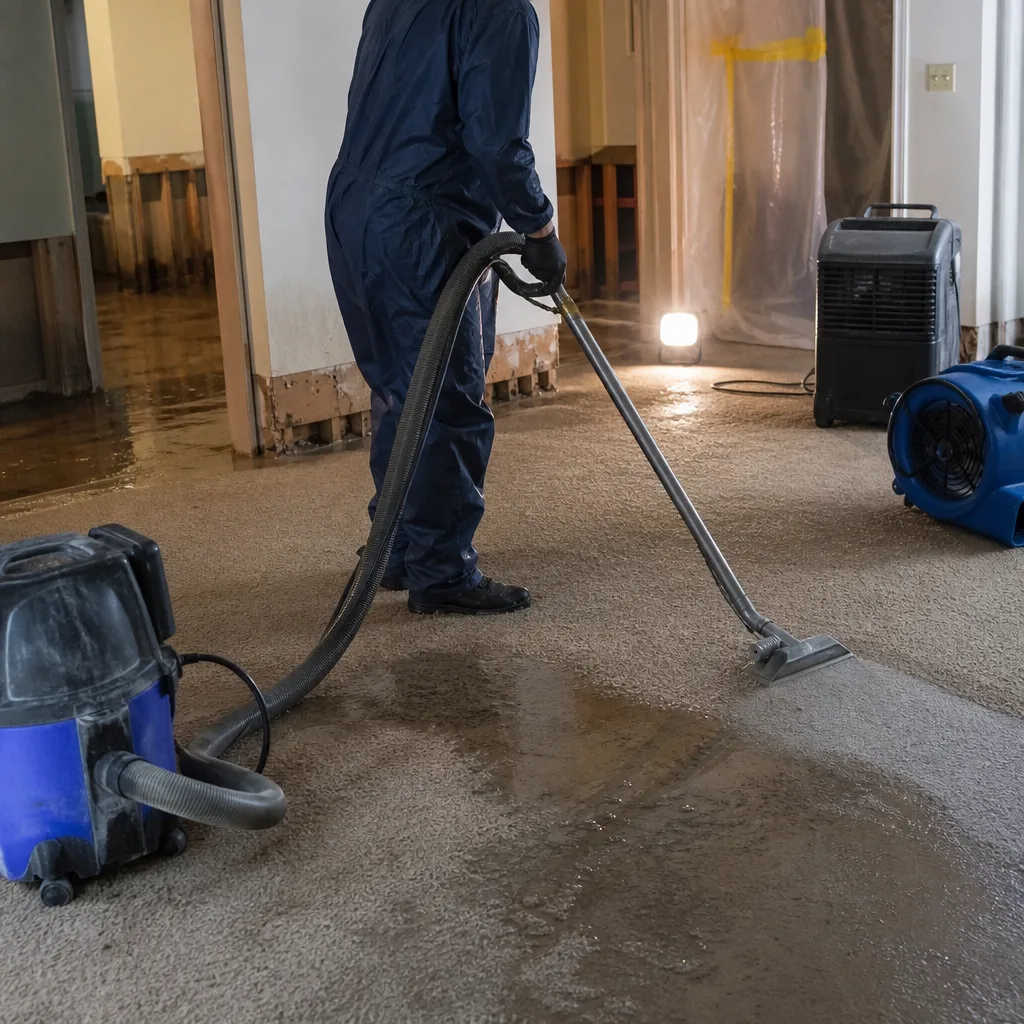
Visible mold on drywall, trim, carpet, or framing gets handled with full containment and proper disposal protocols. In Elmwood Park’s attached homes, we always check the shared wall or floor assembly before finalizing scope, because removing mold from one side of a wall while leaving the other side damp is a waste of your money. Our Mold Remediation team handles removal, drying, and rebuild as one continuous job.
Black Mold Remediation
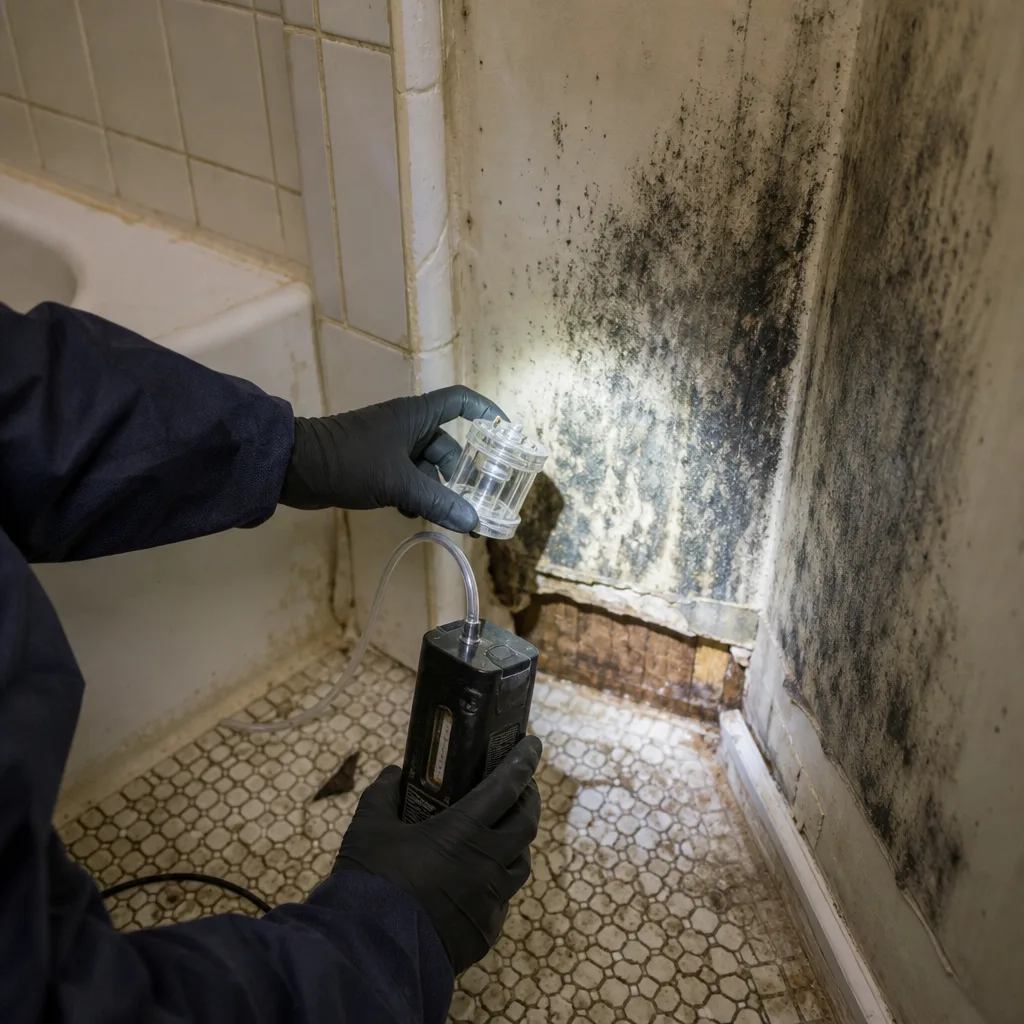
Black mold, or Stachybotrys chartarum, gets a lot of media attention and a lot of fear. The truth: any mold growing on wet drywall or wood in a damp environment can cause health problems, and black mold specifically thrives on chronically wet, cellulose-rich materials. We treat it with the same protocol as any Category 2 or 3 water-driven mold: full containment, HEPA air scrubbing, removal of colonized material, and air clearance testing when the job calls for it.
Air Quality Restoration
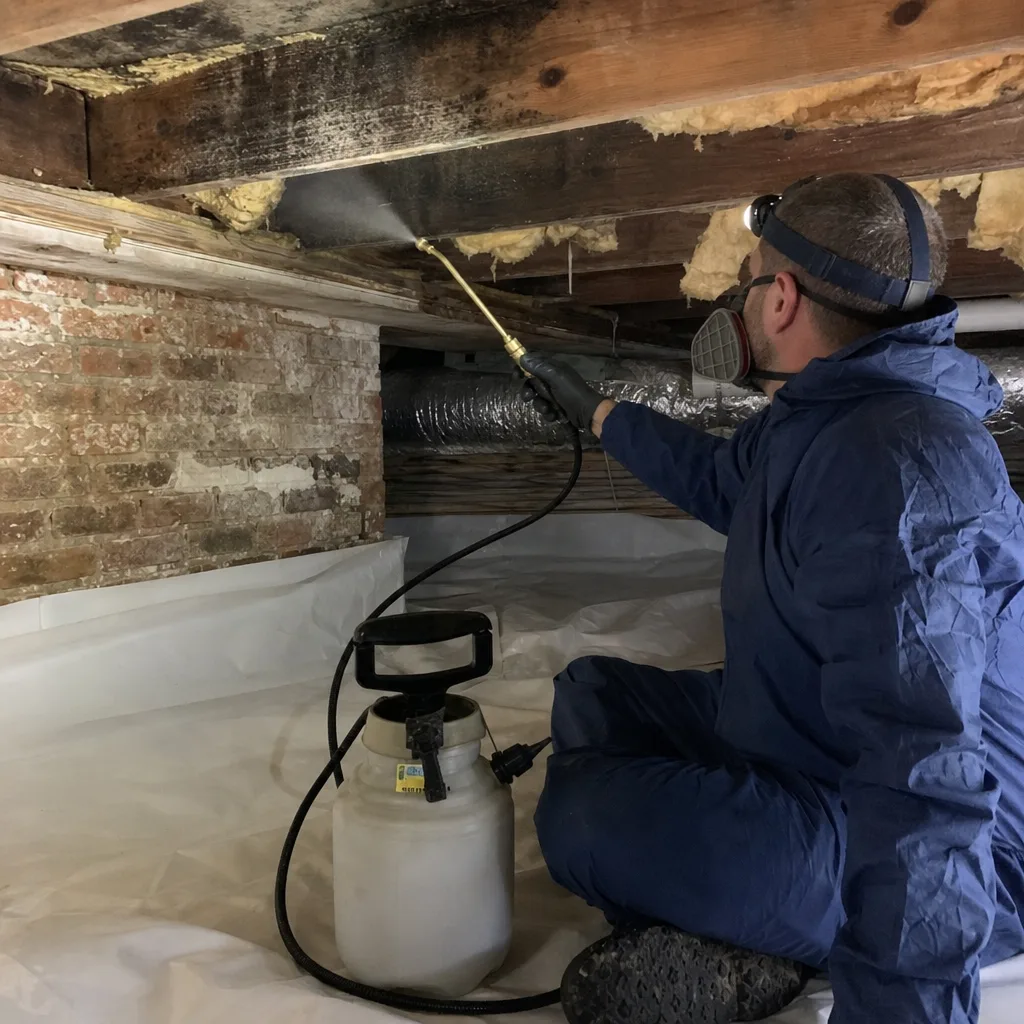
After any mold job, we can run HEPA air scrubbers to pull airborne spores and particulates out of the living space before we clear containment. In Elmwood Park’s two-family homes, we often run scrubbers on both sides of a shared wall after a multi-unit job, because the air in one unit is the air in the other. We also address the underlying humidity problem that lets mold recur, whether that means a dehumidifier, ventilation correction, or crawl space sealing.
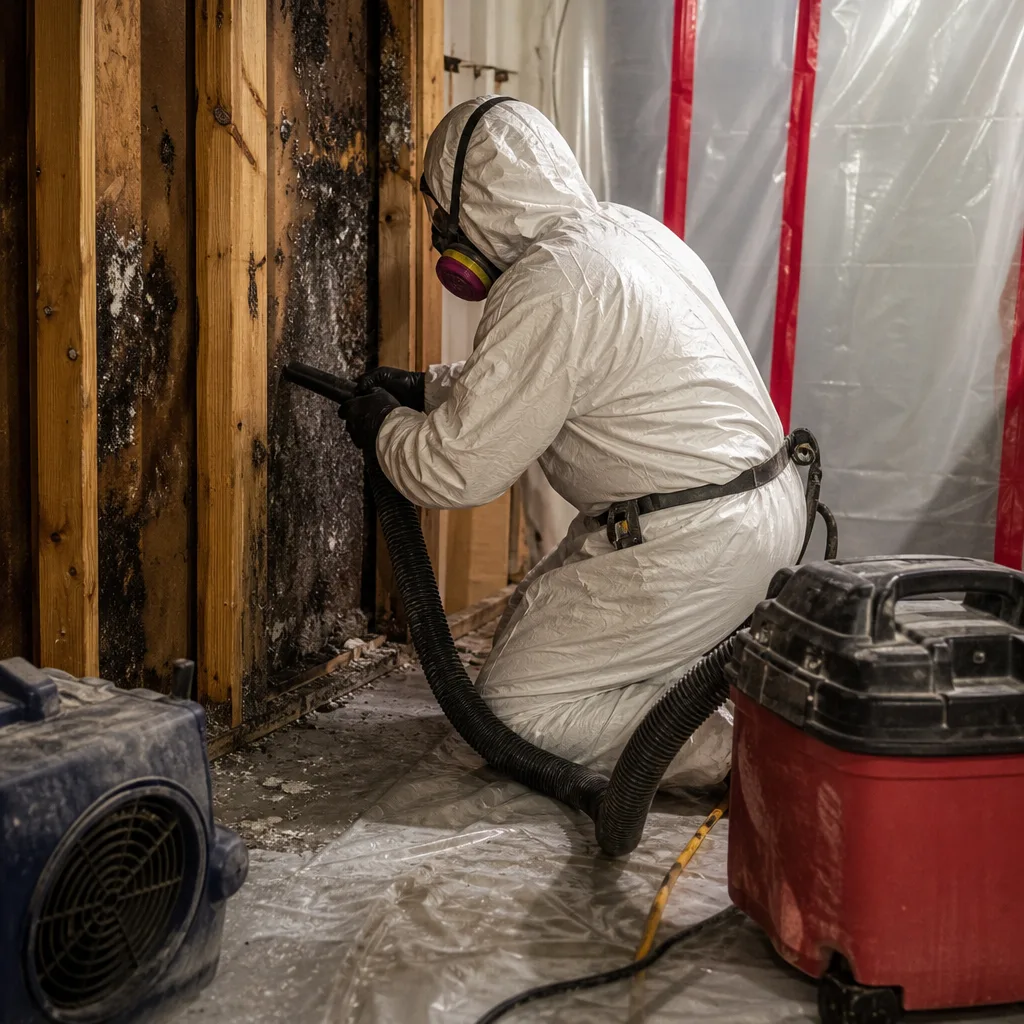
Crawl Space Treatment
The crawl spaces under Elmwood Park’s Capes and small colonials are often the mold source you never see. Damp earth, standing water after rain, and no vapor barrier create a mold factory that pumps spores up into the living space through floor gaps and wall cavities. We treat the crawl space directly: remove standing water, apply antimicrobial treatment to framing, install or replace vapor barriers, and correct ventilation. It’s a full Elmwood Park specialty because so many of our homes were built with exactly this problem.
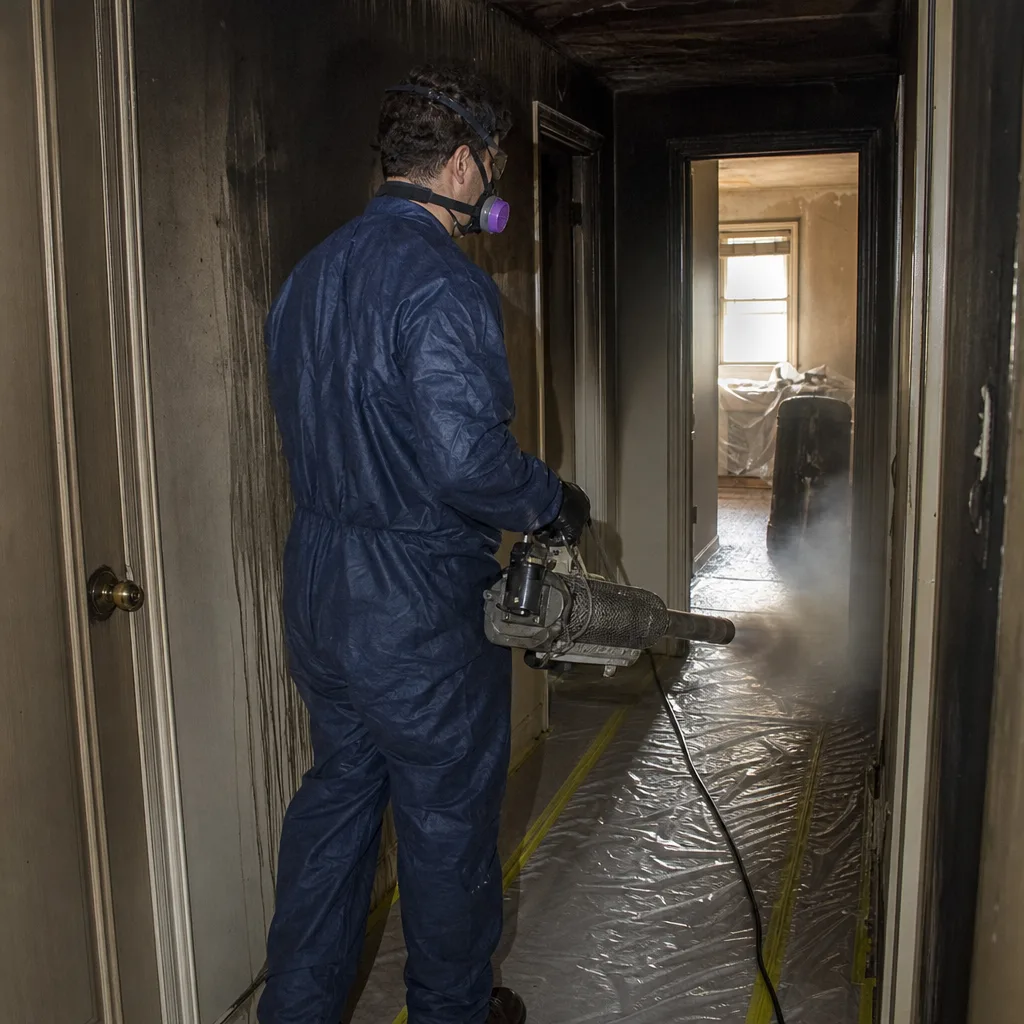
Moisture & Humidity Control
If your Elmwood Park basement or crawl space is chronically damp but you don’t have visible mold, the fix is moisture control before the mold starts. We install dehumidification systems, correct drainage and grading issues where feasible, seal foundation penetrations, and set up the space so it stays dry through the next spring rain season. It’s cheaper than remediation and it works.
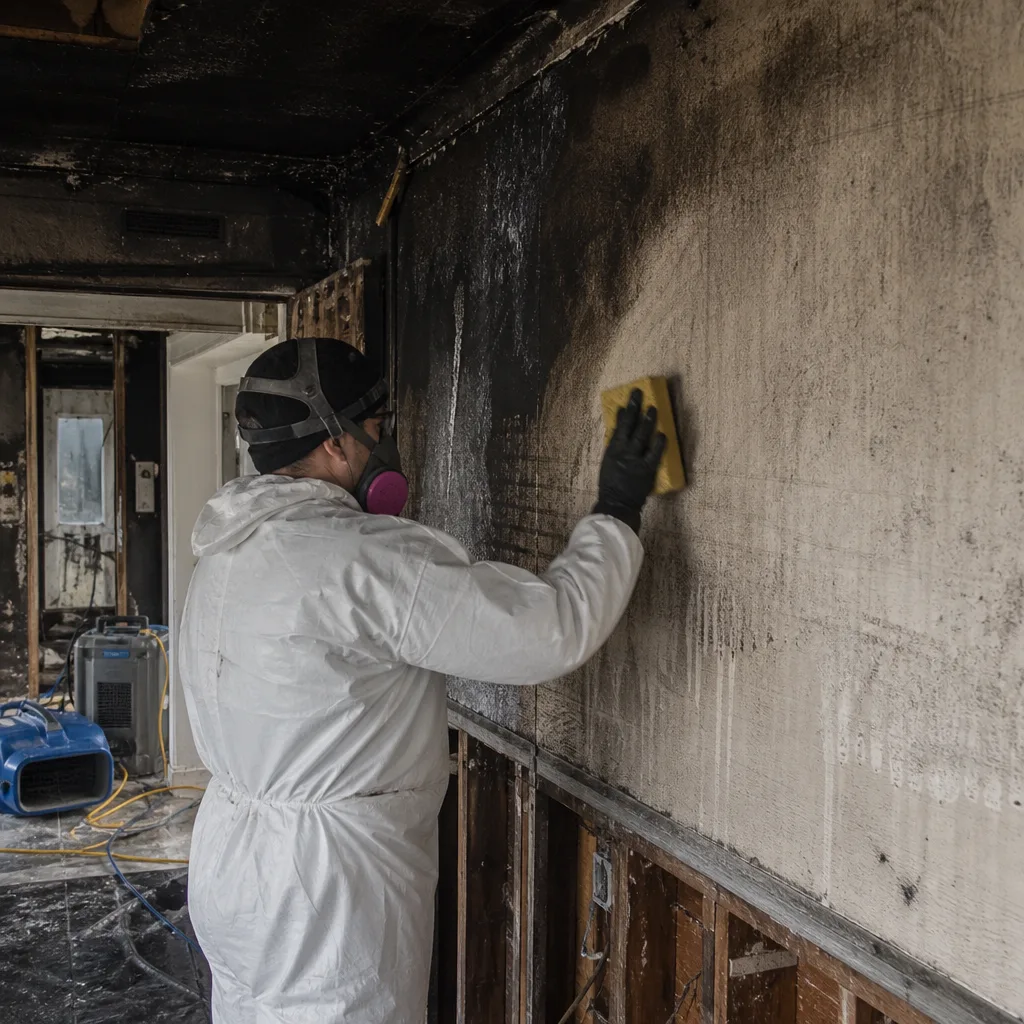
What happens when you call
- 1
A real person answersNo phone trees - you reach a local pro.
- 2
You get an upfront price rangeHonest numbers before anyone is dispatched.
- 3
A background-checked tech heads outLicensed & insured, dispatched right away.
- 4
You approve before work beginsNothing starts until you say go.
Mold Remediation Costs in Elmwood Park, NJ
Honest numbers: a typical mold removal job in Elmwood Park runs $1,800 to $4,500 for a contained area like a bathroom ceiling or a single wall cavity. A crawl space treatment with vapor barrier replacement runs $2,500 to $6,000 depending on square footage and access. A multi-unit shared-wall remediation in one of our two-family homes typically runs $5,000 to $12,000 because you’re doing containment and drying on both sides of the wall, plus rebuild. A full basement mold job with tear-out, drying, treatment, and rebuild commonly lands between $6,000 and $15,000. What moves the price: the size of the affected area, whether the mold reached structural framing, whether the leak source is still active, and whether you need pack-out and content cleaning. Insurance-covered jobs often pay for themselves minus your deductible. The free visual inspection gives you a firm written scope before you commit to anything, so the number doesn’t move on you mid-job. Call (917) 924-4221 for an inspection and an exact quote.
We Also Serve Cities Near Elmwood Park
Our crews work throughout the surrounding area every day. We serve Saddle Brook with its similar postwar housing stock and shared-wall mold patterns, Fair Lawn with its mix of Capes and split-levels, Garfield with its older attached homes and basement seepage issues, and Rochelle Park with its small-lot colonials and crawl space problems. If you’re within a few miles of any of these, we’re already close.
Serving Elmwood Park, NJ - Our Local Coverage Area
We’re based in the Elmwood Park area and know this community well. Use the map below to see our service coverage - if you’re nearby, we can almost certainly help.
Elmwood Park Mold Remediation Questions, Answered
How do you handle a mold problem that started behind a shared wall in an Elmwood Park two-family?
We start by setting containment on both sides of the shared wall and coordinating access with both owners before any demolition begins. A one-sided mold job in a two-family always fails because the moisture source and the mold colony both live inside the common assembly, not in one unit or the other. We moisture-map the entire wall, identify the source, then dry, treat, and rebuild the full assembly. Both units get documentation, and both owners know exactly what we found.
Why do finished basements in Elmwood Park seem to get mold every spring?
Because most postwar homes here were built with minimal lot grading, so snowmelt and spring rain saturate the soil and channel water against the foundation. That water finds its way into the basement through cracks, gaps, and old utility penetrations, and the finished drywall and carpet wick it up. The mold you see in April or May is usually the result of water intrusion in March. The permanent fix is addressing the drainage and grading around the foundation, plus a vapor barrier and humidity control inside. Call (917) 924-4221 and we’ll trace the water path and give you a real fix, not just a surface cleaning.
Can you dry out a crawl space in an Elmwood Park Cape Cod without a full rip-out?
Yes, in most cases. We remove any standing water, run commercial dehumidifiers until the framing reaches the dry standard, treat the wood with antimicrobials, and install a proper vapor barrier. We also correct ventilation or add a dehumidifier if the space needs it. Full rip-out is only necessary when the framing itself is rotted or structurally compromised. We’ll show you the difference with moisture readings before we touch anything.
What does category 3 water have to do with mold in an Elmwood Park basement?
Category 3 water is grossly contaminated water, like sewage backup or floodwater that has picked up soil, chemicals, or waste. It’s not just wet, it’s dirty, and the mold that follows often includes bacteria and pathogens. Category 3 water damage requires full containment, disposal of saturated porous materials, and professional antimicrobial treatment. Basements in Elmwood Park that take on stormwater from the Passaic River floodplain or a backed-up sewer line are often Category 3 events. You don’t want to be in that space without protection while it dries.
After a burst pipe in my Elmwood Park split-level, how soon should I call for mold remediation?
Call the same day. Mold colonization on wet drywall begins within 24 to 48 hours, and a burst pipe in a split-level means water soaked through the lower level’s walls and flooring before you even noticed the leak. If you call us within the first 24 hours, we can often dry the structure before mold takes hold. After 48 hours, you’re usually looking at tear-out and remediation instead of just drying. The number is (917) 924-4221. It’s cheaper to call early.
Can we stay in our home during mold remediation?
In most cases, yes. We contain the affected area so spores don’t spread through the rest of the house, and HEPA air scrubbers run continuously during the job. If the affected area includes a bedroom or the kitchen, or if anyone in the home has respiratory conditions, we may recommend staying elsewhere for a few days. We’ll tell you straight what’s safe and what isn’t, and we’ll work around your household schedule as much as possible.
Are your mold remediation technicians certified?
Yes. Our crews hold IICRC certifications including AMRT (Applied Microbial Remediation Technician) and WRT (Water Damage Restoration Technician), and they’re trained to RIA and IFA standards as well. Every technician is background-checked and uniformed. You’ll know who’s in your home, and they’ll have the credentials to back up the work.
What should I do in the first 30 minutes after I find mold in my Elmwood Park house?
Don’t disturb it. Scrubbing or even fanning the area can release spores into the air and spread the problem. Shut the door to the room if you can, don’t run the HVAC fan, and call (917) 924-4221. We’ll walk you through what to do over the phone and have a crew on the way. If the mold is near a sink, toilet, or appliance, shut off the water supply to that fixture. If it’s near a wall shared with the neighbor’s unit, don’t touch anything and let us handle the coordination.
Written by Curt Bowman, Owner at Floodline Restoration Co. of Manhattan, serving Elmwood Park and the surrounding communities with full-cycle mold remediation, water damage restoration, and reconstruction. Done right, and backed in writing.
If you’re dealing with mold in Elmwood Park, call (917) 924-4221 for a free visual inspection and a straight answer about what you’re looking at. A real person answers, day or night. The line the water left is where we start.