

Free visual inspection and a written scope of work before any mitigation begins - photos, moisture readings, and drying logs go in your claim file
The scope we write is the scope we bill. Anything new gets shown to you, in writing, before we touch it.






 Before
 After
After Before
 After
After Before
 After
After24/7 Emergency Mold Remediation in Stuyvesant Town-Peter Cooper Village
Mold remediation in Stuyvesant Town-Peter Cooper Village typically costs $1,800-$6,500 for a single-unit scope and $8,000-$25,000 when a stacked riser failure requires opening wet-wall cavities across multiple floors. Response time matters more here than almost anywhere else in Manhattan: the identical floor plans across all 110 red-brick towers mean a hidden leak found on one floor has usually been feeding mold two or three floors below it for weeks. Call (917) 924-4221 day or night and a live dispatcher answers. We send a certified crew to your building with containment equipment and moisture-mapping tools, and we begin the visual inspection the same visit.
Understanding Mold Remediation Severity in Stuyvesant Town-Peter Cooper Village Properties
Every building in Stuyvesant Town-Peter Cooper Village was constructed between 1947 and 1949 with uniform masonry walls, identical floor plans, and central steam-heat risers. Those risers and the cast-iron drain lines inside the wet walls are now 75-plus years old. When a pinhole leak develops in one, the moisture spreads inside a shared wall cavity that repeats on every floor above and below. That changes the severity equation entirely. A category 1 clean-water drip that would be a minor patch-and-dry job in a private home becomes a category 2 or 3 contamination event when it has been wicking through stacked drywall, plaster, and mortar for weeks. We assess severity by moisture mapping the full wall cavity, not just the visible patch: infrared thermal imaging and penetrating moisture meters tell us how far the water traveled before the first stain showed. In this housing stock, visible mold on one floor almost never means a single-floor job. The same failure mode repeats in the same location across dozens of sister buildings on the campus, and our Mold Remediation team treats it that way from the first reading.
Why Stuyvesant Town-Peter Cooper Village Property Owners Choose Floodline Restoration Co. of Manhattan
- 45-minute response commitment from dispatch to arrival. We coordinate directly with building management for access and freight elevator reservations so the crew is working, not waiting in the lobby.
- A live person answers the phone 24/7. No automated triage, no call-back queue. At 2 a.m. on a Sunday, you get a dispatcher who can send a crew immediately.
- Certified, background-checked technicians. Our crews hold IICRC AMRT (Applied Microbial Remediation Technician) and WRT (Water Damage Restoration Technician) credentials, trained to RIA and IFA standards.
- Free visual inspection with moisture mapping. Before any work is priced, we show you exactly where the moisture is and why it spread the way it did.
- Direct insurance billing with adjuster coordination. We document everything, submit the claim paperwork, and bill your carrier directly. You are not the messenger.
- One crew from containment to rebuild. The same team that sets containment and removes damaged drywall rebuilds the wall, primes it, and hands you a finished unit with a moisture log.
Our Mold Remediation Process
Inspection & Assessment
We start with a full visual inspection plus infrared thermal imaging and moisture readings across the affected unit and the identical wall cavities above and below. In StuyTown, we check the same wet wall on every floor in the stack before we write the scope.
Containment & Source Stabilization
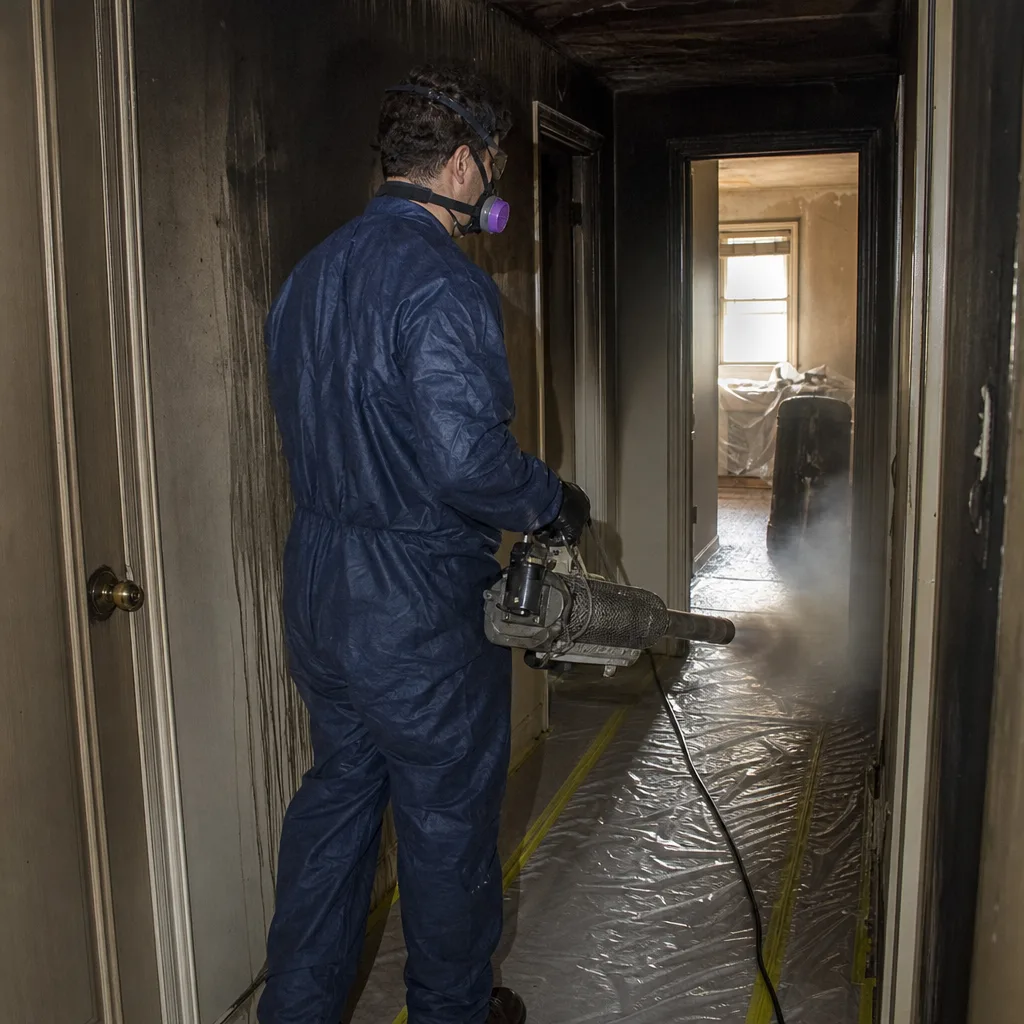
We set up negative-pressure containment with HEPA-filtered exhaust before disturbing any mold-damaged material. The source leak, whether it is a cast-iron stack or a steam riser, gets stabilized so we are not drying against an active drip.
Drying & Dehumidification
Dri-Eaz LGR dehumidifiers and XPOWER air movers run inside the containment. We log daily moisture readings, including behind-plaster readings in the masonry cavities, until every surface reaches the dry standard. That log goes to you and to management.
Cleaning & Sanitization
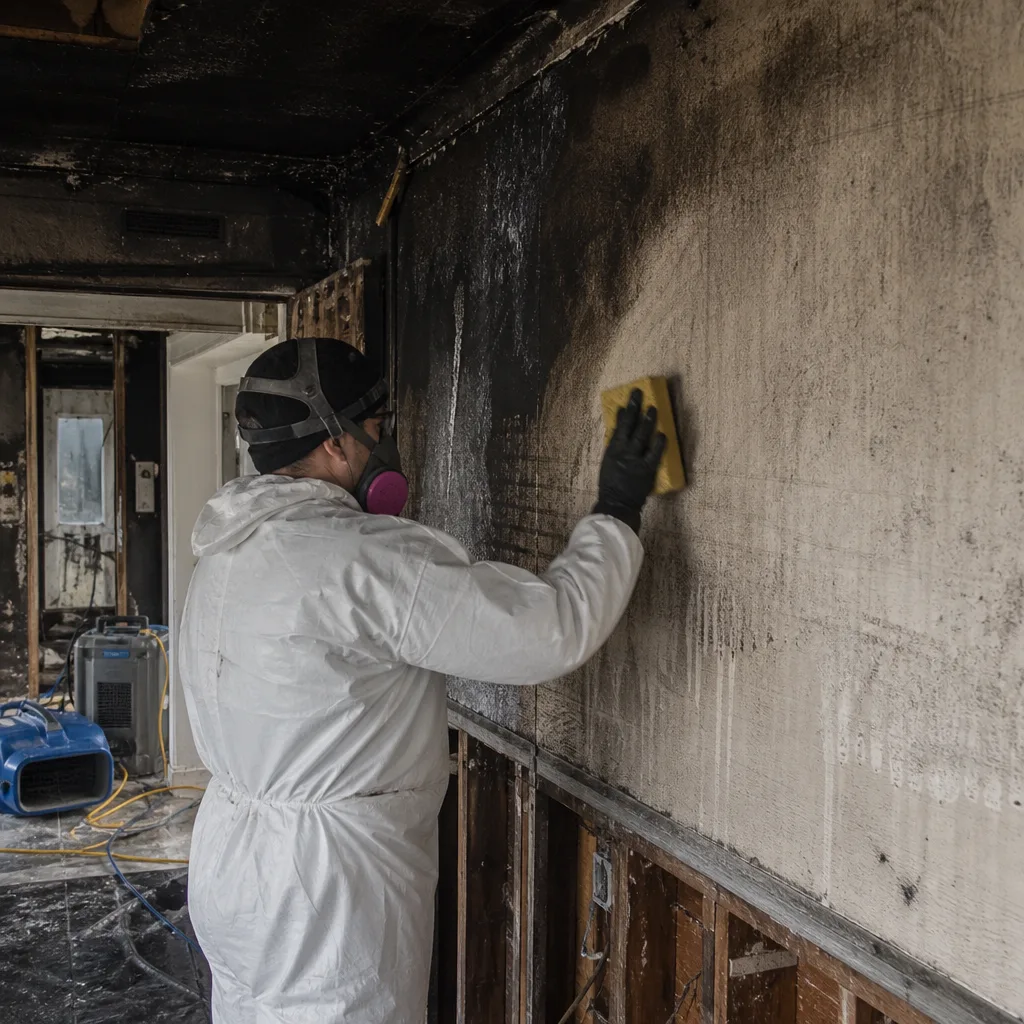
Mold-damaged drywall and insulation are removed and bagged inside containment. Remaining structural surfaces are HEPA-vacuumed and treated with an EPA-registered antimicrobial. Air scrubbers run throughout the process to keep spore counts from migrating into shared corridors.
Clearance & Air Quality Verification
We inspect the treated cavities, confirm dry standard, and verify that no hidden moisture remains in the mortar or plaster. If management or a tenant requests independent clearance testing, we coordinate the sampling. The unit is not closed up until readings are clean.
Repairs & Restoration
The same crew rebuilds the wall with mold-resistant drywall, retapes, primes, and finishes. Because we know the floor plans are identical, we can restore the unit to true pre-loss condition without guesswork on layout or finish.
Need Emergency Mold Remediation in Stuyvesant Town-Peter Cooper Village Now?
Crews minutes away, answering live 24 hours a day. The sooner we start, the less it costs.
Working With Your Insurance Company
Mold claims in Stuyvesant Town-Peter Cooper Village almost always involve a liability question: was the moisture source a sudden pipe failure, a slow leak, or a storm-surge event? The answer changes what the carrier pays and who pays it. Our documentation answers that question in a format adjusters recognize. From the first hour, we photograph the affected units room by room, including the wall cavities before any demolition. We log daily moisture readings, air scrubber run times, and containment pressure readings. We write a line-item scope that separates remediation from rebuild, which matters when the carrier covers one but not the other. And we coordinate directly with your adjuster so you never have to explain why the sixth-floor leak required opening the fourth-floor wall too. The 90-Day Done Right Promise applies to every mold job we complete: if something is not right, we make it right, in writing, with no argument.
What We Provide Your Insurer
- Thorough documentation of the loss
- Photos of all damage, room by room
- Moisture readings and drying logs
- A detailed, line-item scope of work
- Direct coordination with your carrier
Built for Stuyvesant Town-Peter Cooper Village’s Loss Calendar
The mold season here follows the building systems, not the weather. The central steam-heat risers run from October through April, and every heating season there is a burst or pinhole failure somewhere on the campus. January deep freezes push the system hardest, and that is when we see the most stacked wet-wall contamination across multiple floors. Spring brings the thaw and a second wave: condensation on cold pipes inside the masonry cavities, especially in unrenovated line apartments where original insulation has settled or failed. Summer thunderstorms do not produce the basement flooding here that they do in private rowhouse neighborhoods, because the below-grade mechanical rooms were flood-hardened after Hurricane Sandy, but high humidity still overwhelms window AC units and drives surface mold in bathrooms with the original 1947 ventilation risers. The constant across every season is the age of the plumbing. A cast-iron drain line that has held since 1948 does not fail on a schedule. It fails when it fails, and the mold follows the identical wall cavity down through the floors.
Mold Remediation Across Stuyvesant Town-Peter Cooper Village’s Neighborhoods
Stuyvesant Town and Peter Cooper Village together form one continuous campus running from East 14th Street up to East 23rd Street, with Avenue C on the east edge and First Avenue on the west. Stuyvesant Town proper, below East 20th Street, has the oldest section of the original 1947 phase, and we see the highest concentration of original cast-iron drain line failures there. Peter Cooper Village, north of 20th Street, was the second phase completed in 1949, and its buildings sit slightly closer to the East River, which matters for basement humidity and below-grade moisture levels. The oval park and loop road at the center of the campus creates internal courtyards that hold moisture after heavy rain, and garden-level units facing those courtyards report more surface mold on window reveals and bathroom ceilings than upper-floor units do. The 14th Street corridor at the southern edge, across from the Con Ed plant, has utility infrastructure running close to the foundation lines, and any excavation or utility work there can shift old plumbing just enough to start a slow leak. Our crews know the building entrances off Avenue C, the freight elevator schedules, and the access rules for each management office, so response times stay short even when the job requires coordination across multiple floors.
Specialized Mold Remediation Services We Offer in Stuyvesant Town-Peter Cooper Village
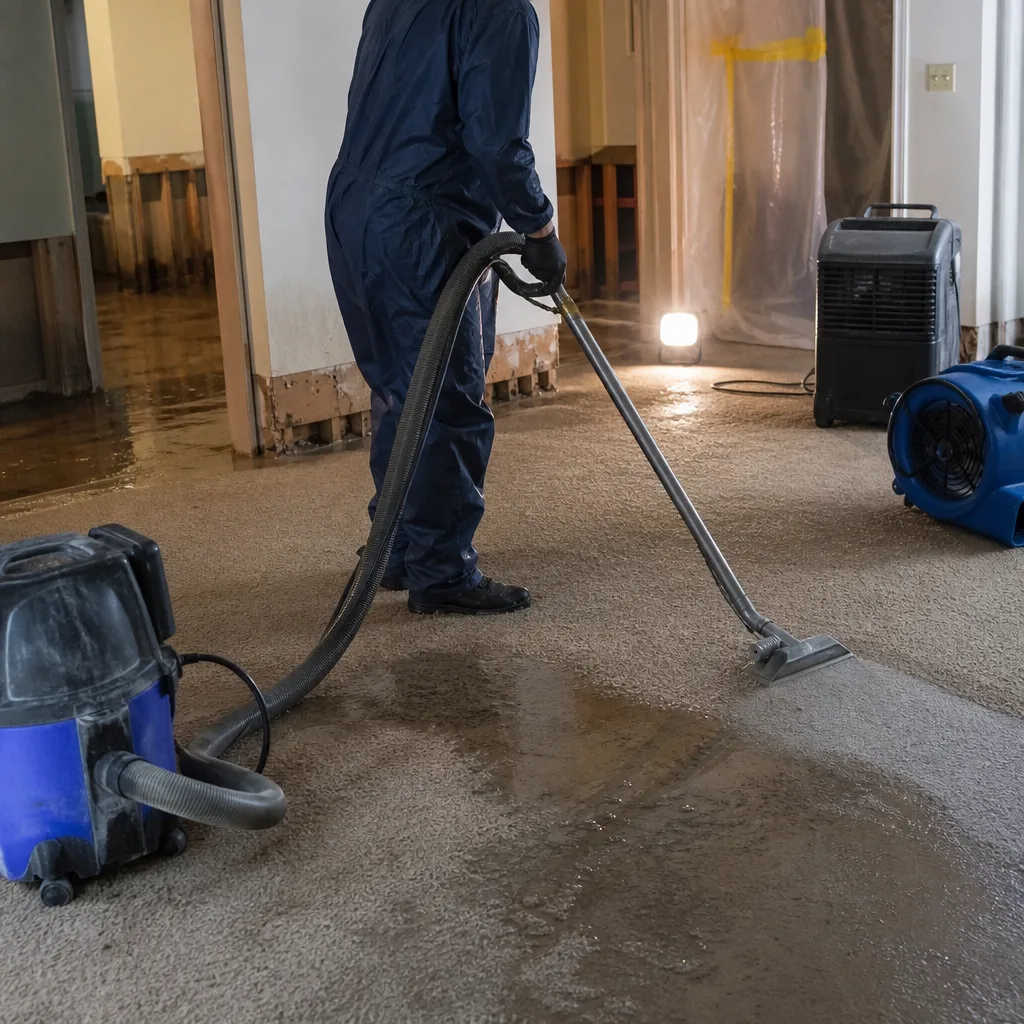
Mold Inspection & Testing
In these buildings, a visual mold patch on one floor is rarely the whole story. Our inspection includes moisture mapping of the identical wet-wall cavity on every floor above and below the visible problem, plus air sampling inside and outside the affected unit when a category 3 event or tenant health concern warrants it. We do not test for mold that we can already see; we test to find the mold that is not visible yet, which in StuyTown usually means opening a wall cavity three floors down.
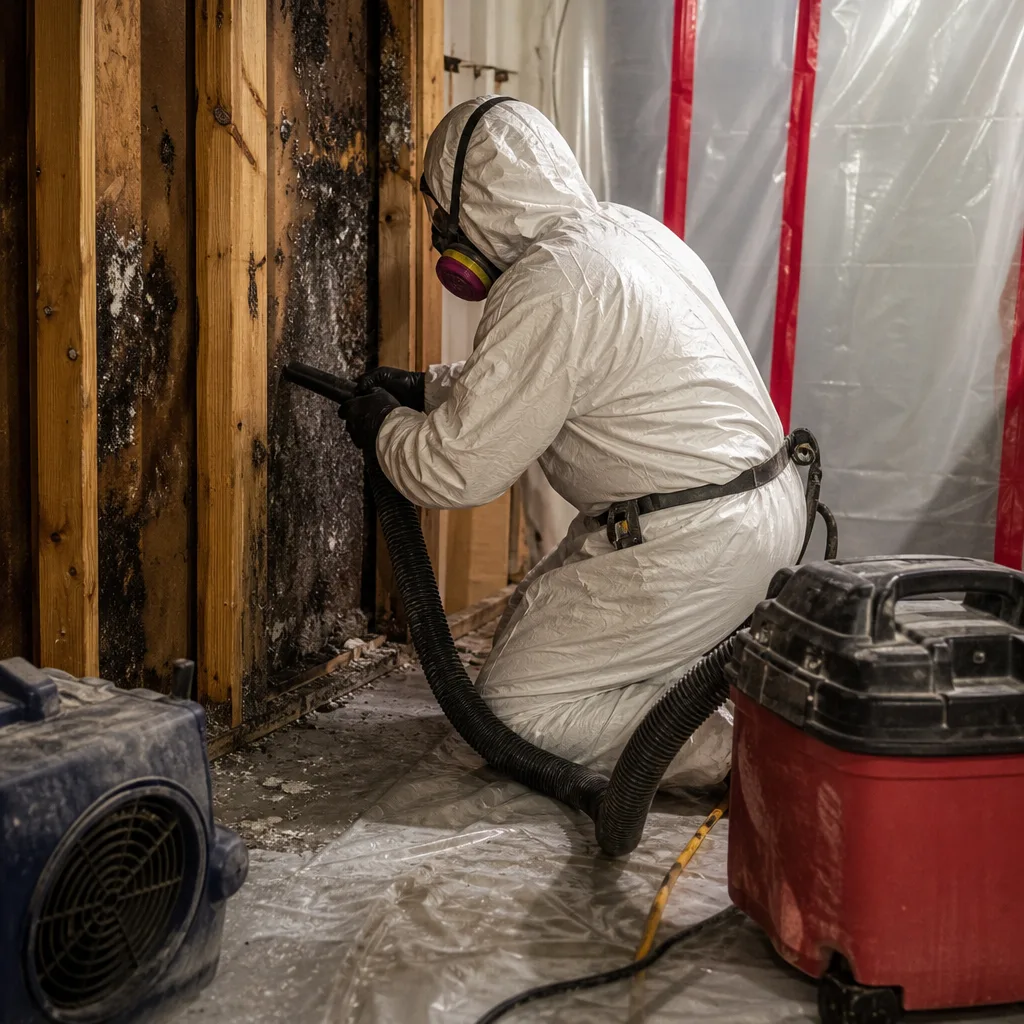
Mold Removal
Mold removal in these units means more than cutting out stained drywall. We remove mold-damaged material inside proper containment, bag it, and treat the remaining framing and masonry surfaces with an EPA-registered antimicrobial. Because the cavity layout is identical across all 110 buildings, our crew can work floor-by-floor through one scaffolding and containment setup, which cuts total job time and disruption for tenants.
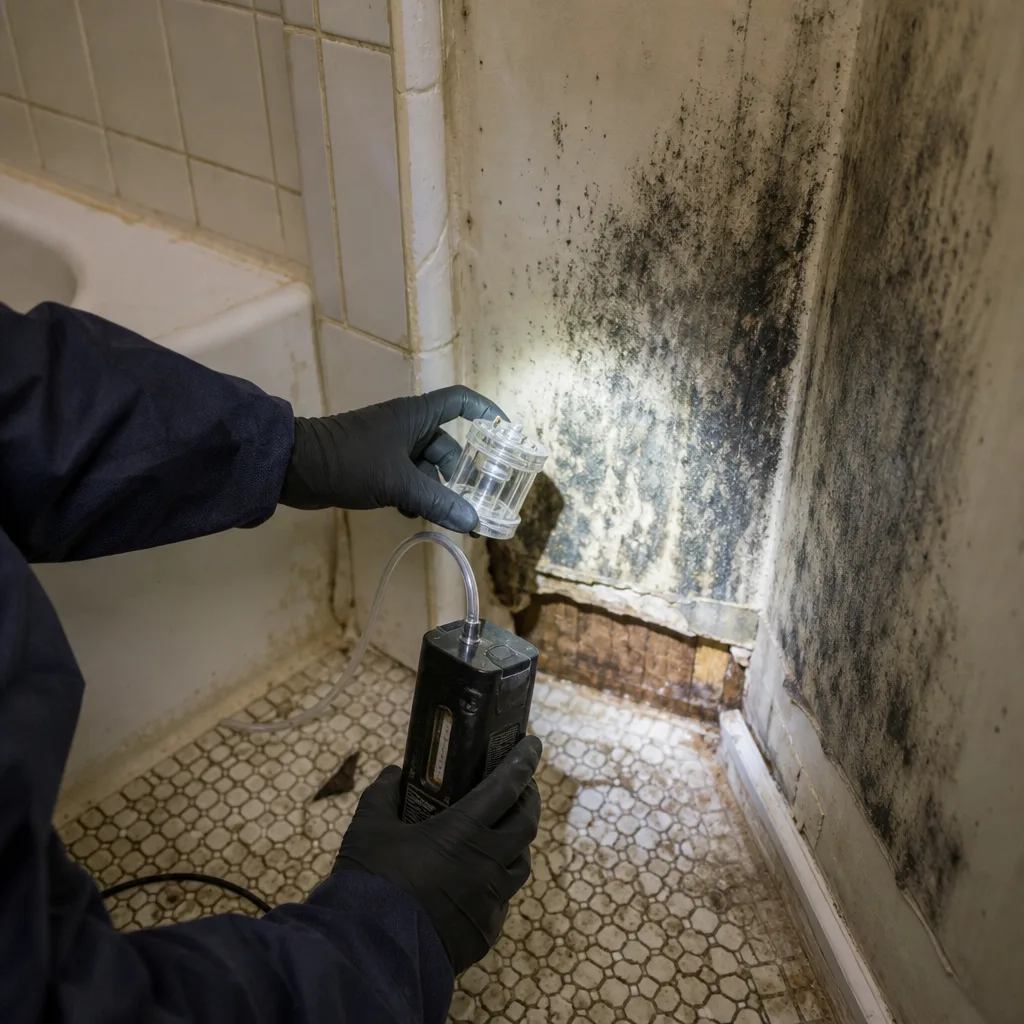
Black Mold Remediation
When black mold (Stachybotrys) is present, the stakes are higher, and the containment standard is stricter. We run full negative-pressure containment with HEPA-filtered exhaust, and we keep air scrubbers running in the shared corridor adjacent to the unit so spores do not migrate through utility chases into neighboring apartments. In a high-density campus like this, proper containment is not optional. It is the difference between a contained one-unit job and a building-wide complaint.
Air Quality Restoration
After any mold removal job, we run HEPA air scrubbers until the air inside the unit meets the dry standard and the spore counts return to normal background. For tenant-occupied units near a category 3 riser overflow, we often add a second scrubber in the corridor outside the containment. The goal is simple: when you walk back in, the apartment smells clean and the air is clean.
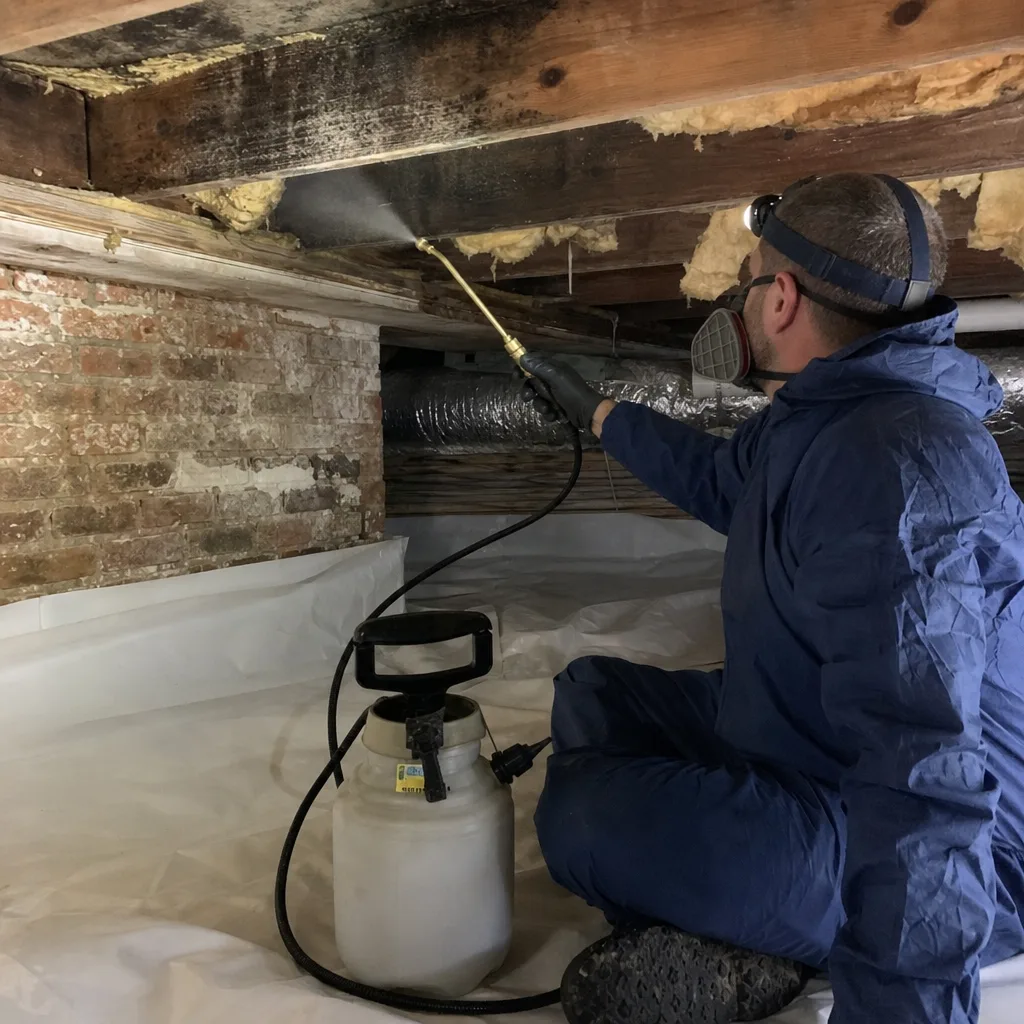
Crawl Space Treatment
Most StuyTown buildings do not have residential crawl spaces in the traditional sense, but garden-level mechanical rooms and basement storage areas do have below-grade concrete walls that wick moisture from the surrounding soil. We treat those surfaces with moisture barriers, dehumidification, and antimicrobial coatings where appropriate, and we coordinate with building management on any sump pump or drainage improvements needed to keep the space dry long-term.
Moisture & Humidity Control
The original ventilation risers in these buildings were designed for 1948 air movement, not for the shower use and cooking loads of modern apartments. High humidity in a bathroom with no working exhaust fan will support surface mold on the ceiling and around the window within weeks. We install and upgrade humidity controls, seal condensation points on cold pipes, and set up dehumidification where the building envelope is the problem. Preventing the next mold bloom is cheaper than remediating it again.
What happens when you call
- 1
A real person answersNo phone trees - you reach a local pro.
- 2
You get an upfront price rangeHonest numbers before anyone is dispatched.
- 3
A background-checked tech heads outLicensed & insured, dispatched right away.
- 4
You approve before work beginsNothing starts until you say go.
Mold Remediation Costs in Stuyvesant Town-Peter Cooper Village, NY
A single-unit mold remediation in Stuyvesant Town-Peter Cooper Village with containment, removal of mold-damaged drywall, treatment, and rebuild typically runs $1,800-$4,500. A stacked riser failure requiring the same wet-wall cavity opened on three to six floors lands between $8,000 and $25,000, depending on how long the water wicked before it was caught and whether a category 3 sewage component is involved. Mold inspection and moisture mapping alone is $350-$650 when quoted as a standalone scope, and it is free when you proceed with remediation through us. Insurance coverage depends on the cause: sudden pipe failures and storm-surge events are generally covered; long-term slow leaks and pre-existing maintenance issues may be partially covered or not covered at all. The only way to know your exact number is a visual inspection with moisture readings. Call (917) 924-4221 and we will schedule it, free.
We Also Serve Cities Near Stuyvesant Town-Peter Cooper Village
Our mold remediation crews cover Stuyvesant Town-Peter Cooper Village and the surrounding areas including Stuyvesant Town-Peter Cooper Village, Fairview, Harrison, East Bronx, and Hunts Point. Call us for a free inspection anywhere in the area.
Serving Stuyvesant Town-Peter Cooper Village, NY - Our Local Coverage Area
We’re based in the Stuyvesant Town-Peter Cooper Village area and know this community well. Use the map below to see our service coverage - if you’re nearby, we can almost certainly help.
Stuyvesant Town-Peter Cooper Village Mold Remediation Questions, Answered
Why does mold remediation in StuyTown often require opening walls on floors above and below the visible problem?
Because all 110 buildings share identical floor plans, and the plumbing stacks run through the same wet-wall cavity on every floor. A leak in a cast-iron drain line or steam riser wicks moisture vertically through that shared cavity, so mold grows in the same spot on multiple floors at once. Opening only the floor where mold is visible leaves hidden contamination above and below, and the mold returns within weeks.
How do you coordinate mold remediation with StuyTown’s centralized building management when units are tenant-occupied?
We have worked with StuyTown management on riser repairs, wet-wall openings, and multi-floor containments. We schedule access through the management office, reserve freight elevators when needed, and submit one consolidated scope of work that covers every affected unit in a stack. For tenant-occupied units, we coordinate entry times directly with tenants and management so the work proceeds without anyone being surprised at their door.
Can we stay in our apartment during mold remediation if the source is a slow riser leak?
Usually not during the active removal phase. Once containment goes up and the damaged drywall comes out, the unit is not livable until the cavity is dry, treated, rebuilt, and the air has been scrubbed. A slow riser leak typically means the affected wall is in a bathroom or closet, but the containment zone includes that entire room, and we run negative-pressure equipment continuously. Most residents leave for two to five days depending on the scope.
What does pre-loss condition mean for a mold claim in a StuyTown apartment?
Pre-loss condition means restoring the unit to the same condition it was in before the moisture event. In these buildings, that means matching the original 1947 plaster walls, the specific tile patterns, and the standard management finish package. We know what pre-loss condition looks like in StuyTown because we have rebuilt dozens of these units, and we photograph everything before demolition so the claim has a clean baseline.
Do you need special access or approvals to remediate mold inside individual units here?
Yes. Individual residents cannot independently authorize invasive remediation work inside StuyTown units. Management must be notified, and for any wall opening, water shutoff, or structural drying, management approval and building staff coordination are required. We handle that communication directly. You call us, we coordinate with management, and you get one clear answer instead of a three-way conversation.
How fast can a mold remediation crew actually get to Stuyvesant Town-Peter Cooper Village?
Our response commitment is 45 minutes from dispatch to building arrival, and we dispatch from the New York City office. For a stacked riser failure or category 3 overflow, we can have containment and drying equipment in the building within two hours of the first call. Call (917) 924-4221 and a live person answers, day or night.
How long does the full mold remediation and rebuild take in a typical stacked riser case?
For a three-to-six floor stacked cavity, full remediation and rebuild typically takes five to ten days. That includes containment, demolition, structural drying, antimicrobial treatment, clearance, and rebuilding the walls to finished condition. Drying is what takes the time. We log daily readings and you see the numbers coming down, so you know the job is moving and not stalled.
What should we do in the first 30 minutes after discovering mold or a hidden leak in a StuyTown unit?
Call building management immediately to report the leak, then call us at (917) 924-4221. Do not open the wall yourself, do not run a box fan on the wet area, and do not spray bleach on visible mold. Running a fan without containment spreads spores through the shared corridor. Get a moisture map done before any wall is opened, because in this housing stock, the mold you see is rarely the whole problem.
Written by Curt Bowman, Owner at Floodline Restoration Co., serving Stuyvesant Town-Peter Cooper Village and the surrounding communities.