
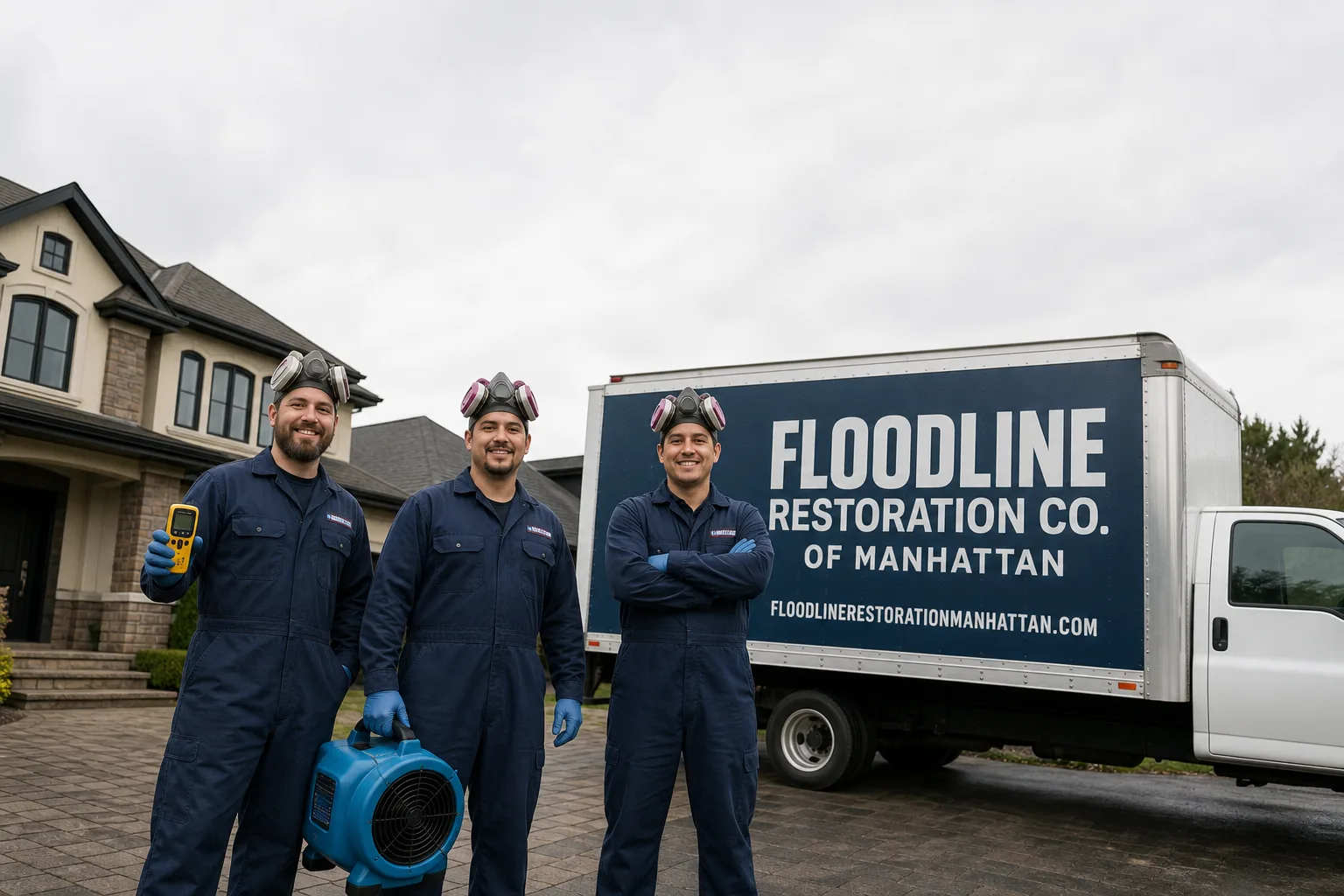
Free visual inspection and a written scope of work before any mitigation begins - photos, moisture readings, and drying logs go in your claim file
The scope we write is the scope we bill. Anything new gets shown to you, in writing, before we touch it.






 Before
 After
After Before
 After
After Before
 After
After24/7 Emergency Mold Remediation in Union City
Mold remediation in Union City typically costs between $1,800 and $6,500 depending on how far the growth has spread through wall cavities and subfloor assemblies. If you’re seeing dark staining on baseboards, smelling musty air near exterior walls, or noticing new respiratory irritation in the house, call (917) 924-4221 and a live dispatcher answers. Not a recording. Not a callback queue. A person who can get a certified crew on the road to your address in Union City right then.
Mold moves fast once moisture is present, especially in Union City’s older wood-frame homes where uninsulated walls hold condensation and give spores a dark, damp place to colonize. The first hour matters because that’s when containment goes up and the spread stops. We answer live every hour of every day because a 2 a.m. discovery shouldn’t wait until business hours. Our crews run Dri-Eaz, Phoenix, and XPOWER equipment sized for the job, and we don’t leave until the moisture log shows the dry standard has been met. You’ll get a straight answer about what we found, what it costs, and what we’ll do about it, before any work starts.
Understanding Mold Remediation Severity in Union City Properties
Not every mold problem in Union City is the same, and the difference usually comes down to water class and how long moisture sat before anyone noticed. A small patch behind a bathroom vanity from a slow supply-line drip is one thing. A basement wall that’s been weeping through cracked mortar since the first spring thaw is another. We categorize the water source first: clean water from supply lines, category 2 water with contaminants from washing machine overflow or sump failure, or category 3 water from sewage backup and Hudson County storm surge into older foundation drains.
Union City’s housing stock makes severity worse in predictable ways. Early-to-mid 20th century wood-frame construction means wall cavities act like chimneys for moisture, drawing damp air upward behind original plaster. Plank sheathing that predates plywood holds water longer once saturated. When we set up containment in these homes, we’re usually isolating more square footage than the homeowner expects, because mold colonizes the void spaces behind walls long before it shows up on the surface. Air scrubbing with HEPA-filtered negative air machines runs through the entire drying phase, and we don’t release a job until clearance testing confirms the spore count is back to normal background for Union City’s environment.
Why Union City Property Owners Choose Floodline Restoration Co. of Manhattan
- 45-minute response commitment. When you call with active mold or a moisture event, we aim to have a crew at your door in Union City within 45 minutes. Live dispatch means we actually hit that target.
- 24/7 live answer, always a person. No automated tree, no “leave a message after the tone.” A real dispatcher picks up at 2 a.m. and starts moving equipment toward your address. Every day, including holidays.
- IICRC-certified crews on every job. Our technicians carry AMRT (Applied Microbial Remediation Technician) and WRT (Water Damage Restoration Technician) certifications. Background-checked, uniformed, and trained to know what they’re looking at before they touch it.
- Free visual inspection. We’ll walk the property, identify the moisture source, map the affected area, and give you a written scope before any equipment rolls in. No charge, no obligation, no pressure.
- Direct insurance billing. If your Union City homeowner’s policy covers the loss, we coordinate with your adjuster and bill the carrier directly. You don’t play messenger between us and them.
- One team from containment to reconstruction. The same certified crew that sets up containment also manages daily moisture readings, removes affected materials, and rebuilds what we had to tear out. No mid-job handoff to a crew you’ve never met.
Our Mold Remediation Process
Inspection & Assessment
We start by finding the moisture, not just the mold. Thermal imaging and moisture meters trace dampness through wall cavities, plank sheathing, and subfloor assemblies. In Union City homes with original construction, we check the low-pitched roof lines and foundation perimeter that freeze-thaw cycles hit hardest.
Containment & Source Control
Before any mold is disturbed, we seal the work area with containment barriers and run HEPA-filtered negative air machines to prevent cross-contamination. The water source gets shut down or repaired, whether that’s a leaking supply line, a failed sump, or a foundation crack letting snowmelt through.
Drying & Dehumidification
Dri-Eaz dehumidifiers and XPOWER air movers pull moisture from saturated framing and subflooring. We take daily readings with hygrometers and log everything. The moisture log goes to you and your carrier, and it’s the proof that the structure hit the dry standard before any rebuild begins.
Cleaning & Antimicrobial Treatment
Affected surfaces get HEPA-vacuumed and treated with hospital-grade antimicrobials registered for mold remediation. Porous materials that can’t be fully cleaned, like heavily saturated drywall or subfloor with deep colonization, get removed and bagged for disposal under containment.
Air Quality Restoration
After cleaning, we run commercial air scrubbers to bring airborne spore counts down to normal background levels. Clearance testing confirms the air inside your Union City home is safe to breathe before we pull the containment barriers.
Repairs & Restoration
We rebuild what remediation required removing. Drywall, insulation, trim, subfloor, and any framing repairs, all done by the same Floodline crew that started the job. You get a finished result, not a stripped room and a referral to someone else.
Need Emergency Mold Remediation in Union City Now?
Crews minutes away, answering live 24 hours a day. The sooner we start, the less it costs.
Working With Your Insurance Company
Mold claims in Union City go smoother when the documentation is complete from the first hour. We photograph every affected surface before we touch it, map the moisture migration path, and log daily drying readings until the dry standard is met. That record is what your adjuster needs to see, and we send it directly. You won’t translate between us and your carrier.
Founded in 2010 by Curt Bowman, Floodline Restoration Co. has spent over a decade coordinating with insurance carriers on Hudson County mold and water losses. Our estimates use industry-standard software and line-item scopes that adjusters recognize. If your policy covers the loss, we bill directly and you’re not out of pocket for the covered portion. If it doesn’t, you’ll know the full price in writing before any work starts. No surprises, no add-ons you didn’t approve.
What We Provide Your Insurer
- Thorough documentation of the loss
- Photos of all damage, room by room
- Moisture readings and drying logs
- A detailed, line-item scope of work
- Direct coordination with your carrier
Built for Union City’s Loss Calendar
Union City’s mold problems follow a calendar that locals know and insurance adjusters can almost set a watch by. January and February bring deep freezes that burst supply lines in under-insulated exterior walls, soaking cavities behind original plaster before anyone finds the leak. The water sits there, warm enough inside the envelope to grow mold, hidden for weeks. Then comes March, when the freeze-thaw cycles push ice dams off low-pitched roofs and snowmelt overwhelms aging foundation drains. That’s when we get the phone calls: basements with water pushing through cracked mortar, subfloor assemblies swelling with absorbed moisture, and mold already colonizing behind paneling and drywall.
Spring in Union City isn’t just wet. It’s wet in the exact places older construction can’t defend. Wood-frame homes from the 1930s and 1940s weren’t built for today’s snow loads or the repeated freeze-thaw stress this part of the state experiences. Summer brings flash thunderstorms that dump water faster than the old storm drainage can move it, and fall nor’easters drive wind-driven rain under cedar siding. Each season leaves moisture behind somewhere. Our crews know where to look because we’ve worked these streets enough to recognize the pattern.
Mold Remediation Across Union City’s Neighborhoods
The density of Union City changes the way we move equipment and stage containment. Around the north end near 49th Street, tight row houses and multifamily conversions mean shared walls and attached foundations. Mold doesn’t respect the property line, and a leak in one unit can push moisture into the neighboring framed assembly. We coordinate access and containment accordingly.
Down near 15th Street and New York Avenue, the older residential blocks hold many of the original wood-frame houses that make up Union City’s core housing stock. These are the jobs where we see hidden mold behind plank sheathing and under hardwood floors that have been down since the Hoover administration. The Kennedy Boulevard corridor runs through commercial and residential mixed use, and those buildings often have flat or low-pitched roof sections that pool water and feed interior leaks. West of Summit Avenue, hillside lots create drainage patterns that force water toward foundations, and spring thaw pushes water through masonry that’s been patched for decades without a real fix. Each area needs the same remediation standard, but the access, the containment setup, and the source repair differ block by block.
Specialized Mold Remediation Services We Offer in Union City
Mold Inspection & Testing
If you suspect mold but can’t see it, air sampling and surface testing tell us what’s in the air and where it’s coming from. In older Union City homes, elevated spore counts often trace back to hidden moisture in wall cavities, and testing gives us the exact species and concentration. We interpret the results against outdoor baseline readings for your block, not some generic national number.
Mold Removal
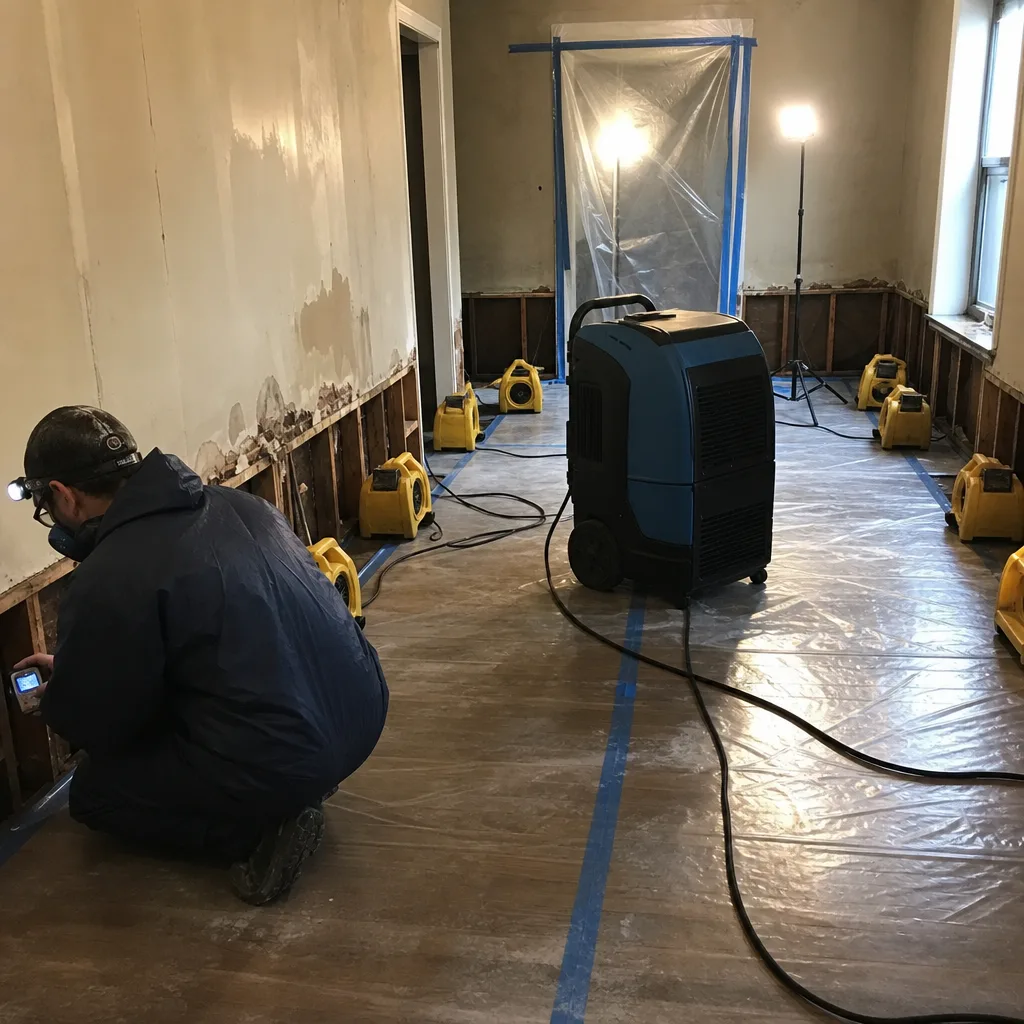
Removal means physical extraction, not just spraying over staining. We cut out colonized drywall, pull saturated insulation, and bag contaminated material under containment. Every cut is deliberate, based on moisture readings and visual inspection, not guesswork. That discipline saves you from paying for unnecessary demolition.
Black Mold Remediation
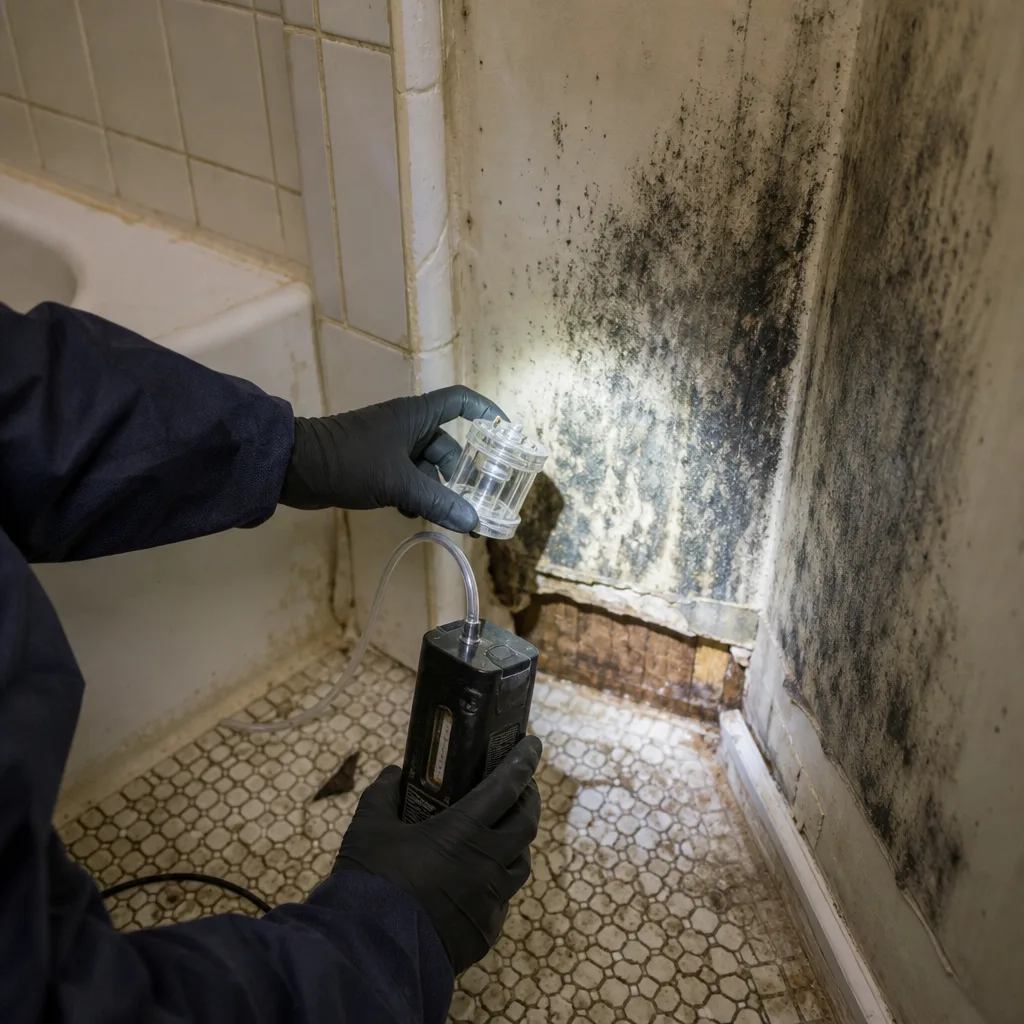
Stachybotrys, what people call black mold, thrives in continuously wet cellulose: drywall, wood, paper backing. In Union City homes with chronic roof leaks or hidden plumbing failures, black mold colonizes deep behind surfaces. Full PPE, negative air containment, and HEPA filtration are non-negotiable on these jobs, and clearance testing verifies the air before anyone re-enters without protection.
Air Quality Restoration
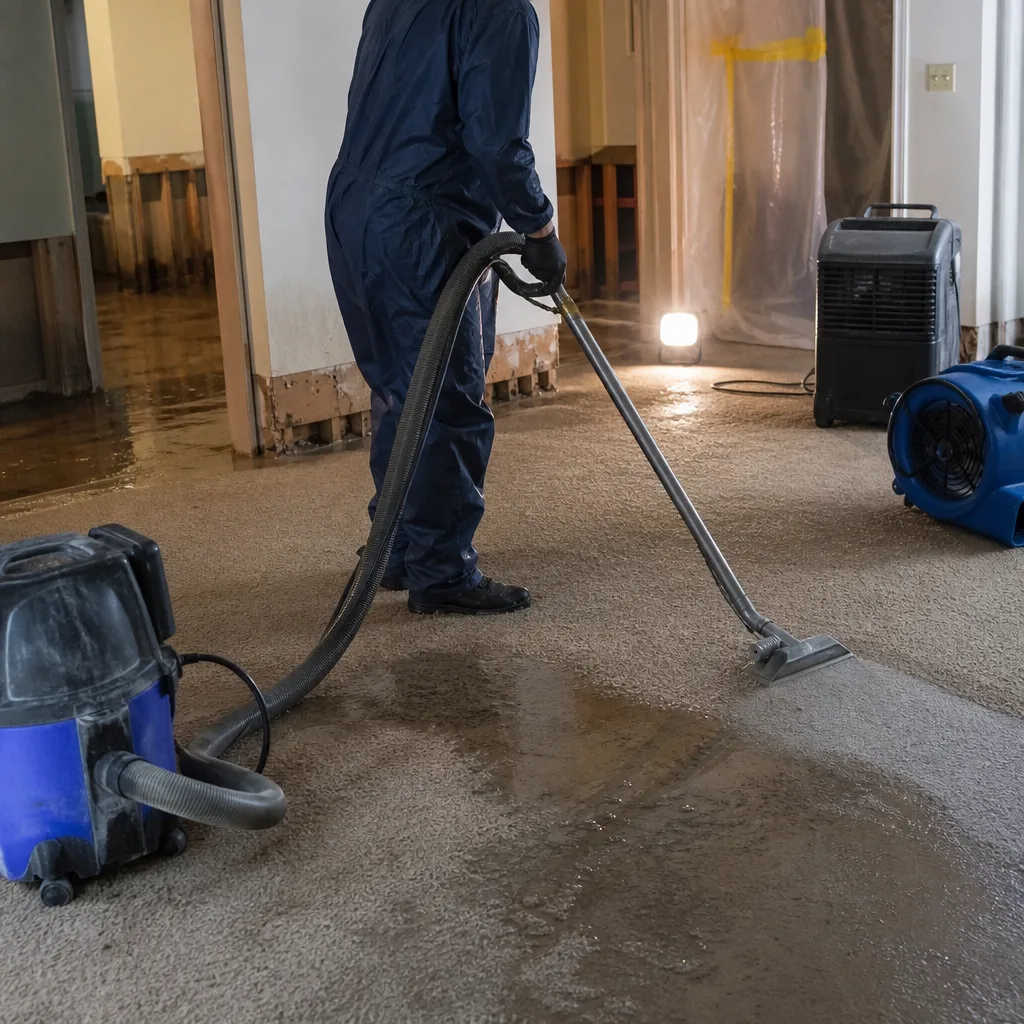
After remediation, the air inside your home needs scrubbing. We run commercial HEPA air scrubbers sized to your square footage and hold them in place until airborne counts drop to safe levels. For homes that have had mold growing for months behind walls, this phase matters as much as the demolition.
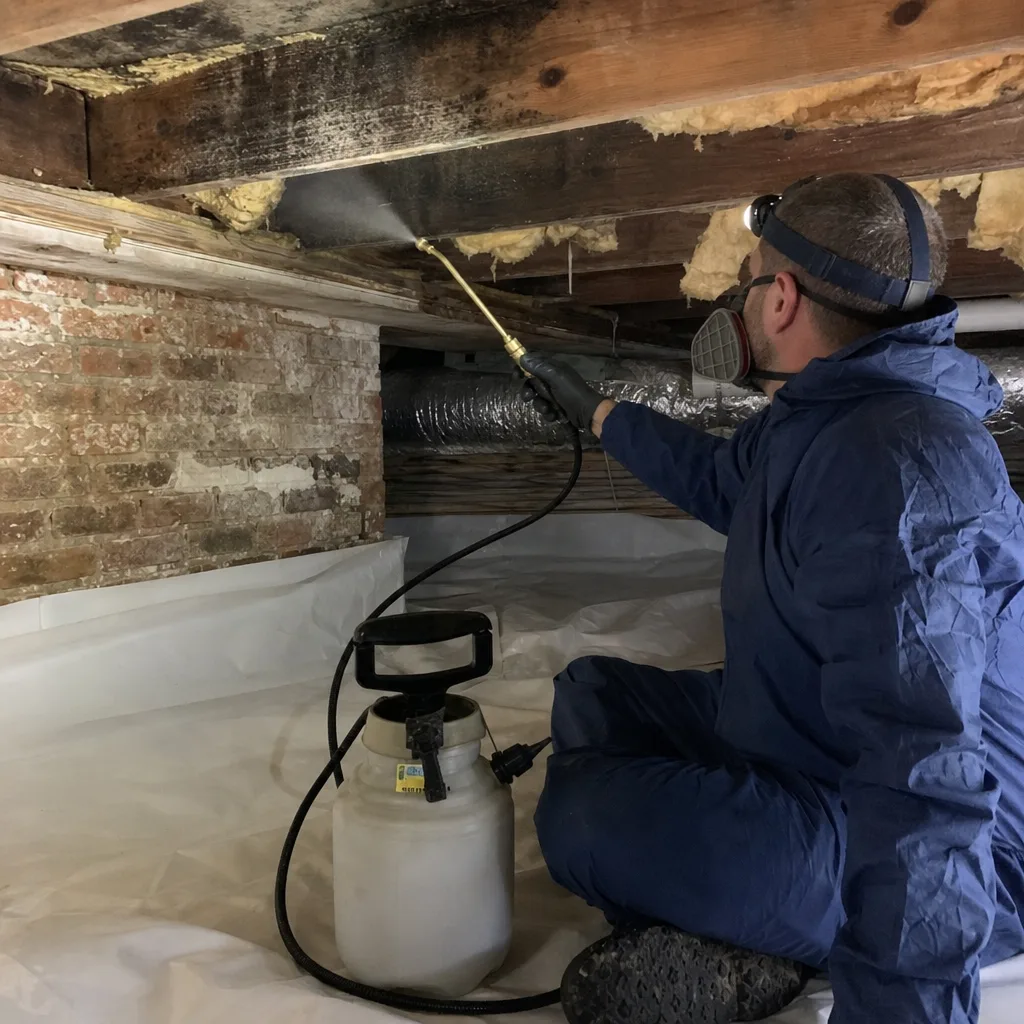
Crawl Space Treatment
Crawl spaces in Union City’s older homes are where moisture hides for years without anyone looking. Dirt floors, missing vapor barriers, and foundation vents that let snowmelt seep through make these spaces mold factories. We dry the space, treat affected framing, install or repair vapor barriers, and leave a moisture log showing the space hit the dry standard.
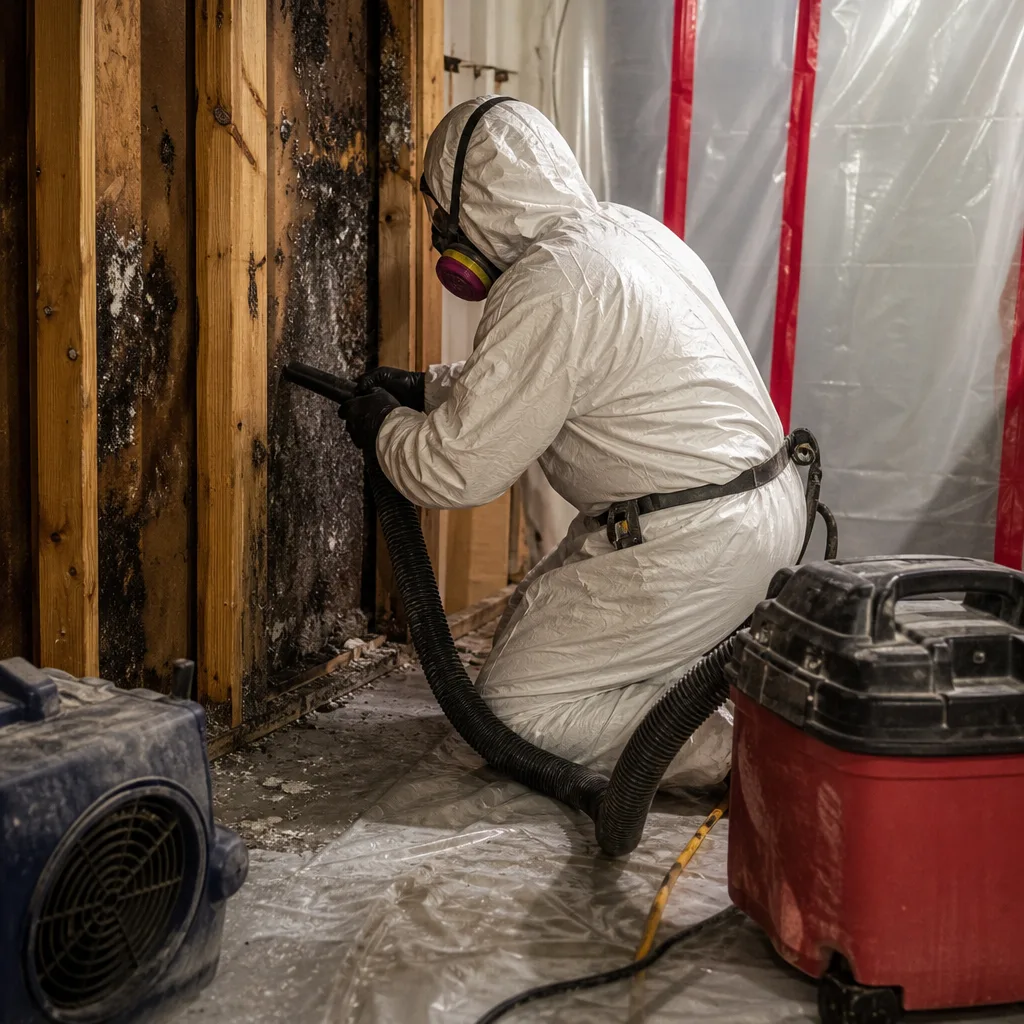
Moisture & Humidity Control
Remediation without moisture control just means the mold comes back. On a residential street near 15th Street, our crew recently tackled a mold outbreak in a 1940s wood-frame home after an ice dam forced category 2 water into the wall cavities. Using moisture mapping and thermal imaging, we traced elevated moisture readings behind original plank sheathing, set up containment, and ran Dri-Eaz dehumidifiers with XPOWER air movers for structural drying before applying antimicrobial treatment to restore pre-loss condition. The dehumidifier settings and air movement pattern weren’t generic. They were dialed to that house’s construction, and the homeowner has the moisture log in hand to prove it.
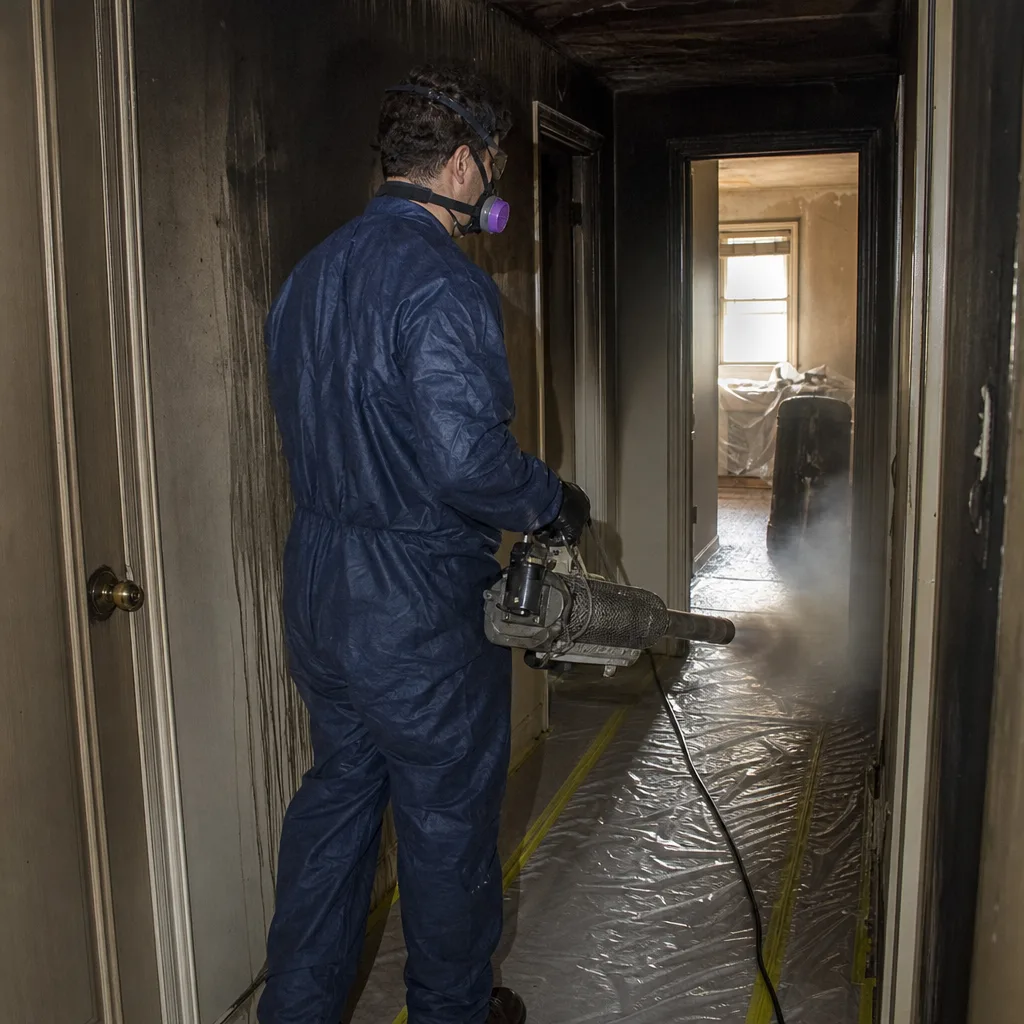
What happens when you call
- 1
A real person answersNo phone trees - you reach a local pro.
- 2
You get an upfront price rangeHonest numbers before anyone is dispatched.
- 3
A background-checked tech heads outLicensed & insured, dispatched right away.
- 4
You approve before work beginsNothing starts until you say go.
Mold Remediation Costs in Union City, NJ
A typical mold remediation in Union City runs between $1,800 and $6,500, with the average job landing around $3,200. Small, contained jobs like a bathroom ceiling patch from a supply line drip start around $800 to $1,500. A full basement with mold behind paneling, wet subfloor, and crawl space involvement across a 1940s wood-frame will push $8,000 to $12,000 when you factor in demolition, drying time, air scrubbing, and rebuild. What moves the price: how much wall and floor has to come out, whether the crawl space needs full treatment, and how long the structure takes to hit the dry standard. Older construction dries slower, and that’s real cost.
If your homeowner’s policy covers the loss, you’ll typically pay only your deductible. If it doesn’t, you get a firm line-item scope in writing before we start, so you know the number and can decide. The free visual inspection is the path to certainty. Call (917) 924-4221 and we’ll tell you what we’re looking at and what it will take. No obligation, no sales speech.
We Also Serve Cities Near Union City
Our crews run the same equipment and the same standards through the surrounding North Jersey area: Mold Remediation for Weehawken and Hoboken residents, North Bergen’s hillside blocks, and Secaucus homes. Same 45-minute response commitment, same live dispatch, same written scope before work starts.
Serving Union City, NJ - Our Local Coverage Area
We’re based in the Union City area and know this community well. Use the map below to see our service coverage - if you’re nearby, we can almost certainly help.
Union City Mold Remediation Questions, Answered
Why do we see a spike in mold remediation calls in Union City every March and April?
Union City’s freeze-thaw winter cycle creates ice dams on low-pitched roofs and spring snowmelt that overwhelms older foundation drainage, saturating the same aging wood-frame homes every year. The moisture enters wall cavities and subfloor assemblies in late winter, and by March the mold has colonized enough to become visible or noticeable by smell.
Is mold in an older Union City home more dangerous because of the original construction materials?
Older construction doesn’t make the mold spores themselves more dangerous, but original plaster over plank sheathing holds moisture longer than modern drywall, giving mold a longer colonization window. Lead paint and asbestos in pre-1978 materials also require careful handling during demolition, which our certified crews are trained to manage safely.
How does our crew determine if mold is from a clean water leak or a sewage backup in Union City?
We test the moisture source and the affected materials. Clean water mold from a supply line colonizes differently than category 3 water from sewage, which introduces bacteria and pathogens requiring more aggressive antimicrobial treatment and often more extensive material removal. The moisture meter readings, water source inspection, and lab sampling pinpoint the contamination level.
Do older Union City homes need different mold remediation techniques than newer builds?
Yes. Original plank sheathing, uninsulated cavities, and legacy plumbing in Union City’s early-to-mid 20th century homes mean moisture hides in places newer construction doesn’t have. Our drying plans account for the slower evaporation rates of old-growth lumber and the chimney effect of open wall cavities, which requires longer containment and more aggressive air movement to hit the dry standard.
Can you prevent mold from recurring after an ice dam leak in Union City?
Recurrence prevention starts with fixing the moisture source, whether that’s roof ventilation, insulation, or gutter repair to stop ice dams, then controlling humidity with proper dehumidification and air sealing. We document the moisture readings through the full dry-down and advise on the specific upgrades your house needs so the same wall doesn’t get wet again next March.
How fast can a crew reach my Union City home?
We commit to 45-minute response for active mold or water events anywhere in Union City. Call (917) 924-4221 and a live dispatcher mobilizes the nearest certified crew immediately. Emergency containment is typically set up the same visit.
Will my insurance cover mold remediation in Union City?
Coverage depends on the source of the water and your policy language. A sudden pipe burst that leads to mold is commonly covered. Long-term seepage or pre-existing moisture is often excluded. We document everything from the first hour and coordinate directly with your adjuster, and we’ll give you an honest read on what your policy likely covers before you commit.
Can we stay in our Union City home during mold remediation?
For small contained jobs, yes. For larger jobs with significant airborne spore counts, full containment, or demolition of colonized materials, we recommend vacating until clearance testing verifies the air is safe. We’ll tell you which situation you’re in during the free inspection, before any work begins.
Written by Curt Bowman, Owner at Floodline Restoration Co. of Manhattan, serving Union City and the surrounding North Jersey area with certified mold remediation and full restoration services.