
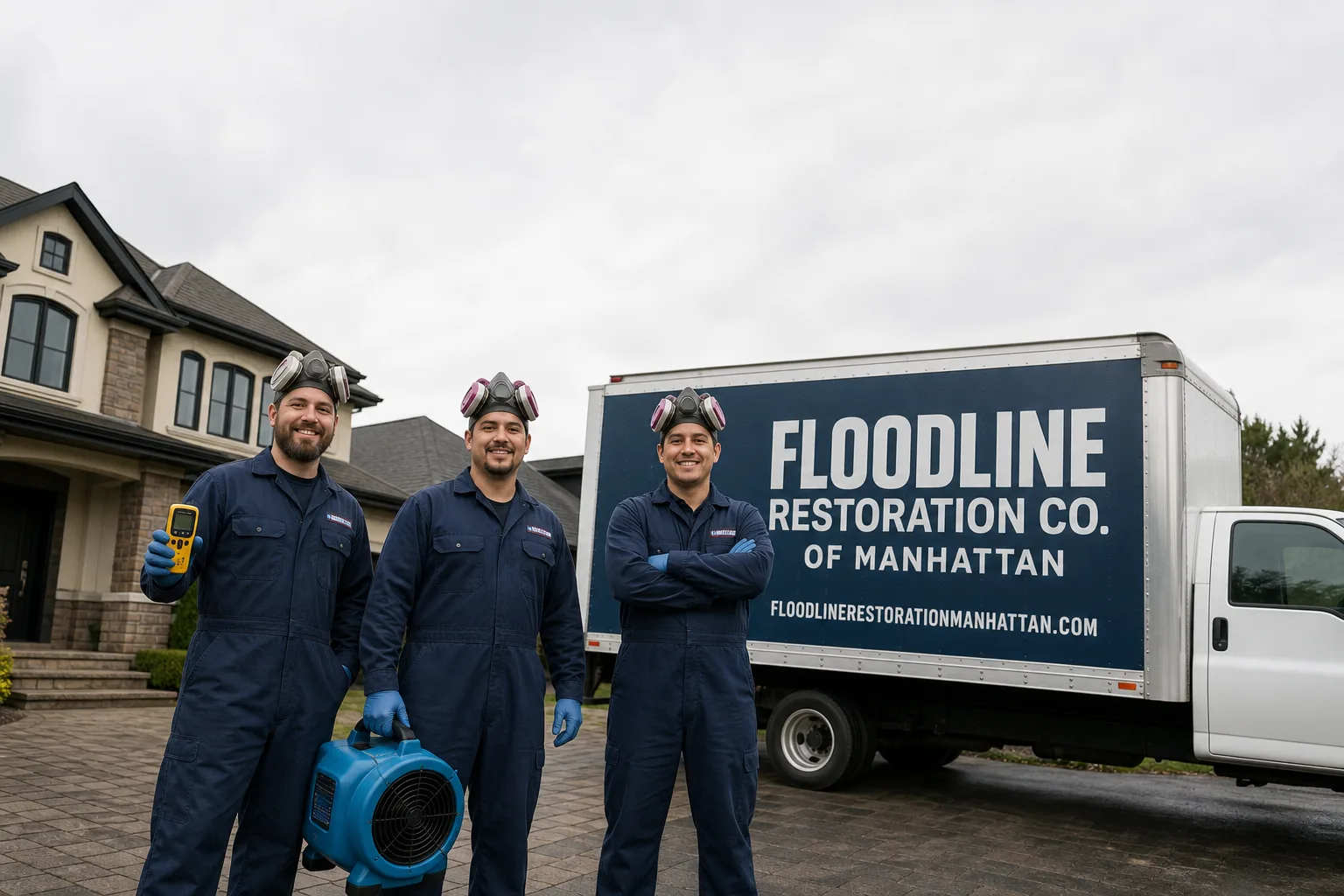
Free visual inspection and a written scope of work before any mitigation begins - photos, moisture readings, and drying logs go in your claim file
The scope we write is the scope we bill. Anything new gets shown to you, in writing, before we touch it.






 Before
 After
After Before
 After
After Before
 After
After24/7 Emergency Sewage Cleanup in Weehawken
A sewage backup inside a Weehawken home or high-rise is a category 3 water loss from the first minute. That means bacteria, viruses, and pathogens are already moving through your flooring, your drywall, and any porous surface they touch. Weehawken’s two-tier geography makes this worse than a typical New Jersey backup: ground-floor units along the Hudson and older row houses up on the Palisades each fail differently, but both need extraction running the same day. Call (917) 924-4221 and a live dispatcher answers, any hour, every day. A background-checked, uniformed crew reaches your property fast, completes a free visual inspection, and gets category 3 water out before the contamination spreads into framing, underlayment, and the stuff you can’t see behind baseboards.
The first hour matters because sewage doesn’t sit still. It wicks upward through drywall, saturates carpet padding, and presses into concrete. In a Port Imperial tower, that water travels down elevator shafts and into underground parking decks. In an upper Weehawken row house, it settles into stone foundations and old floor systems. Both paths turn a $2,000 extraction into a $20,000 rebuild if you wait. We answer the phone with a person because at 2 a.m. on a Sunday you shouldn’t talk to a recording. You should talk to a dispatcher who can put a crew on the road before you hang up.
Understanding Sewage Cleanup Severity in Weehawken Properties
The water restoration trade classifies water in three categories. Category 1 is clean water from a supply line. Category 2 is gray water with some contamination, like a dishwasher overflow. Category 3 is black water: sewage, floodwater, and anything carrying human waste or chemical runoff. Every sewage backup in Weehawken is category 3, and that classification drives the entire scope. Category 3 water demands full extraction, porous material removal, antimicrobial treatment, and containment during demolition. You can’t just dry it out and paint over it.
Weehawken’s housing stock makes this classification especially pointed. Upper-town row houses built between 1900 and 1940 often sit on stone or brick foundations that hold moisture for weeks. When sewage backs up into a basement on Boulevard East or in the Heights, that category 3 water finds its way into fieldstone joints, under old flooring, and behind lath-and-plaster walls. Moisture mapping with thermal imaging and hygrometers tells us what’s actually wet, not just what looks wet. The Port Imperial towers present a different severity profile: shared mechanical rooms, elevator pits, and underground parking decks collect category 3 water in spaces no homeowner ever sees. In those buildings, a backup is rarely a single-unit loss. It’s a multi-floor event that requires building management, engineers, and industrial drying on a scale most restoration companies never see. We see it regularly.
Why Weehawken Property Owners Choose Floodline Restoration Co. of Manhattan
- A 45-minute response commitment, on the record. From the moment you call, we commit to getting a crew dispatched and moving toward Weehawken. We’ll be there when we say.
- 24/7 live answer. Always a person, never a phone tree. A dispatcher picks up at 2 a.m. Not a recording, not an answering service that takes a callback number. A person who knows sewage cleanup.
- IICRC-certified crews, trained to WRT and AMRT standards. Water Restoration Technician and Applied Microbial Remediation Technician certifications mean our crews understand category 3 containment and remediation, not just water removal.
- Free visual inspection before any work begins. We look, we document, we explain what needs to happen and why. You get a written scope before we start. No surprises on the bill.
- Direct insurance billing. We deal with your adjuster, not the other way around. We’ve handled sewage losses in Weehawken towers and row houses, and we know what carriers need to see.
- One team from extraction to reconstruction. The same crew that extracts the sewage and dries the space rebuilds what needed removing. No mid-job handoff to a third-party contractor.
Our Sewage Cleanup Process
Inspection & Assessment
We arrive, walk the property with you, and document everything before a single piece of equipment runs. Thermal imaging and moisture meters map the full extent of the category 3 water, including what’s inside walls and under flooring. You get a straight answer about what’s salvageable and what isn’t.
Extraction & Stabilization
Truck-mounted extraction units pull sewage and saturated water out of the structure. In a Weehawken row house basement, that means pumping standing water, removing saturated carpet and pad, and cutting away contaminated drywall to the studs. We set up containment so nothing spreads to clean areas.
Drying & Dehumidification
Professional-grade Dri-Eaz and Phoenix air movers and dehumidifiers go in after the sewage is gone. Daily moisture readings are logged until the dry standard is met. In older Weehawken foundations, this takes longer because stone and brick hold water. We don’t rush the dry.
Cleaning & Sanitization
Every affected surface gets antimicrobial treatment and disinfection. Hard surfaces get scrubbed and sanitized. Porous materials that can’t be cleaned, like saturated insulation and carpet pad, get bagged and removed. The goal is a space that’s safe for you to stand in, not just one that looks dry.
Crawl Space Sewage Removal & Specialty Treatment
In upper Weehawken homes with crawl spaces, category 3 water hides where nobody looks. We access the crawl, remove contaminated materials, and install containment or drying equipment where needed. Moisture mapping in this space catches what an untrained eye misses, and this is where hidden structural damage starts.
Repairs & Restoration
Once the space is dry and clean, the same Floodline crew rebuilds what came out: drywall, trim, flooring, paint. The job finishes with a moisture log in your hand and the 90-Day Done Right Promise in writing.
Need Emergency Sewage Cleanup in Weehawken Now?
Crews minutes away, answering live 24 hours a day. The sooner we start, the less it costs.
Working With Your Insurance Company
Sewage backup coverage isn’t automatic on every New Jersey homeowners policy. Many carriers require a specific endorsement for backup of sewers and drains. That’s a conversation to have with your agent, but here’s what we do on every Weehawken loss from day one: we document everything. Photos of every affected room, moisture readings from every affected surface, drying logs updated daily, and a detailed line-item scope of work in the format adjusters expect. For Port Imperial high-rise losses, we coordinate directly with the building’s carrier and the unit owner’s carrier because both usually have exposure.
We’ve walked adjusters through category 3 losses in Weehawken more times than we can count. We know what they push back on and what they approve without question. When you hire Floodline, you stop playing messenger. We talk to your adjuster, we explain the scope in their language, and we bill the carrier directly for the covered portion.
What We Provide Your Insurer
- Thorough documentation of the loss
- Photos of all damage, room by room
- Moisture readings and drying logs
- A detailed, line-item scope of work
- Direct coordination with your carrier
Built for Weehawken’s Loss Calendar
Weehawken’s sewage backup season has a rhythm, and it maps directly onto the town’s elevation split. January and February freeze the ground above the Palisades, and the older cast-iron drain lines in upper-town row houses contract and crack. A deep freeze followed by a thaw sends groundwater into those cracks, and stormwater infiltrates the sanitary lines. That’s when we see toilet overflows in basements off Park Avenue and backups in kitchens on Highwood Terrace.
Spring brings nor’easters. A single stalled coastal storm drives Hudson River water into Port Imperial’s storm system, and the force of that water backs up through floor drains in lower-level common areas. We’ve responded to backups in underground parking decks and elevator pits after a nor’easter pushed the river over the bulkhead. Summer thunderstorms dump an inch of rain in an hour. Weehawken’s cliff face channels runoff downhill fast, and upper-town homes with old drainage systems back up under the surge. Fall hurricane season brings the same. The pattern doesn’t surprise us anymore. We stay ready for it.
Sewage Cleanup Across Weehawken’s Neighborhoods
Weehawken crams a lot of housing into one square mile, and the loss profile changes block by block. Up along Boulevard East, the early 20th-century brick row houses and two-family walk-ups have basements with stone foundations. Sewage backups here are usually cast-iron drain line failures or stormwater infiltration overwhelming the sanitary system. The water pools in the lowest point of the basement, and because those foundations breathe, the contamination soaks into masonry that’s held moisture for a hundred years.
In the Heights, the streets climbing toward the Palisades have similar housing stock but steeper grade. Surface runoff after a heavy rain pushes directly against foundation walls, and cracked sewer laterals pull that water in. Bungalow and mid-block homes off Highwood Avenue see more toilet overflows after storms than most homeowners realize.
Down at the base of the cliff, Port Imperial is a different world. Luxury towers with underground parking decks and elevator pits sit at or near sea level along the Hudson. A sewage backup in one of these buildings rarely stays in one unit. It migrates down through floor assemblies into shared mechanical spaces. Building management gets involved, engineers get involved, and the scope balloons. Our Sewage Cleanup team has worked inside multiple Port Imperial buildings and understands the access and coordination challenges these losses create.
The Kings Bluff and Shadyside sections have a mix of older frame houses and multifamily buildings. Crawl spaces here are common, and a sewage backup that reaches a crawl space can sit unnoticed for days because no one sees it. Moisture mapping catches it. Homeowners checking only the visible basement floor miss it until the smell or the floor movement gives it away.
Specialized Sewage Cleanup Services We Offer in Weehawken
Sewage Backup Cleanup
When a floor drain or sewer line backs up into a Weehawken basement, the response has to be immediate. We extract the standing category 3 water, remove contaminated materials, and start drying the same day. In upper-town row houses, that usually means cutting drywall, pulling carpet and pad, and treating the stone foundation. In Port Imperial, it means containing the affected area before the contamination travels through mechanical shafts.
Toilet Overflow Cleanup
A toilet overflow in a Weehawken bathroom that’s above a finished lower level is a fast-moving loss. The water finds its way through the floor assembly in minutes. We respond, extract what’s visible, then open the ceiling below to dry what’s not. That second step is the one most homeowners skip, and it’s the one that prevents mold and structural rot later.
Septic Failure Cleanup
Some of the older homes in upper Weehawken are on septic systems that have been patched and extended for decades. When a septic field fails or a line collapses, raw sewage surfaces or backs into the house. We handle the cleanup and coordinate with a licensed septic contractor for the system repair. The cleanup comes first; the repair is separate, and we’ll help you find the right person.
Black Water Extraction
This is the heavy work. Truck-mounted extraction units pull hundreds or thousands of gallons of category 3 water out of basements, parking decks, elevator pits, and crawl spaces. In a Port Imperial parking deck, we coordinate with building management to stage extraction units where they can actually reach the water. In a Weehawken row house basement, we work around old utilities and tight stairwells. The extraction isn’t done until the water is gone and the surfaces are ready to dry.
Sanitization & Disinfection
After extraction and demolition, everything that stays gets treated. Hard surfaces get scrubbed with antimicrobial solutions. The air gets scrubbed too, using HEPA filtration to remove airborne contaminants that category 3 water releases during drying. You shouldn’t smell sewage after we finish. If you do, the job isn’t done. We stand behind that with the 90-Day Done Right Promise.
Crawl Space Sewage Removal
Weehawken homes with crawl spaces present a specific problem: the sewage gets where you can’t see it. We access the crawl, remove contaminated insulation and debris, treat the ground and foundation walls, and install drying equipment sized for that space. Skipping this step leaves category 3 contamination under your house. That’s how structural decay starts, and it’s exactly the kind of thing our moisture mapping is built to catch.
What happens when you call
- 1
A real person answersNo phone trees - you reach a local pro.
- 2
You get an upfront price rangeHonest numbers before anyone is dispatched.
- 3
A background-checked tech heads outLicensed & insured, dispatched right away.
- 4
You approve before work beginsNothing starts until you say go.
Sewage Cleanup Costs in Weehawken, NJ
A typical category 3 sewage backup in a Weehawken row house basement runs $2,500 to $6,500 for extraction, demolition, drying, and sanitization. That’s the common range for a basement or bathroom loss where the backup is caught within hours and the affected area is under 500 square feet. Toilet overflows in a single bathroom on an upper floor usually run $1,200 to $2,800. A sewage loss that sat for days, or one that spread through multiple rooms, runs $8,000 to $20,000 or more once reconstruction is factored in.
Port Imperial high-rise losses are a different animal. A category 3 loss in a shared mechanical room or parking deck can run $25,000 to $100,000 depending on the equipment affected and the square footage involved. That’s why building management involvement changes everything. If your unit in a tower is affected, your policy and the building’s policy likely share the loss, and the scope depends on who owns what. The free visual inspection gives you a firm scope in writing before any work starts. Call (917) 924-4221 and we’ll walk the property with you.
We Also Serve Cities Near Weehawken
Floodline’s crews cover the towns immediately around Weehawken as well. We run the same 24/7 live dispatch and the same certified crews into Union City, Hoboken, North Bergen, and Secaucus. If your building is on the border, or your sewage backup runs across a property line, we handle the whole loss without calling in a separate company. One team, one scope, one bill to your carrier.
Serving Weehawken, NJ - Our Local Coverage Area
We’re based in the Weehawken area and know this community well. Use the map below to see our service coverage - if you’re nearby, we can almost certainly help.
Weehawken Sewage Cleanup Questions, Answered
How does sewage cleanup differ between a Port Imperial high-rise and an upper-town row house in Weehawken?
In a Port Imperial tower, a sewage backup travels down through floor assemblies into elevator pits, underground parking decks, and shared mechanical rooms, so the scope involves containment across multiple levels and coordination with building management. In an upper-town row house, the backup is usually a localized basement or first-floor loss driven by aging cast-iron drains or stormwater infiltration, and the work centers on one owner’s space and a stone or brick foundation. We handle both, but the scopes look nothing alike.
What category of water is a sewage backup in Weehawken, and why does it matter?
A sewage backup is always category 3 water, meaning it carries bacteria, viruses, and pathogens. The classification determines the entire approach: full containment, porous material removal, antimicrobial treatment, and documentation that the space is safe before rebuilding starts. Treating category 3 water like a clean-water loss leads to mold, structural decay, and health risks, and it won’t pass an insurance carrier’s review.
How quickly should I call for sewage cleanup in a Weehawken basement after a backup?
Call immediately. Category 3 water wicks upward through drywall and saturates porous materials within hours. In older Weehawken foundations, stone and brick pull that contamination deep into the masonry. The sooner extraction starts, the less demolition is required and the lower the final bill. Call (917) 924-4221 any hour; a live dispatcher answers and a crew gets moving.
Does Weehawken require any special permits for sewage cleanup or disposal?
Weehawken’s building department may require permits for structural demolition or reconstruction work that follows a sewage loss, but the initial mitigation, extraction, and sanitization typically proceeds as emergency work. Category 3 waste is disposed of under New Jersey regulations for biohazardous material. We handle permitting for the repair phase and coordinate with the township where needed.
Can you clean a sewage backup in a Weehawken crawl space without removing the flooring?
Often no. If category 3 water reached the crawl space, it has contacted the subfloor and floor framing from below. Sanitizing the crawl while leaving contaminated flooring in place leaves a health problem under your feet. We access the crawl, remove contaminated insulation, treat the framing and ground, and open the floor from above only where moisture mapping shows it’s necessary. The goal is to remove every contaminated surface, not to hide one.
How fast can you actually get to Weehawken?
Our commitment is a 45-minute dispatch from your call, with crews arriving in Weehawken as fast as traffic allows from our metro dispatch. The dispatcher who answers at 2 a.m. is the same person routing the crew. You’re not waiting for a callback or a franchise’s “local partner” to become available.
Will my insurance cover a sewage backup in Weehawken?
Standard homeowners policies vary. Many require a sewer backup endorsement, which some Weehawken owners have and some don’t. The building’s policy usually has a role in Port Imperial high-rise losses. We photograph everything from the first hour, produce a line-item scope in the format your carrier expects, and bill the carrier directly for the covered portion. You’ll know where you stand before the work starts.
How long does sewage cleanup and drying take in a Weehawken home?
A contained, localized basement backup typically dries in 3 to 5 days using professional-grade Dri-Eaz and Phoenix air movers and dehumidifiers. Older stone foundations in upper Weehawken can extend drying to a week because masonry holds moisture. A Port Imperial loss involving shared mechanical spaces can run two weeks or more. We give you a day-by-day drying log so you know where the job stands at all times.
Call for a Free Visual Inspection in Weehawken
If you’ve got sewage water where it shouldn’t be, stop reading and call. We’ll walk the property with you, explain what needs to happen in plain language, and hand you a written scope before any work begins. The 90-Day Done Right Promise stands behind every job we do in Weehawken, including Sewage Cleanup in towers and row houses alike. Call (917) 924-4221 for a free estimate. A live person answers, day or night.
Written by Curt Bowman, Owner at Floodline Restoration Co., serving Weehawken with full-cycle restoration and reconstruction.