
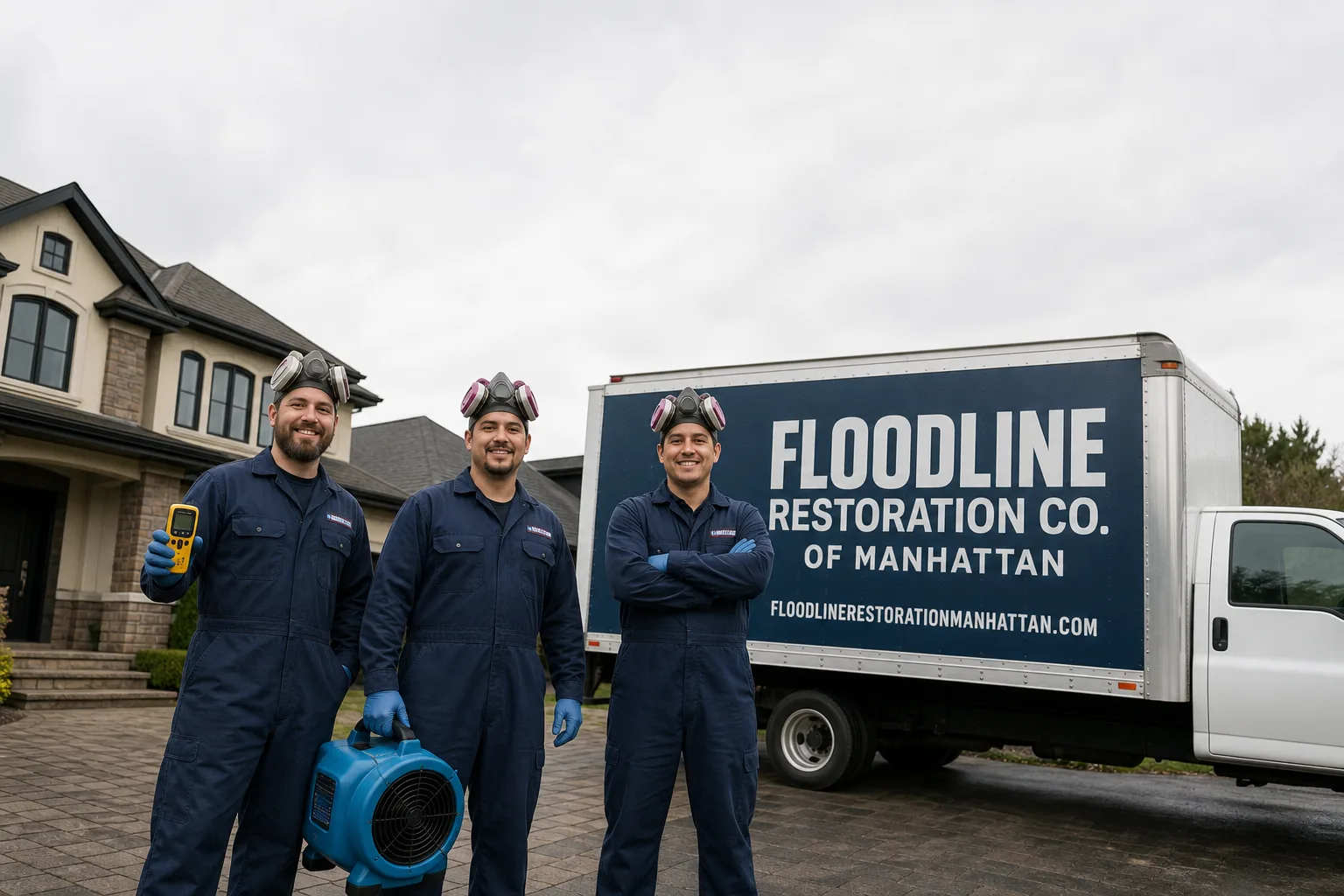
Free visual inspection and a written scope of work before any mitigation begins - photos, moisture readings, and drying logs go in your claim file
The scope we write is the scope we bill. Anything new gets shown to you, in writing, before we touch it.






 Before
 After
After Before
 After
After Before
 After
AfterWater Damage Restoration in Carlstadt, NJ
24/7 Emergency Water Damage Restoration in Carlstadt
Water in a Carlstadt basement demands a response measured in minutes, not hours. The Hackensack River sits close, the water table sits high, and every hour of delay lets moisture climb walls, wick into drywall, and feed the mold that this borough’s humidity already encourages. If you see standing water, buckling flooring, or water lines creeping up foundation walls, call (917) 924-4221 right now. We answer live at two in the morning, a real dispatcher who can route a certified crew to your door on short notice. Your free visual inspection covers the full scope: where the water came from, what category it is, how far it has traveled, and what extraction and drying will take to make the structure safe again. The first hour is when we can still stop damage from becoming demolition.
Understanding Water Damage Restoration Severity in Carlstadt Properties
Not all water behaves the same, and in Carlstadt the distinction matters more than in most Bergen County towns. Clean water from a burst supply line is Category 1, straightforward to extract and dry. Gray water from a washing machine or dishwasher overflow carries contaminants and falls into Category 2. Floodwater from the Hackensack River, storm surge, or storm drain backflow is Category 3: it contains sewage, bacteria, and in this borough specifically, brackish salt residue that corrodes framing lumber and electrical connections on contact. Carlstadt’s 1940s and 1950s homes add another layer. Full basements with original lath-and-plaster walls hide water in wall cavities where surface readings stay low for weeks. Our crews run moisture mapping with hygrometers and thermal imaging on every job, not just the obvious ones, because a basement that looks dry at the surface often holds 20% moisture content six inches into the wall. Warehouse and distribution buildings along the Meadowlands corridor present the same challenge at larger scale: below-grade dock pits and mechanical rooms collect water out of sight. Severity assessment here means finding what the water is doing behind the surfaces, not just what it did in front of them.
Why Carlstadt Property Owners Choose Floodline Restoration Co. of Manhattan
- 45-minute response commitment. We stage crews in the Carlstadt area so the clock starts from the moment your call connects, not from a dispatch center three towns over.
- 24/7 live answer. A real person picks up, every hour, every day. Never an automated tree, never a paging service that calls you back in the morning.
- IICRC-certified crews. Our technicians hold WRT and ASD certifications, so the drying plan follows the industry standard for structural drying, not somebody’s best guess.
- Free visual inspection. We walk the loss with you before any work begins, show you where the water sits, and give you a written scope. No charge, no obligation.
- Direct insurance billing. We bill your carrier, talk to your adjuster, and handle the paperwork so you are not the go-between.
- One team from extraction to reconstruction. The same certified crew that pulls the water also frames the walls and finishes the floor. No handoffs, no strangers midway through the job, no work done twice.
Our Water Damage Restoration Process
Inspection & Assessment
We arrive, walk the property, and determine the water category, the migration path, and the drying plan. Thermal imaging and moisture meters tell us what is wet behind walls, under floors, and above ceilings before we move a single piece of equipment.
Extraction & Stabilization
Standing water comes out first with truck-mounted and portable extraction units. We remove saturated materials that cannot be saved: carpet padding, soaked drywall, and baseboards that have absorbed water to the core. The goal in hour one is to stop the spread.
Drying & Dehumidification
Dri-Eaz and Phoenix air movers and dehumidifiers go in, positioned for the specific floor plan and stairwell constraints of your Carlstadt home or warehouse. Daily moisture readings are logged against the dry standard, and equipment stays until the structure measures dry, not until the clock runs out.
Cleaning & Sanitization
If floodwater is Category 2 or 3, antimicrobial treatment goes on every affected surface. In this borough we treat Hackensack backflow as contaminated by default, because the salt and sediment it leaves behind create a second wave of damage if not neutralized.
Specialty Treatment for Brackish Floodwater
Carlstadt’s tidal influence means floodwater often contains chlorides and organic matter from the river. We run chloride-specific cleaning protocols on concrete slabs and metal framing, because salt residue left in pores keeps pulling moisture for years after the floor looks dry.
Repairs & Restoration
The same crew that extracted the water rebuilds what was removed: drywall, flooring, baseboards, paint. Done right, and backed in writing by the 90-Day Done Right Promise.
Need Emergency Water Damage Restoration in Carlstadt Now?
Crews minutes away, answering live 24 hours a day. The sooner we start, the less it costs.
Working With Your Insurance Company
Insurance claims live or die on documentation. From the first hour on site, we photograph every affected room, log moisture readings, map the water’s migration path, and record what we removed and why. That evidence goes to your adjuster in a format they recognize: industry-standard line items, supportable labor rates, and a drying log that shows the structure reached the dry standard. We talk to your carrier directly, so you are not spending the week after a flood playing phone tag with a claims department. You get a copy of everything. A square deal, a written scope before work begins, and no surprises on the bill.
What We Provide Your Insurer
- Thorough documentation of the loss
- Photos of all damage, room by room
- Moisture readings and drying logs
- A detailed, line-item scope of work
- Direct coordination with your carrier
Built for Carlstadt’s Loss Calendar
Carlstadt sees water damage losses on a schedule, and we plan our crews around it. Deep freezes in January and February burst supply lines in the borough’s 60-to-80-year-old homes, where original copper has thinned and pinhole leaks turn into full ruptures overnight. March and April bring the thaw, and with it the first round of basement seepage as groundwater rises into foundations built against the Meadowlands water table. Summer thunderstorms hit hard here: flat terrain, dense runoff, and storm drains that cannot keep pace in the warehouse corridor send water into loading docks and residential basements alike. Nor’easter season in the fall is the big one. When the Hackensack backs up under tidal surge, streets that stayed dry for a decade flood in an afternoon. Superstorm Sandy in 2012 made this borough a reference case for Meadowlands flood damage, and every serious property owner in Carlstadt remembers it. We do too. That is why our equipment is staged for this calendar, not for a generic northeastern winter.
Water Damage Restoration Across Carlstadt’s Neighborhoods
Carlstadt’s neighborhoods each show water damage differently. The residential blocks around 4th Street and 5th Street, with their 1940s and 1950s two-families, run on tight alleys and narrow stairwells. Basement doors here often measure under 32 inches wide, which means staging air movers and dehumidifiers takes creativity: through side windows, down chute-style stairs, and along foundations where a truck cannot park. The commercial corridor along Paterson Plank Road and the warehouse district near 16th Street throws a different curve. Below-grade loading docks and sump systems there were never designed for the river levels we see now, and mechanical rooms collect water where no one looks for weeks. Homes near Veterans Field sit slightly higher and dry faster, but their catch basins overflow first in a flash storm, sending street water into driveways and garages. Along Hackensack Street and the river side, floodwater is always assumed Category 3: when the tide pushes the river over its banks, it brings everything in the river with it. Every neighborhood gets a plan written for its specific building types and access constraints, not a template from a manual.
One of the biggest differences in Carlstadt is the brackish water factor. Because the Hackensack River is tidal here, flood events mix freshwater runoff with estuarine backflow. That leaves salt residue in porous concrete, in wall cavities, and in floor joists. If that salt is not removed with chloride-specific cleaning, the material stays hygroscopic, meaning it keeps absorbing humidity from the air and never truly dries. A neighbor in East Rutherford might not face the same issue. A home in Hasbrouck Heights almost certainly will not. Carlstadt is different, and we treat it that way.
Our crew extracted 14,000 gallons from a 1950s two-family home on 4th Street after a nor’easter pushed the Hackensack over its banks. The basement door measured barely 30 inches wide, so we staged air movers in the alley and ran containment through a side window. Moisture readings came down from 99% relative humidity to 42% in 58 hours, and mold never got a chance to take hold. That is what local knowledge does: it knows which door you can get through, and which one you cannot.
We have also seen what happens when crews without Meadowlands experience work Carlstadt homes. Floodwater gets treated as Category 1 when it is really Category 2 or 3, the antimicrobial step gets skipped or rushed, and mold shows up three months later. Contractors skip moisture mapping in tight basement stairwells and miss water trapped behind 1940s lath and plaster. Or a crew shows up with a full-sized truck that cannot park on a narrow residential block, and burns the first critical hour looking for a spot. Those are the failure modes we train against. Those are the jobs we get called to fix.
Specialized Water Damage Restoration Services We Offer in Carlstadt
Emergency Water Extraction
Standing water in a Carlstadt basement or warehouse dock has to come out before drying can start. We run truck-mounted and portable extraction units rated for high-volume removal, and we get them running before the first hour is out. Extraction is not just about the water you see; it is the water already wicked into the drywall, the carpet pad, and the sill plates that does the long-term damage.
Structural Drying & Dehumidification
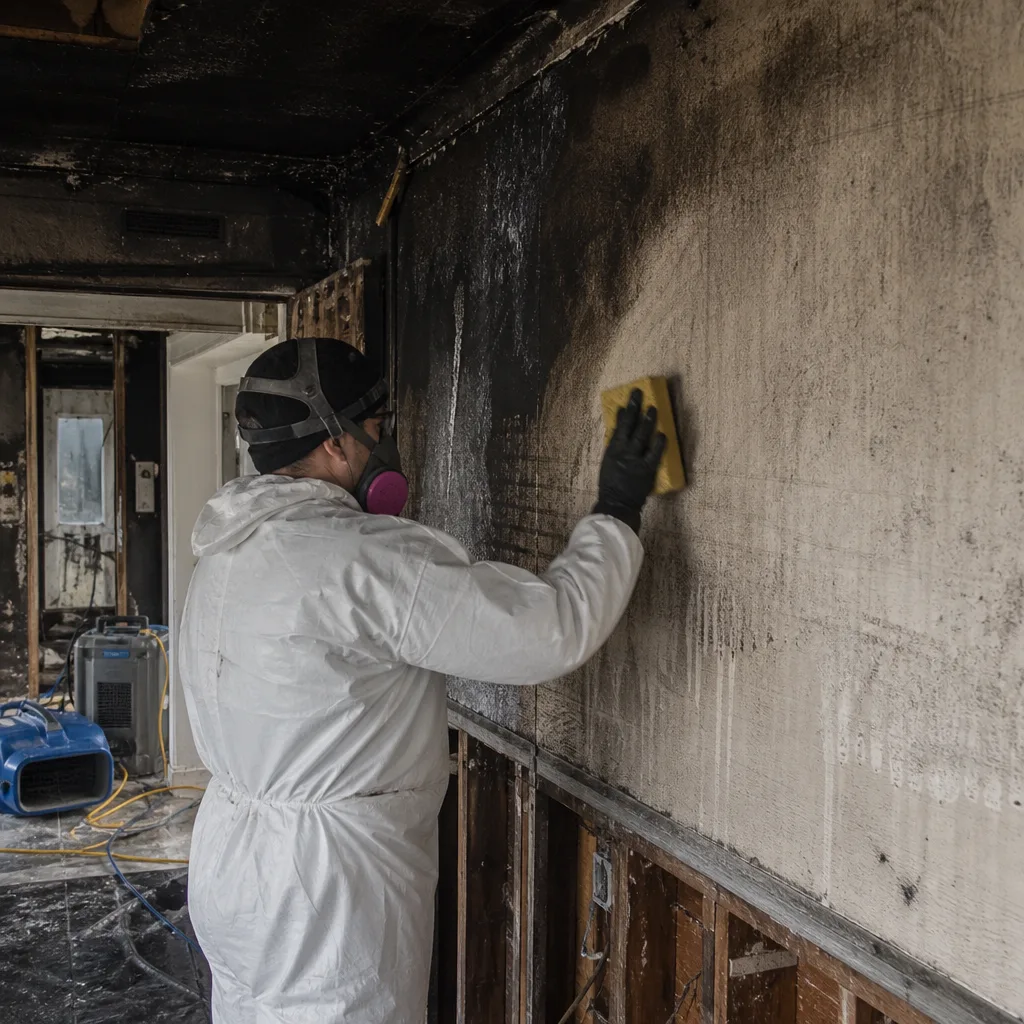
Getting a structure “dry” in Carlstadt is not a guess. Our crews calculate the drying goal using the IICRC s500 standard, set up Dri-Eaz and Phoenix dehumidifiers with the right pint capacity for the cubic footage, and place air movers to create cross-flow across wet surfaces. Daily readings get logged. The log goes to you and your carrier. Drying here carries the extra weight of the borough’s humidity, so we plan for slower-than-average evaporation in the summer months and adjust equipment counts accordingly. Curt Bowman’s crews track the numbers until the structure measures dry, not until a timer goes off.
Flood Cleanup
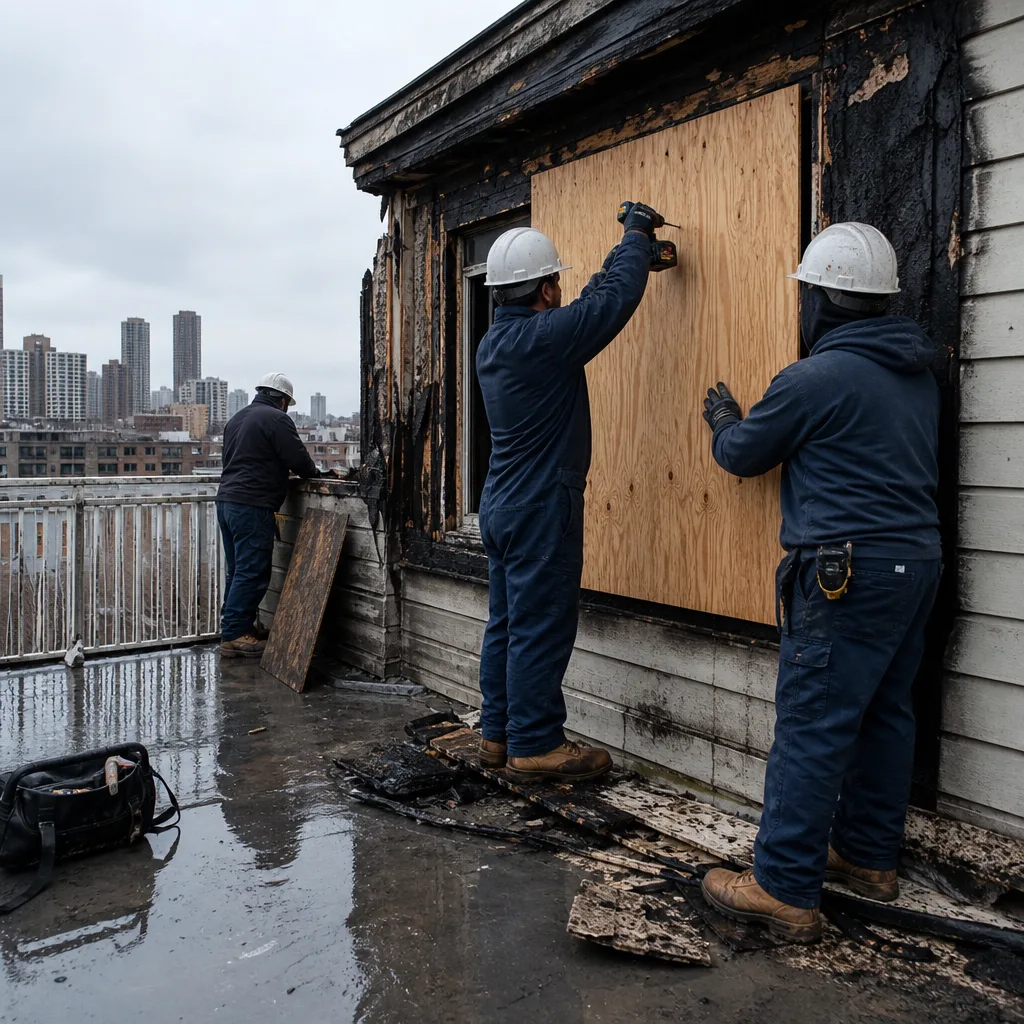
Flood cleanup in Carlstadt starts with the assumption that river water is contaminated. The Hackensack carries sediment, sewage overflow, and salt, and we treat every flood loss as Category 3 until proven otherwise. That means full extraction, removal of saturated porous materials, antimicrobial treatment on all remaining surfaces, and air scrubbing where contamination is airborne. A flood cleanup here is not a mop-up. It is a contamination response with a drying plan attached.

Burst Pipe Restoration
A burst pipe in a Carlstadt home is typically Category 1 water, which is good news in one way and bad news in another. Clean water from a supply line spreads faster through drywall and flooring than muddy water does, because it soaks in clean and travels far before it shows. Our crews trace the migration path, open the walls where the water went, and dry to standard before replacing what was removed. The same holds for an aging warehouse: a burst pipe above a mechanical room puts water in places no one sees until the ceiling gives way.

Basement Water Removal
Carlstadt basements sit close enough to the water table that even moderate rain can push groundwater up through floor cracks and cove joints. This is hydrostatic pressure, and it is a chronic condition in this borough, not a one-time event. We remove the water, dry the slab and walls, and then point you to the drainage and waterproofing conversation you will eventually need, while making sure the immediate loss is handled. A basement pump-out without follow-up drying just sets up the next flood.

What happens when you call
- 1
A real person answersNo phone trees - you reach a local pro.
- 2
You get an upfront price rangeHonest numbers before anyone is dispatched.
- 3
A background-checked tech heads outLicensed & insured, dispatched right away.
- 4
You approve before work beginsNothing starts until you say go.
Water Damage Restoration Costs in Carlstadt, NJ
Water damage restoration in Carlstadt runs a wide range because the job size runs a wide range. A small Category 1 loss from a burst supply line in a single room, extracted the same day and dried with two or three air movers, typically lands between $1,200 and $3,500. A full basement flood from Hackensack backflow, requiring extraction, removal of drywall and flooring, antimicrobial treatment, and seven to ten days of drying, commonly runs $5,000 to $15,000. Large-loss commercial drying in a warehouse dock pit or mechanical room can exceed $25,000 depending on square footage and contamination level. What moves the price: how much water, what category, how long it sat, and what building materials it saturated. Insurance typically covers sudden and accidental losses, while gradual seepage often falls outside the policy. The fastest way to a firm number is the free inspection: our crew walks the space, maps the damage, and hands you a written scope before any work begins. Call (917) 924-4221 and we will get you an exact number, not a range.
We Also Serve Cities Near Carlstadt
Our Water Damage Restoration crews cover Carlstadt and the surrounding boroughs. If you are in East Rutherford, Wallington, Rutherford, or Hasbrouck Heights, the same certified technicians, the same 24/7 live dispatch, and the same 90-Day Done Right Promise apply. We run every job with the same written scope and the same direct insurance billing, no matter which side of the river you are on.
Serving Carlstadt, NJ - Our Local Coverage Area
We’re based in the Carlstadt area and know this community well. Use the map below to see our service coverage - if you’re nearby, we can almost certainly help.
Carlstadt Water Damage Restoration Questions, Answered
How does the Hackensack River’s tidal influence change water damage restoration in Carlstadt compared to inland Bergen County towns?
It changes the chemistry of the water. Because the river is tidal here, flood events pull brackish water into basements and commercial bays, and that water carries salt. Salt corrodes steel, wicks moisture for years, and requires chloride-specific cleaning that a standard freshwater drying job would never need. Towns like Hasbrouck Heights do not face this problem. We assume every river-related flood in Carlstadt is brackish until we test it, and we build the drying and cleaning plan around that assumption.
Why do Carlstadt basements flood even when there’s no visible standing water outside?
Hydrostatic pressure. Carlstadt sits on some of the highest water table land in Bergen County, sitting directly over the Meadowlands. When the water table rises after rain or a river surge, groundwater pushes up through floor cracks, cove joints, and even the pores in older concrete. Your basement does not need surface flooding to get wet; it just needs the water table to climb. That is why we inspect foundation walls and cove joints on every Carlstadt basement loss, even when the homeowner tells us no water ever came in from outdoors.
What special challenges do Carlstadt’s older warehouse loading docks present for water damage restoration?
Dock leveler pits and below-grade mechanical rooms were designed for logistics, not for river surge. When Hackensack floodwater finds its way in, it fills those pits and sits there, soaking into steel-framed wall cavities and running behind steel siding where no one looks. We regularly find hidden mold colonies inside warehouse walls from minor flood events that were never properly dried, because initial scopes stopped at the visible water. A proper assessment opens the walls, checks the cavities, and maps moisture in the cavity insulation before the drying plan is set.
How quickly can a crew start water extraction in Carlstadt given the tight streets and parking?
We commit to a 45-minute dispatch from the time your call connects. Our crews know which residential blocks have parking restrictions, which alleys fit a panel van, and where a larger truck needs to stage. That knowledge means the first critical hour goes to extraction, not to circling the block looking for a spot. Call (917) 924-4221 and a dispatcher will confirm a crew’s location and give you a straight arrival window.
Does Carlstadt’s flood history after Superstorm Sandy mean I need different drying equipment than a typical house?
Sandy changed the baseline for everyone in this borough. What used to be a once-in-a-generation flood is now a planning assumption. For that reason, we spec Dri-Eaz and Phoenix dehumidifiers with higher pint removal for Carlstadt jobs, especially on the river side of Hackensack Street, because the ambient humidity is higher and the drying curves run longer. In a standard inland home we might run three dehumidifiers. In a Carlstadt basement with brackish water and high outdoor humidity, we often run four or five to maintain the drying gradient.
Will my insurance cover water damage restoration in Carlstadt?
Most homeowners policies cover sudden and accidental water losses: a burst pipe, a water heater rupture, storm surge if you have flood coverage. Gradual seepage, like groundwater intrusion through foundation cracks over months, typically falls outside standard policies. What matters most is documentation. We photograph everything, log moisture readings daily, and send your adjuster a line-item scope that matches the language carriers expect. Direct billing means your carrier pays us for the work, and you are not fronting the cost while a claim processes. Call (917) 924-4221 and we will walk through what your specific situation is likely to cover.
How long does structural drying take in a Carlstadt home?
Most residential water losses dry in three to seven days. Brackish floodwater jobs run longer, often five to ten days, because the salt content slows evaporation and requires additional cleaning steps. Warehouse and commercial losses can take two to three weeks depending on square footage and cavity access. The structure is dry when the moisture readings say it is dry, not when the schedule says we are done. We hand you the log that proves it.
What should I do in the first 30 minutes after discovering water damage in Carlstadt?
Call (917) 924-4221 first. Then shut off your electrical at the breaker if the water is near outlets or appliances and you can reach it safely. Do not walk through standing water. Do not run a home vacuum to pick it up. Do not assume it is clean water if it came from the ground or outside. Move valuables up and out if you can, take photos for your records, and wait for our crew. The sooner we start extraction, the less gets torn out.
Written by Curt Bowman, Owner at Floodline Restoration Co. of Manhattan, serving Carlstadt and the surrounding Meadowlands communities since 2010.