
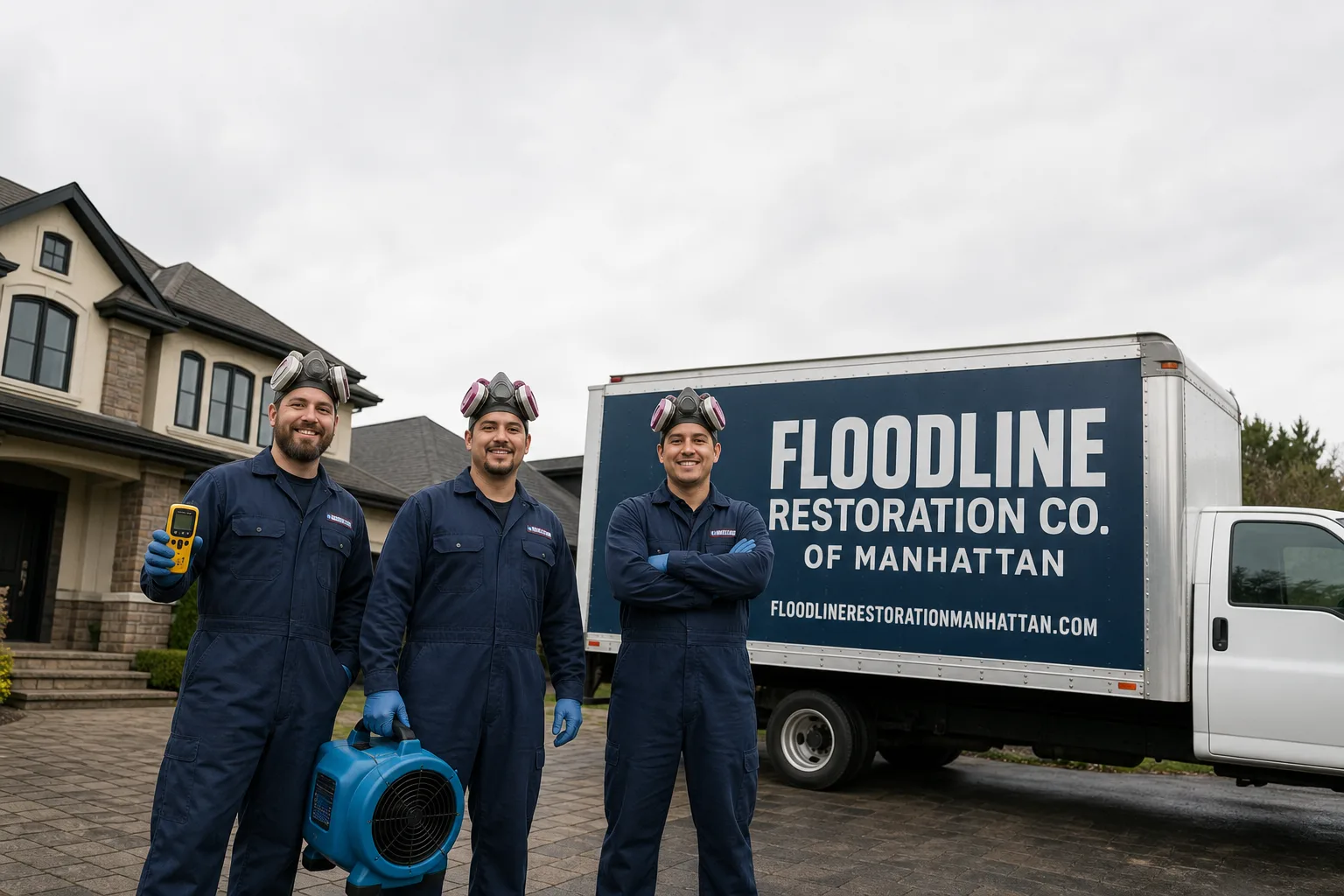
Free visual inspection and a written scope of work before any mitigation begins - photos, moisture readings, and drying logs go in your claim file
The scope we write is the scope we bill. Anything new gets shown to you, in writing, before we touch it.






 Before
 After
After Before
 After
After Before
 After
After24/7 Emergency Water Damage Restoration in Sea Cliff
A burst supply line inside a Sea Cliff Victorian’s exterior wall typically requires full structural drying, not just surface extraction, because original cedar shiplap sheathing traps moisture for decades. The first 60 minutes decide whether you’re looking at a $900 dry-out or a $9,000 rebuild with mold remediation attached. That’s the reality of vintage wood-frame construction on a harbor bluff. Call (917) 924-4221 the moment you see water where it shouldn’t be. A live dispatcher answers, not a recording, and a certified crew from Water Damage Restoration heads toward Sea Cliff immediately. We’re here around the clock, every day, because water does not wait for business hours and neither do we.
The math is honest: every hour water sits in original plaster-and-lath, it wicks further up the wall, saturates the cedar shiplap behind it, and starts feeding the mold spores that were already dormant in those cavities. Sea Cliff homes do not tolerate delay the way newer construction does. Our crews run extraction the same visit. The initial assessment costs you nothing.
Understanding Water Damage Restoration Severity in Sea Cliff Properties
Water damage breaks into three categories, and each demands a different protocol. Category 1 is clean water from a supply line or tub overflow. Category 2 carries contaminants from washing machines, dishwashers, or sump failures. Category 3, the one we see most often in Sea Cliff basements after a nor’easter pushes Hempstead Harbor surge uphill, is grossly contaminated, carrying sewage, seawater, or ground runoff into foundations never built with a waterproofing membrane.
For Sea Cliff’s housing stock, the severity question is rarely about how much water you can see. It’s about what’s hiding. A 2-inch puddle on a tile floor in a 1950s split-level dries with air movers in two days. The same puddle in an 1890s converted camp cottage finds its way into the lath cavity behind original plaster, saturates the cedar shiplap sheathing, and sits there at 30% moisture content until someone opens the wall. Moisture mapping with thermal imaging and penetrating meters tells us which situation you have. Guessing does not. The worst losses in this village are the ones where a previous contractor dried the surface, packed up, and the musty smell came back in April.
Structural drying in Sea Cliff means drying what you cannot see. Skip that step and you’re scheduling us again in six months, this time for mold remediation.
Why Sea Cliff Property Owners Choose Floodline Restoration Co. of Manhattan
- 45-minute response commitment to Sea Cliff. We run dispatch from our New York City office and keep crews staged so the drive time to Sea Cliff Avenue, Prospect Avenue, or the waterfront is measured in minutes, not hours.
- 24/7 live answer, every single call. A real dispatcher picks up at 2 a.m. No automated tree, no voicemail. If you have water moving through your house, you talk to a person who can send a truck.
- IICRC-certified crews, trained to WRT and ASD standards. Background-checked, uniformed technicians who know the difference between drying a sheetrock wall and drying original plaster-and-lath over cedar shiplap.
- Free visual inspection with moisture mapping. Before any work starts, we show you where the water went. Not where you think it went. The map does not flatter anyone.
- Direct insurance billing with full documentation. We photograph everything, log daily moisture readings, and talk to your adjuster directly so you don’t play messenger.
- One team from extraction to reconstruction. The same crew that runs the Dri-Eaz dehumidifiers on day one is the crew that replaces the trim on day twelve. No handoff, no inherited strangers, no scope drift.
Every Sea Cliff job carries our 90-Day Done Right Promise, the Keystone Standard, in writing. If it’s not done right, we make it right. No paperwork battles. No arguing. Curt Bowman founded this company in 2010 around a dispatch board, not a sales desk, and that’s still how we run it.
Our Water Damage Restoration Process
Inspection & Assessment
We arrive, walk the loss with you, and start the moisture map immediately. Thermal imaging, penetrating meters, and hygrometers tell us what’s wet, how wet, and where it’s hiding. In Sea Cliff’s converted cottages, that means checking every plaster wall, floor cavity, and crawl space, because water travels along old shiplap in ways modern framing never does.
Extraction & Stabilization
Truck-mounted extraction pulls standing water from floors, basements, and wall cavities. We stop water at the source, whether that’s isolating a burst supply line or blocking stormwater entry at a foundation seam. The goal is arresting the spread before drying starts.
Drying & Dehumidification
Dri-Eaz and Phoenix dehumidifiers run continuously, with Injectidry panels pulling moisture from inside lath cavities and behind original shiplap. We take daily readings and log them. The dry standard is a number, not a feeling.
Cleaning & Sanitization
Antimicrobial treatment on surfaces that took Category 2 or 3 water, plus HEPA air scrubbing where needed. For Sea Cliff’s older homes, this step is not optional, because dormant spores in dark wall cavities get activated by any humidity spike.
Specialty Treatment for Plaster & Lath
Original plaster-and-lath walls that took water get treated differently than drywall. We dry them slowly, monitor for delamination, and preserve what’s salvageable. Ripping out original plaster in a Sea Cliff Victorian is a last resort, not a first instinct.
Repairs & Restoration
The same crew that mapped the moisture now rebuilds what needed rebuilding, re-insulates to pre-loss condition or better, and hands you the moisture log and our 90-Day Done Right Promise in writing.
Need Emergency Water Damage Restoration in Sea Cliff Now?
Crews minutes away, answering live 24 hours a day. The sooner we start, the less it costs.
Working With Your Insurance Company
Insurance adjusters know Sea Cliff’s housing stock well enough to understand why a burst pipe in a 1905 cottage costs more than one in a 1985 colonial. What they need from you is proof: proof of what was damaged, proof of what we did, proof of what it cost. We document from the first hour. Photos room by room, moisture readings day by day, a line-item scope of work that mirrors industry-standard estimating software your carrier already accepts. We coordinate with your adjuster directly, so you are not translating construction language into insurance language over dinner. Direct billing means your carrier pays us for covered work, the way it’s supposed to work.
What We Provide Your Insurer
- Thorough documentation of the loss
- Photos of all damage, room by room
- Moisture readings and drying logs
- A detailed, line-item scope of work
- Direct coordination with your carrier
Built for Sea Cliff’s Loss Calendar
Sea Cliff’s water damage season does not run on a single calendar. January and February bring the deep freezes that burst supply lines inside the uninsulated exterior walls of converted summer cottages, the slow leaks that go unnoticed until water shows up on a ceiling below. March and April are thaw season, when snowmelt and spring rain find their way through slopes and into foundations that predate waterproofing systems. Summer brings the thunderstorm downpours that overwhelm basement sumps in minutes, especially on the steep streets running down toward Hempstead Harbor. And then come the nor’easters, the wind-driven rain at elevation that works into exterior walls no amount of modern caulk can fully seal on a 130-year-old structure. The village’s grade change means stormwater channels downhill fast, direct to older foundations. Flat neighborhoods in Glen Cove delay water; Sea Cliff directs it. That’s the difference. Every one of these losses follows the same rule: response time determines outcome. Water does not self-correct.
Water Damage Restoration Across Sea Cliff’s Neighborhoods
Down along Sea Cliff Avenue and the streets running toward the water, the Victorians sit on steep lots where stormwater channels hard toward foundations. These are the losses where basement water removal becomes structural drying quickly, because the water enters fast and the original stone or brick foundations offer no modern moisture barrier. On Prospect Avenue and the tree-lined lanes around the old Methodist camp ground, the converted cottages dominate, and that means plaster-and-lath walls and cedar shiplap sheathing. Burst pipes in those homes require opening walls, not just extracting water, because the moisture hides inside cavities. Up near the village center, smaller early-20th-century homes with later additions bring their own complications, often a mix of original lath and newer drywall that makes moisture mapping uneven and unpredictable. The waterfront side, below the bluff, sees the most direct nor’easter surge, and those basements flood fast with Category 3 water that demands extraction, sanitization, and fast drying. Route 25A is the artery our crews take when dispatch gets the call, and it’s familiar to every one of our drivers.
Specialized Water Damage Restoration Services We Offer in Sea Cliff
Emergency Water Extraction
Standing water moves through an old house fast, carried by the same gaps and channels that have been there since the summer-camp days. We get it out now, with truck-mounted extraction, before it claims more square footage.
Structural Drying & Dehumidification
This is the service Sea Cliff properties need most and receive least. Surface drying is not structural drying. We dry lath cavities, shiplap sheathing, floor assemblies, and crawl spaces to measurable standards using Dri-Eaz and Phoenix dehumidifiers with Injectidry panels.
Flood Cleanup
When Hempstead Harbor surge or stormwater runoff floods a bluff-side basement, you’re dealing with Category 3 water. We remove it, sanitize what can be saved, cut out what can’t, and dry the rest. Full stop.
Burst Pipe Restoration
A frozen supply line inside a Sea Cliff cottage exterior wall is not a simple patch. We open the wall, extract the trapped water from the cavity, dry the shiplap behind it, treat for the mold that already started forming, and rebuild to pre-loss condition.
Basement Water Removal
Sea Cliff basements flood faster than nearly anywhere else on the North Shore because of the bluff grade and the age of the foundations. Removal is step one. Structural drying and foundation inspection follow, because the water that came in will come back if the entry point isn’t addressed.
What happens when you call
- 1
A real person answersNo phone trees - you reach a local pro.
- 2
You get an upfront price rangeHonest numbers before anyone is dispatched.
- 3
A background-checked tech heads outLicensed & insured, dispatched right away.
- 4
You approve before work beginsNothing starts until you say go.
Water Damage Restoration Costs in Sea Cliff, NY
A typical emergency water extraction for a single room in Sea Cliff runs $700 to $1,400. Add structural drying with dehumidifiers and Injectidry panels, and you’re at $2,000 to $5,000 for most wall-cavity and ceiling losses. A burst pipe that requires opening original plaster-and-lath, drying the shiplap cavity, and rebuilding the wall typically runs $4,500 to $9,500 depending on the wall’s size and what’s behind it. A flooded basement from a nor’easter surge with Category 3 water ranges from $3,000 to $8,000 when you factor in sanitization and what needs cutting out. These are Sea Cliff numbers, shaped by older construction, steep lot grades, and the extra labor of working around plaster, shiplap, and knob-and-tube wiring. Insurance covers most of these losses when a sudden event caused them, and we document everything to support that claim. A free visual inspection with moisture mapping gives you a firm scope before you commit to anything. Call (917) 924-4221 and we will walk the loss with you.
We Also Serve Cities Near Sea Cliff
Water Damage Restoration in Sea Cliff is our home service territory, and our crews also cover Glen Cove, Port Washington, Manhasset, and Great Neck. Each of those communities has its own housing stock and its own loss patterns, but the response commitment is identical: live answers, minute-driven dispatch, one team until the job is done.
Serving Sea Cliff, NY - Our Local Coverage Area
We’re based in the Sea Cliff area and know this community well. Use the map below to see our service coverage - if you’re nearby, we can almost certainly help.
Sea Cliff Water Damage Restoration Questions, Answered
Why do burst pipes in Sea Cliff Victorians usually require cutting open the wall instead of just extracting the water?
Because the water does not stay where you can see it. In a Victorian with original plaster-and-lath over cedar shiplap, a burst supply line inside an exterior wall saturates the entire cavity. The shiplap sheathing absorbs moisture and holds it, plaster wicks it upward, and lath channels carry it sideways. Surface extraction removes perhaps 40% of the water. The rest stays trapped, feeding mold and rot. Opening the wall is the only way to dry it properly.
How does Sea Cliff’s bluff location change basement water removal compared to nearby flat neighborhoods?
Water moves faster here. The steep grade from village center down toward Hempstead Harbor means stormwater channels downhill hard, hitting older foundations with no modern waterproofing. A flat neighborhood in Port Washington sees gradual seepage; Sea Cliff sees fast, severe flooding that arrives in minutes and overwhelms sumps. Extraction has to be sized for that volume, and the drying plan has to account for saturated foundation walls.
Are original knob-and-tube or early post-war electrical systems a problem during water damage restoration in Sea Cliff?
Yes, and we treat them with real caution. Water-soaked knob-and-tube or early post-war wiring cannot simply be dried and re-energized. We isolate affected circuits before water work begins, coordinate with a licensed electrician, and document everything for your insurer. It’s one more reason older Sea Cliff homes cost more to restore correctly, and it’s never a corner we cut.
What is the difference between category 1, 2, and 3 water in a Sea Cliff flooded basement?
Category 1 is clean water from a supply line or tub overflow. Category 2 carries contaminants, like washing machine discharge or sump water. Category 3 is grossly contaminated, including sewage, seawater, and ground runoff. Sea Cliff’s bluff-side basements during a nor’easter typically take Category 3 water from Hempstead Harbor surge, which demands extraction, sanitization, and cutting out saturated porous materials, not just drying.
How do you dry original plaster-and-lath walls in a Sea Cliff cottage without tearing everything out?
Slowly and with the right equipment. We use Injectidry panels to pull moisture from inside the lath cavity while Dri-Eaz dehumidifiers control ambient humidity. We monitor plaster for delamination daily. If the plaster is sound and drying proceeds correctly, we preserve it. If it has already separated from the lath, we cut out only what’s unsalvageable and patch to match. The goal is keeping original material where it can be kept.
How fast can a crew actually reach my Sea Cliff home?
Our commitment is 45 minutes or less from dispatch to arrival. We run live crews staged to serve the North Shore, including Sea Cliff, Glen Cove, Port Washington, Manhasset, and Great Neck. The call is answered by a person, the truck is sent immediately, and extraction is running the same visit.
Will my insurance cover water damage restoration in Sea Cliff?
Most sudden and accidental events are covered: a burst pipe, a storm-driven flood if you carry flood coverage, a water heater failure. Gradual leaks and long-term seepage often are not, because policies exclude maintenance issues. But our team documents everything from the first hour, works with your adjuster directly, and bills your carrier for covered work. Call (917) 924-4221 for an honest read on your specific policy.
What should I do in the first 30 minutes after discovering water damage?
Shut off the water source if you can do so safely. Do not enter standing water in an area with active electrical systems. Shut off power to affected areas at the panel if it’s dry and accessible. Move valuables to dry ground. Then call (917) 924-4221. The sooner our crew starts extraction, the less wall we have to open, the less we have to cut out, and the lower the final bill.
Written by Curt Bowman, Owner at Floodline Restoration Co., serving Sea Cliff and the North Shore with a live dispatch board and a written guarantee on every job.