
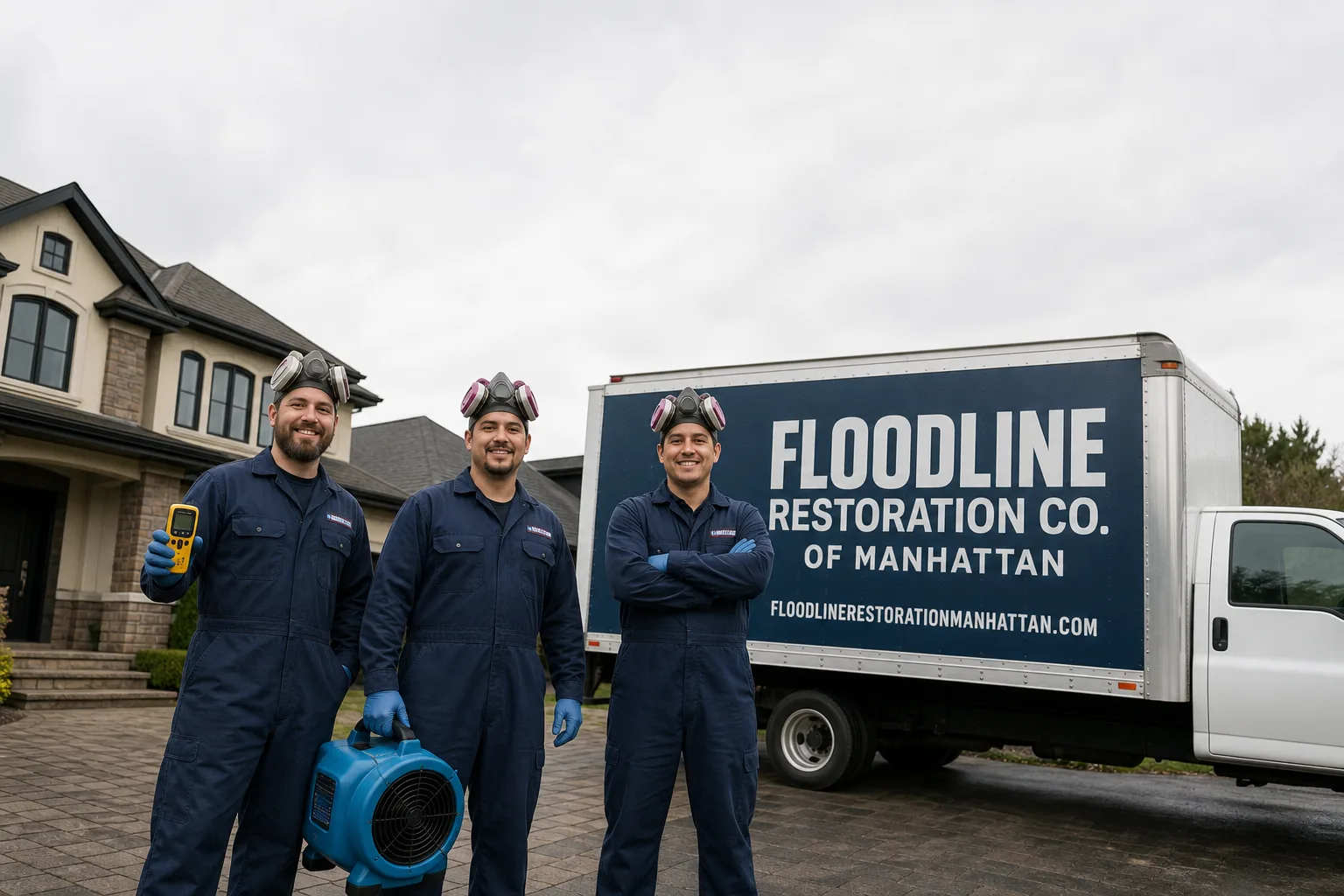
Free visual inspection and a written scope of work before any mitigation begins - photos, moisture readings, and drying logs go in your claim file
The scope we write is the scope we bill. Anything new gets shown to you, in writing, before we touch it.






 Before
 After
After Before
 After
After Before
 After
After24/7 Emergency Storm & Disaster Restoration in Maywood
Storm and disaster restoration in Maywood moves on one clock: the one on the wall of a flooded basement. Water from a nor’easter or a burst supply line does not wait for business hours, and neither do we. Floodline Restoration Co. of Manhattan answers the phone with a live dispatcher at any hour, every day. A certified crew reaches Maywood homes fast, extraction starts the same visit, and the first hour is spent on the decisions that keep a Category 3 event from becoming a full teardown. Call (917) 924-4221 the moment water is where it should not be. We’ll be there when we say.
Understanding Storm & Disaster Restoration Severity in Maywood Properties
The severity of a Maywood storm loss is almost always determined by the water category, not the water volume. Category 1 is clean supply water from a burst pipe. Category 2 carries contaminants from washing machine overflow or sump discharge. Category 3 is what Maywood sees after a serious storm: floodwater, sewage, or groundwater that has picked up silt, bacteria, and whatever the clay-heavy soil around a foundation has been holding. The distinction matters because Category 3 water means disposal, not drying. We moisture-map the affected rooms, identify the water category before we touch materials, and set a structural drying standard that matches the IICRC S500 for flooded structures. In Maywood’s older homes, the bigger variable is what was behind the drywall before the water arrived. Early fiberglass insulation, asbestos floor tile, and lead paint complicate the scope. We test and document before we cut.
Why Maywood Property Owners Choose Floodline Restoration Co. of Manhattan
- 45-minute response commitment to Maywood. A live dispatcher confirms the address and the damage type while the nearest certified crew is already moving toward your street.
- 24/7 live answer. A real person picks up at 2 a.m. No answering service, no callback queue.
- IICRC-certified crews. Technicians trained to IICRC, RIA, and IFA standards, with WRT and ASD certifications applied to the drying floor.
- Free visual inspection. We walk the wet areas, take moisture readings, and tell you what needs to go before we propose a scope.
- Direct insurance billing. We bill your carrier, not you, and we send your adjuster the documentation he or she actually wants.
- One team from extraction to reconstruction. The same crew that sets the containment on day one rebuilds the walls and floors weeks later, so no mid-job handoff and no inherited labor.
Our Storm & Disaster Restoration Process
Inspection & Assessment
We map the water migration with thermal imaging and pin-style moisture meters, identify the water category, and document the condition of materials before we move anything. This part is critical in Maywood, where prior flood damage must be recorded for layered claims.
Extraction & Stabilization
We pull standing water with truck-mounted or portable extraction units, remove unsalvageable materials, and set up temporary power or tarping if the structure is exposed. Containment goes up before we disturb any drywall that may be mold-bearing.
Drying & Dehumidification
Dri-Eaz and Phoenix dehumidifiers run with air movers positioned from the moisture map, not from a guess. Daily psychrometric readings are logged until the dry standard is met, and the log goes to you and your carrier.
Cleaning & Sanitization
We clean what can be saved, apply antimicrobial treatments to structural materials that stay, and HEPA-vacuum all surfaces inside containment. Air scrubbers run during the entire process.
Flood Path Documentation
For Maywood flood losses, we build a file that pairs the current event with any prior evidence: flood marks, sump pit retrofits, prior repairs. This is what keeps a repeat claim from being denied as undisclosed pre-existing damage.
Repairs & Restoration
Framing, drywall, insulation, flooring, and finish work are rebuilt by the same certified crew, with a drainage plane or vapor barrier specified for the basement conditions. The job ends with the 90-Day Done Right Promise in your hands, in writing.
Need Emergency Storm & Disaster Restoration in Maywood Now?
Crews minutes away, answering live 24 hours a day. The sooner we start, the less it costs.
Working With Your Insurance Company

Maywood homeowners have filed multiple flood claims on the same property since Hurricane Irene in 2011 and the remnants of Ida in 2021. That creates a documentation burden most restoration companies do not carry. We do. From the first hour, we photograph every room, log moisture readings daily, and write a line-item scope that makes it plain which damage is from this event. We talk directly to your adjuster, send the file directly to your carrier, and answer the layered prior-damage questions with evidence instead of silence. The bill goes to the carrier where coverage applies, and you get the report whether or not you file. That is how you hold a claim together after the third flood in the same house.
What We Provide Your Insurer
- Thorough documentation of the loss
- Photos of all damage, room by room
- Moisture readings and drying logs
- A detailed, line-item scope of work
- Direct coordination with your carrier
Built for Maywood’s Loss Calendar
Maywood’s storm season runs on a schedule that a local contractor can set a clock by. January and February bring deep freezes that crack supply lines in exterior walls of older ranches, and the thaw that follows leaks for days before anyone notices. Spring rains land on clay-heavy glacial soils that cannot absorb another inch, so groundwater pushes through block foundations and retrofitted sump pits everywhere in Orangetown. Summer thunderstorms drop two inches in an hour, overwhelming drain tiles and flooding finished basements along the lower-grade streets. Late summer and fall bring the remnants of tropical systems tracking up the lower Hudson Valley, and those are the events that fill basements with Category 3 water and force the full gut-and-rebuild. Each season has its own signature loss, and our crews stock for all of them.
Storm & Disaster Restoration Across Maywood’s Neighborhoods
Maywood is small, but the response route changes depending on where you live. On the west side, off West Central Avenue, homes sit closer to the low-lying ground where runoff from the slope above pools against poured-concrete foundations. We see more Category 3 groundwater intrusion there, and we set extraction and drying expectations accordingly. Over near the Maywood Station area and the tracks, the older Cape Cods have shallow basement slabs and original drainage systems, and water moves fast through those spaces. North of East Pleasant Avenue, the 1950s ranches have the classic no-vapor-barrier basement finish, and every storm event that reaches drywall becomes a removal job, not a dry-out. On the side streets off Spring Valley Road, longer driveways and partially finished lower levels mean our crews arrive with enough hose and enough containment for a full negative-air setup, because the air in those basements carries what the water left behind.
Specialized Storm & Disaster Restoration Services We Offer in Maywood
Flood Damage Restoration
Flood damage in Maywood rarely starts above the slab. It comes up through the floor, or through the wall, or through a window well that the grading has been fighting for forty years. We extract first, map the water migration, and then decide with you what is salvageable and what is not. In a 1970s finished basement over clay soil, the honest answer is usually that the drywall and the bottom eighteen inches of framing have to go.
Storm Damage Cleanup
After the water is out, the storm cleanup job in Maywood is about the mud, the silt, and the saturated insulation. We remove affected materials, contain the workspace so airborne spores stay put, and dispose of everything under Rockland County’s local waste rules. The goal is a space that is clean, dry, and ready for either rebuild or a final claim inspection.
Debris Removal
Fallen limbs, damaged roofing, ruined basement contents, and torn-out drywall all have to leave the property before dry-out can work. We haul it, and we document what was lost for the claim file before it goes. In a borough like Maywood with tight lots and off-street parking constraints, we bring the right truck size for the street, not the biggest one in the fleet.
Emergency Board-Up
A window blown out or a door forced open by wind or falling limbs means the house is now exposed to weather and to intrusion. We board and secure openings the same visit, and we photograph everything before we touch it so the claim shows the original condition.
Roof Tarping
Roof damage from nor’easter winds and ice-heavy branches is common on Maywood’s low-pitch ranch roofs. We install temporary weatherproof tarping, but not before we photograph the exposed deck and document the framing condition. The tarp holds until a permanent repair is scheduled.
What happens when you call
- 1
A real person answersNo phone trees - you reach a local pro.
- 2
You get an upfront price rangeHonest numbers before anyone is dispatched.
- 3
A background-checked tech heads outLicensed & insured, dispatched right away.
- 4
You approve before work beginsNothing starts until you say go.
Storm & Disaster Restoration Costs in Maywood, NJ
A typical extraction-only job in Maywood, where the water is caught early and the basement is unfinished, runs $2,400 to $4,800. A full Category 3 gut-and-dry of a finished basement in a 1960s ranch starts around $7,500 and often reaches $18,000 to $28,000 depending on asbestos abatement, vapor barrier reconstruction, and the finish level of the space being rebuilt. Emergency board-up is $350 to $800 for a standard window or door. Roof tarping usually falls between $600 and $1,400 depending on access and pitch. The free visual inspection is how you get a firm number instead of a guess. We write the scope, we put it in writing before work starts, and we bill your carrier directly when coverage applies. A square deal: no surprises on the bill.
We Also Serve Cities Near Maywood
Our Storm & Disaster Restoration crews run from Maywood through the broader Rockland County area and into Rochelle Park, Hackensack, Saddle Brook, and River Edge. If you are in one of those towns and the water is rising, the same live dispatcher answers the same phone number.
Serving Maywood, NJ - Our Local Coverage Area
We’re based in the Maywood area and know this community well. Use the map below to see our service coverage - if you’re nearby, we can almost certainly help.
Maywood Storm & Disaster Restoration Questions, Answered
How do I know if the water in my Maywood basement is Category 1, 2, or 3?
Category 1 is clean water from a supply line or a pipe that just burst. Category 2 is water that has been used, from a washing machine or a sump pit discharge, and it carries some level of contaminant. Category 3 is floodwater, groundwater, or sewage that has picked up soil, bacteria, and debris, and it requires removal of saturated porous materials, not drying them. In Maywood, storm water that comes up through the slab or in through a wall is almost always Category 3 because the surrounding clay soil holds contaminants. Call (917) 924-4221 and we will tell you over the phone what you are likely dealing with.
Why does my Maywood basement keep flooding even after I replaced the sump pump?
Because the sump pump was never the whole problem. Maywood sits on clay-heavy glacial soils that do not drain quickly, and the natural grading in much of the borough funnels groundwater toward low foundations. Many of the basements we see also have framing and drywall installed directly against block walls with no vapor barrier, so even water that does not pool is wicking through the wall assembly. The fix is structural, not mechanical. We can tell you in a single inspection whether your recurring flooding is a drainage correction job or a full foundation waterproofing issue. Call (917) 924-4221.
Will my flood damage claim be denied because I had prior water damage that I never disclosed?
It can be, if the prior damage was never properly documented and the carrier classifies it as pre-existing and undisclosed. Maywood homeowners who filed after Irene and again after Ida are often facing this exact problem on their third claim. The path through it is documentation: we photograph the current event, we record the flood marks and the prior repair evidence, and we write the scope so the carrier can see what is new. That is the file we build on every Maywood flood job, and we send it directly to your adjuster. Call (917) 924-4221 before you disturb anything.
How fast do I need to start water extraction in my Maywood home after a storm?
Within hours. Category 3 water sitting in a basement with drywall wicks upward at roughly half an inch per hour, and mold colonization on drywall can begin in 24 to 48 hours. In Maywood’s clay-soil basements, water also keeps pressing in from outside even after the rain stops, so extraction without a plan for the water table just means more water tomorrow. Call us the moment you see standing water, and a crew reaches Maywood fast enough to stop the wicking before it becomes a full removal. Estimates are free.
Can you dry out my finished Maywood basement without tearing out all the paneling and drywall?
Sometimes, if the water is Category 1 and you catch it before the wicking reaches the framing. In most of the 1960s and 1970s Maywood basements we work on, the drywall and paneling were installed directly against the foundation with no vapor barrier, and once Category 2 or 3 water reaches that assembly, there is no drying it safely. We will tell you plainly which situation you have after a moisture reading. Call (917) 924-4221 for a free visual inspection.
How long does structural drying take in a Maywood basement?
Most Maywood basements dry in three to six days with professional-grade Dri-Eaz and Phoenix dehumidifiers running continuously, assuming proper containment and daily moisture readings. The clay soil around the foundation extends the drying window because water keeps wicking through the slab even after the free water is gone. We take psychrometric readings every day and hand you the log when the structure hits the dry standard.
Are your technicians certified for storm and flood work?
Yes. Our crews are trained to IICRC standards including WRT, ASD, and FSRT where relevant, plus RIA and IFA guidelines. Every technician is background-checked, uniformed, and works under the same 90-Day Done Right Promise. That promise is in writing, and it is not softened by fine print.
Can I stay in my Maywood home during the restoration?
It depends on the water category and the extent of the damage. Category 1 clean-water losses on an upper floor usually allow you to stay. Category 3 floodwater in a finished basement, with containment, air scrubbers, and debris removal running, usually means the basement is sealed off and you can stay upstairs. We recommend against staying in the home when there is mold or sewage exposure in the living space. We will tell you honestly in the first hour, and we will document what we recommend in writing.
Free Estimates. Live Dispatch. No Softened Promises.
Call now and talk to a person, not a recording. The line the water left is where we start.
Written by Curt Bowman, Owner at Floodline Restoration Co., serving Maywood from metro dispatch. Done right - and backed in writing.