
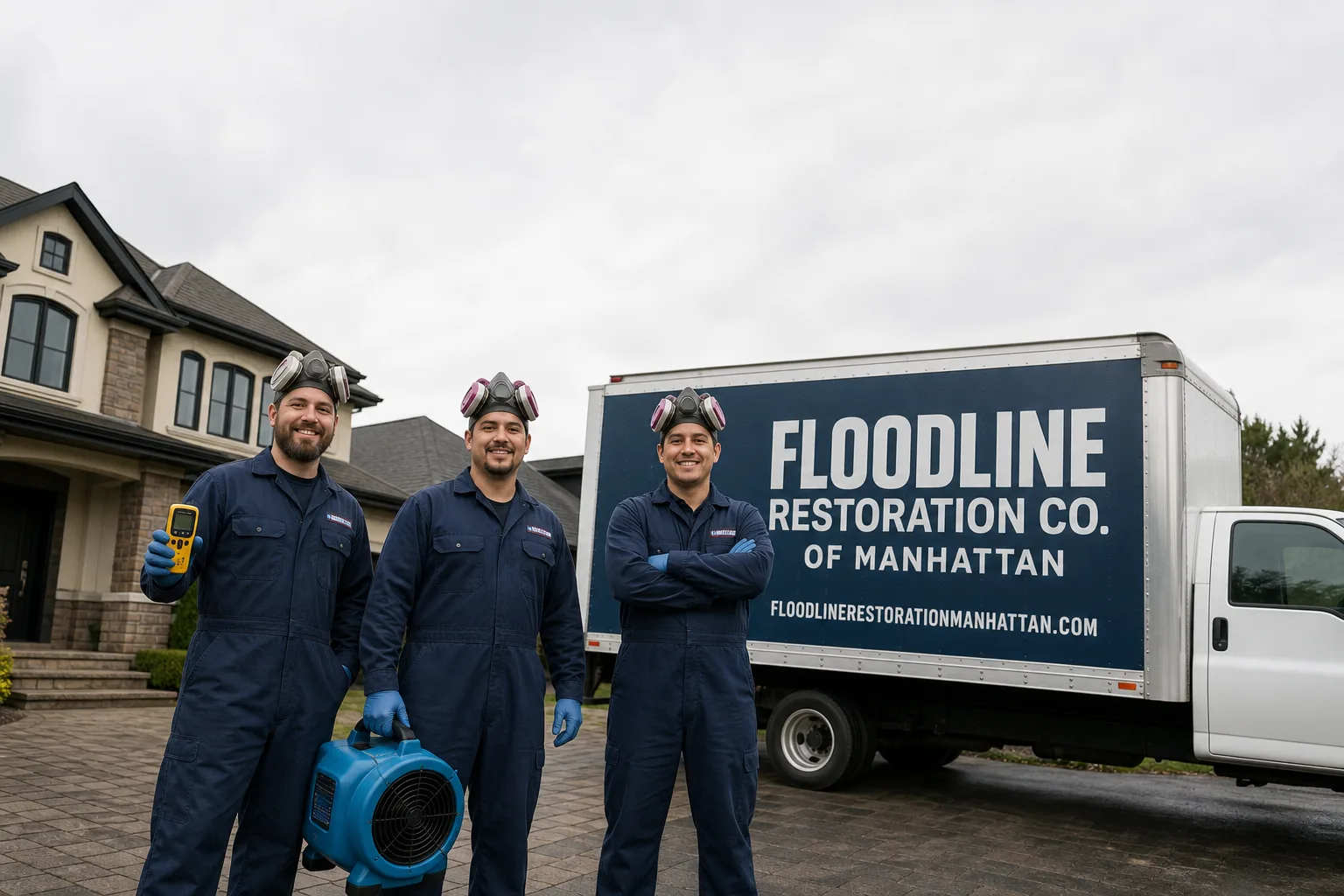
Free visual inspection and a written scope of work before any mitigation begins - photos, moisture readings, and drying logs go in your claim file
The scope we write is the scope we bill. Anything new gets shown to you, in writing, before we touch it.






 Before
 After
After Before
 After
After Before
 After
After24/7 Emergency Water Damage Restoration in Harlem
Water damage restoration in Harlem typically costs between $1,800 and $6,400 depending on how far the water has traveled behind plaster walls and whether Local Law 55 mold protocols get triggered. The first hour matters more in Harlem than almost anywhere else in the city, because water inside a pre-war brownstone party wall does not stay in one apartment. It moves sideways, downward, and into the building next door before you ever see a stain. Call (917) 924-4221 and a live dispatcher answers, any hour, any day. Our Water Damage Restoration crews reach Harlem fast, start extraction the same visit, and document everything your carrier needs from the first hour.
Understanding Water Damage Restoration Severity in Harlem Properties
Water losses fall into three categories, and Harlem’s housing stock makes category mistakes costlier than they need to be. Category 1 is clean water from a supply line or radiator. Category 2 carries contaminants, think washing machine overflow or sump failure. Category 3 is grossly contaminated: sewage, street flooding, or anything that has sat long enough to breed bacteria. The problem in Harlem is that dense plaster-and-lathe walls hide what category you are actually dealing with. A tenement basement sewage backup often looks like clean water because nothing stains the surface for days. By the time a technician cuts into the wall, category 3 water has saturated multiple stud bays and the job scope changes from dryout to full containment, antimicrobial treatment, and possible material removal. Moisture mapping with penetrating probes, not surface meters, tells us where the water actually went. Structural drying in a 1910 brownstone means moving air through closed plaster cavities, not across open drywall, and that takes longer, costs more, and cannot be rushed without risking hidden mold.
Why Harlem Property Owners Choose Floodline Restoration Co. of Manhattan
- 45-minute response commitment. We dispatch from within the city and crews arrive in Harlem as fast as traffic allows, not from a suburban office an hour away.
- 24/7 live answer. A real person picks up at 2 a.m. Not a recording, not an answering service. You tell us what happened and we start moving.
- IICRC-certified crews. Our technicians hold WRT and ASD certifications and train to RIA and IFA standards, so the dry log we hand your carrier is written by someone qualified to sign it.
- Free visual inspection. We show up, walk the loss, and tell you what we are seeing before anyone opens a wall.
- Direct insurance billing. We deal with your adjuster, submit the line-item scope, and bill the carrier directly. You are not the messenger.
- One team, start to finish. Extraction, drying, and rebuild are handled by the same certified crew. No mid-job handoff to a third party you never vetted.
Our Water Damage Restoration Process
Inspection & Assessment
We arrive, walk the loss, and document the visible damage. Thermal imaging and penetrating moisture meters show us what the plaster is hiding. In Harlem, that hidden spread is usually two to three stud bays wider than the stain.
Extraction & Stabilization
We remove standing water with truck-mounted extractors and set containment where category 3 water or possible lead and asbestos are present. We stop the loss at the source before we dry anything.
Drying & Dehumidification
Dri-Eaz air movers and Phoenix dehumidifiers go in, with daily moisture readings logged until the dry standard is met. In plaster-and-lathe construction, this means cavity drying, not just surface drying.
Cleaning & Sanitization
We treat affected surfaces with antimicrobials and clean what can be saved. In pre-1980 buildings, we follow Local Law 55 mold protocol and coordinate any required lead or asbestos testing before opening walls.
Specialty Water Damage Treatment
For Harlem’s one-pipe steam systems, we check radiator pitch and air vent condition so the same radiator does not flood again next heating season. For party wall losses, we assess the neighboring unit.
Repairs & Restoration
Selective demolition, plaster restoration, and finish work are done by our own crew. We rebuild to match the original character of the brownstone, not with generic patchwork.
Need Emergency Water Damage Restoration in Harlem Now?
Crews minutes away, answering live 24 hours a day. The sooner we start, the less it costs.
Working With Your Insurance Company
Most Harlem water damage claims involve a carrier that has seen every corner cut in this industry. We hand them documentation that holds up. Our crews photograph every affected area room by room, before and after opening walls. Moisture readings and drying logs are generated daily, signed, and dated. The scope of work is line-item detailed, so your adjuster sees exactly what the loss required and why. And we talk to the adjuster directly. You do not sit on hold with a claims department. We file, we follow up, and we bill the carrier for the covered work. Curt Bowman built Floodline Restoration Co. on the belief that a restoration company should make the insurance process easier for the homeowner, not harder.
What We Provide Your Insurer
- Thorough documentation of the loss
- Photos of all damage, room by room
- Moisture readings and drying logs
- A detailed, line-item scope of work
- Direct coordination with your carrier
Built for Harlem’s Loss Calendar
Harlem’s water damage seasons are predictable, and we staff for them. January and February deep freezes burst supply lines in unheated tenement hallways and along the north-facing exterior walls of brownstones along Convent Avenue and Edgecombe Avenue. The freeze-thaw cycles stress the flat and low-slope roof membranes on nearly every pre-war building, so ice dams and membrane failures show up as ceiling leaks across the upper floors of the Strivers’ Row rowhouses and the apartment buildings south of 125th Street. Spring thaw brings basement seepage through the original fieldstone foundations common in the Hamilton Heights section, where hydrostatic pressure builds against mortar joints that have not been repointed in decades. Summer thunderstorms overwhelm the combined sewer system, sending street water back through basement floor drains in low-lying parts of Central Harlem. And every autumn, the first time the steam heat comes up, one-pipe systems across Harlem start weeping into wall cavities again because settled pipe pitch never got corrected the year before.
Water Damage Restoration Across Harlem’s Neighborhoods
Response patterns differ block by block. In Hamilton Heights, the brownstones along Hamilton Terrace and the Sugar Hill section run on the same one-pipe steam systems installed when the buildings went up in the 1890s and 1910s, and the losses we see there are almost always radiator-fed wall cavity saturation from a failed air vent or a pipe that settled out of pitch. Over in Central Harlem, the five and six story tenement walkups between Lenox Avenue and Adam Clayton Powell Jr. Boulevard share party walls, which means a kitchen supply line break on the fourth floor of one building dries not just that unit, but the wall cavities on both sides of the shared masonry. In East Harlem, where a large share of the housing stock is NYCHA public housing, chronic pipe failures and long-standing moisture issues inside wall assemblies create conditions where category 2 and category 3 water has often been present for weeks before a work order gets opened. Up around Morningside Heights and the blocks near City College, older co-op buildings with renovated interiors still hide the original galvanized supply lines and cast iron stacks inside walls, and a pinhole leak behind a renovated kitchen backsplash migrates downward into the unit below before anyone in the building knows the source.
Specialized Water Damage Restoration Services We Offer in Harlem
Emergency Water Extraction
Standing water in a Harlem basement or first-floor parlor gets pulled the same day we are called. We extract with truck-mounted units where access allows and portable XPOWER and B-Air extractors where stairwells and tight brownstone entries make truck hoses impractical. Speed here is not about convenience. It is about keeping water out of the shared party wall before it reaches your neighbor’s plaster.
Structural Drying & Dehumidification
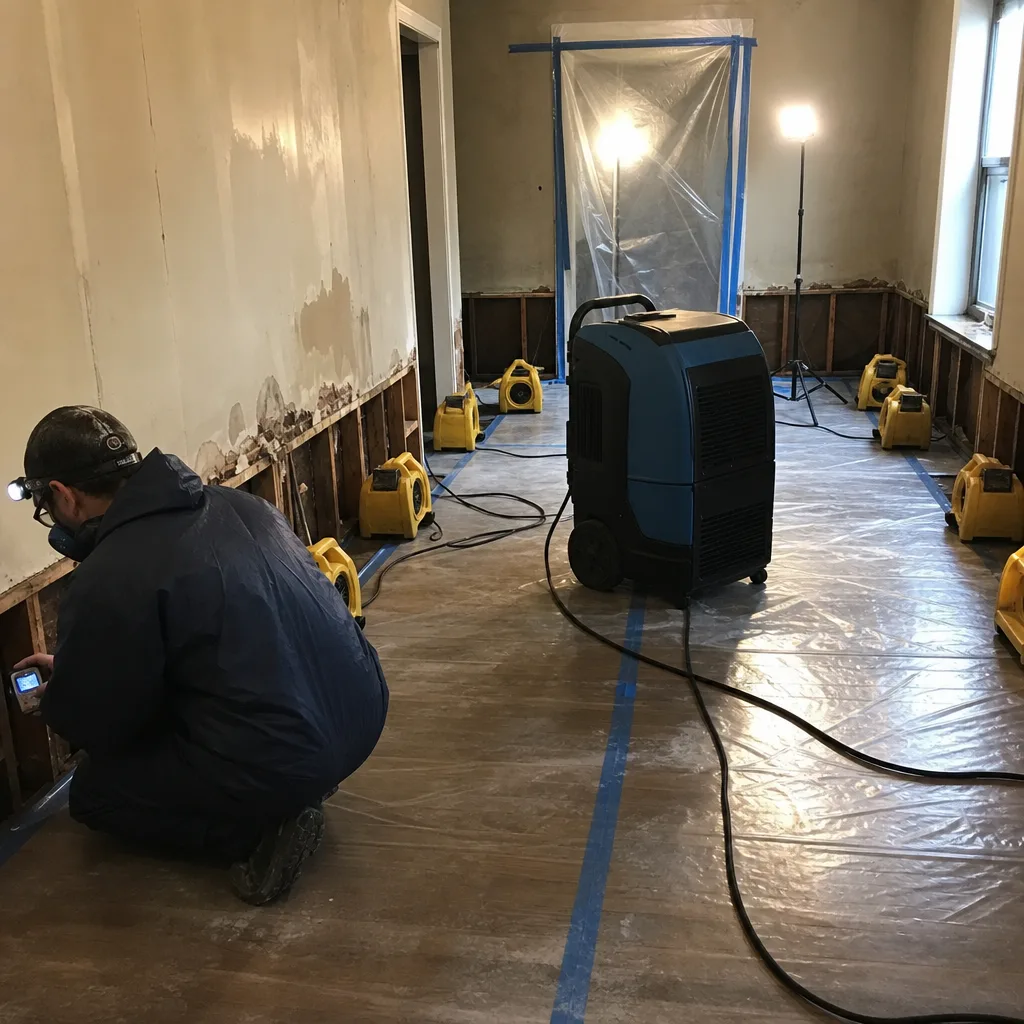
Harlem’s plaster-and-lathe walls hold water differently than drywall. We dry the cavities, not just the surface. That means drilling small access points, running Dri-Eaz air movers against open stud bays, and placing Phoenix dehumidifiers sized for the cubic footage of the room, not a generic square-footage chart. Daily moisture readings log the drying curve until the dry standard is met.
Burst Pipe Restoration
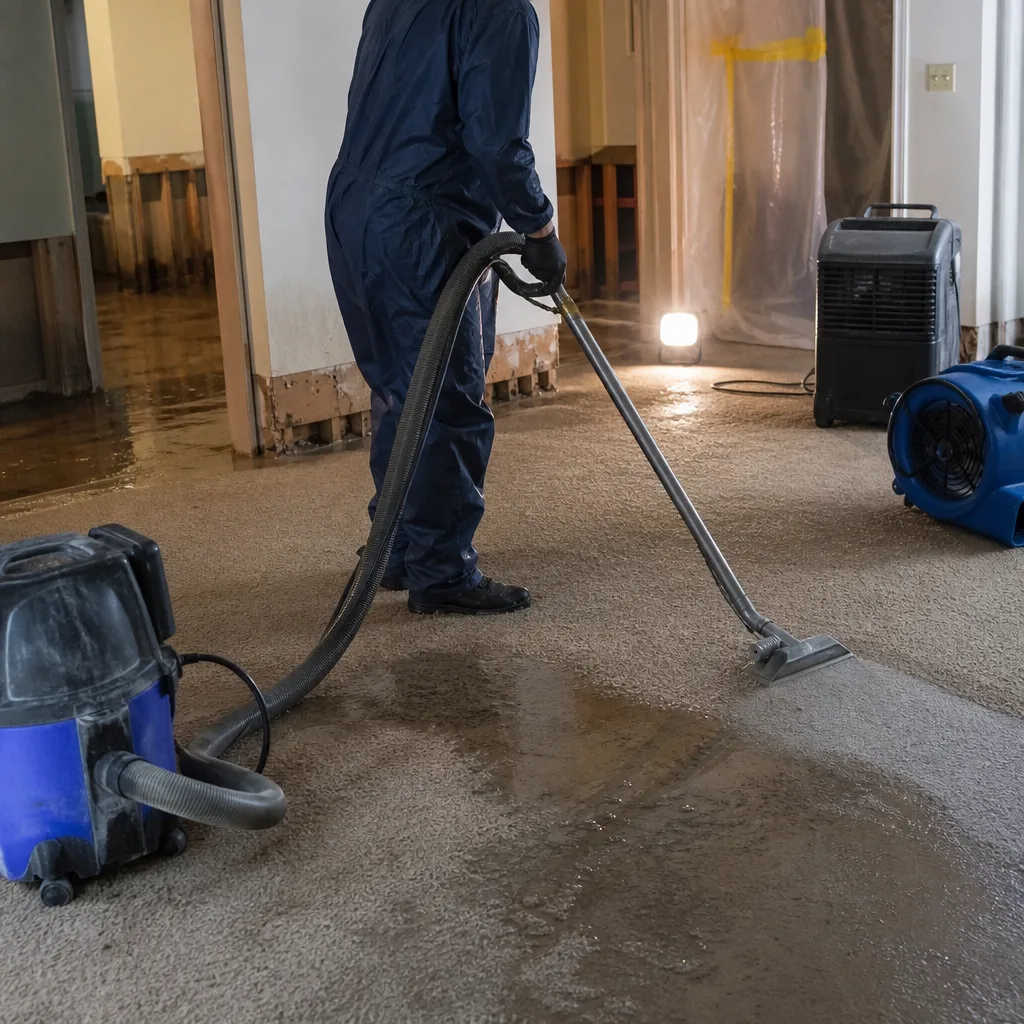
Frozen supply lines in Harlem’s unheated hallways and exterior wall chases burst in the coldest weeks of the year. We locate the break, stop the flow, extract, dry, and restore the wall assembly. In pre-war buildings, we coordinate with the super and the managing agent, because the source is often in a common space with shared responsibility.
Ceiling & Roof Leak Water Damage
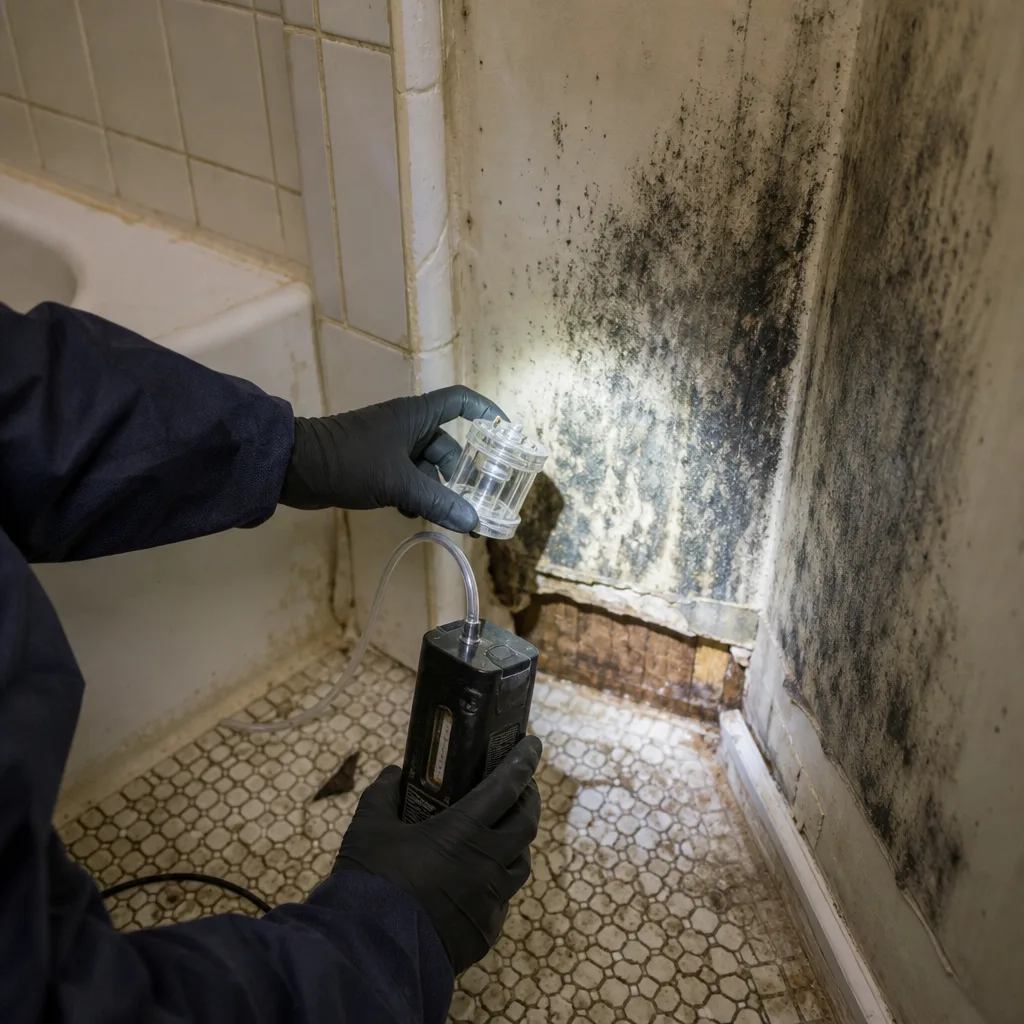
Flat and low-slope roof membranes on Harlem’s brownstones and tenements fail on a schedule that does not care about your renovation budget. When a membrane splits and water runs down through three floors of apartments on its way to the basement, we track the path with thermal imaging, dry each affected ceiling and wall cavity, and coordinate the roof repair so the water does not come back in the next storm.
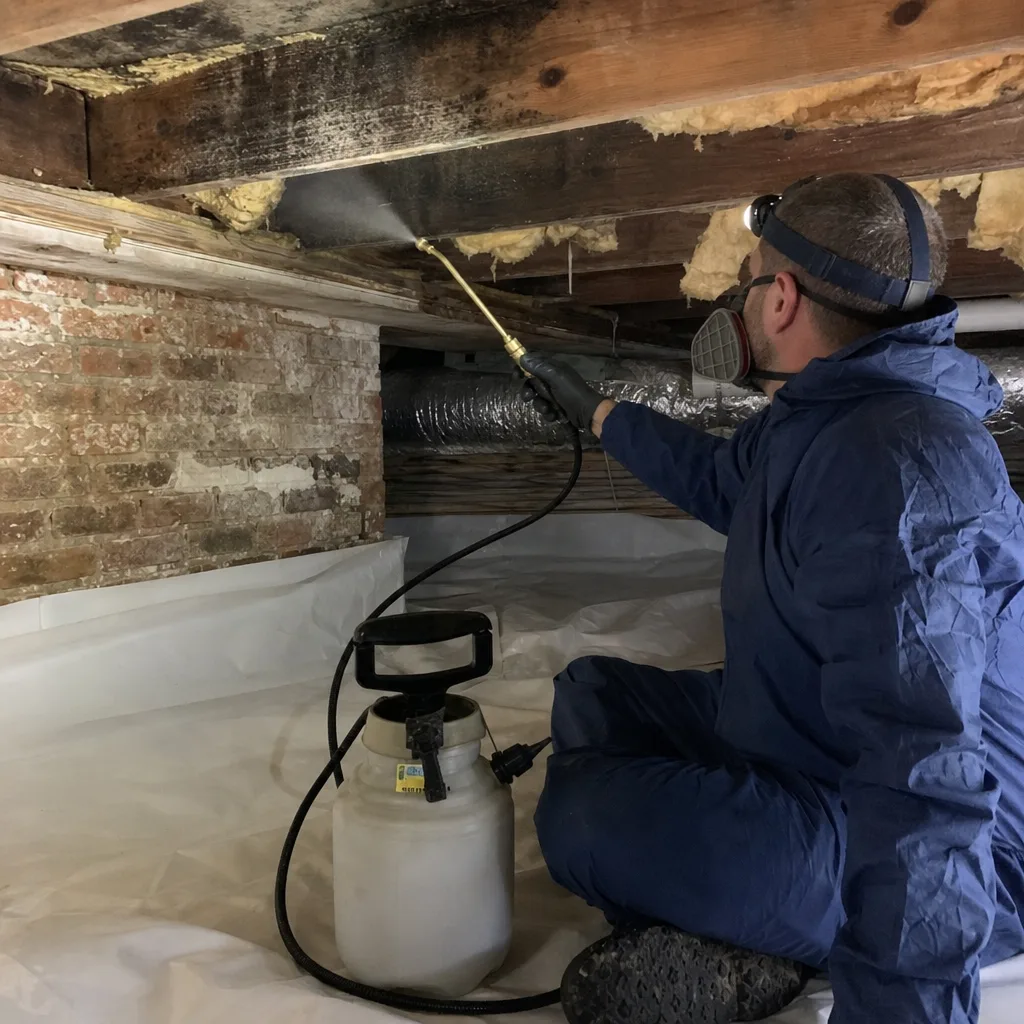
Basement Water Removal
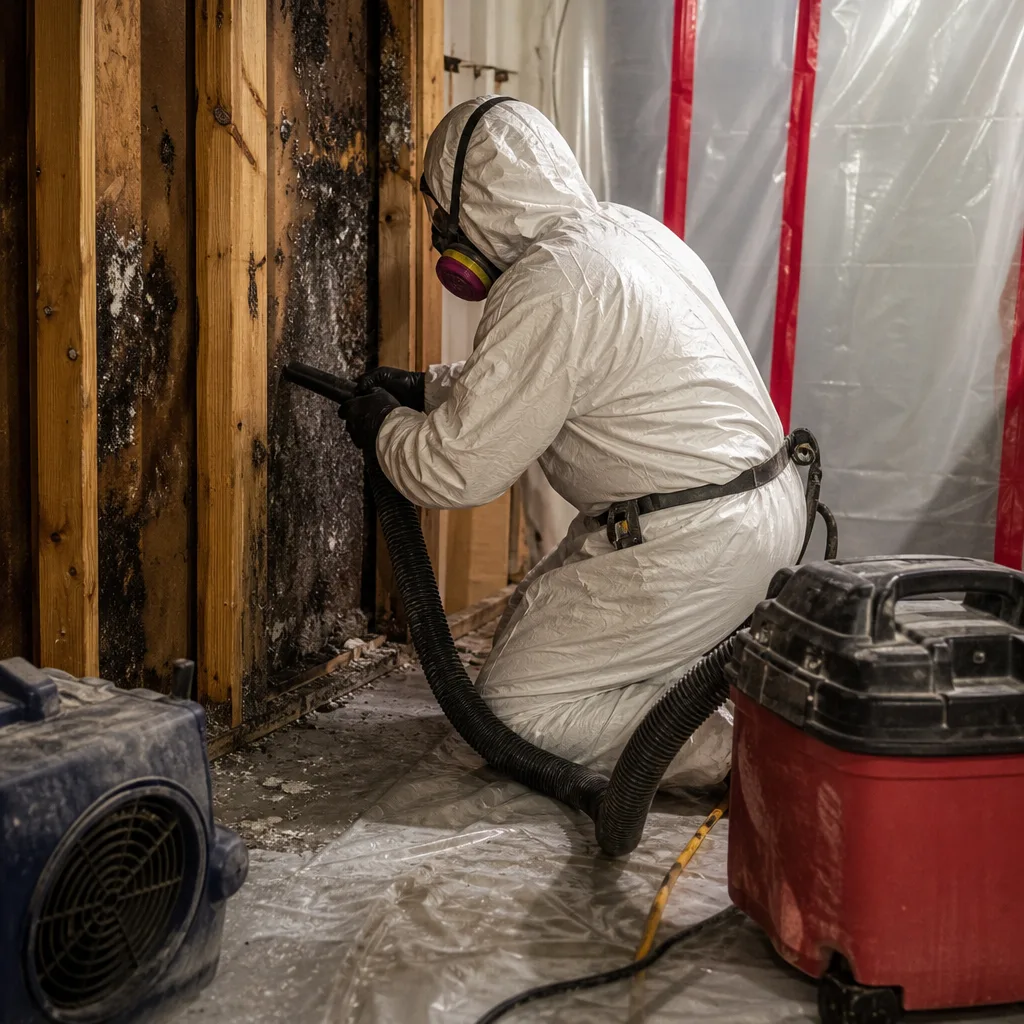
Fieldstone foundations and decades of combined sewer overloads mean Harlem basements see water. We extract, mitigate, and dry. When the source is a sewer backup, we treat it as category 3 from the first minute, with full containment and antimicrobial treatment, because in a tenement basement shared by multiple households, cross-contamination is not a hypothetical.
What happens when you call
- 1
A real person answersNo phone trees - you reach a local pro.
- 2
You get an upfront price rangeHonest numbers before anyone is dispatched.
- 3
A background-checked tech heads outLicensed & insured, dispatched right away.
- 4
You approve before work beginsNothing starts until you say go.
Water Damage Restoration Costs in Harlem, NY
In Harlem, a straightforward emergency water extraction with drying runs $1,800 to $3,500 for a single room where the water is category 1 and the plaster is not hiding spread. A ceiling or roof leak that has run through multiple floors typically lands between $3,200 and $6,400 once you account for thermal imaging, multiple cavities, and plaster restoration. A category 3 sewage or street water backup in a basement starts around $4,000 and rises with the size of the space and whether Local Law 55 mold protocol is triggered. What moves the price in Harlem more than anywhere else is the wall opening. Once we cut into a pre-1980 wall, lead and asbestos testing joins the scope, and the compliance path adds $800 to $2,500 to the job. Anyone quoting a Harlem water damage job without accounting for Local Law 55, Local Law 1, and asbestos is quoting a number that will change once they open the wall. Our estimates come after a free visual inspection, and we put the scope in writing before we start.
The 90-Day Done Right Promise covers the work. If it is not done right, we make it right, in writing, with no arguments. That is the Keystone Standard, and it applies to every water damage restoration job we do in Harlem. Seniors and veterans get a 5% discount, and any repair over $250 qualifies for $50 off.
We Also Serve Cities Near Harlem
Our crews work the full Harlem area including Harlem proper, plus the surrounding communities of Fairview, Harrison, East Bronx, and Hunts Point. Same live dispatch, same 45-minute response commitment, same one-team process from first extraction to final rebuild.
Harlem Water Damage Restoration Questions, Answered
How do Harlem’s one-pipe steam systems affect water damage restoration in brownstones?
One-pipe steam systems flood wall cavities when radiator air vents fail or pipe pitch settles, and the water sits behind plaster for weeks before you see a stain. Restoration on these systems means drying the hidden cavity, not just the visible surface, then correcting the pitch and vent so the same radiator does not flood again. Call (917) 924-4221 if you suspect a steam-system leak.
How do shared party walls in Harlem brownstones affect the scope of a water damage restoration job?
Water in a party wall does not stop at the property line. It migrates sideways into the adjacent building, often before any surface staining appears in either unit. That means the scope includes assessing and sometimes drying the neighbor’s side of the shared masonry, which changes access, cost, and coordination. We handle that assessment as part of the initial inspection.
Why does drying take longer in Harlem’s plaster-and-lathe walls than in modern drywall construction?
Plaster and lathe is dense, closed, and holds moisture inside cavities where air does not naturally move. Modern drywall dries quickly because it is porous and air flows freely inside stud bays. Harlem’s pre-war walls require penetrating moisture meters, drilled access points, and longer structural drying cycles to reach the dry standard without leaving hidden saturation. Expect drying to run three to seven days longer than a comparable drywall loss.
What role does NYC Local Law 55 play in a typical Harlem water damage restoration?
Local Law 55 requires specific mold assessment and remediation protocols whenever water damage affects pre-1980 buildings, which covers nearly all of Harlem’s housing stock. Opening a wall triggers the law, and the same job often requires Local Law 1 lead testing and asbestos testing on the same opening. Compliance changes the scope and the cost, and skipping it puts your building in violation. We build compliance into the estimate from day one.
Can you restore original plaster and lathe walls after water damage instead of replacing them with drywall?
Yes. We selectively remove only the saturated plaster, dry the lathe and stud cavities, and restore the plaster to match the surrounding surface. Replacing original plaster with drywall in a Harlem brownstone changes the character and the value of the home, and most owners of pre-war buildings want the plaster preserved. We restore what can be saved and match the original finish.
How fast can you get to Harlem for an emergency water damage call?
Our commitment is 45 minutes from your call to crew dispatch, with arrival depending on traffic and location within Harlem. A live dispatcher takes the call at any hour, and extraction starts the same visit. The faster water is pulled, the less it spreads into party walls and the lower the final cost.
Will my insurance cover water damage restoration in my Harlem apartment or brownstone?
Most homeowner and co-op policies cover sudden and accidental water damage, which includes burst pipes, appliance failures, and roof leaks. They typically exclude long-term seepage or maintenance-related damage. We document the loss, submit the line-item scope, and bill the carrier directly, and we coordinate with your adjuster so you do not have to negotiate the claim yourself.
What should I do in the first 30 minutes after discovering water damage in Harlem?
Shut off the water at the source if you can do so safely, move valuables out of the wet area, and call (917) 924-4221. Do not open walls yourself, especially in a pre-1980 building where lead and asbestos are present. Do not wait to see if it dries on its own. In Harlem’s plaster walls, what you cannot see is usually bigger than what you can.
Serving Harlem, NY - Our Local Coverage Area
We’re based in the Harlem area and know this community well. Use the map below to see our service coverage - if you’re nearby, we can almost certainly help.
Contact Floodline Restoration Co. of Manhattan
If water is actively spreading through your Harlem apartment or brownstone, the next move is a phone call. We answer live, we dispatch fast, and we bring 42 years of combined experience to your door with a written scope and a guarantee that stands up. Call (917) 924-4221 for a free estimate, any time of day or night.
Written by Curt Bowman, Owner at Floodline Restoration Co., serving Harlem and the surrounding communities since 2010.