
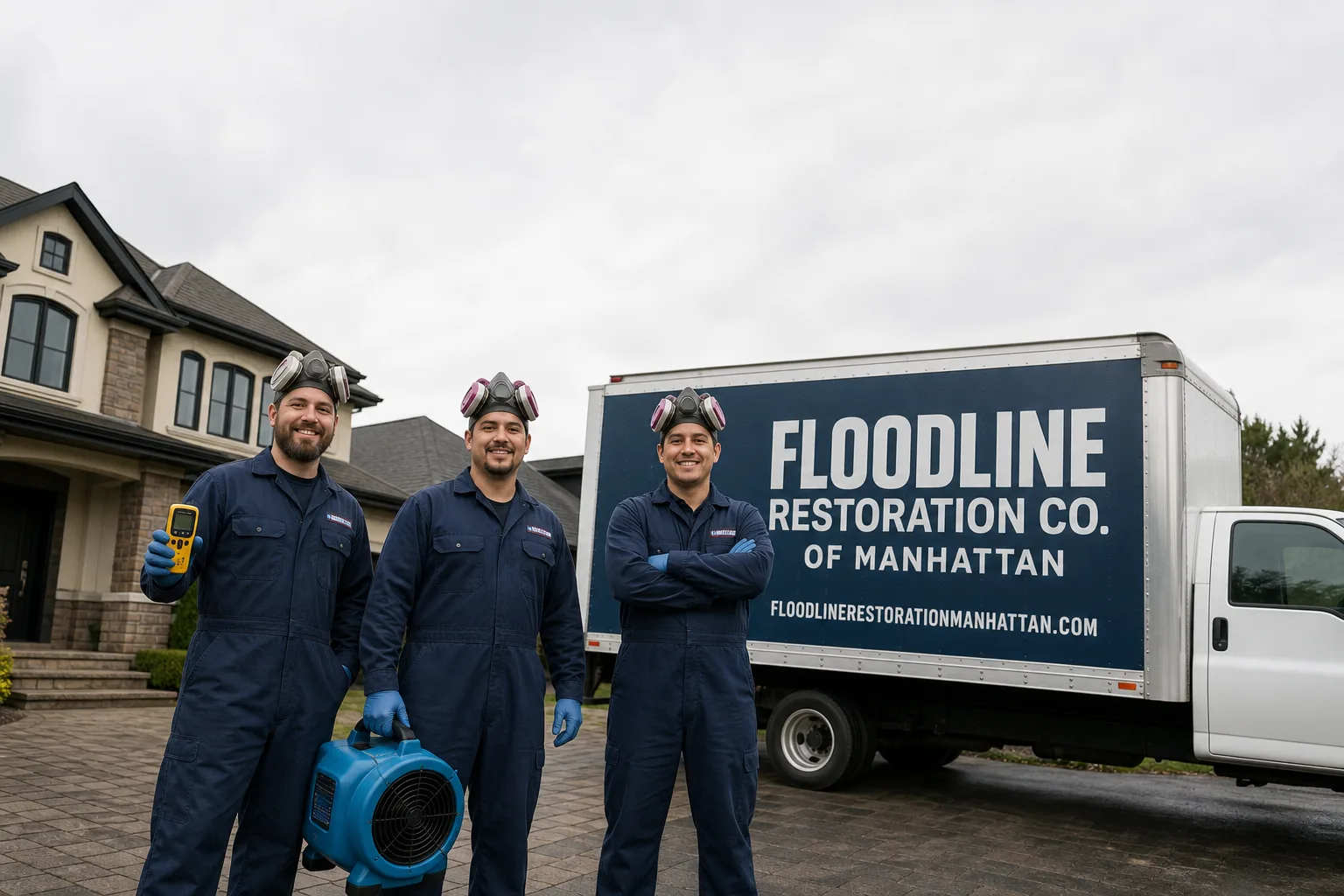
Free visual inspection and a written scope of work before any mitigation begins - photos, moisture readings, and drying logs go in your claim file
The scope we write is the scope we bill. Anything new gets shown to you, in writing, before we touch it.






 Before
 After
After Before
 After
After Before
 After
After24/7 Emergency Mold Remediation in Dumont
Mold remediation in Dumont costs between $1,200 and $6,500 for most basement jobs, with black mold removal behind finished walls typically running $2,800 to $5,400. We answer the phone with a live person at (917) 924-4221 any hour, any day. A certified crew reaches most Dumont homes within 45 minutes for a free visual inspection, because mold that sits for a week can double the scope of the work.
Here’s what the first hour actually buys you. We contain the affected area before spores spread through your HVAC, we take moisture readings that tell us how deep the water wicked, and we hand you a written scope before any wall comes open. That matters in Dumont, where a 1970s-finished basement can hide Stachybotrys behind paneling that looks completely dry from the outside. Call (917) 924-4221 and a dispatcher picks up. Not a recording.
Understanding Mold Remediation Severity in Dumont Properties
Dumont’s housing stock is almost entirely 1940s-1960s Cape Cods, split-levels, and small colonials. That matters for mold because these homes share the same failure timeline: original galvanized supply lines, drain tile that’s now 60 to 70 years old, and finished basements that predate vapor-barrier code. When water enters, it doesn’t just wet the floor. It wicks into drywall that was screwed directly against concrete block, and it migrates into cavities nobody sees.
We classify every loss by severity before we quote. A Category 1 water event, clean supply-line water caught within 24 hours, is often dryable without full wall removal. A Category 3 event, sewer backup or groundwater carrying soil bacteria, means the drywall and insulation in the affected area come out, no debate. Between those sits the Dumont reality: category 1 source water that has been trapped behind 1980s paneling for weeks is no longer category 1. It’s become a mold reservoir. We use moisture mapping, thermal imaging, and a written drying log to determine which it is, and we don’t remove a wall we can dry.
Why Dumont Property Owners Choose Floodline Restoration Co. of Manhattan
- 45-minute response commitment for Dumont calls. Our dispatch board tracks every truck in the northern Bergen corridor, so the nearest certified crew heads straight to you, not back to a shop.
- 24/7 live answer, no automated phone tree. A person picks up at 2 a.m., takes your address, and sends a crew. You never leave a message during an active water event.
- IICRC-certified crews trained to WRT and AMRT standards. Mold work requires containment and air-scrubbing discipline, not just demolition. Our technicians carry the certifications that back the work.
- Free visual inspection, no obligation. We’ll tell you if it’s a dryable condition or a full remediation. Sometimes it’s a $89 tune-up issue, not a $5,000 tear-out.
- Direct insurance billing from day one. We document, photograph, and communicate with your adjuster so you’re not the messenger between us and the carrier.
- One team from extraction to reconstruction. The same crew that removes the mold rebuilds the wall. No handoff, no new team learning your house at the halfway point.
Our Mold Remediation Process
Inspection & Assessment
We start with a moisture map of the entire affected area, not just the visible stain. Thermal imaging reveals what’s hiding behind Dumont’s mid-century paneling and drywall. You get a written scope before anything opens up.
Containment & Stabilization
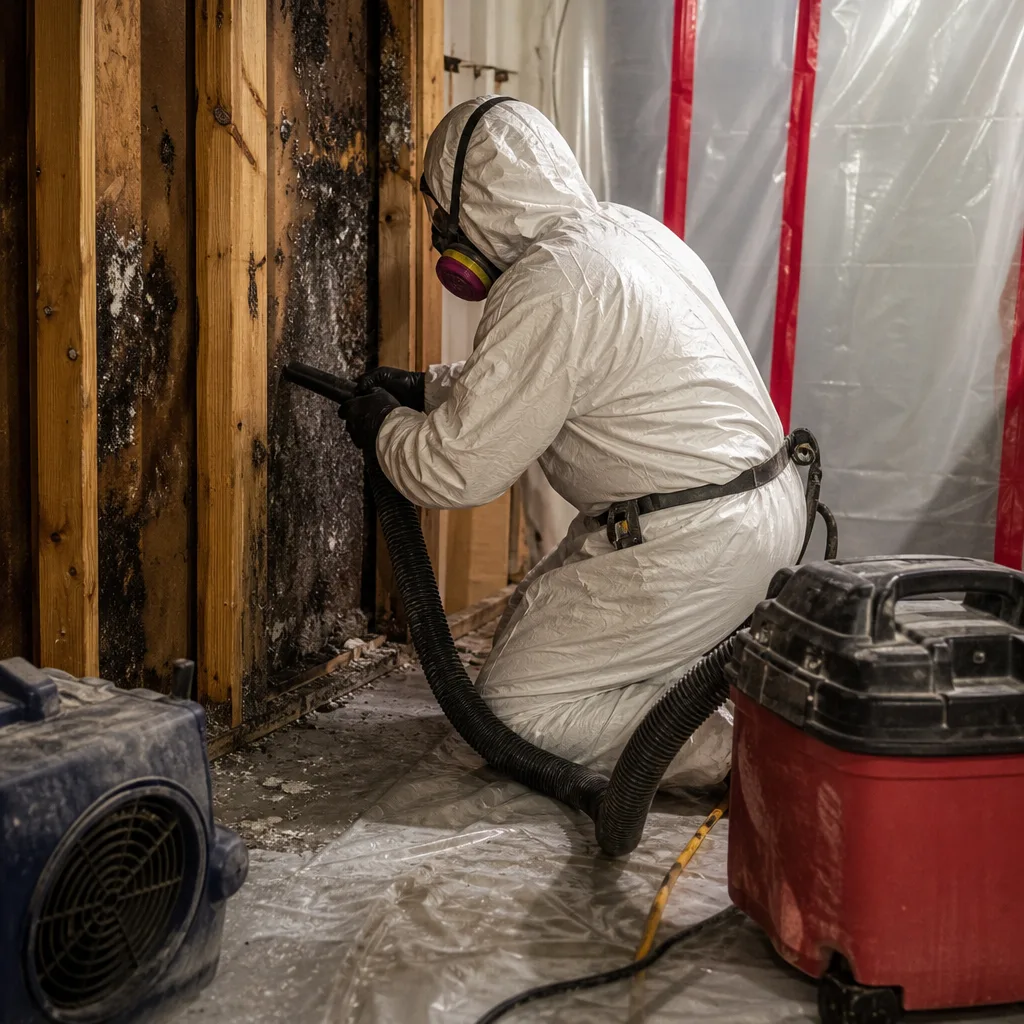
We seal the work area with poly sheeting and run HEPA air scrubbers creating negative air pressure. That keeps spores from migrating through your home while we work, which is the step amateurs skip.
Drying & Dehumidification
Dri-Eaz dehumidifiers and XPOWER air movers pull moisture until daily readings hit the dry standard. In Dumont’s high-humidity basements, this is not a one-day step. We log every reading and hand you the log.
Removal & Cleaning
Mold-colonized materials come out in sealed bags. Non-porous surfaces get HEPA vacuuming and antimicrobial treatment. We protect the structural framing that stays.
Moisture & Humidity Control
We address the reason the mold grew: failed drain tile, missing vapor barrier, poor grading. Without this step, you’re renting the problem, not fixing it.
Repairs & Restoration
We rebuild with proper vapor barriers and moisture-resistant materials, restoring your basement to pre-loss condition or better. Every job carries the 90-Day Done Right Promise in writing.
Need Emergency Mold Remediation in Dumont Now?
Crews minutes away, answering live 24 hours a day. The sooner we start, the less it costs.
Working With Your Insurance Company
Most Dumont homeowners have mold coverage tied to a sudden and accidental water event, not a slow chronic leak. That distinction decides whether the carrier pays, and how much. Our crew documents everything from the first hour: the source of the water, the extent of the migration, and the condition of the wall cavity when we open it. We write estimates in the line-item format carriers expect, and we talk to your adjuster directly. You shouldn’t have to argue about whether behind-the-paneling Stachybotrys counts as covered damage. We make the case with photographs and moisture readings, not phone calls and guesswork. More than half our Dumont mold jobs are fully or partially insurance-covered, and we handle the billing so you see the paperwork, not the fight.
What We Provide Your Insurer
- Thorough documentation of the loss
- Photos of all damage, room by room
- Moisture readings and drying logs
- A detailed, line-item scope of work
- Direct coordination with your carrier
Built for Dumont’s Loss Calendar
Dumont has a mold season that maps directly to its water season, and that starts in January. Bergen County’s freeze-thaw cycle pushes temperatures above and below 32°F repeatedly through late winter. Galvanized supply lines in poorly insulated exterior walls of 1950s split-levels don’t survive that cycling forever. When they burst, water travels inside wall cavities before anyone sees a stain. Spring thaw and nor’easters come next, pushing groundwater into basements whose original drain tile is six or seven decades old and failing by the foot. Summer thunderstorms drop an inch of rain in an hour on ground that can’t absorb it, and window wells and bulkhead stairs become entry points. The common thread is this: by the time a Dumont homeowner notices a puddle on the basement floor, the water has usually been present in the wall cavity long enough for mold spores to germinate. That’s why we treat every wet-floor call as a potential mold call from the first reading.
Mold Remediation Across Dumont’s Neighborhoods
Dumont compresses a lot of housing into roughly two square miles, and the mold patterns shift block by block. The streets off Washington Avenue near New Milford border, with their tight pre-war and early post-war lots, see chronic groundwater pressure against shared foundation walls. Homes along Madison Avenue and the side streets toward the Demarest line, where 1960s split-levels predominate, more often show supply-line failures in exterior kitchen walls. The neighborhoods east of the tracks, closer to Bergenfield, run heavy on Cape Cods with slab-on-grade additions, and those additions are notorious for wicking moisture upward because nobody installed a vapor barrier in 1972. In the blocks around Grant Park and north toward the Cresskill border, finished basements from the 1970s and 80s, drywall against block, no barrier, are the single most common mold reservoir we open. We know these streets because we work them weekly. That’s not sales language. That’s the route sheet.
Specialized Mold Remediation Services We Offer in Dumont
Mold Inspection & Testing
Before you buy a 1950s Cape Cod in Dumont, spend the money on an inspection that looks behind the paneling, not just at the wall surface. We do moisture mapping and air sampling where indicated, and we tell you honestly whether what you’re seeing is cosmetic staining or an active problem. A $400 inspection can save you a $20,000 surprise.
Black Mold Remediation
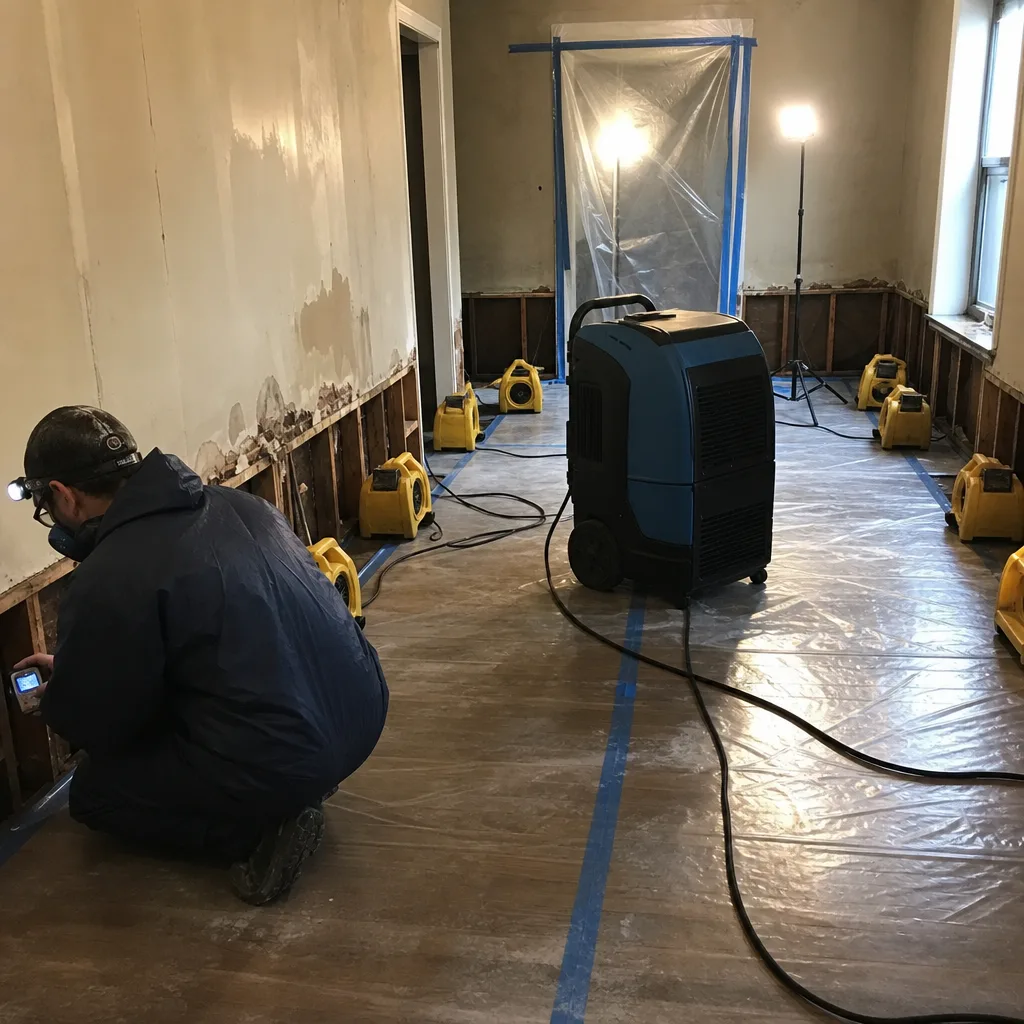
Stachybotrys is the one people fear, and in Dumont basements it’s earned the reputation. The 1970s-finished basement with drywall against concrete block is its natural habitat. We contain the area under negative air pressure, remove the colonized material in sealed bags, treat the framing, and dry to standard before rebuild. No shortcuts, no drywall-over-it fixes.
Moisture & Humidity Control
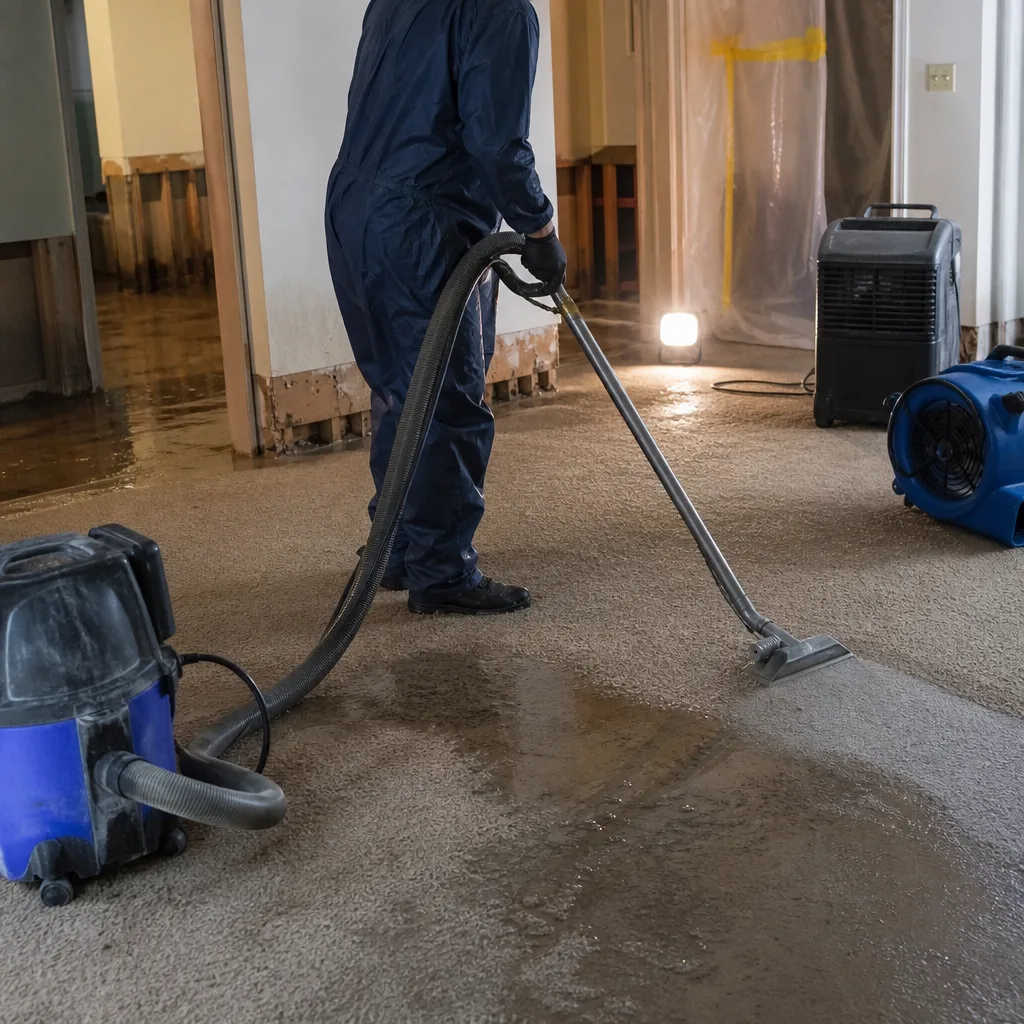
Remediation that doesn’t fix the moisture source is just prep work for the next mold bloom. In Dumont, that usually means addressing failed drain tile, adding vapor barriers to below-grade walls, and sizing a dehumidifier for a basement that holds 65% relative humidity in August. We handle the mold and the reason it grew.
Air Quality Restoration
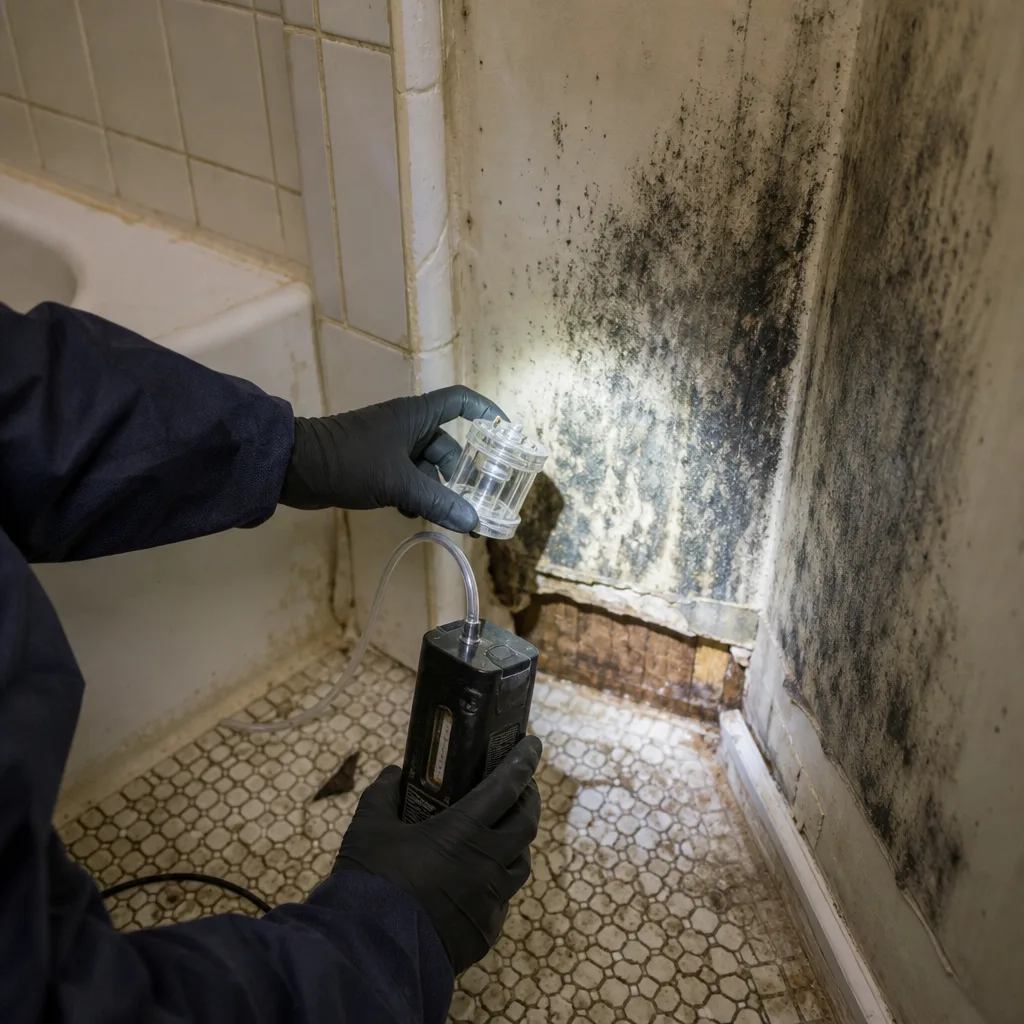
After the mold is gone, the air in your house still carries what it carried before. We run HEPA air scrubbers during remediation and can perform post-remediation clearance testing so you’re not guessing whether the air your family breathes is actually clean. Dumont’s mid-century homes have tight envelope issues, and that makes air quality harder to fix by opening a window.
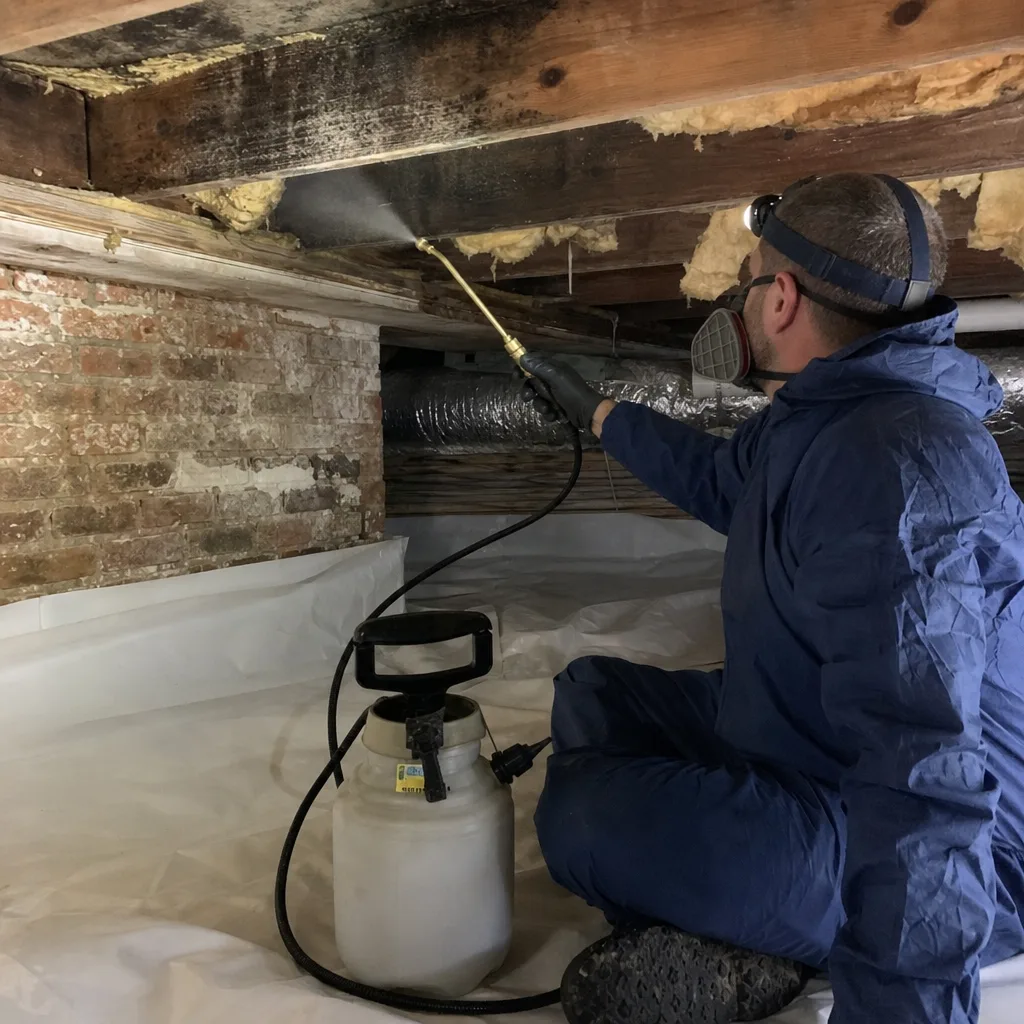
Crawl Space Treatment
Slab-on-grade additions and partial crawl spaces under older Dumont colonials trap humidity against floor joists for decades. We treat the source, install vapor barriers where the design allows, and dry the space to standard. Crawl space mold feeds the air above it, even if you never go down there.
What happens when you call
- 1
A real person answersNo phone trees - you reach a local pro.
- 2
You get an upfront price rangeHonest numbers before anyone is dispatched.
- 3
A background-checked tech heads outLicensed & insured, dispatched right away.
- 4
You approve before work beginsNothing starts until you say go.
Mold Remediation Costs in Dumont, NJ
Here’s where the money actually goes. A straightforward mold cleanup in an unfinished Dumont basement, 50 to 100 square feet of visible growth, runs $1,200 to $2,800. Once we’re behind finished walls with containment, HEPA scrubbing, and reconstruction, $2,800 to $6,500 is the honest range. Black mold remediation involving Stachybotrys behind 1980s paneling typically lands at $3,500 to $7,000 because the wall cavity, insulation, and vapor barrier all get rebuilt, not just cleaned. What moves the price: whether the drain tile has failed and needs replacement, whether your HVAC spread spores beyond the immediate area, and whether asbestos tile or lead paint complicates the removal. Insurance covers most sudden water-source mold claims; chronic seepage is usually out of pocket. The free visual inspection gives you a real number in writing before you commit to anything. Call (917) 924-4221 and we’ll put eyes on it.
We Also Serve Cities Near Dumont
Our crews work the entire northern Bergen corridor, so if you’re in Dumont and a neighbor in Haworth, Cresskill, Bergenfield, or New Milford has a basement full of water at midnight, we can have a truck there just as fast. Same live dispatch, same certified crews, same 90-Day Done Right Promise.
Dumont Mold Remediation Questions, Answered
Why do small water events in Dumont basements so often turn into black mold behind intact paneling?
Because the water wicks into drywall and wood framing inside the wall cavity, where there’s no airflow to dry it, and Dumont’s 1970s-finished basements lack the vapor barriers that modern code requires. What looks like a dry paneled wall from the outside can be colonized with Stachybotrys on the backside within two to three weeks. Mold doesn’t need standing water, just sustained humidity above about 60% and an organic food source, which drywall paper is. This is the single most common finding on our Dumont calls. If your basement got wet even briefly, call (917) 924-4221 for a free inspection before it becomes a full wall tear-out.
How do you determine whether to dry or remove a Dumont basement wall after a sewer backup?
It comes down to the water category and the wall construction. Sewer backup is Category 3 water, contaminated with bacteria and pathogens, and anything porous it touched, drywall, insulation, carpet pad, gets removed, not dried. There’s no scenario where we try to dry drywall that’s absorbed Category 3 water in a Dumont basement. For Category 1 water from a burst supply line, we use moisture readings to decide: if the drywall is wet but structurally sound and was installed with a gap from the floor, drying may be possible. If it’s 1980s drywall against block with no vapor barrier, removal is usually cheaper than fighting a losing battle against trapped moisture. Each situation gets a written recommendation with numbers, not a guess.
Does Dumont require a permit for mold remediation that involves removing drywall in a finished basement?
Dumont follows New Jersey’s standard construction code, and in general, removing and replacing drywall as part of remediation, without altering the structure, does not require a building permit. What does change the equation: if the work involves replacing failed drain tile, relocating plumbing, or modifying framing, the borough will want a permit and an inspection. We handle the permit paperwork when it’s needed, and we’ll tell you upfront if your job sits in the permit territory. No surprises, in writing.
What should I look for in a Dumont mold inspection before buying a 1950s Cape Cod?
Three things. First, check the basement wall finish: if it’s drywall or paneling against concrete block with no visible gap, assume moisture is behind it and ask for a moisture reading, not just a visual walkthrough. Second, walk the foundation perimeter outside and look at grading. Dumont’s narrow lots mean downspouts often discharge too close to the house, and that steady wetting is a chronic mold engine. Third, ask for air sampling in the basement and the first floor, not just a surface swab. A house that smells faintly musty in July is telling you something the seller’s paint job isn’t. We do pre-purchase inspections for exactly this situation, and we’ll give you a straight answer about whether to walk away or negotiate a remediation credit.
Why do Dumont homes need dehumidification during mold remediation even in winter?
Because the outdoor dew point doesn’t control the indoor humidity in a closed mid-century basement. A below-grade concrete slab in a 1950s Dumont colonial stays around 55°F year round. When outdoor air from a January cold snap or a July heat wave enters the basement and meets that cold slab, the relative humidity spikes, and that’s exactly what mold needs. Dehumidification during remediation keeps the materials we’re drying from reabsorbing moisture from the air itself. It is not a seasonal step. It’s a dry-standard requirement we log with daily readings until the job passes.
How fast can a mold remediation crew actually reach a Dumont home in an emergency?
We commit to 45 minutes for Dumont calls, and on most days we beat it. Our dispatch board tracks every certified crew in the northern Bergen corridor, and the nearest one heads straight to your address when you call. A live person answers at (917) 924-4221, takes the address, and confirms the truck is rolling. No callbacks, no “we’ll be there between noon and 5.”
Will my homeowner’s insurance cover mold remediation in Dumont?
Most standard HO-3 policies cover mold remediation when it results from a sudden and accidental water event that is itself covered: a burst pipe, a sewer backup if you carry that endorsement, a storm opening in the roof. What’s typically excluded is mold from chronic, long-term seepage or unattended humidity, because the policy treats that as maintenance, not a covered loss. The difference between a covered and declined claim often comes down to documentation: when the water event happened, how quickly you responded, and what the source was. We document from the first hour and bill your carrier directly, so you’re not advancing thousands out of pocket while waiting for a check. For an exact answer on your policy, call (917) 924-4221 and we’ll talk you through what the typical Carrier pays in Dumont’s market.
What should a Dumont homeowner do in the first 30 minutes after discovering a basement water event?
First, stop the source if you can do so safely, shut off the supply line at the valve, or the main if needed. Second, kill power to the affected area if water is near outlets or the panel. Third, document what you see in photos, including the waterline on the wall. Fourth, call (917) 924-4221. Don’t move standing water yourself if there’s any chance it’s sewer water, and don’t start pulling paneling off walls, that releases the mold spores you’re about to contain. Leave the wall alone and let our crew handle the containment, the readings, and the decision about what gets dried versus removed. The first hour is when a $2,000 drying job becomes a $6,000 mold remediation, and acting fast is the cheapest insurance you’ll ever buy.
The Dumont Basement Problem No One Warned You About
Here’s the insight this page exists to deliver. In Dumont, a wet basement floor is rarely just a wet floor. The borough’s finished basements, renovated largely in the 1970s and early 1980s, were built with drywall or paneling installed directly against concrete block, with no vapor barrier and often with wood furring strips right on the masonry. That creates a sealed cavity with no airflow, and when groundwater or a burst pipe introduces moisture, the backside of that wall never dries. Within two to three weeks, Stachybotrys, what people call black mold, is colonizing the paper backing of the drywall and the wood studs. The wall looks intact. It smells faintly musty, maybe not even that. And then a homeowner leans against it and the paneling flexes, or a renovation starts and the whole hidden colony opens up. We respond to Dumont split-levels on this exact scenario more weeks than not.
Our crew responded to a Dumont split-level where a frozen galvanized supply line burst inside an exterior wall. Moisture mapping showed the water had wicked behind 1980s drywall installed directly against the block foundation. We contained the area, removed the paneling, and found Stachybotrys already colonizing the cavity behind what looked like a dry wall. After structural drying with Dri-Eaz dehumidifiers and air movers, we applied antimicrobial treatment and restored the pre-loss condition with new vapor barrier and proper moisture barriers. The homeowner thought they’d had a plumbing inconvenience. They’d actually had a mold reservoir growing for weeks. This is what we mean when we say Dumont’s mid-century basements hide problems the wall itself won’t tell you about. The Mold Remediation work starts with looking where the problem actually lives, not where the stain appears.
Serving Dumont, NJ - Our Local Coverage Area
We’re based in the Dumont area and know this community well. Use the map below to see our service coverage - if you’re nearby, we can almost certainly help.
Call Floodline Restoration Co. of Manhattan for Mold Remediation in Dumont
If you’ve got water in your Dumont basement, a musty smell that won’t leave, or a home inspector’s report that says “possible mold behind paneling,” don’t wait for it to become a bigger problem. Call (917) 924-4221 now. A live person answers, a certified crew heads your way, and you get a written scope before any wall comes open. We’ve been doing this work in northern Bergen County long enough to know what’s behind the walls in a 1950s Cape Cod, and we stand behind every job with the 90-Day Done Right Promise, in writing. That’s the Keystone Standard, and it’s not a slogan. It’s what lets us say, without hesitation: done right, and backed in writing.
Written by Curt Bowman, Owner at Floodline Restoration Co. of Manhattan, serving Dumont and the northern Bergen corridor with certified mold remediation and water damage restoration.