
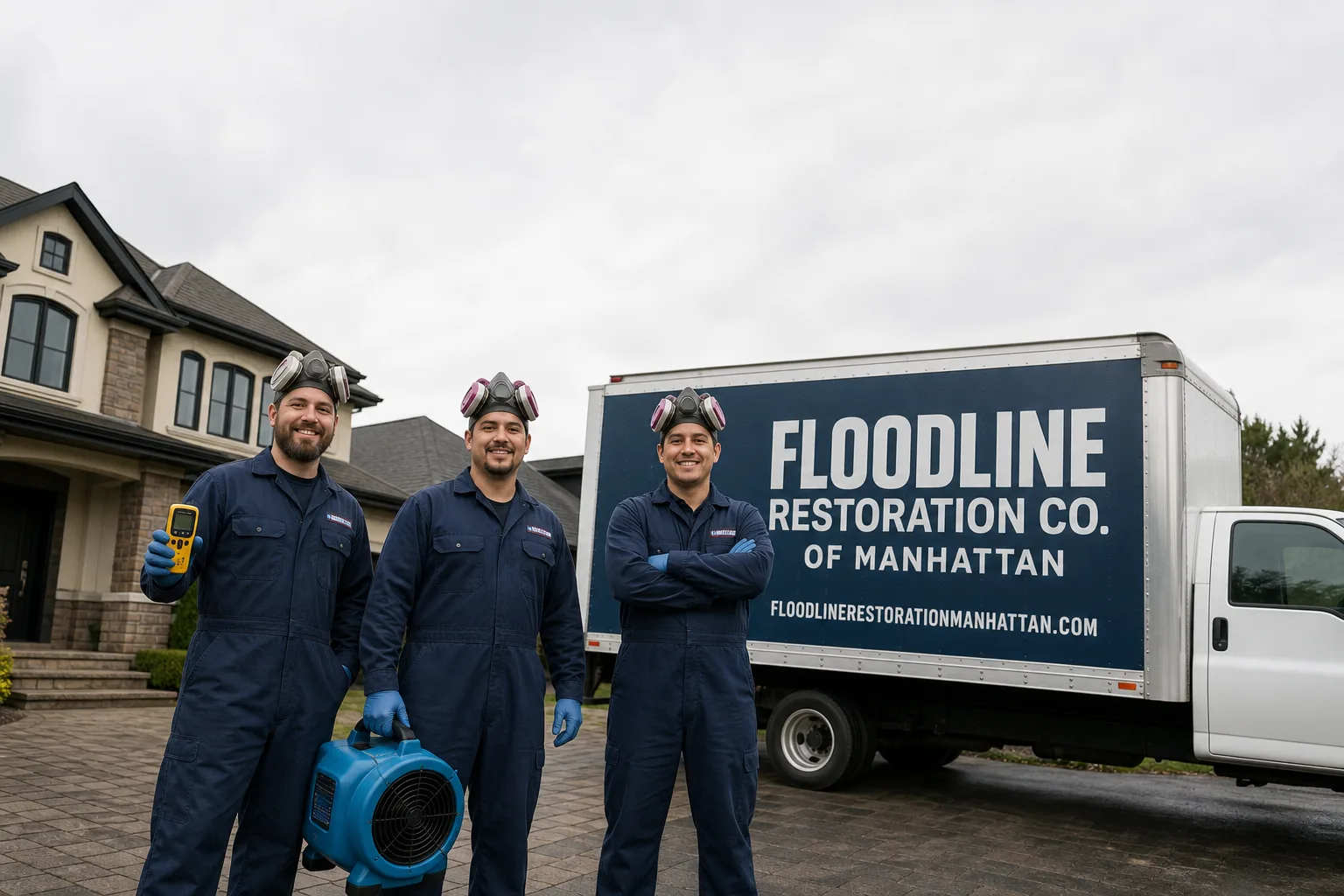
Free visual inspection and a written scope of work before any mitigation begins - photos, moisture readings, and drying logs go in your claim file
The scope we write is the scope we bill. Anything new gets shown to you, in writing, before we touch it.






 Before
 After
After Before
 After
After Before
 After
After24/7 Emergency Mold Remediation in Howard Beach
Mold remediation in Howard Beach typically costs $1,800-$6,500 depending on how far the contamination has spread, and urgent cases can usually be contained the same day you call. We answer live around the clock at (917) 924-4221, and a certified crew can be at your door in Howard Beach within 45 minutes for a free visual inspection. Mold that feeds on salt-saturated drywall and 60-year-old insulation doesn’t wait, and neither should you. The first hour matters because bay-driven humidity keeps feeding the colony while you wait, and every day of delay pushes the repair from a $2,000 containment job toward a $9,000 gut-and-rebuild.
Understanding Mold Remediation Severity in Howard Beach Properties
We classify mold problems by the size of the contaminated area and what the colony is feeding on. A contained patch under a bathroom sink, under 10 square feet, is a cleaning and drying job. Anything over 30 square feet, or any mold inside wall cavities and ceiling plenums in Howard Beach’s post-Sandy elevated homes, requires full containment with negative air pressure, HEPA air scrubbing, and clearance testing before we hand the keys back. Here’s what we know from working this neighborhood: the slab-on-grade ranches from the 1950s and the elevated Capes from the NY Rising era share a common failure point. Both trap moisture at the sill plate where the structure meets the foundation, and both hide mold behind finishes that look perfectly fine from the living room. In Howard Beach, we treat every visible mold patch as the tip of something larger until moisture mapping proves otherwise.
Need Emergency Mold Remediation in Howard Beach Now?
Crews minutes away, answering live 24 hours a day. The sooner we start, the less it costs.
Why Howard Beach Property Owners Choose Floodline Restoration Co. of Manhattan
- 45-minute response commitment. When you call with mold spreading behind a wall, every hour widens the containment zone. We commit to having a certified tech on-site in Howard Beach within 45 minutes, not the next morning.
- A live person answers, 24/7. No phone trees, no “leave a message.” A dispatcher picks up at 2 a.m. and starts moving a crew toward your street, whether you’re near Cross Bay Boulevard or down by the Shellbank Basin.
- IICRC-certified crews, trained to the AMRT and WRT codes. Applied Microbial Remediation Technician and Water Restoration Technician certifications mean our people know salt-contaminated cavities differently than a general contractor ever will.
- Free visual inspection with a written scope. We walk the affected areas, run initial moisture readings, and put the work in writing before any equipment comes off the truck. No pressure, no vague verbal estimates.
- Direct insurance billing. We send documentation, photos, drying logs, and the line-item estimate straight to your carrier. You never play messenger between Floodline and your adjuster.
- One team from containment to reconstruction. The same certified crew that contains the mold also handles tear-out, drying, and the rebuild of the finished wall. No mid-job handoff to a crew you’ve never met.
Our Mold Remediation Process
Inspection & Assessment
We start with a full visual walkthrough plus moisture mapping of walls, floors, and the crawl space. In Howard Beach’s elevated homes, we pay special attention to the original 1960s framing and kraft-faced drywall hidden behind post-Sandy finishes. Thermal imaging and Dri-Eaz moisture sensors tell us where the colony actually extends, not just where you can see it.
Containment & Stabilization
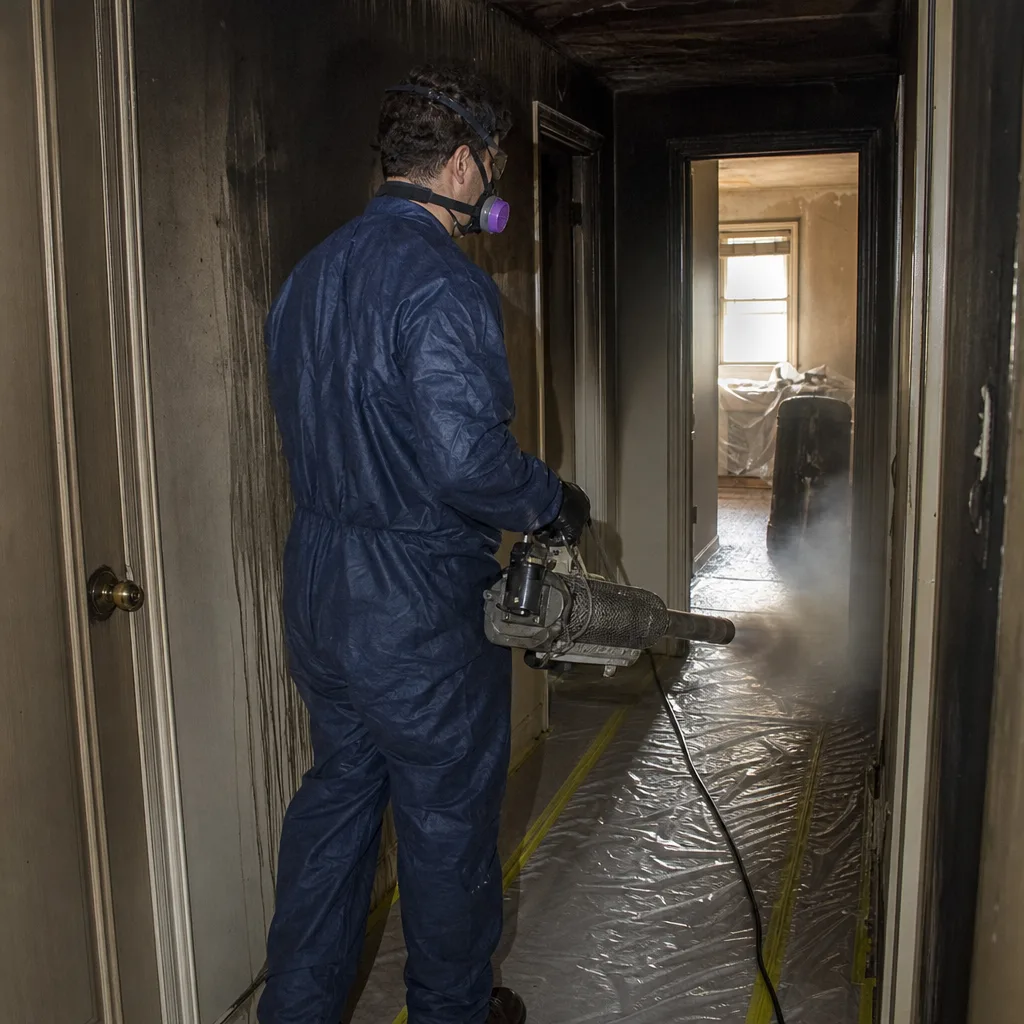
Before any drywall comes down, we seal off the affected area with 6-mil poly sheeting and run negative air pressure through HEPA-scrubbed exhaust. This prevents spores from cross-contaminating your living room, kitchen, or newly finished upper floors. Containment is non-negotiable in Howard Beach because the same bay breeze that keeps the air moving will also carry spores into every room you don’t seal.
Mold Removal & Controlled Demolition
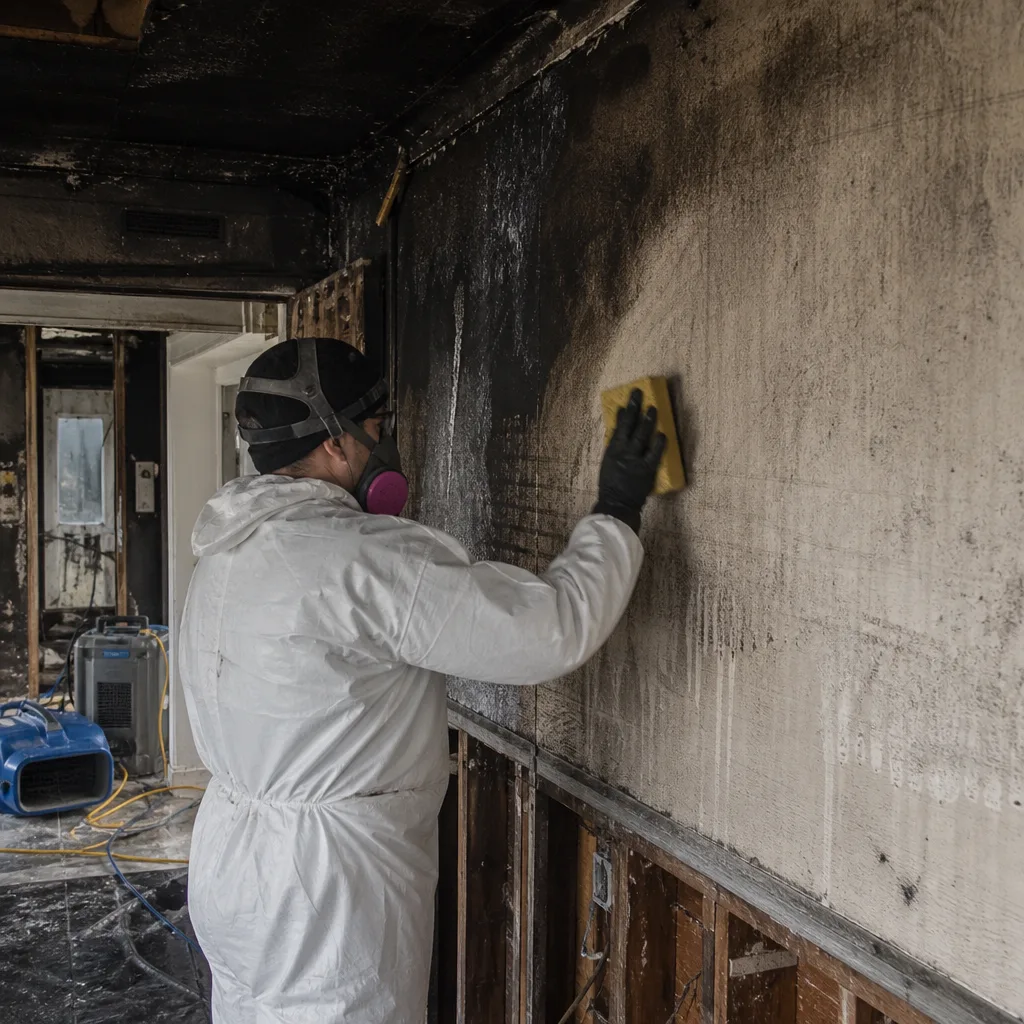
We cut out contaminated drywall and insulation with the containment still under negative pressure. In Howard Beach, this frequently means pulling modern finishes to expose original materials that were never treated after Sandy or after routine tidal overflows. Every cut surface gets treated before demolition continues.
Salt Neutralization & Antimicrobial Treatment
This step is specific to Howard Beach’s Jamaica Bay water. Standard antimicrobials fail when salt crystals remain embedded in masonry and framing, so we neutralize chloride residue before applying the antimicrobial to every exposed stud and sill plate. Skip this step and the mold regrows within six weeks.
Drying & Dehumidification
We set professional-grade commercial dehumidifiers and air movers, then hold the structure at the IICRC dry standard. Daily moisture readings get logged and shared with you and your carrier. In Howard Beach’s coastal humidity, most basements and crawl spaces need 4 to 7 days to hit the target, not the 72 hours you’d see inland.
Post-Remediation Verification & Repairs
After drying is confirmed with a third-party clearance test where applicable, we handle cleanup of the contained area and any reconstruction you’ve authorized. The same crew that pulled the mold handles the drywall patching, paint, and trim, so your warranty is one name: Floodline Restoration Co., backed by the 90-Day Done Right Promise.
Working With Your Insurance Company
Most Howard Beach homeowners have mold language in their policy that covers remediation when it results from a covered water event, whether that’s a burst pipe, a nor’easter overflow, or a documented storm surge. The carrier’s adjuster wants the same things we provide: proof of cause, proof of extent, and a defensible line-item scope. We photograph every affected room before demolition starts, pull moisture readings from every stud bay we open, and keep a drying log your adjuster can audit. Our team has handled claims tied to post-Sandy renovation defects, tidal flooding along the bay-facing streets, and the appraiser battles that come with both. We bill your carrier directly whenever your policy applies, so you’re not floating out-of-pocket costs while your claim sits in a queue.
What We Provide Your Insurer
- Thorough documentation of the loss
- Photos of all damage, room by room
- Moisture readings and drying logs
- A detailed, line-item scope of work
- Direct coordination with your carrier
Built for Howard Beach’s Loss Calendar
Howard Beach’s mold season isn’t a season. It’s a year-round pressure test driven by where this neighborhood sits. January and February bring deep freezes that crack supply lines in unheated crawl spaces, and when the thaw hits in March, that water soaks into the same 1960s fiberglass that has already absorbed decades of humidity. Spring nor’easters push Jamaica Bay over its edge along the low-lying streets near Hawtree Creek, and every overflow saturates slab-on-grade foundations that never truly dry. Summer thunderstorms drop two inches of rain in an hour, overwhelming the neighborhood’s storm drains and sending sheet water into ground-level entrances. By September, the humidity is still thick enough that a wall opened for a “small patch” of mold at 90th Street will show growth behind the baseboards that nobody saw. The common thread is salt. Every one of these events leaves chloride in the wood and masonry, and every one accelerates the next mold bloom. This is why we tell Howard Beach homeowners to treat any visible mold as a symptom, not the full diagnosis.
Mold Remediation Across Howard Beach’s Neighborhoods
The homes near Cross Bay Boulevard and the Shellbank Basin sit closest to the water and absorb the most routine tidal flooding. We run more full crawl space treatments along the bay side because the wet-dry cycle there is relentless. Up around Coleman Square and toward the Lindenwood section, we see the highest concentration of elevated NY Rising homes, where modern additions sit on original frames that never got proper remediation after Sandy. Those jobs are almost always two-layer removals: fresh drywall on the surface, contaminated 1960s materials underneath. The streets around PS 207 and the blocks south of the Belt Parkway hold a dense stock of slab-on-grade ranches with finished basements at or barely above the water table. When those basements get wet, the mold moves up into the floor joists within 72 hours. Response routes differ by street, but the failure pattern is consistent: water gets in, stays longer than anyone realizes, and feeds something built before modern vapor barriers existed.
Specialized Mold Remediation Services We Offer in Howard Beach
Mold Inspection & Testing
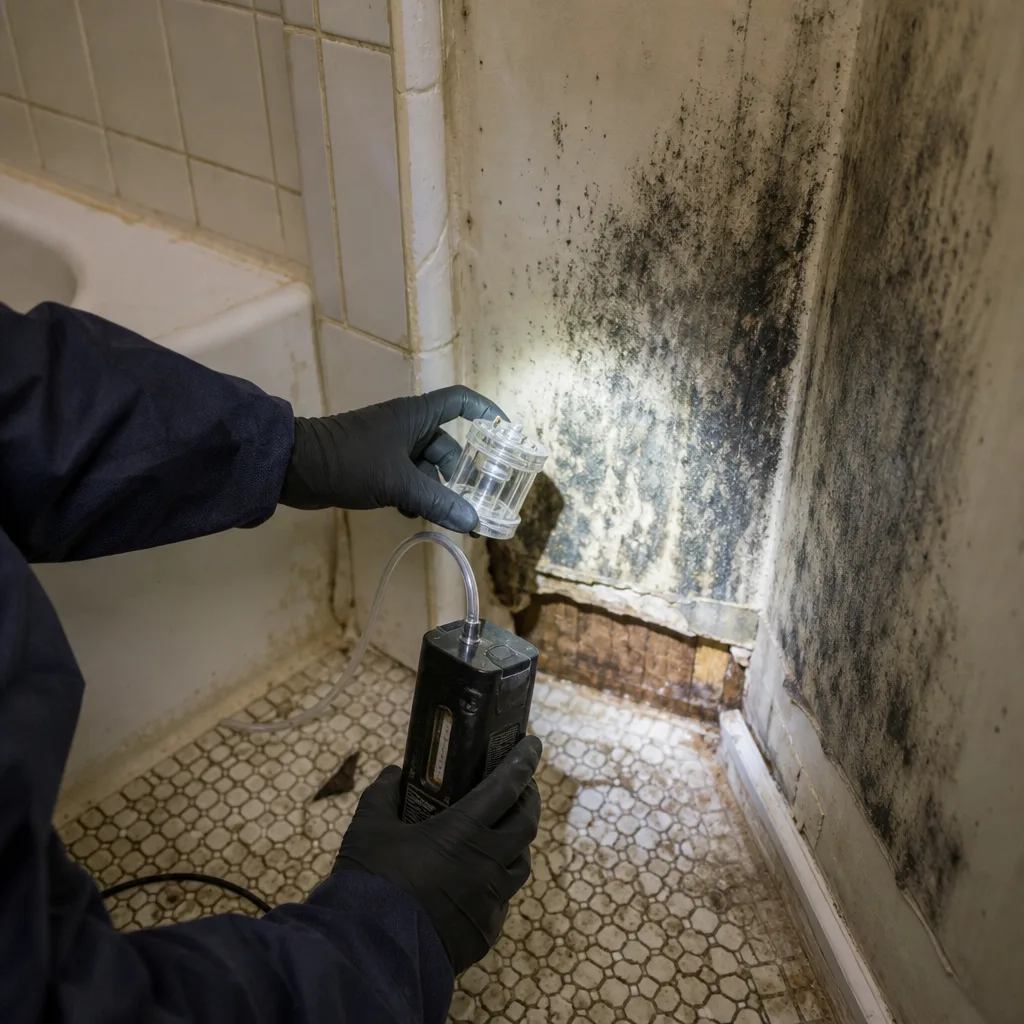
Every Howard Beach job starts with a real inspection, not a quick look and a bid. We run moisture mapping with Dri-Eaz sensors across walls, floors, and the crawl space, and we take air and surface samples where the source isn’t obvious. In elevated homes, we specifically inspect the original sill plate and the junction where 1960s framing meets 2015-era additions, because that’s where hidden mold thrives in this neighborhood.
Mold Removal
Removing mold in Howard Beach means cutting back until you hit clean, dry material, then cutting a little further to be sure. Because so many homes here carry salt-laden wood from repeated bay flooding, our crews treat every exposed surface with a chloride-neutralizing agent before applying antimicrobial. Surface scrubbing alone doesn’t survive a Howard Beach summer.
Black Mold Remediation
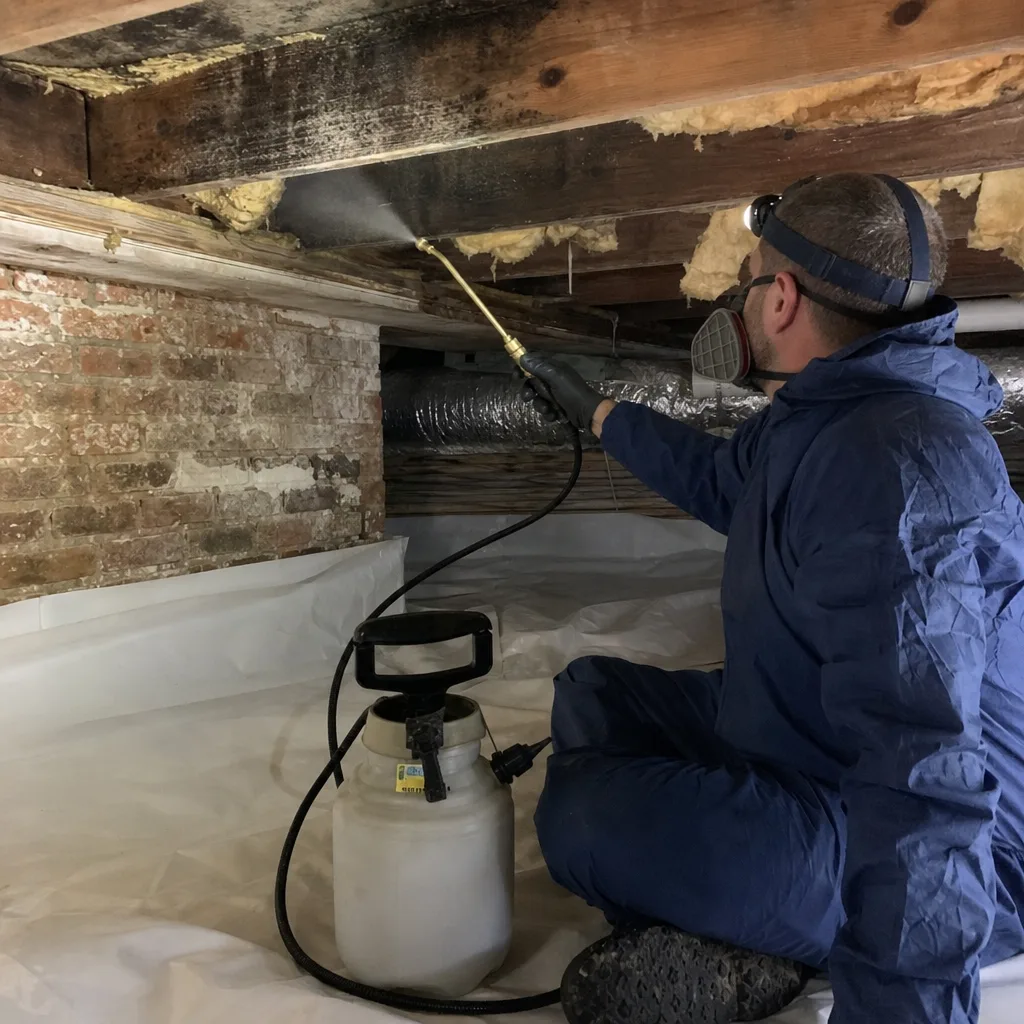
Black mold, meaning Stachybotrys chartarum, is particularly common in Howard Beach because it loves cellulose-rich materials that have been repeatedly wetted: drywall paper, kraft-faced insulation, ceiling tiles, and wood studs. We contain it with full negative air pressure and remove all contaminated material to a 2-foot margin beyond visible growth. No shortcuts, no encapsulation over active colonies.
Air Quality Restoration
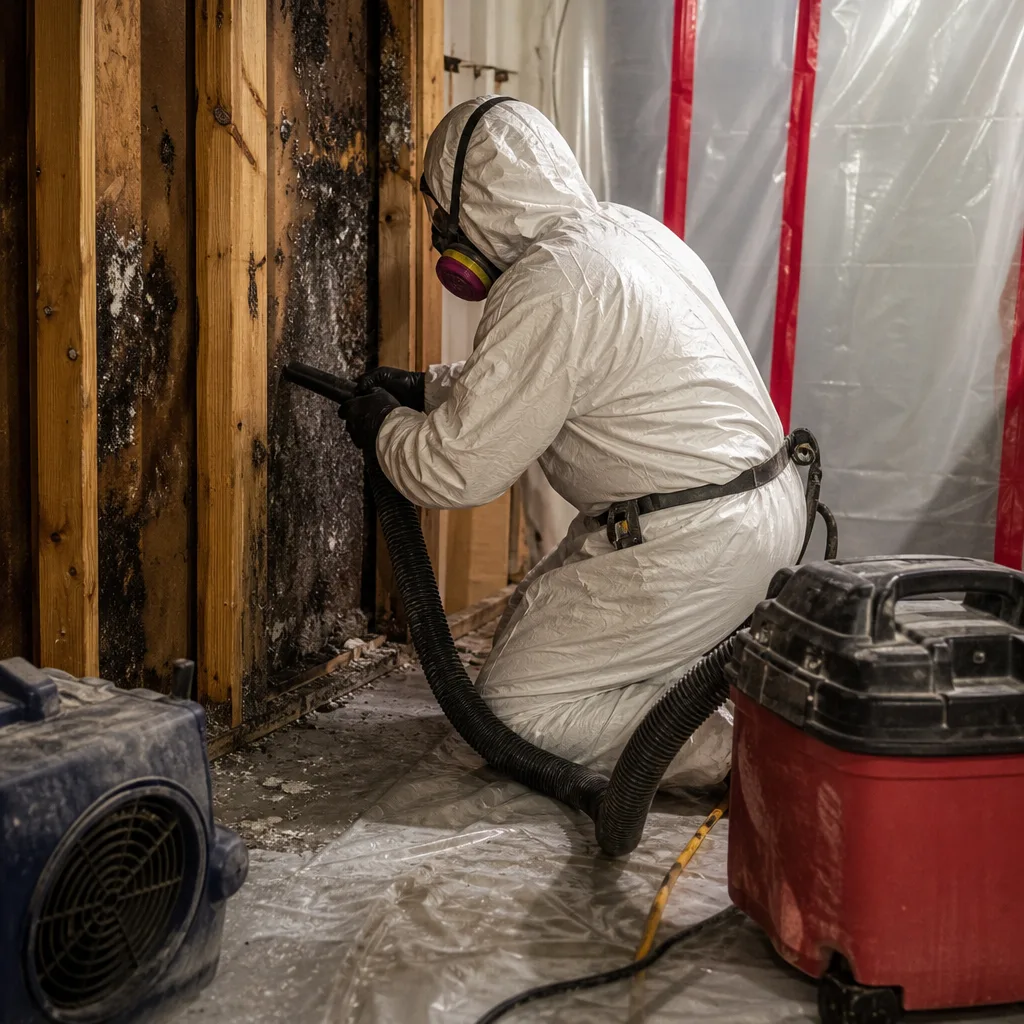
After a significant mold event, the air inside a Howard Beach house can carry spore counts twenty times higher than outdoors. We run commercial HEPA air scrubbing during the entire remediation, then do post-remediation clearance testing to confirm the indoor air has returned to acceptable levels. You get the lab data, not a verbal assurance.
Crawl Space Treatment
Crawl spaces in Howard Beach’s slab-on-grade ranches and early Capes are ground zero for recurring mold. We install vapor barriers, address drainage and grading, and treat every accessible framing member with the salt-neutralizing protocol this neighborhood requires. In a raised Cape near 84th Street, our crew contained the crawl space and pulled back new drywall to find black mold feeding on decades-old fiberglass batts saturated by repeated Jamaica Bay tidal overflows. We ran moisture mapping with Dri-Eaz sensors, cut out the contaminated kraft-faced board, and treated the framing with antimicrobial before installing a dehumidification plan tied to IICRC drying logs. That’s a standard Howard Beach crawl space job for us.
What happens when you call
- 1
A real person answersNo phone trees - you reach a local pro.
- 2
You get an upfront price rangeHonest numbers before anyone is dispatched.
- 3
A background-checked tech heads outLicensed & insured, dispatched right away.
- 4
You approve before work beginsNothing starts until you say go.
Mold Remediation Costs in Howard Beach, NY
You should know the range before anyone puts on a Tyvek suit. A contained mold removal under 30 square feet in a Howard Beach bathroom or closet typically runs $1,800-$3,400. A full-room remediation with containment, HEPA air scrubbing, and new drywall usually lands between $4,200-$6,500. A whole-crawl-space treatment with vapor barrier, salt neutralization, and dehumidification runs $5,000-$9,500 depending on access and how much original framing is contaminated. The wild card in Howard Beach is what’s behind the walls: when we open a post-Sandy renovation and find the original 1960s materials were never treated, the price moves up because the scope legitimately expands. That’s not an upsell. That’s the job. The free visual inspection we offer gives you a firm written scope before any money changes hands, and our direct insurance billing means your carrier pays us when the policy applies. Call (917) 924-4221 and we’ll put the number in writing within the hour.
We Also Serve Cities Near Howard Beach
Floodline Restoration Co. of Manhattan serves Howard Beach and the surrounding Queens communities with the same 45-minute response commitment and 90-Day Done Right Promise. If you’re in Jamaica, South Ozone Park, Ozone Park, or South Richmond Hill, our certified mold remediation crews are already working in your area and available around the clock.
Howard Beach Mold Remediation Questions, Answered
Why does mold in Howard Beach homes often require removing more drywall than expected?
Because Howard Beach’s post-Sandy elevation projects created homes with mismatched material ages. The drywall you see might be new, but the insulation and framing behind it are often original 1960s fiberglass batt and kraft-faced board that absorbed saltwater during Sandy and repeated tidal overflows. Mold feeds on the old materials behind the new finish, so removing the visible patch without opening the wall means leaving the actual food source in place. We remove drywall to two feet beyond any visible growth, and in Howard Beach that frequently exposes contaminated original materials that extend the cut.
How does salt water from Jamaica Bay flooding affect mold growth differently than fresh water?
Salt water is far more destructive than fresh water because it leaves chloride crystals embedded in wood and masonry even after the surface feels dry. Those crystals wick moisture from the air, keeping the material at elevated humidity levels long after a fresh-water flood would have dried out. Mold loves that sustained moisture. Standard antimicrobials also fail unless the salt is neutralized first, because the chloride creates a barrier that prevents the treatment from binding to the surface. In Howard Beach, salt-neutralization is a mandatory step before antimicrobial application, and skipping it is why some remediation jobs fail within weeks.
Do I need a Category 3 (black water) assessment even if the flooding was just tidal?
Yes, and in Howard Beach specifically, the answer is almost always yes. Jamaica Bay tidal overflows and nor’easter surge water carries sewage, marine organisms, roadway runoff, and whatever has accumulated in the storm drain system. That meets the definition of Category 3 water, meaning the contaminated area must be treated as a biohazard, not just a moisture problem. Even if the water looked clear when it entered, by the time it sat in your crawl space or basement for hours, it was Category 3. We handle the assessment as part of the free inspection and document the water classification for your carrier.
Why is moisture mapping more critical in elevated Howard Beach homes than inland Queens?
Because elevation changes the moisture profile of the entire structure. In a typical inland Queens home, gravity drains water down and out. In an elevated Howard Beach home, the original foundation and sill plate are now enclosed by new framing and finishes, trapping moisture in the space where the old structure meets the new. Moisture mapping with Dri-Eaz sensors tells us whether the original materials are still holding water from a prior flood event, even when the visible surfaces read dry. Without that data, you’ll remediate the surface and leave a reservoir of moisture and mold inside the walls.
How long does structural drying take in a Howard Beach basement after a nor’easter overflow?
Most Howard Beach basements hit the IICRC dry standard in 4 to 7 days with professional-grade dehumidifiers and air movers running continuously. Coastal humidity is the factor that prolongs drying here: when the outside air is saturated, the dehumidifier works harder and the moisture bound in salt-laden materials releases more slowly. We log daily moisture readings and don’t stop the equipment until the numbers say we’re done, not until the calendar says we’ve been there long enough. You get copies of those logs for your own records and your insurer’s.
Can I stay in my Howard Beach home during mold remediation?
That depends on the size of the affected area and whether it’s connected to your living space. For small contained jobs under 30 square feet in a bathroom or closet, you can usually stay. For a full crawl space treatment or any job requiring negative air pressure across a floor, we recommend relocating for 3 to 5 days. The concern is airborne spores during demolition, not just the mold itself. We’ll give you a straight answer during the free inspection, not after you’ve already started coughing.
What certifications do your Howard Beach mold remediation crews hold?
Our technicians are background-checked, uniformed, and certified to IICRC, RIA, and IFA standards, including the Applied Microbial Remediation Technician (AMRT) and Water Restoration Technician (WRT) certifications. That means they understand microbial containment, structural drying science, and the salt-specific challenges of coastal Queens mold work. The same crew that reads the moisture map on day one handles daily readings and the rebuild, so certification isn’t decorative; it’s applied on every Howard Beach job.
What should I do in the first 30 minutes after I find mold in my Howard Beach home?
Don’t disturb it. Don’t spray bleach on it, don’t wipe it, don’t run a fan near it, and don’t open the wall. Disturbing visible mold launches spores into the air and spreads the contamination. Close the door to the affected area if possible, turn off the HVAC system so spores can’t circulate through ducts, and call us at (917) 924-4221. A live dispatcher will walk you through the next steps and get a certified crew to your Howard Beach address within 45 minutes. The first 30 minutes are about limiting spread, not fixing the problem, and the more you contain on your own, the smaller the job stays.
Serving Howard Beach, NY - Our Local Coverage Area
We’re based in the Howard Beach area and know this community well. Use the map below to see our service coverage - if you’re nearby, we can almost certainly help.
Mold Remediation in Howard Beach Is a Two-Layer Job
Most mold pages tell you about spores, moisture, and containment. They don’t tell you about what’s behind the walls of a Howard Beach house that got elevated after Sandy and never had its original materials remediated. Here’s what we see weekly: modern drywall, fresh paint, a dehumidifier running in the corner, and a colony of black mold feeding on 1960s fiberglass batts that soaked up saltwater years before the new finish went up. That’s why our Mold Remediation team treats every Howard Beach job as a two-layer problem: what you can see, and what the bay left behind. If you’re a homeowner anywhere in Howard Beach who’s been told your mold problem is “just surface,” call us for a second look. We’ll show you the moisture readings that prove otherwise, and we’ll put the real scope in writing before we touch a single stud. Call (917) 924-4221 for a free visual inspection and a straight answer.
Written by Curt Bowman, Owner at Floodline Restoration Co., serving Howard Beach and the surrounding Queens communities since 2010.