
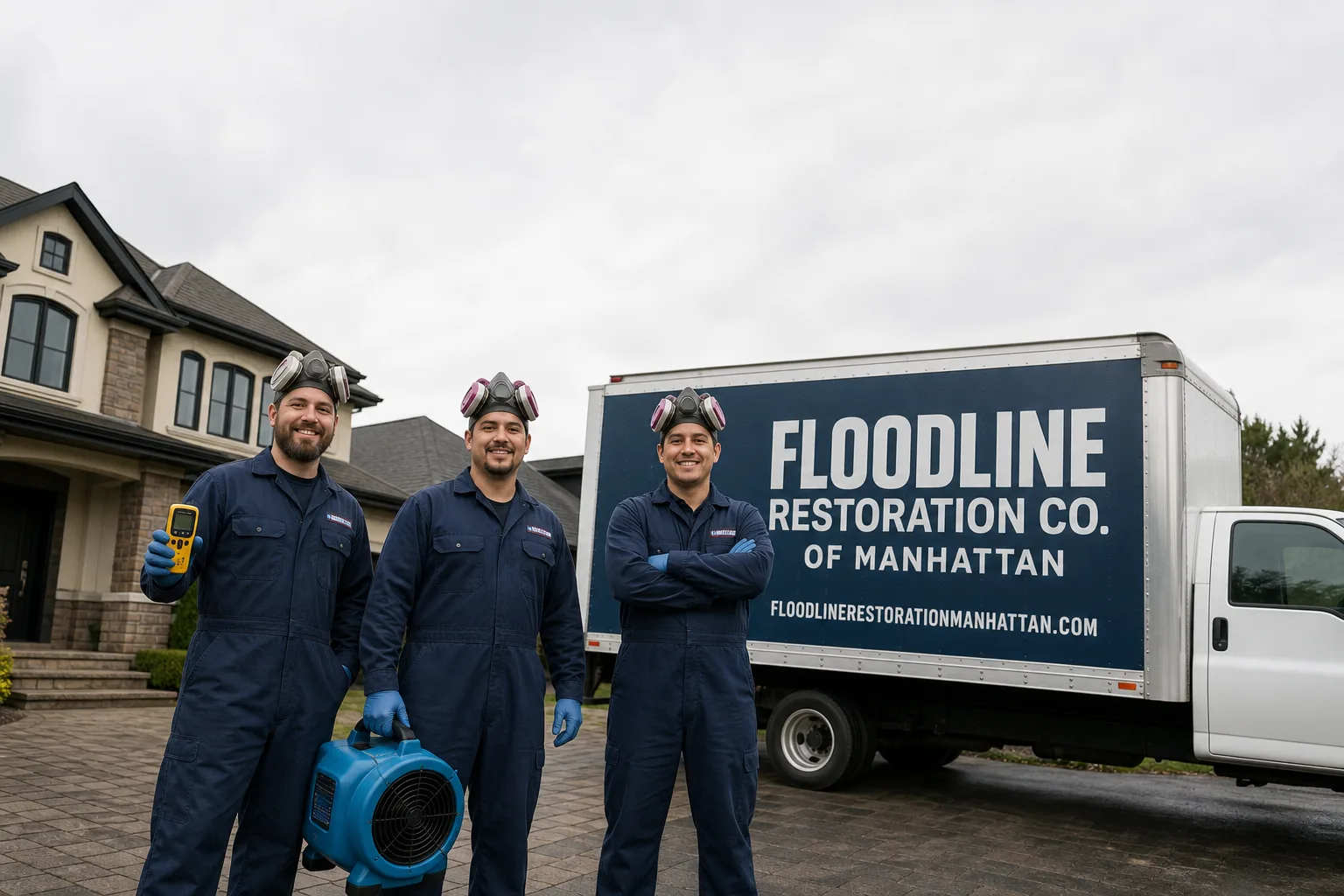
Free visual inspection and a written scope of work before any mitigation begins - photos, moisture readings, and drying logs go in your claim file
The scope we write is the scope we bill. Anything new gets shown to you, in writing, before we touch it.






 Before
 After
After Before
 After
After Before
 After
After24/7 Emergency Mold Remediation in West Nyack
Mold remediation in West Nyack typically costs between $1,800 and $6,500 depending on how far the colony has spread behind finished walls, and emergency crews can usually be on site within 45 minutes. If you’ve found black staining on a basement wall, a musty smell that won’t leave, or water that sat for more than 48 hours, call (917) 924-4221 right now. A live person answers at 2 a.m., not a recording, and a certified crew reaches West Nyack the same visit to start containment.
The first hour matters because mold doesn’t wait. In West Nyack’s clay-heavy soils, what looks like a small patch on drywall is often the visible edge of a colony that’s been growing for two or three seasons behind the wall cavity. We start with a free visual inspection, map the moisture, and give you a written scope before any work begins.
Understanding Mold Remediation Severity in West Nyack Properties
Mold severity breaks into three practical levels, and West Nyack’s housing stock makes all three common. Level one is surface contamination: visible mold on drywall, baseboards, or ceiling tiles, under 10 square feet, with no hidden moisture source. Level two is cavity colonization: mold growing inside wall cavities, behind finished basement panels, or in HVAC duct runs. Level three is structural: colonies established in framing lumber, sill plates, or subflooring, usually after repeated water intrusion.
The 1950s-1970s split-levels and ranches that dominate West Nyack share a weakness: original concrete-block or fieldstone foundations with no modern waterproofing membrane. When groundwater pushes against those walls through Rockland’s clay soil, the block absorbs it. Finished basement drywall hides the moisture until the mold has spread across multiple stud bays. We use moisture mapping, thermal imaging, and air sampling to find what’s behind the wall before we cut into it. Containment with negative air pressure and HEPA air scrubbers keeps spores from spreading to the rest of the house during removal.
Why West Nyack Property Owners Choose Floodline Restoration Co. of Manhattan
- 45-minute response commitment: a live dispatcher confirms your address, and a crew is rolling toward West Nyack immediately, not scheduling you for “sometime Thursday.”
- 24/7 live answer: at 2 a.m., a person picks up. No phone tree, no voicemail, no automated system. The same dispatcher stays with your job until the crew arrives.
- IICRC-certified crews: our technicians hold WRT, FSRT, and AMRT certifications, plus IFA and RIA training. They know West Nyack’s split-levels and crawl spaces, not just textbook mold science.
- Free visual inspection: we look at the damage, give you a straight answer, and write the scope before you spend a dollar. No obligation, no pressure.
- Direct insurance billing: we document everything from the first hour, bill your carrier directly, and handle adjuster calls so you don’t have to.
- One team from extraction to reconstruction: the same crew that pulls wet drywall rebuilds the wall. No mid-job handoff to a subcontractor you’ve never met.
Our Mold Remediation Process
Inspection & Assessment
We start with a visual walkthrough, then probe the lower courses of foundation walls and crawl spaces with hygrometers and thermal imaging. In West Nyack’s block foundations, we specifically check for efflorescence and hidden moisture behind finished drywall. A written scope follows, with line-item costs.
Containment & Stabilization
We seal the affected area with 6-mil poly sheeting, establish negative air pressure, and run HEPA air scrubbers. This prevents spores from moving into your living spaces. If we find Category 3 water from a sump failure or storm backup, we cut the affected drywall and carpet the same day.
Drying & Dehumidification
Dri-Eaz dehumidifiers and XPOWER air movers run continuously, with daily moisture readings logged until we hit the dry standard. We hand you the log for your records and your adjuster. In West Nyack’s clay-soil basements, this step is where cheap contractors fail: they dry the air, not the block wall.
Cleaning & Sanitization
We remove contaminated drywall, insulation, and carpet, HEPA-vacuum all framing, and apply antimicrobial treatment to studs and sill plates. Every surface gets cleaned before any rebuild starts. No encapsulant-paint shortcuts.
Mold Inspection & Testing
After remediation, we run air quality clearance testing to verify spore counts match or fall below outdoor baseline. In West Nyack’s finished basements, we test the wall cavities, not just the room air. You get the report in writing for your carrier.
Repairs & Restoration
We rebuild what we removed: drywall, insulation, trim, carpet, paint. The same crew that started the job finishes it. Every repair is backed by the 90-Day Done Right Promise, in writing.
Need Emergency Mold Remediation in West Nyack Now?
Crews minutes away, answering live 24 hours a day. The sooner we start, the less it costs.
Working With Your Insurance Company
Mold claims are won or lost on documentation. When a pipe bursts in a West Nyack split-level, the carrier needs proof the water was sudden and accidental, not a slow leak you ignored. We document from the first hour: photos of the source, moisture readings at the base plate, extraction equipment running, daily drying logs. Our estimates follow industry-standard pricing software that adjusters recognize, not inflated numbers that trigger audits.
We speak directly to your adjuster. You don’t play messenger between us and the carrier. If a second opinion is needed, our lead tech walks the adjuster through the loss with the evidence in hand. Homeowners in West Nyack who try to handle mold claims alone usually get denied because they lack the third-party documentation carriers demand.
What We Provide Your Insurer
- Thorough documentation of the loss
- Photos of all damage, room by room
- Moisture readings and drying logs
- A detailed, line-item scope of work
- Direct coordination with your carrier
Built for West Nyack’s Loss Calendar
West Nyack’s mold season runs on a schedule you can set a calendar to. February and March bring the freeze-thaw cycle: original cast-iron and galvanized pipes in uninsulated crawl spaces burst, soaking insulation and floor joists. Spring thaw saturates the clay soil around foundation walls, feeding hydrostatic pressure against block foundations and causing basement seepage. July and August thunderstorms drop inches of rain in hours, overwhelming the hamlet’s low-lying drainage basin and flooding finished basements through floor drains and sump pits.
Late summer and fall are when we find what spring left behind: hidden colonies behind basement drywall, crawl space mold on floor joists, musty HVAC returns. Nor’easters in November and December repeat the cycle. Tropical remnants like Hurricane Ida in 2021 turned West Nyack streets into channels that pushed water into every low-lying foundation in the hamlet. If you’ve seen water in your basement even once this year, the mold clock is already running.
Mold Remediation Across West Nyack’s Neighborhoods
The homes along Strawtown Road and the surrounding side streets are mostly 1950s-1970s split-levels with original block foundations and later finished basements. These are our most common mold jobs: the basement is drywalled over a foundation wall that has been wicking groundwater for decades. We probe the lower courses of block walls for efflorescence on every job here, even when the call is just a “small pipe leak.”
The ranch homes and Cape Cods clustered around Lake Nanuet and West Nyack Road face a different problem: uninsulated crawl spaces with original copper supply lines. Mold grows on floor joists, then spores get pulled into the living space through HVAC returns. Homes nearer the Palisades ridgeline, on streets off Germonds Road, deal less with groundwater and more with condensation from poor ventilation in tight 1960s construction.
The commercial corridors along Route 59 and the Palisades Center area have their own profile: flat roofs with failed drainage, HVAC condensate leaks, and tiled kitchens with failed grout lines that let water into subflooring. The 10994 zip code’s housing stock runs older than Nanuet’s, which means more fieldstone foundations and more hidden moisture behind original plaster.
Specialized Mold Remediation Services We Offer in West Nyack
Mold Inspection & Testing
We inspect the visible surfaces, then check what’s hidden: wall cavities, crawl spaces, behind finished basement panels, inside HVAC returns. Air sampling and surface swabs go to a certified lab. In West Nyack, we always probe the lower block wall courses because clay soil keeps the foundation under pressure year-round. A written report tells you exactly where the mold is, what species, and what remediation requires.
Crawl Space Treatment
Uninsulated crawl spaces under 1950s ranches are West Nyack’s quietest mold factory. Original copper pipes sweat, groundwater wicks through fieldstone walls, and mold colonizes floor joists that never see daylight. We remove contaminated insulation, treat the framing, install vapor barriers, and set up dehumidification. A properly treated crawl space stops re-contaminating your living room through the HVAC returns.
Moisture & Humidity Control
Mold is a moisture problem first. In West Nyack’s low-lying bowl, most basements run humid even without a leak. We map the moisture sources: foundation seepage, crawl space evaporation, undersized exhaust fans, plumbing condensation. Then we fix them with drainage correction, vapor barriers, dehumidification systems, and ventilation. Without this step, any mold removal is temporary.
Mold Removal
We remove contaminated materials and clean the rest. In a West Nyack finished basement, that means cutting out wet drywall, pulling fiberglass insulation that has been wicking moisture, HEPA-vacuuming studs, and treating framing with antimicrobial. We follow IICRC S520 standards, not salesman “spray and paint” shortcuts. Every removal ends with clearance testing so you know the air is clean.
Air Quality Restoration
After remediation, we restore the air. HEPA air scrubbers run during the job. Post-remediation clearance testing confirms spore counts are back to outdoor baseline. We check HVAC returns and duct runs for contamination and clean what needs cleaning. In West Nyack’s older homes, this step catches what other contractors miss: mold in the ductwork that keeps re-infecting the house.
What happens when you call
- 1
A real person answersNo phone trees - you reach a local pro.
- 2
You get an upfront price rangeHonest numbers before anyone is dispatched.
- 3
A background-checked tech heads outLicensed & insured, dispatched right away.
- 4
You approve before work beginsNothing starts until you say go.
Mold Remediation Costs in West Nyack, NY
A typical Mold Remediation job in West Nyack runs $1,800-$6,500, with most finished-basement remediations landing around $3,200-$4,500. A standalone mold inspection with air testing costs $350-$650. Crawl space treatment, including insulation removal and vapor barrier installation, runs $2,000-$5,000 depending on square footage. Black mold remediation, if the colony is cavitated behind drywall, typically falls in the $2,500-$7,000 range.
What moves the price: how much drywall has to come out, whether the crawl space is involved, how many rooms need containment, and whether HVAC runs are contaminated. Insurance-covered losses cost you only your deductible when the water source is sudden and accidental. Out-of-pocket work gets a firm line-item scope after a free inspection. Call (917) 924-4221 for an exact quote, and remember the Senior & Veteran 5% discount is always available.
We Also Serve Cities Near West Nyack
Floodline Restoration Co. of Manhattan serves the surrounding Rockland County communities, including Nanuet, Valley Cottage, Blauvelt, and Nyack. The same certified crews, the same 45-minute response commitment, and the same 90-Day Done Right Promise apply throughout the area. If you’re in a neighboring town and water or mold has found your foundation, call the same number: (917) 924-4221.
Serving West Nyack, NY - Our Local Coverage Area
We’re based in the West Nyack area and know this community well. Use the map below to see our service coverage - if you’re nearby, we can almost certainly help.
West Nyack Mold Remediation Questions, Answered
Why does mold keep returning in my West Nyack basement, even after I bleach the walls?
Because bleach doesn’t reach what’s feeding the mold. In West Nyack’s clay-heavy soil, hydrostatic pressure pushes moisture through original block foundations year-round. The mold is growing inside the wall cavity where bleach never touches. Once the drywall is back up, the moisture is still there, and the colony re-blooms within weeks. Real remediation fixes the moisture source first, then removes the contaminated material. Call (917) 924-4221 for a free inspection.
Do I need a mold inspection if I just had a ‘small’ pipe leak in my West Nyack Cape Cod?
Yes, if the leak ran behind a wall or under flooring for more than 48 hours, mold has likely started. In a Cape Cod with original plaster, water from a small supply line leak can wick into lath and studs before you ever see staining. An inspection with moisture mapping and air sampling costs $350-$650 and tells you whether you’re dealing with a cleanup or a hidden colony. Call us, and we’ll be there when we say.
What’s the difference between mold removal and mold remediation in a split-level on a low-lying West Nyack street?
Mold removal is cleaning what’s visible. Mold remediation is the full process: identify the moisture source, contain the area, remove contaminated materials, treat the framing, dry to standard, and verify with clearance testing. In a low-lying West Nyack split-level, removal alone almost always fails because the foundation wall keeps wicking groundwater. Remediation addresses the wall, the air, and the mold. The 90-Day Done Right Promise covers the result in writing.
Is mold in a crawl space under my 1960s ranch a health risk?
Yes. Mold in a crawl space doesn’t stay in the crawl space. Spores get pulled into the living area through HVAC returns, especially in 1960s ranches with ductwork running through the crawl space. People with asthma, allergies, or compromised immune systems typically feel it first. We treat the crawl space as part of the home’s air envelope: remove contaminated insulation, treat the framing, install vapor barriers, and set up dehumidification.
How soon after a basement flood should I call for mold remediation in West Nyack?
Within 24 hours for extraction, and mold can start in 48 to 72 hours if materials stay wet. In West Nyack’s finished basements over clay soil, the clock starts the moment water sits on carpet over a concrete slab. Call (917) 924-4221 as soon as you see standing water. A live person answers, and a crew arrives the same visit to start extraction and drying. The sooner we start, the less material has to be cut out.
How fast can someone actually get to my West Nyack home?
Our standard commitment is 45 minutes from your call. A live dispatcher confirms your address and the nearest certified crew leaves immediately. In practice, West Nyack calls during a storm surge may run slightly longer if multiple homes are affected, but you’ll always speak to a person, never a recording. Emergency containment can be started the same visit.
Are your mold remediation technicians certified?
Yes. Our crews hold IICRC certifications in WRT (Water Damage Restoration), FSRT (Fire & Smoke Restoration), and AMRT (Applied Microbial Remediation), plus IFA and RIA training. They’re background-checked, uniformed, and trained to handle the foundation, air, and rebuild as one system. Curt Bowman, our founder, built the company around certified crews, not sales reps who hand the work to strangers.
What should I do in the first 30 minutes after finding mold in my West Nyack home?
Don’t disturb it. Don’t wipe it, don’t sand it, don’t run a fan on it. Disturbing mold releases spores into the air and spreads the problem. Turn off HVAC fans if they’re circulating air through the affected area. Keep people and pets out of the room. Call (917) 924-4221, and a live person will talk you through the immediate steps and get a crew rolling. The free visual inspection tells us exactly what we’re dealing with.
Written by Curt Bowman, Owner at Floodline Restoration Co. of Manhattan.