
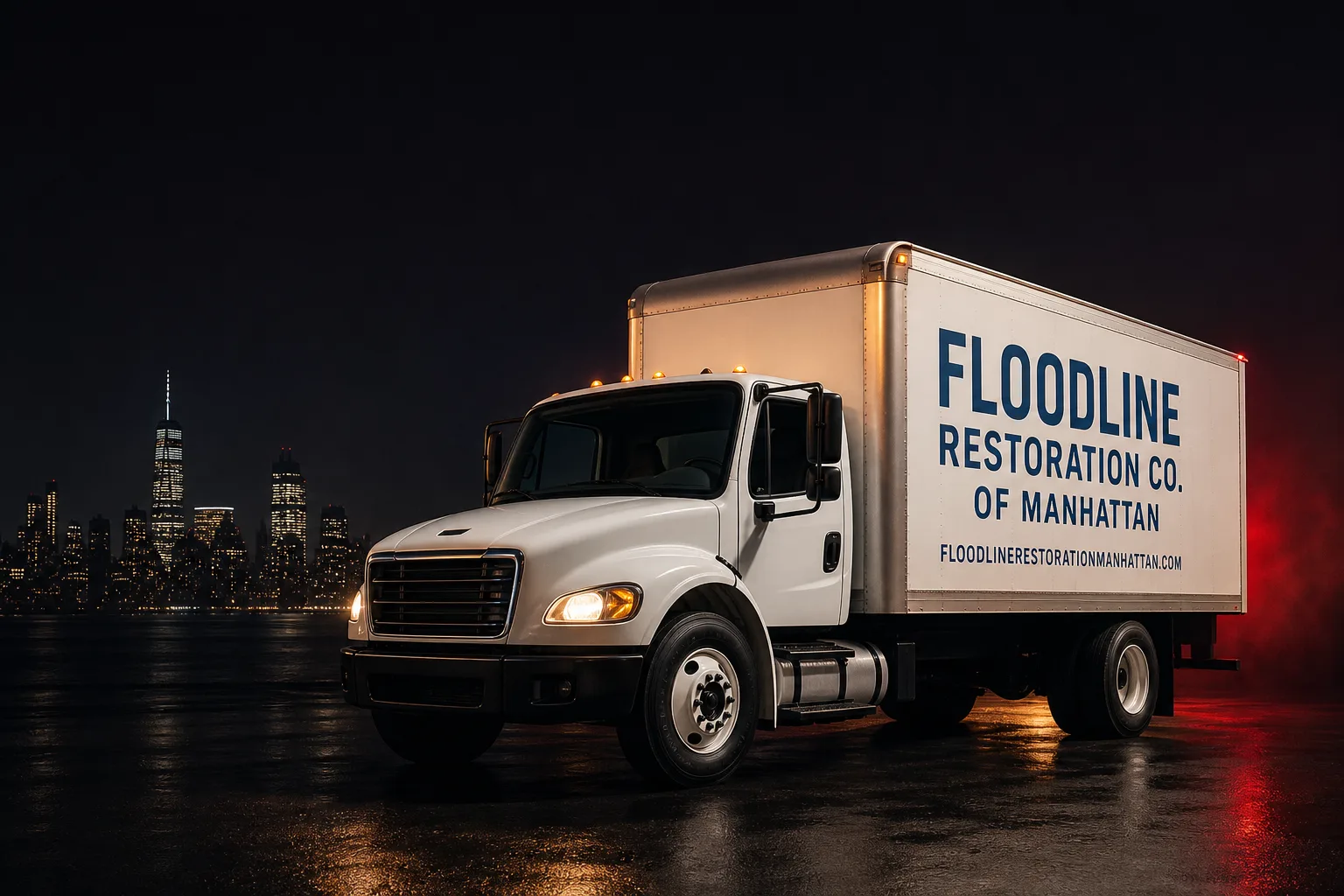
Free visual inspection and a written scope of work before any mitigation begins - photos, moisture readings, and drying logs go in your claim file
The scope we write is the scope we bill. Anything new gets shown to you, in writing, before we touch it.






 Before
 After
After Before
 After
After Before
 After
After24/7 Emergency Mold Remediation in Williamsburg
Mold remediation in Williamsburg typically starts with a same-day inspection, and active growth can usually be contained within 24 to 48 hours. The cost for most Williamsburg jobs lands between $1,800 and $6,500, depending on square footage and how far the moisture traveled. If you’re seeing black staining on baseboards, smelling must in a basement unit, or dealing with a leak that sat over the weekend, call (917) 924-4221 for a free visual inspection. A live person answers, any hour, and a certified crew reaches Williamsburg inside 45 minutes.
Understanding Mold Remediation Severity in Williamsburg Properties
Not every mold problem is the same job. In Williamsburg, the building stock alone forces a sharper severity assessment than most neighborhoods in Brooklyn. An 1880s brick tenement with horsehair plaster walls and original clay drain pipes holds moisture differently than a post-2005 glass-and-steel condo on Kent Avenue. The tenement absorbs water into lime plaster and lathe, where mold colonizes behind the surface within 48 hours. The condo traps humidity between exposed concrete and interior drywall, feeding spores you won’t see until the paint bubbles.
Severity breaks into three practical levels. Surface mold on non-porous materials, under 10 square feet, is a cleanup. Mold that has penetrated porous materials like plaster, drywall, or unsealed concrete requires containment, HEPA air scrubbing, and removal of affected material. Mold tied to Category 3 water, meaning sewage or storm-surge backup from the combined sewer system along the East River, requires full containment, pack-out of affected contents, and post-remediation clearance testing. Williamsburg’s flood zone AE stretches along the waterfront, and after a nor’easter, ground-floor units often need that third tier. Underestimating severity here means mold returns inside twelve weeks.
Why Williamsburg Property Owners Choose Floodline Restoration Co. of Manhattan
- 45-minute response commitment: A certified crew reaches Williamsburg within 45 minutes of your call, day or night. We dispatch from the New York City office and know the Williamsburg Bridge and BQE approach times by heart.
- 24/7 live answer: You get a person, not a recording. At 2 a.m. on a Saturday, a dispatcher picks up, takes your address, and sends a crew.
- IICRC-certified crews: Our technicians hold IICRC certifications including WRT (Water Restoration Technician) and AMRT (Applied Microbial Remediation Technician). They arrive in uniform, background-checked, and trained to RIA and IFA standards.
- Free visual inspection: We assess the scope before any work is authorized. You’ll know what needs remediation and what just needs drying.
- Direct insurance billing: We document from the first hour, send the estimate to your carrier, and coordinate with the adjuster directly. You never carry paperwork between two parties.
- One team from extraction to reconstruction: The same certified crew that sets up containment handles structural drying, antimicrobial treatment, and the repair work after. No mid-job handoff.
Our Mold Remediation Process
Inspection & Assessment
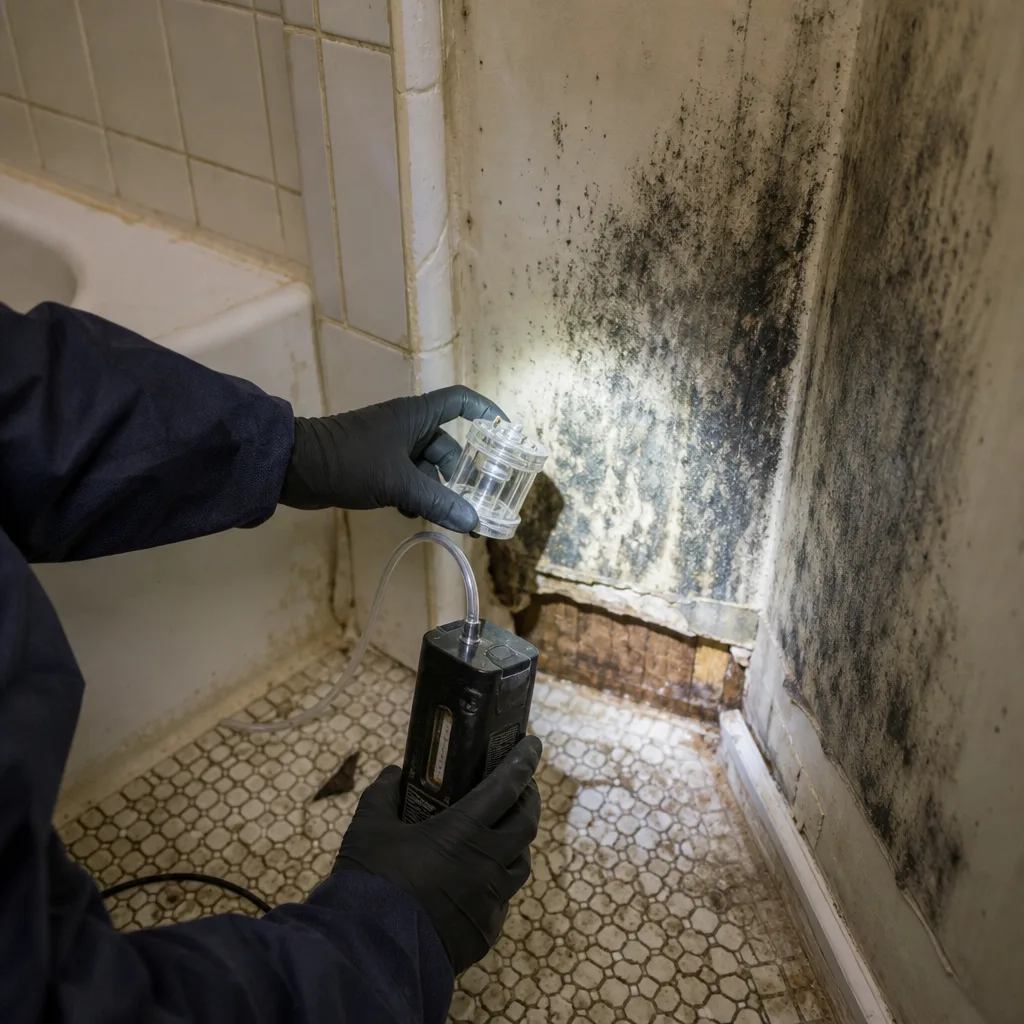
We walk the affected area with thermal imaging and moisture meters, mapping exactly where water traveled and where mold is active. In Williamsburg lofts, that means checking uninsulated concrete floors and exposed-brick walls for hidden moisture that visual inspection misses.
Containment Setup
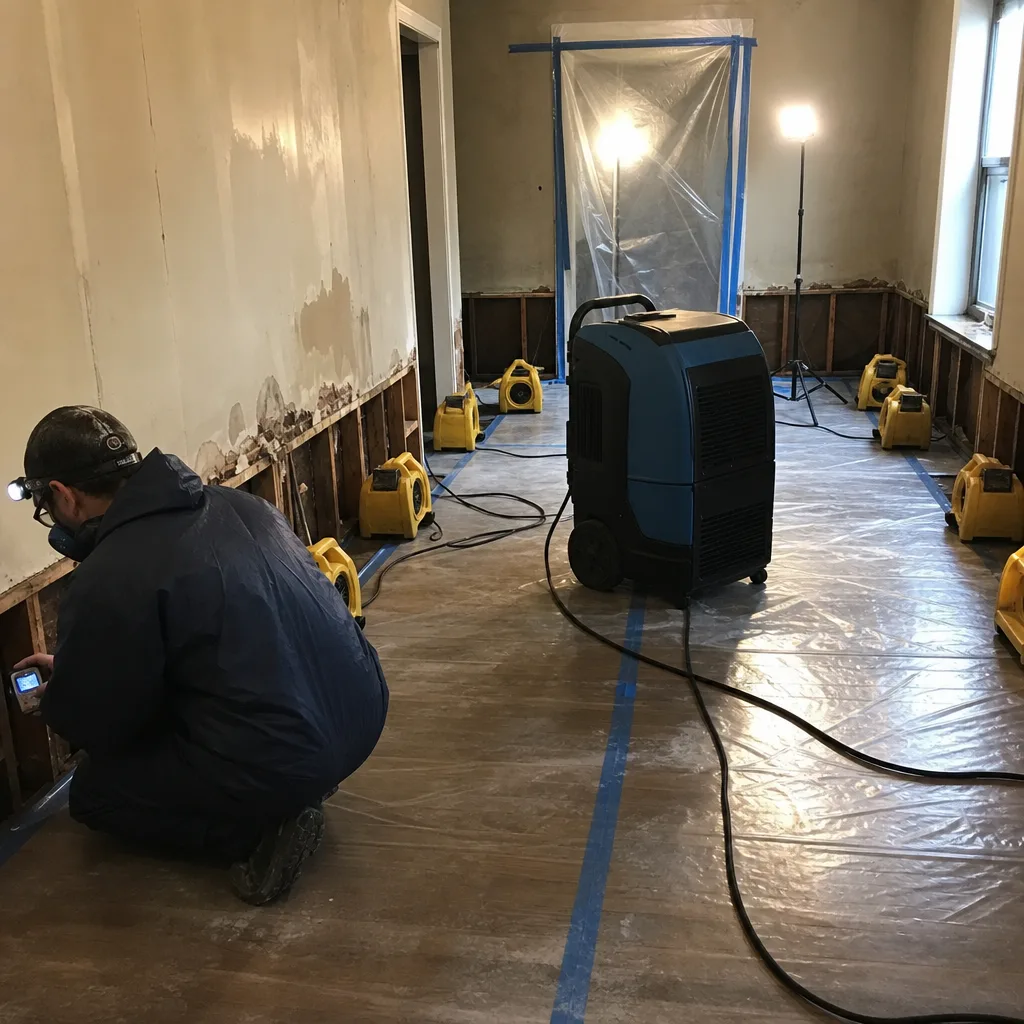
We seal the work area with 6-mil polyethylene and run HEPA air scrubbers to create negative air pressure. This keeps spores from moving through open-plan lofts or shared tenement hallways into unaffected rooms.
Moisture Extraction & Drying
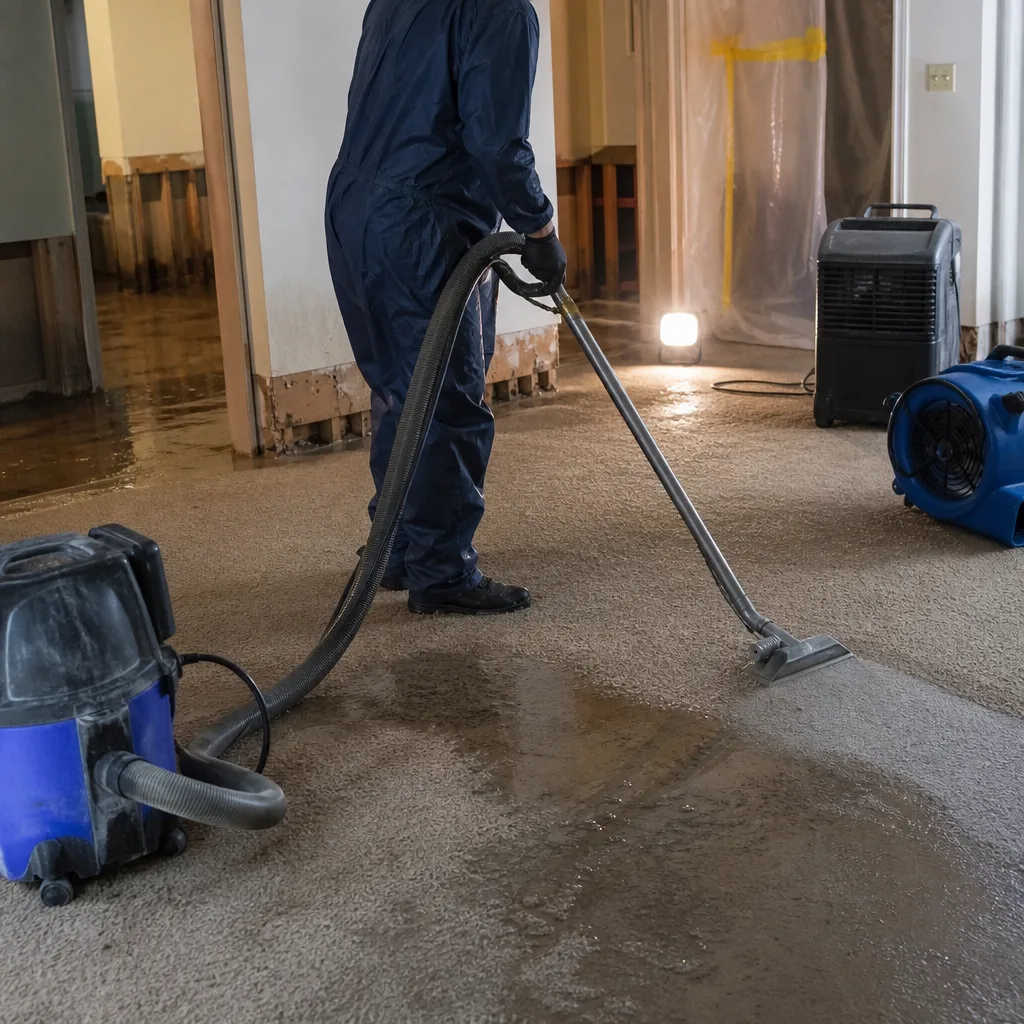
Dri-Eaz dehumidifiers and XPOWER air movers pull moisture from plaster, concrete, and structural cavities. We log daily readings until materials hit the dry standard, not when the visible water is gone.
Removal & Cleaning
Mold-affected drywall, plaster, and insulation are cut out and removed in sealed bags. Remaining surfaces get HEPA vacuuming and antimicrobial treatment appropriate to the material.
Air Quality Restoration
After remediation, HEPA filtration runs until airborne spore counts return to pre-loss levels. We provide clearance testing, not guesswork, before we call the job finished.
Repairs & Restoration
Our own crew reconstructs what came out. Drywall, trim, flooring, and paint go back in. The 90-Day Done Right Promise covers the work in writing.
Need Emergency Mold Remediation in Williamsburg Now?
Crews minutes away, answering live 24 hours a day. The sooner we start, the less it costs.
Working With Your Insurance Company
Mold coverage depends entirely on the source of the water. If a burst supply line or a covered appliance failure caused it, your policy likely responds. If the moisture accumulated slowly, coverage gets harder. When you call us, we document cause from the first hour: photos of the source, readings from the affected materials, and a timeline of when the water started. That record is what adjusters accept. We bill your carrier directly and handle adjuster communication, so you’re not chasing paperwork while your bedroom wall is open. For Williamsburg condos, we coordinate with both your unit policy and the building master policy when the loss originated in a common area like a roof drain or corridor pipe.
What We Provide Your Insurer
- Thorough documentation of the loss
- Photos of all damage, room by room
- Moisture readings and drying logs
- A detailed, line-item scope of work
- Direct coordination with your carrier
Built for Williamsburg’s Loss Calendar
Williamsburg’s mold season follows the water, and the water here comes in three waves. January and February deep freezes burst cast-iron supply lines in 1880s tenements along streets like Bedford Avenue and Driggs Avenue, flooding wall cavities and basement spaces before anyone notices the puddle forming under the stairs. March and April bring snowmelt and spring rain that backs up the combined sewer system, pushing Category 3 water into below-grade units near the East River. August and September deliver the nor’easters and tropical remnants that drive storm surge into flood zone AE along Kent Avenue and N 11th Street, where ground-floor condos and converted warehouse lofts take water through door thresholds and foundation seams.
The pattern matters because the response changes with the source. A clean water pipe burst in a tenement gets extraction and structural drying. Sewer backup or storm surge gets full containment, pack-out, and antimicrobial treatment. In Williamsburg, two units across the street from each other can need entirely different protocols for the same storm. That’s why we send a certified inspector first, not a crew with a preset plan.
Mold Remediation Across Williamsburg’s Neighborhoods
Northside Williamsburg, the blocks between McCarren Park and the East River, mixes pre-war walk-ups with post-rezoning condo buildings. Bedford Avenue tenements have thick horsehair plaster that holds moisture stubbornly, and drying those walls takes patience, not more equipment. The waterfront corridor along Kent Avenue and Wythe Avenue is flood zone AE, where ground-floor commercial conversions and loft apartments need elevated containment and extended drying after any surge event. South Williamsburg, around Division Avenue and Broadway, has a high concentration of older rowhouses with shared party walls, meaning moisture in one unit migrates laterally into the neighbor’s framing. East Williamsburg, past the BQE toward Flushing Avenue, holds converted industrial buildings where open-plan concrete floors and missing vapor barriers create unpredictable drying timelines. Each response route changes, but the standard doesn’t.
Specialized Mold Remediation Services We Offer in Williamsburg
Mold Inspection & Testing
We start with thermal imaging and moisture mapping, not a visual walkthrough. In Williamsburg lofts with exposed-brick walls and poured-concrete floors, surface-level inspection misses moisture trapped in assemblies. Testing confirms spore type and concentration before and after remediation.
Mold Removal
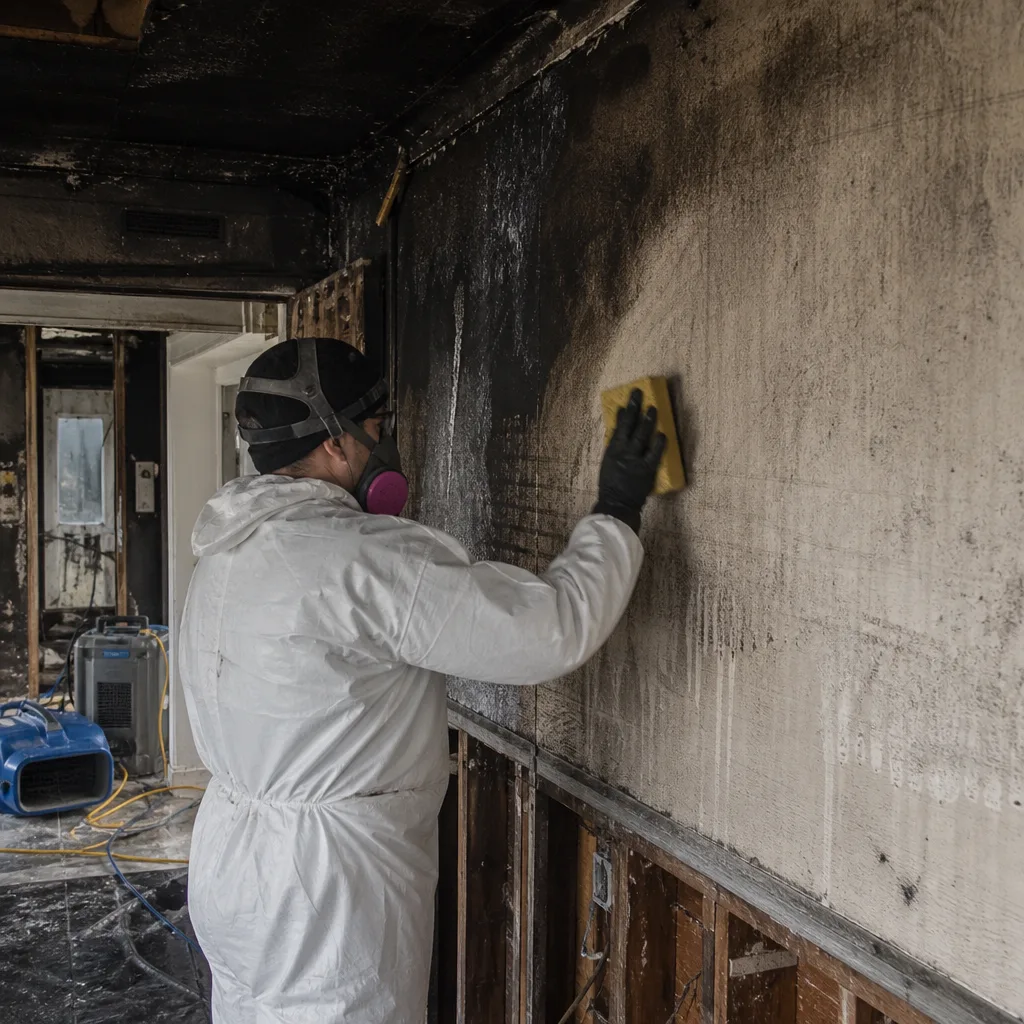
Removal means cutting out affected material and treating what remains, not spraying bleach on drywall. In pre-war tenements with horsehair plaster, that often means removing entire wall sections where moisture has wicked into the lathe behind the plaster surface.
Black Mold Remediation
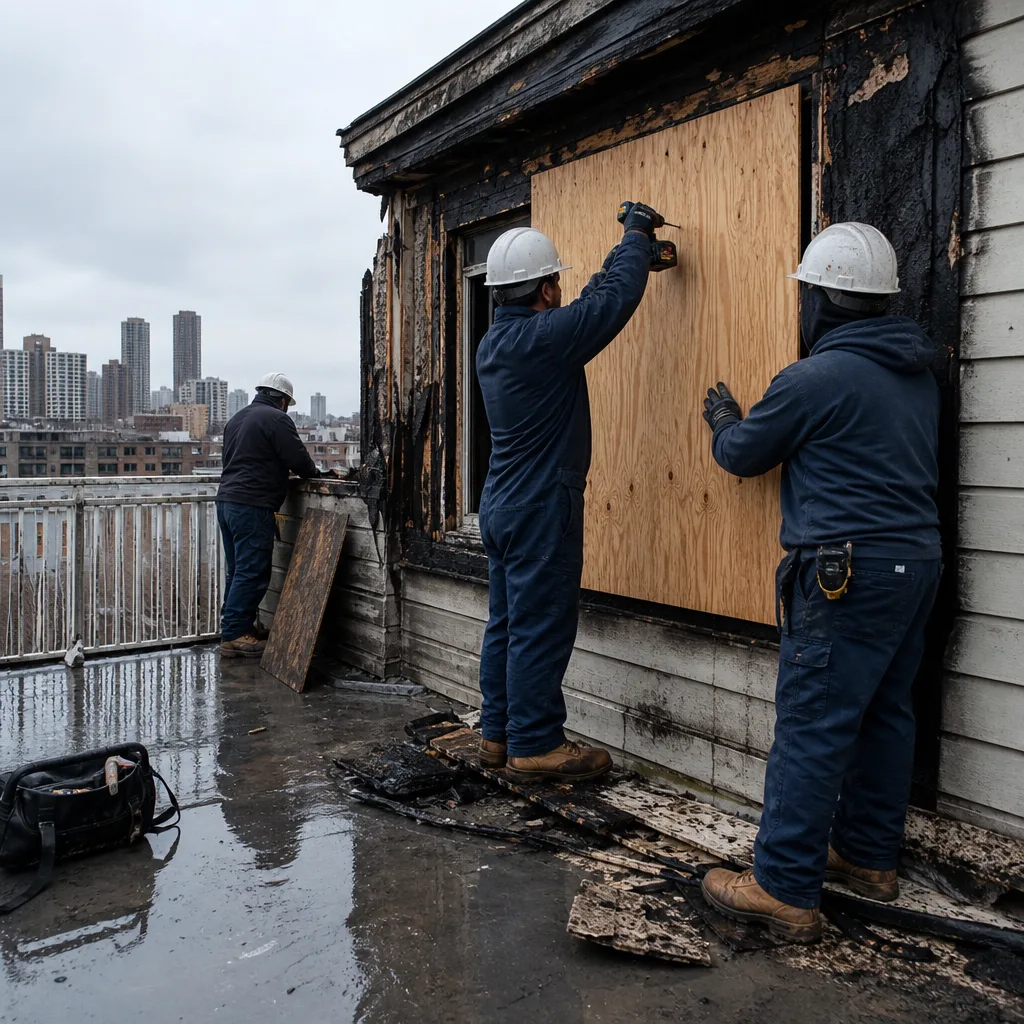
Black mold, Stachybotrys chartarum, feeds on cellulose materials that stayed wet for days. We see it in Williamsburg basements after sewer backup and behind drywall in waterfront units after surge events. Full containment and HEPA air scrubbing run throughout the job, and clearance testing confirms the space is clean before we rebuild.
Air Quality Restoration
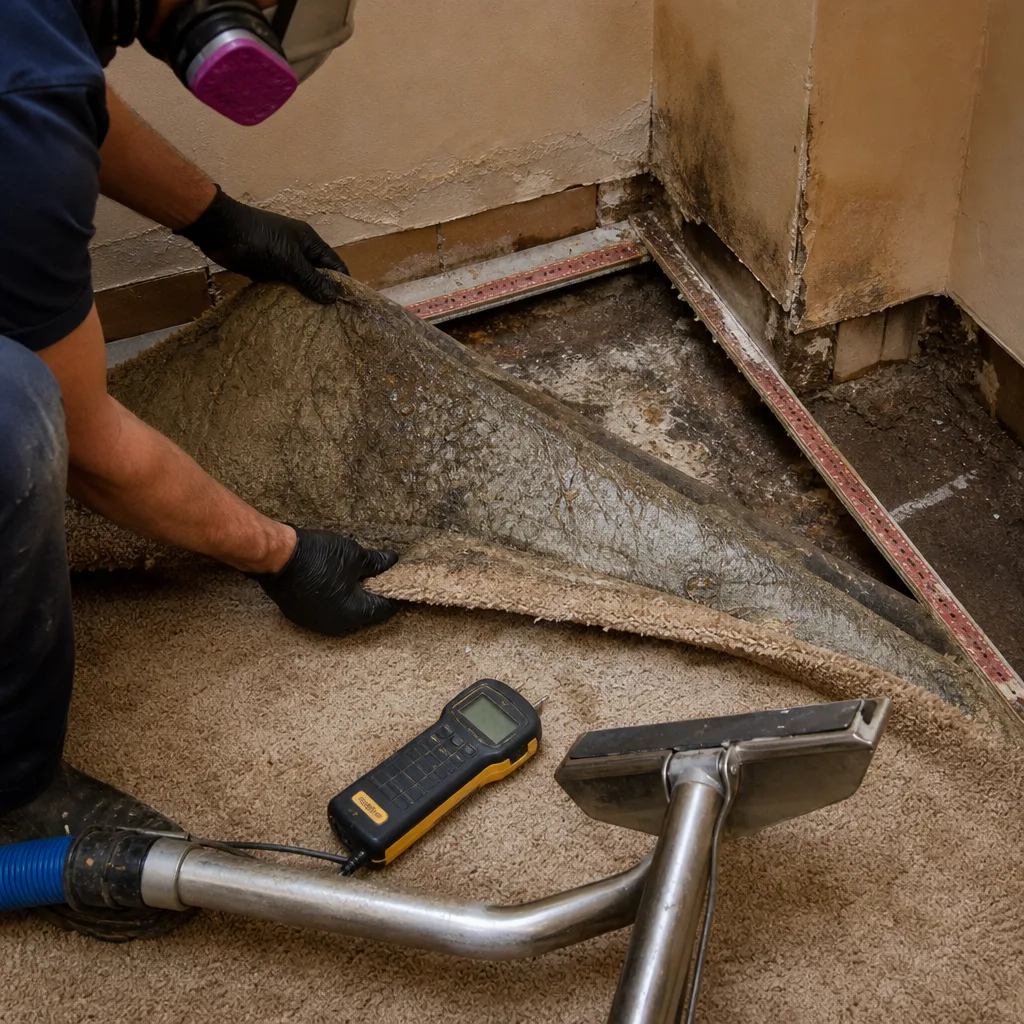
After mold removal, airborne spore counts don’t drop to safe levels on their own. HEPA filtration runs until independent readings match outdoor baseline. In open-plan warehouse conversions off Kent Avenue, where air moves unpredictably across concrete floors, this step takes longer and matters more. We treat adjacent units as connected spaces.
Crawl Space Treatment
Rowhouse crawl spaces in South Williamsburg trap humidity from exposed soil and foundation seepage. We install vapor barriers, seal foundation gaps, and run dehumidifiers sized to the cubic footage. The goal is a dry crawl space that stops feeding mold growth into the floor assembly above.
Moisture & Humidity Control
Williamsburg’s pre-war buildings were designed to breathe, and post-2005 towers were sealed tight. Both fail in opposite directions. We calibrate dehumidification and ventilation to the specific assembly, whether that means adding mechanical dehumidification to a converted loft or adjusting fresh-air intake in a luxury tower. Continuous humidity control is the only durable mold prevention.
What happens when you call
- 1
A real person answersNo phone trees - you reach a local pro.
- 2
You get an upfront price rangeHonest numbers before anyone is dispatched.
- 3
A background-checked tech heads outLicensed & insured, dispatched right away.
- 4
You approve before work beginsNothing starts until you say go.
Mold Remediation Costs in Williamsburg, NY
Williamsburg mold remediation prices sit similar to the rest of the New York metro, with local quirks. A standard containment and removal in a 10-by-10 bedroom runs $1,800 to $3,200. A full basement remediation after sewer backup, including pack-out, floor demolition, and antimicrobial treatment, ranges $4,500 to $8,500. Crawl space treatment with vapor barrier installation typically costs $2,000 to $4,500. Air quality restoration and clearance testing add $600 to $1,200 depending on unit size. What moves the price in Williamsburg specifically: horsehair plaster removal runs higher than drywall, open-plan lofts require more containment material, and flood zone AE ground-floor work sometimes needs extended drying days. The free visual inspection gives you a firm scope and a line-item number before any work starts. Senior and veteran homeowners get 5% off, always. Ask about the $50 off any repair over $250.
We Also Serve Cities Near Williamsburg
Our crews regularly respond beyond Williamsburg proper, covering Fairview, Harrison, East Bronx, and Hunts Point. Same 45-minute dispatch commitment, same Mold Remediation standard. If you’re in a neighboring area and seeing signs of mold, call the same number: (917) 924-4221.
Williamsburg Mold Remediation Questions, Answered
How fast can you get to a Williamsburg address?
Within 45 minutes. Calls are answered live 24/7, and crews dispatch from the New York City office directly to Williamsburg. For active water intrusion, containment can start the same visit.
How does Williamsburg’s flood zone AE risk affect mold remediation in ground-floor units after a nor’easter?
Flood zone AE ground-floor units take storm surge and combined sewer backup together, meaning the water is Category 3 and requires full containment, pack-out, and antimicrobial treatment. Standard drying alone isn’t enough. We treat every flood zone AE loss as contaminated water, not grey water, because skipping that distinction is why mold returns in those units.
Why do mold problems linger in former factory lofts on Kent Avenue after a water leak?
Uninsulated poured-concrete floors and exposed-brick walls with no vapor barrier wick moisture far beyond the visible wet area, trapping it for weeks. Standard drying timelines underestimate the load. Those assemblies need extended drying with Dri-Eaz dehumidifiers and daily moisture logs until readings hit the dry standard, not the calendar estimate.
How do you handle mold in 19th-century brick tenements with horsehair plaster walls?
Horsehair plaster absorbs moisture into the lathe behind the surface, where mold grows invisibly for weeks. Remediation means removing affected plaster sections, not surface treatment, then drying the framing and treating remaining structure before replastering or drywalling. We adjust moisture readings for the material’s baseline, which runs higher than modern drywall.
What is the first step in mold remediation for a Williamsburg condo after a Hurricane Sandy-type surge?
Containment and source identification. We seal the affected unit, identify whether water entered from the street, the sewer, or the building envelope, and classify it correctly. Category 3 water gets full containment and pack-out before drying. Then we coordinate with your condo board and your carrier, because common-area losses involve two policies.
Will my insurance cover mold remediation?
Coverage follows the water source. Sudden and accidental events like a burst pipe or storm surge are more likely covered than slow leaks or deferred maintenance. We document cause, readings, and timeline from the first hour, and bill your carrier directly with photographs and a line-item scope. Call (917) 924-4221 and we’ll walk you through your specific policy.
Does the 2005 waterfront rezoning affect mold remediation in newer Williamsburg towers?
Yes. Post-2005 towers are tightly sealed, so humidity from a small leak stays trapped and drives spore growth in wall cavities. Remediation in these buildings often requires containment on upper floors, coordination with building management, and HEPA air scrubbing to protect adjacent units sharing HVAC runs. The envelope and occupancy density change the protocol.
Can we stay in our Williamsburg home during mold remediation?
For isolated jobs under 10 square feet, often yes, with containment sealing the work area. For Category 3 water, black mold, or open-plan lofts where air moves freely, we recommend vacating until clearance testing confirms safe spore counts. We’ll tell you straight, based on the tech’s readings, not a script.
At a converted warehouse loft off Kent Avenue, our techs found uninsulated poured-concrete floors and exposed-brick walls with no vapor barrier had wicked moisture for weeks after Sandy’s storm surge. We set up containment with XPOWER air movers and Dri-Eaz dehumidifiers, ran moisture mapping on the brick and slab, and applied antimicrobial treatment after structural drying. The drying logs showed those assemblies needed twice the standard timeline before readings dropped to pre-loss condition. That’s the job in Williamsburg: two different buildings on the same block, two completely different protocols, one standard. Done right, and backed in writing.
Serving Williamsburg, NY - Our Local Coverage Area
We’re based in the Williamsburg area and know this community well. Use the map below to see our service coverage - if you’re nearby, we can almost certainly help.
Call Floodline Restoration Co. of Manhattan for Mold Remediation in Williamsburg
If you suspect mold in your Williamsburg home, condo, or loft, call (917) 924-4221 now. A live person answers. We’ll send a certified inspector, give you a free visual assessment, and if remediation is needed, you’ll get a written scope and line-item price before any work begins. The same uniformed crew handles extraction, drying, remediation, and rebuild. Direct insurance billing. The 90-Day Done Right Promise in writing. Senior and veteran discounts always apply. We’ll be there when we say.
Written by Curt Bowman, Owner at Floodline Restoration Co. of Manhattan, serving Williamsburg since the company’s founding in 2010.