
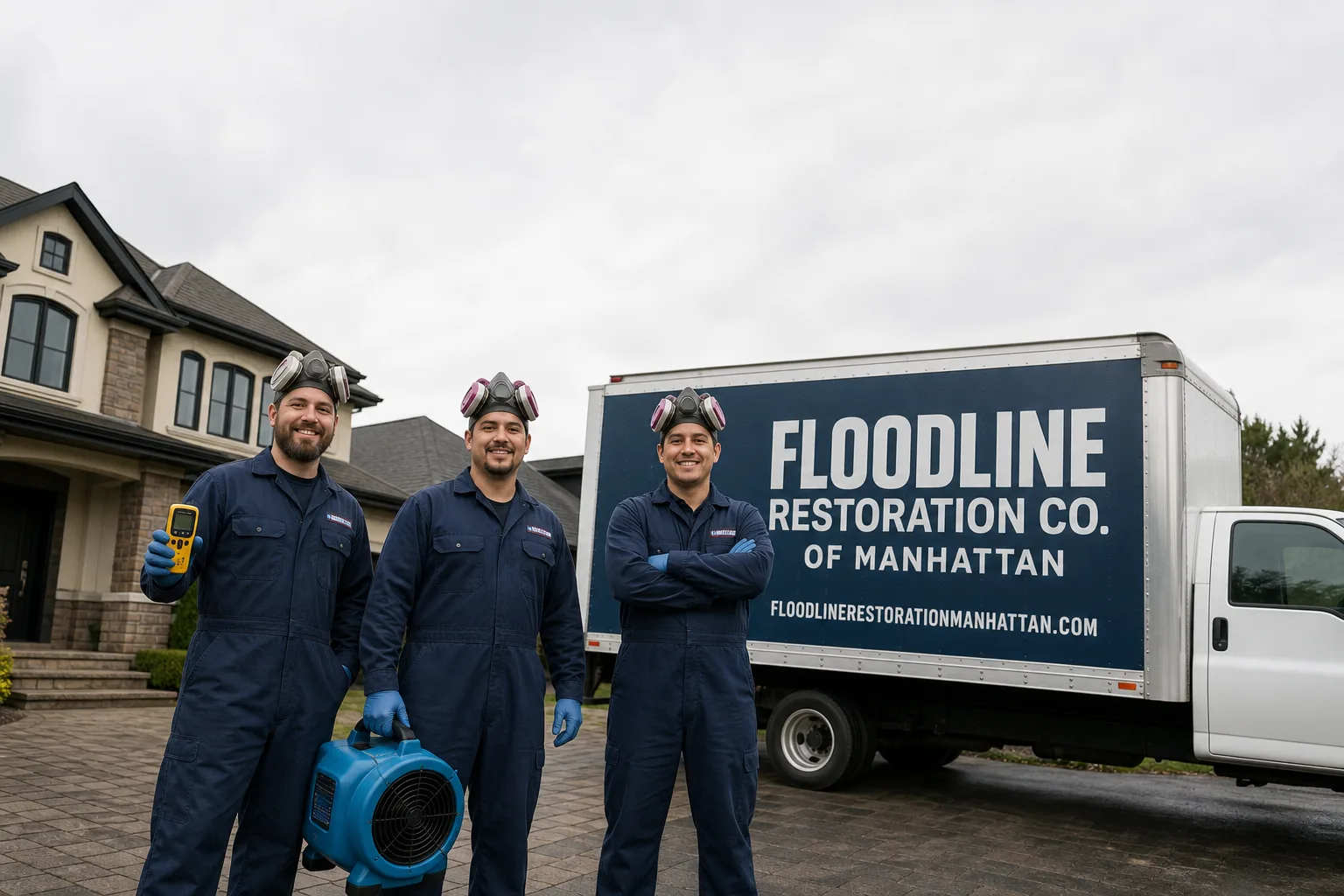
Free visual inspection and a written scope of work before any mitigation begins - photos, moisture readings, and drying logs go in your claim file
The scope we write is the scope we bill. Anything new gets shown to you, in writing, before we touch it.






 Before
 After
After Before
 After
After Before
 After
After24/7 Emergency Mold Remediation in Woodside
Mold in a Woodside rowhouse rarely announces itself. It starts as a musty smell in the basement apartment on 65th Place, a dark patch blooming behind a dresser on 43rd Avenue, a tenant’s cough that won’t clear. By the time it’s visible, it has usually been growing for weeks inside a shared party wall or behind plaster and lath. When you call Floodline Restoration Co. of Manhattan at (917) 924-4221, a live dispatcher answers immediately, day or night, and a certified crew is dispatched into the Woodside area right away. The first hour matters because mold releases spores continuously once disturbed, and in attached brick rowhouses, those spores travel through wall cavities, floor systems, and common hallways into units where the problem didn’t start. Our free visual inspection tells you what you’re actually dealing with before any work begins.
Understanding Mold Remediation Severity in Woodside Properties
Mold remediation is not a surface wipe, and in Woodside’s housing stock, it is rarely a contained problem. The neighborhood’s 1920s-1940s attached and semi-attached brick rowhouses share masonry party walls, and moisture moves through those walls the way it moves through a sponge. When a sewer line beneath 31st Avenue backs up into one basement, the adjoining basement often shows elevated moisture within days. Our crews use thermal imaging and moisture meters to map how far the water traveled, then set up full containment with negative air pressure and HEPA air scrubbing before any moldy material is disturbed. That containment step matters more in Woodside than in detached-home neighborhoods: opening a moldy plaster-and-lath wall without it sends spores into the tenant apartment above and the neighbor’s stairwell at the same time. We classify the water source first because it changes the protocol. Category 1 water from a burst supply pipe inside a unit calls for drying and antimicrobial treatment. Category 3 water from a combined sewer surcharge calls for removal and disposal of contaminated drywall, insulation, and often flooring before drying even begins. Treating sewage water as clean water is the single most common error we see from companies that don’t work regularly in Woodside, and it leads directly to rebound mold growth behind repaired walls.
Why Woodside Property Owners Choose Floodline Restoration Co. of Manhattan
- 45-minute response commitment – A certified crew is dispatched from our New York City office and reaches most Woodside addresses within 45 minutes of your call, with live phone dispatch running all 24 hours of the day.
- A real person answers, always – No automated phone tree, no answering service that takes a message. You call at 2 a.m., a live dispatcher picks up and starts the response.
- IICRC-certified crews – Our technicians carry current WRT, FSRT, and AMRT certifications and have worked hundreds of prewar rowhouse jobs, which matters when the mold is behind original plaster and lath.
- Free visual inspection – Before any remediation begins, we walk the property with you, explain what we’re seeing, and give you a written scope of work. No work starts until you approve it.
- Direct insurance billing – We document everything from the first hour, bill your carrier directly, and handle adjuster communication. You don’t play messenger between us and your insurer.
- One team from first visit to final coat – The same Floodline crew that reads the moisture map on day one monitors daily drying, removes contaminated material, and rebuilds what needs rebuilding. No mid-job handoff to an unfamiliar subcontractor.
Our Mold Remediation Process
Inspection & Assessment
We begin with a visual inspection, moisture readings across floors, walls, and party wall surfaces, and thermal imaging to find hidden moisture. If your property has a below-grade finished apartment, we map the entire footprint because water moves downhill through old foundations. The assessment includes identifying the water source, which is the only way to stop mold at its origin.
Containment & Stabilization
Before any moldy material is removed, we seal the affected area with plastic sheeting and set up negative air pressure using HEPA-filtered air scrubbers. This is non-negotiable in Woodside’s attached rowhouses, where disturbing mold in one unit sends spores through shared wall cavities into the adjacent home. We also address the water source immediately, whether that means stopping a supply leak or calling in our Sewage Cleanup in Woodside team for a floor drain that backed up.
Drying & Dehumidification
We position professional-grade Dri-Eaz dehumidifiers and Phoenix air movers to dry the structure to IICRC dry standard, using daily moisture readings logged in writing. In shared party walls, we may use Injectidry systems to pull moisture from within a wall cavity without opening the neighbor’s side. You and your insurer receive the full moisture log so the drying is documented, not claimed.
Cleaning & Sanitization
All affected surfaces are HEPA-vacuumed, then treated with EPA-registered antimicrobial solutions appropriate to the contamination category. We also run air scrubbing throughout the remediation period to capture airborne spores. This step combines with the containment to protect tenants in other units of your two-family house.
Mold Removal & Specialty Treatment
Contaminated drywall, insulation, carpet, or trim is bagged and removed through the nearest exit while containment remains in place. We treat the underlying framing and masonry with antimicrobial products sized to the category of the original water loss, then inspect the cavity for any remaining moisture before reconstruction begins. For black mold, or Stachybotrys, we follow full removal and disposal protocols and conduct clearance testing after remediation is complete.
Repairs & Restoration
The same Floodline crew that performed the remediation rebuilds what was removed. We match materials and finishes to your rowhouse’s original character, from plaster repair to baseboard profiles, so the finished space doesn’t look like a patch job. The job isn’t done until you and your insurer have documentation of every step, and our 90-Day Done Right Promise stands behind all of it in writing.
Need Emergency Mold Remediation in Woodside Now?
Crews minutes away, answering live 24 hours a day. The sooner we start, the less it costs.
Working With Your Insurance Company
Mold remediation in Woodside is rarely a simple single-policy claim. Many of the neighborhood’s two-and-three-family homes have an owner’s policy covering the structure and a tenant’s policy covering personal property and displacement. When mold began with a sewer backup in a basement apartment, the adjusters for both policies need documentation that speaks their language. Floodline Restoration Co. has handled hundreds of these split claims, and we built our documentation process around them. From the first hour, we photograph every affected room, log moisture readings daily, and note exactly which portions of the loss are structural versus personal property. That documentation goes to your carrier directly, and our team communicates with your adjuster throughout the job. You aren’t left translating between a restoration company and an insurance desk.
What We Provide Your Insurer
- Thorough documentation of the loss
- Photos of all damage, room by room
- Moisture readings and drying logs
- A detailed, line-item scope of work
- Direct coordination with your carrier
Built for Woodside’s Loss Calendar
Woodside’s mold calls follow the weather and the sewers, and anyone who has lived here through a full year knows the two are connected. In January and February, deep freezes stress the aging supply lines running through unheated basement crawl spaces and exterior wall cavities in 1920s brick construction. When those pipes split, water runs down into the party wall and the basement below, and mold follows within days if drying doesn’t start immediately. Spring brings thaw and the first sustained rain events, when Queens’ combined sewer system begins to hit its limits. By summer, heavy thunderstorm downpours routinely surcharge the lines beneath Woodside Avenue, Roosevelt Avenue, and the residential side streets, sending category 3 water back through floor drains into below-grade apartments. Each of those events is a mold event waiting to happen, because sewage water soaked into drywall and lath sits there growing cultures long after the standing water is gone. The fall nor’easter season brings roof leaks from flat roofs with aging membranes, and those leaks drip into top-floor ceilings and travel down through wall cavities for weeks before anyone sees a stain. In every season, the pattern is the same: Woodside’s attached housing stock doesn’t isolate water the way a detached house does. What starts in one unit becomes a problem for the house next door, and the house above it.
Mold Remediation Across Woodside’s Neighborhoods
Our crews know Woodside’s streets because we’ve worked most of them. The blocks around 65th Place and 64th Street are dense with 1930s brick rowhouses where basement apartments sit below grade, and those units account for a large share of our sewer-backup mold calls. On the blocks between Roosevelt Avenue and Broadway, two-family homes with commercial storefronts below often hide mold behind partition walls that were added during conversions decades ago, with no vapor barrier and no airflow. The Winfield section near 69th Street and 48th Avenue has many semi-attached frames where mold spreads laterally through shared attic spaces as well as party walls, which changes how we scope the containment. And in the blocks around the Woodside LIRR station, the constant vibration from trains can open hairline cracks in old foundation walls over time, giving groundwater an entry point during wet months. Each area has its own pattern, and knowing the pattern is part of why we can give an accurate assessment on the first visit rather than discovering problems mid-job. Our Mold Remediation in Woodside team stages from a New York City dispatch office and knows the response routes through Queens Boulevard, 31st Avenue, and Northern Boulevard by heart.
Specialized Mold Remediation Services We Offer in Woodside
Our core Mold Remediation work covers every phase from first inspection to final rebuild. Within that, these are the services Woodside calls us for most often.
Mold Inspection & Testing
Before any remediation begins, you need to know what you’re looking at. In a Woodside rowhouse, that means understanding not just the visible mold but the moisture behind it and where it came from. We use thermal imaging, moisture meters, and air sampling where called for, and we explain the findings in plain language. If you’re selling a two-family house on 43rd Avenue or preparing to rent a basement unit, this inspection documents the condition of the property.
Black Mold Remediation
Black mold, or Stachybotrys, gets attention because it should. It grows on materials that were wet for an extended period, and in Woodside, those materials are usually the drywall, lath, and framing that sat in sewage-backed floodwater or behind a leaking roof membrane. Full removal requires containment, HEPA air scrubbing, bagged disposal of all contaminated material, antimicrobial treatment of the cavity, and clearance testing before anyone moves back into that room. We handle the entire sequence in-house.
Moisture & Humidity Control
Mold returns when moisture returns, and in Woodside’s below-grade apartments, moisture is a constant. After remediation, we address the conditions that let mold thrive in the first place: sealing foundation cracks, installing vapor barriers, upgrading drainage, and recommending dehumidification sized to the space. This is the step that separates a job that stays done from a job that comes back in six months.
Air Quality Restoration
After moldy materials are removed, the air in the affected unit and often the whole house needs to be brought back to a healthy condition. We run HEPA air scrubbers throughout the remediation and leave the air cleaner than we found it. In a rowhouse with shared stairwells and party walls, this matters for tenants who live above or next to the affected apartment.
Crawl Space Treatment
Many Woodside rowhouses have shallow crawl spaces under the rear extension where kitchen and bath plumbing runs. These spaces are rarely vented properly, and a slow plumbing leak there can feed mold for months before anyone notices a smell. We treat crawl spaces with containment, antimicrobial application, and moisture control so the hidden space stays dry and clean.
What happens when you call
- 1
A real person answersNo phone trees - you reach a local pro.
- 2
You get an upfront price rangeHonest numbers before anyone is dispatched.
- 3
A background-checked tech heads outLicensed & insured, dispatched right away.
- 4
You approve before work beginsNothing starts until you say go.
Mold Remediation Costs in Woodside, NY
Mold remediation in Woodside is priced by the scope of the affected area, the category of the original water, and the number of units involved. A typical containment-and-remediation job for a single basement wall in a rowhouse on 65th Place runs $1,800 to $4,500. A full basement apartment affected by category 3 sewer backup water usually falls between $6,000 and $14,000, with the higher end reflecting the removal and replacement of drywall, insulation, and flooring across multiple rooms plus the equipment and labor needed for multi-day drying. Mold inspection and testing alone typically runs $450 to $900 in the Woodside market. If the mold spread through a party wall into a neighbor’s unit, the job becomes a two-unit scope and the total may reach $15,000 to $25,000 split between two insurers. What moves the price is the water source first: a clean water leak costs less to remediate because materials can often be dried in place, while category 3 sewage water means removal and disposal. The free visual inspection is how you get to a firm number. We walk the property, map the affected areas, and give you a written scope with the price fixed before any work begins. Then that same scope goes to your insurer, and we bill them directly. For a free estimate, call (917) 924-4221.
We Also Serve Cities Near Woodside
Our Woodside crews routinely work in the bordering Queens neighborhoods of Sunnyside, where the prewar brick six-family buildings have many of the same party wall issues, Jackson Heights, with its co-op basement spaces under similar combined sewer stress, Long Island City, where converted industrial buildings bring their own moisture challenges, and Maspeth, where two-family frame and brick homes face the same seasonal patterns.
Serving Woodside, NY - Our Local Coverage Area
We’re based in the Woodside area and know this community well. Use the map below to see our service coverage - if you’re nearby, we can almost certainly help.
Woodside Mold Remediation Questions, Answered
How do you handle mold remediation in a Woodside rowhouse where the mold started in my neighbor’s unit and spread through the party wall?
We remediate both sides of the wall or we don’t fix the problem. When mold travels through a shared party wall, any treatment that only addresses one unit leaves active growth on the other side that will migrate back within months. In these situations, we coordinate with both owners, set containment on both sides, and document the scope so each insurer handles its own portion of the loss. In one job on 65th Place, a basement apartment in a 1930s brick rowhouse had repeated category 3 backups through the floor drain, and moisture had wicked into the party wall shared with the neighbor. We also offer Biohazard & Crime Scene Cleanup in Woodside for situations requiring specialized decontamination. We set full containment, removed contaminated drywall and lath, applied antimicrobial treatment, and used Injectidry to dry the shared wall without opening the neighbor’s side, halting mold growth and restoring air quality in both units. The key is catching the shared wall issue early. If you suspect mold from a neighbor’s unit is reaching yours, call (917) 924-4221 for a free inspection. We measure both sides and give you a written answer.
My basement apartment in Woodside flooded from a sewer backup during a heavy rain. Does that affect how the mold remediation is done?
Yes, and it’s the single biggest factor. Sewer backup water is category 3 water under IICRC standards, meaning it carries sewage, bacteria, and pathogens. Materials that absorbed that water – drywall, insulation, carpet, wood trim – must be removed and disposed of, not dried in place. Companies that misclassify sewage backup as category 2 often try to dry it out, and that leaves contamination inside your walls that becomes a mold source within weeks. In Woodside, where the combined sewer system backs up through floor drains into below-grade apartments during heavy rain events, this is a routine call for us. Full decontamination protocols, HEPA vacuuming, and antimicrobial treatment are standard on every sewage-related job. If your basement apartment flooded from a sewer backup, don’t wait to see if it dries on its own. Call our Mold Remediation team at (917) 924-4221, and we’ll assess it properly from the start.
Do I need to vacate my Woodside two-family house during mold remediation?
In most cases, the affected unit needs to be vacated while work is active, but the rest of the house can remain occupied thanks to containment. We seal the work area with plastic barriers and run negative air pressure so spores and dust stay inside the contained zone, not in hallways, stairwells, or the adjoining unit. For a typical basement apartment job, the tenants above can stay in place. If the remediation involves a whole-floor scope in a two-family rowhouse, the affected floor should be empty during active removal and for a short period after, usually 24 to 72 hours. We give you a clear timeline before work starts, and we’ll tell you exactly which rooms need to be clear and when. The containment approach matters especially in Woodside’s attached homes, where common hallways and shared stairwells connect units.
What causes the recurring musty smell in my Woodside prewar rowhouse even after cleaning?
A musty smell that returns after cleaning is almost always a moisture source that hasn’t been found and stopped. In Woodside’s prewar rowhouses, the usual suspects are a slow leak in a drain line inside a wall cavity, moisture wicking through a foundation wall into a basement, or water trapped in a party wall after a past backup. The smell is volatile organic compounds released by mold growing somewhere you can’t see. Cleaning surfaces treats the symptom. The fix is to find the moisture with thermal imaging and moisture meters, remove the moldy material, and dry the cavity to standard. In a brick rowhouse on 31st Avenue, a recurring smell in the kitchen turned out to be a cracked cast-iron waste line inside the party wall that had been leaking for years. For major weather events, see our Storm & Disaster Restoration in Woodside services. Once we opened the wall under containment, removed the contaminated lath, dried the cavity, and repaired the line, the smell was gone for good. If your rowhouse smells musty after rain or in damp months, call us at (917) 924-4221 for a free inspection.
Can you remediate mold in a Woodside rowhouse without damaging the original plaster and lath details?
Often yes, but it depends on how much water the plaster absorbed and for how long. Plaster is porous, and when it sat wet for weeks behind a leaking roof or in a flooded basement, it cannot be saved. But in cases where the mold is surface-level or the plaster walls stayed relatively dry while the damage was in the framing or the cavity behind, we can sometimes remove only the contaminated portions and stabilize the rest. Our crews also know how to cut clean lines and patch with plaster, not just drywall, so the original detail is preserved where possible. The important part is that we don’t take a saw to plaster before we know what’s behind it. In a 1930s rowhouse, the walls may contain original lead-based paint layers, and we handle that with proper work practices. If preserving your original plaster matters to you, tell us during the inspection, and we’ll factor that into the scope. The goal is to remove the mold, not the character of your house.
How fast can you get to my Woodside rowhouse for a mold problem?
Our commitment is 45 minutes. A live dispatcher answers your call at (917) 924-4221, and a certified crew is dispatched from our New York City office into Woodside. In many cases we’re on site sooner, but 45 minutes is the outside mark. For active mold spread, that speed matters because every hour the mold is left undisturbed is another hour of spore release into the air of your home. We bring our inspection equipment on the first visit, so the free visual inspection happens the same visit, not on a follow-up appointment.
Will my insurance cover mold remediation in Woodside?
It depends on the cause of the original water loss and the terms of your policy. Most standard homeowners policies cover mold remediation when it results from a covered water event, like a burst pipe or a sewer backup with the proper endorsement. They generally do not cover mold from long-term humidity or gradual leaks with no sudden event. The challenge in Woodside is that many properties are two-family homes with tenants, so there may be two policies involved: your owner’s policy for the structure and your tenant’s renters policy for personal property and displacement. We help you sort that out. Our team documents the loss from the first hour, photographs everything, and communicates directly with both adjusters so you don’t have to argue the facts yourself. The best way to know is to call us for the free inspection and then let us walk your claim through the documentation process.
What should I do in the first 30 minutes after I discover mold in my Woodside home?
Don’t touch it. Disturbing visible mold, even by wiping it, releases spores into the air and spreads the problem through wall cavities and into other rooms. If there’s an active water source, shut off the water supply if you can do so safely. Keep children, pets, and anyone with respiratory conditions out of the affected room. Close the door to contain the area as much as possible. Then call (917) 924-4221. A live dispatcher answers, and we’ll walk you through what to do while the crew is on the way. The first 30 minutes are about containment, not cleanup. Let our certified technicians handle the assessment and the removal.
Written by Curt Bowman, Owner at Floodline Restoration Co. of Manhattan. After more than a decade running crews through Queens’ prewar housing stock, Curt has seen just about every way water finds its way into a rowhouse, and he built this company around one rule: the job is done when the moisture log says it’s done, and the guarantee is in writing.