
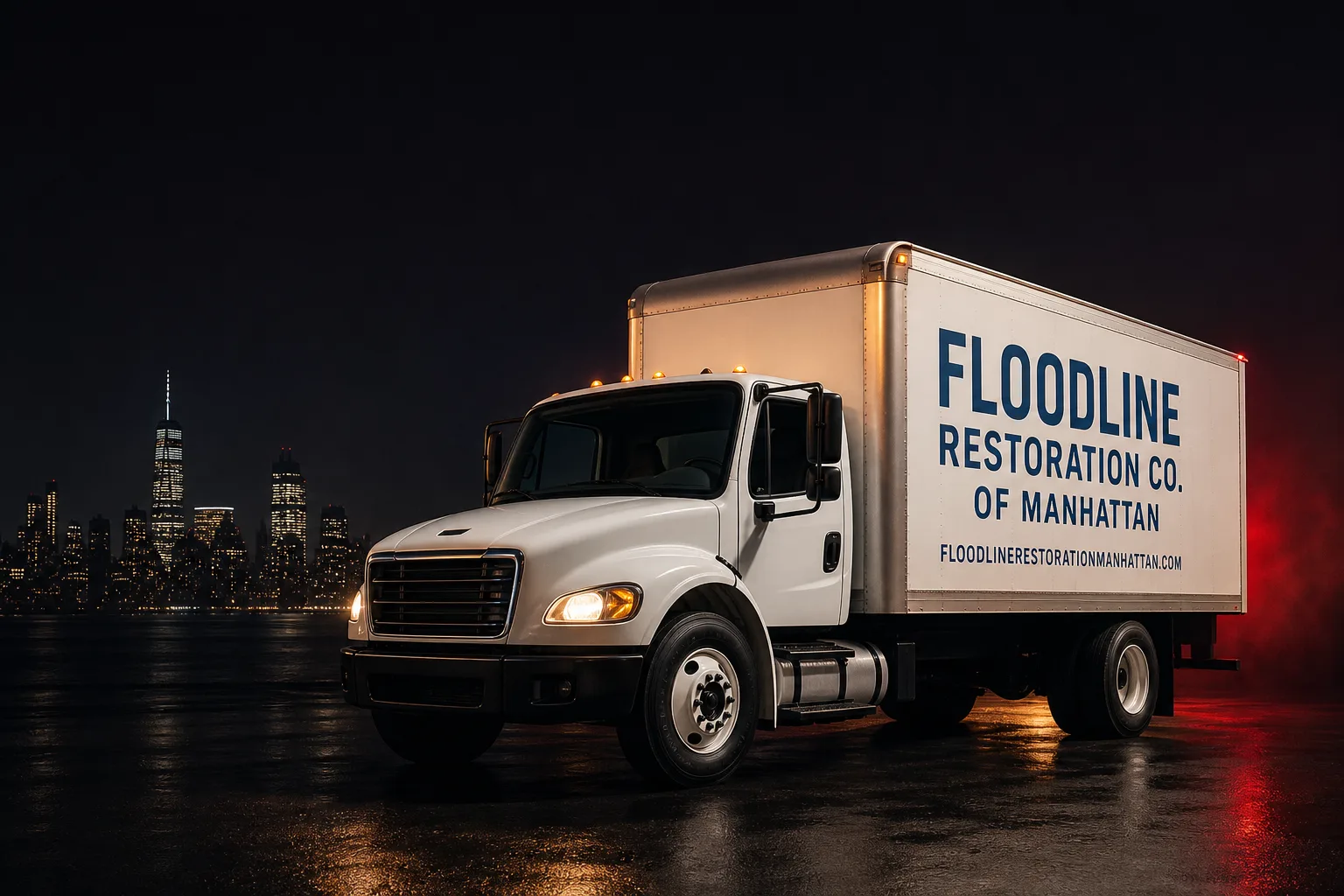
Free visual inspection and a written scope of work before any mitigation begins - photos, moisture readings, and drying logs go in your claim file
The scope we write is the scope we bill. Anything new gets shown to you, in writing, before we touch it.






 Before
 After
After Before
 After
After Before
 After
After24/7 Emergency Storm & Disaster Restoration in Central Harlem
When a storm tears through Central Harlem and water is pushing through a party wall or a flat roof gives way, you need a crew that answers the phone at two in the morning and gets extraction running the same visit. Floodline Restoration Co. of Manhattan dispatches certified, uniformed crews to Central Harlem around the clock, every day of the year. We arrive fast, assess the full scope without sales pressure, and start stabilizing the building so the damage stops spreading while you watch. Call (917) 924-4221 now and you’ll reach a live dispatcher, not a recording. The first hour matters most: the sooner we start pulling water and air-drying structural cavities, the less invasive and expensive the final repair becomes, especially in the shared-wall brownstones and pre-war tenement buildings that define this neighborhood.
Understanding Storm & Disaster Restoration Severity in Central Harlem Properties
Storm restoration in Central Harlem is never just about the water you can see. The housing stock here, mostly built between the 1890s and 1930s, hides damage in ways newer construction doesn’t. Water is classified in three categories: Category 1 is clean water from a supply line; Category 2 carries contaminants from appliances or sump overflow; Category 3 is sewage, floodwater, or water that has passed through building materials and picked up bacteria. In Central Harlem, the combined sewer system surcharges during heavy thunderstorms and nor’easters, so what starts as rain in a basement floor drain can quickly become Category 3 sewage back-flow through the same pipes. Inside these buildings, terra cotta block walls and plaster-over-lath ceilings wick moisture laterally. Water from one burst cast iron stack travels horizontally through party walls into two or three adjacent units, often across separate ownerships. Our crews use thermal imaging and moisture mapping to find that hidden migration, then set containment and run Dri-Eaz and Phoenix dehumidifiers with daily moisture readings until the dry standard is met. On landmarked blocks like Strivers’ Row, that early documentation is the only thing standing between a straightforward repair and a stop-work order.
Why Central Harlem Property Owners Choose Floodline Restoration Co. of Manhattan
- 45-minute response commitment. When water is spreading through a party wall on W. 139th St., forty-five minutes is the difference between one affected unit and three. We commit to it because that speed is what our crews are built around.
- Live answer 24/7. A person picks up the phone at 2 a.m. Not a queue, not a callback. A dispatcher who knows Central Harlem’s buildings and can send a crew immediately.
- IICRC-certified crews. Our technicians hold WRT, FSRT, and AMRT certifications and work on IICRC, RIA, and IFA standards. They’ve been background-checked, uniformed, and trained on pre-war building systems, not just modern drywall and stud construction.
- Free visual inspection. We walk the loss with you before any invoice exists, explain what we’re seeing in plain language, and agree on a written scope. No pressure, no surprises.
- Direct insurance billing. We bill your carrier directly and coordinate with your adjuster, so you’re never the messenger between a contractor and an insurance company that doesn’t return calls.
- One team from extraction to reconstruction. The same certified crew that reads the moisture map on day one handles the daily readings, the drying log, and the rebuild. No mid-job handoff. No inherited crew.
Our Storm & Disaster Restoration Process
Inspection & Assessment
We arrive, walk the property, and use thermal imaging and hygrometers to map the full extent of moisture migration, including inside party walls and beneath plaster ceilings. On landmarked blocks, we photograph everything before anything is touched. You get a straight explanation of what we found and what it costs.
Extraction & Stabilization
High-capacity extractors pull standing water from floors, basements, and wall cavities. We set up emergency board-up and roof tarping where the storm opened the envelope, so no more water enters while we work. Containment barriers go up in affected areas to stop disturbed soot, mold spores, or sewage aerosol from spreading through the rest of the home.
Drying & Dehumidification
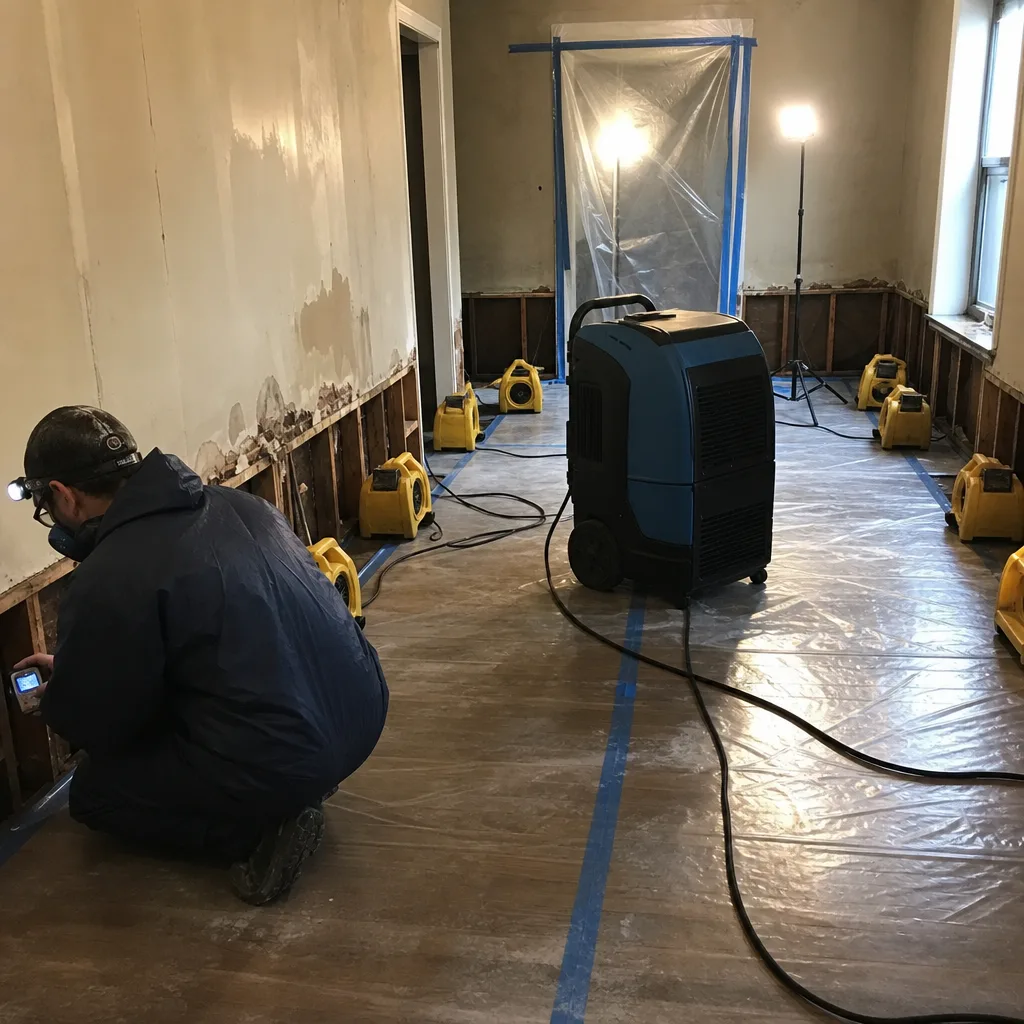
Commercial Dri-Eaz and Phoenix air movers and dehumidifiers are placed on a moisture-map-driven layout, not scattered by guesswork. We take daily readings and keep a written drying log for you and your carrier until the dry standard is met. In Central Harlem’s terra cotta block and plaster-over-lath construction, this phase usually takes longer than in drywall-and-stud buildings. We plan for that and tell you the truth about it.
Cleaning & Sanitization
After storm damage with sewage back-flow or floodwater, surfaces that were affected are cleaned with antimicrobial treatments and HEPA-filtered air scrubbing is run to capture airborne contaminants. Salvageable contents are cleaned and restored where possible; unsalvageable materials are removed and catalogued for your claim.
Specialty Treatment: Landmark & Party-Wall Work
On Strivers’ Row, Mount Morris Park, and other designated blocks, we file emergency Landmarks Preservation Commission applications before removing original plaster, millwork, or masonry. On ordinary pre-war buildings, our structural crew assesses shared party-wall drainage before replacing any cast iron stack, because the wrong material choice just moves the leak next door.
Repairs & Restoration
Once the building is dry and stable, our own reconstruction crew rebuilds. Original plaster is reinstated on landmarked blocks, not swapped for drywall. Cast iron stacks are replaced with compatible materials and tested before walls close. The job isn’t done until the moisture log is in your hand and the 90-Day Done Right Promise is in writing.
Need Emergency Storm & Disaster Restoration in Central Harlem Now?
Crews minutes away, answering live 24 hours a day. The sooner we start, the less it costs.
Working With Your Insurance Company
We’ve handled storm and flood claims for Central Harlem homeowners for years, and the pattern is always the same: the claim goes smoothly when the documentation is airtight and the adjuster can see exactly what happened. From the first hour on site, our team photographs every affected room, logs moisture readings daily, and builds a line-item scope of work that matches industry-standard estimating software your carrier already recognizes. We coordinate directly with your adjuster and bill your insurer directly, so you’re not chasing reimbursement or translating a contractor’s invoice into claim language. We’ve gone through this with carriers ranging from major national insurers to niche policies written for older Manhattan co-ops and condos. If your building is a co-op with its own master policy and your own individual unit policy, we know how to split the claim correctly so neither party pays for the other’s loss.
Our Storm & Disaster Restoration team treats the insurance claim as part of the restoration job, not an afterthought. That means the scope we write on day one reflects the full stop the damage caused, not just what’s easiest to photograph.
What We Provide Your Insurer
- Thorough documentation of the loss
- Photos of all damage, room by room
- Moisture readings and drying logs
- A detailed, line-item scope of work
- Direct coordination with your carrier
Built for Central Harlem’s Loss Calendar
The storm damage we see in Central Harlem follows a rhythm that anyone who’s owned a brownstone here for twenty years already knows. Winter is the supply-line season: deep freezes burst uninsulated plumbing in these old buildings, and water runs down through plaster ceilings and into the unit below. Spring brings thaw and the first serious rain events, when flat tar-and-gravel roofs that were just barely holding on finally fail and basement floor drains begin backing up as the ground saturates. Summer is the worst for sewage back-flow, because sudden thunderstorms dump more water than the combined sewer system can handle, and that water comes up through basement drains as Category 3. Fall and early winter bring nor’easters, the storms that push wind-driven rain against the soft brownstone masonry on facades, and that water finds its way into interior walls through masonry spalling that’s been developing all year. Nobody who lives here is surprised by these seasons, but surprises are what happen when they’re ignored.
Storm & Disaster Restoration Across Central Harlem’s Neighborhoods
Central Harlem isn’t one building type, and the restoration work changes block by block. Up on Strivers’ Row, the landmarked brownstones between W. 138th and W. 139th Streets are among the most architecturally significant rowhouses in the city, and any water-damaged plaster ceiling or millwork there triggers Landmarks Preservation Commission review before we can touch it. Around Mount Morris Park on W. 120th to W. 124th Streets, the historic district adds similar constraints, and the steep grade toward Marcus Garvey Park means basement flooding follows the slope. The five- and six-story tenement-style walk-ups along Lenox Avenue and Adam Clayton Powell Jr. Boulevard were built in the first decades of the 1900s with shared party walls and roof drains that often serve multiple units, so a storm backup in one line backs up four apartments at once. The larger pre-war elevator buildings east of Frederick Douglass Boulevard present their own profile: long roof spans, large windows that fail under high wind, and basement-level mechanical spaces that flood during combined sewer surcharge events. Our crews know the response routes down Adam Clayton Powell Jr. Boulevard, across 125th Street, and up St. Nicholas Avenue, which matters when a nor’easter has knocked out traffic signals and you need a truck through Manhattan quickly.
Specialized Storm & Disaster Restoration Services We Offer in Central Harlem
Storm Damage Cleanup
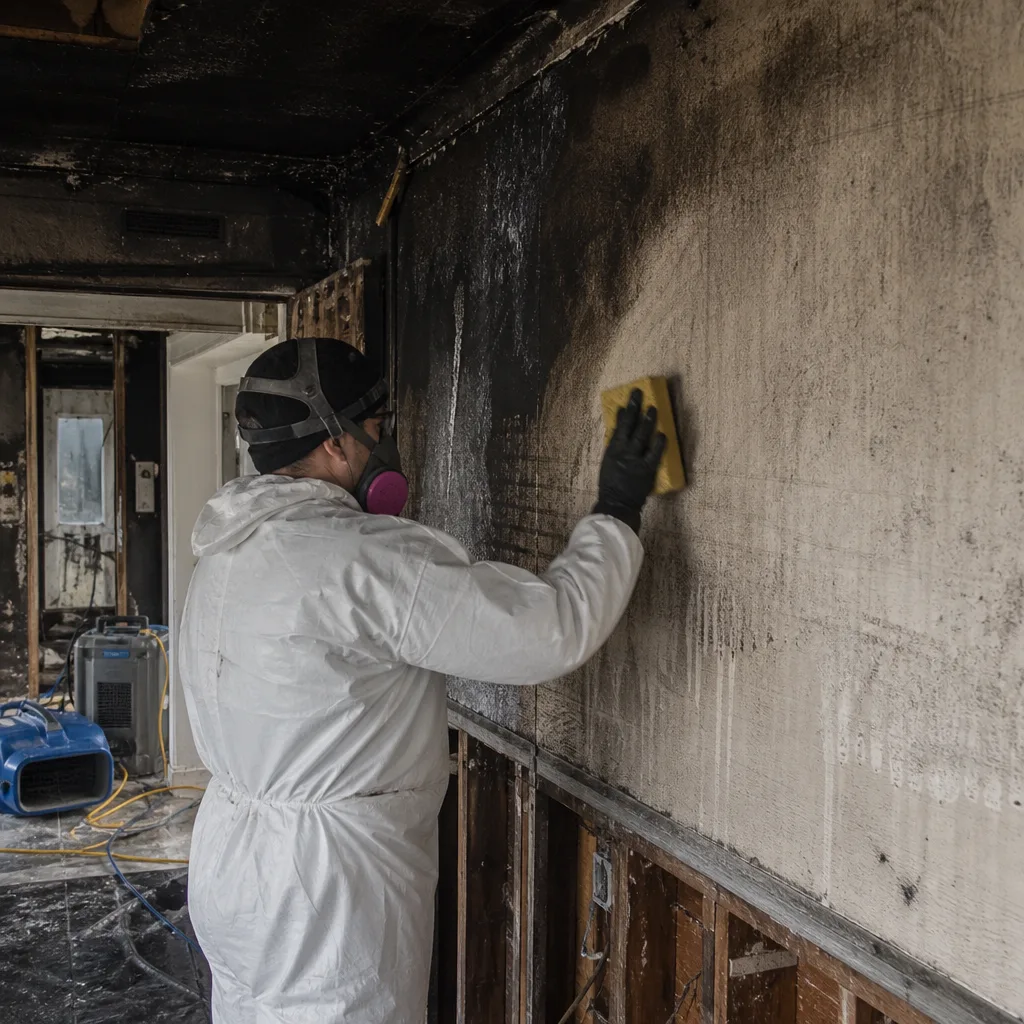
After the wind and water stop, the cleanup is where secondary damage starts or stops. We remove wet contents, dry structural cavities, and clean storm residue with professional-grade equipment. In Central Harlem’s pre-war buildings, cleanup without moisture mapping just hides the water that’s already inside the walls, which is why our team always documents moisture levels before we close anything up.
Flood Damage Restoration
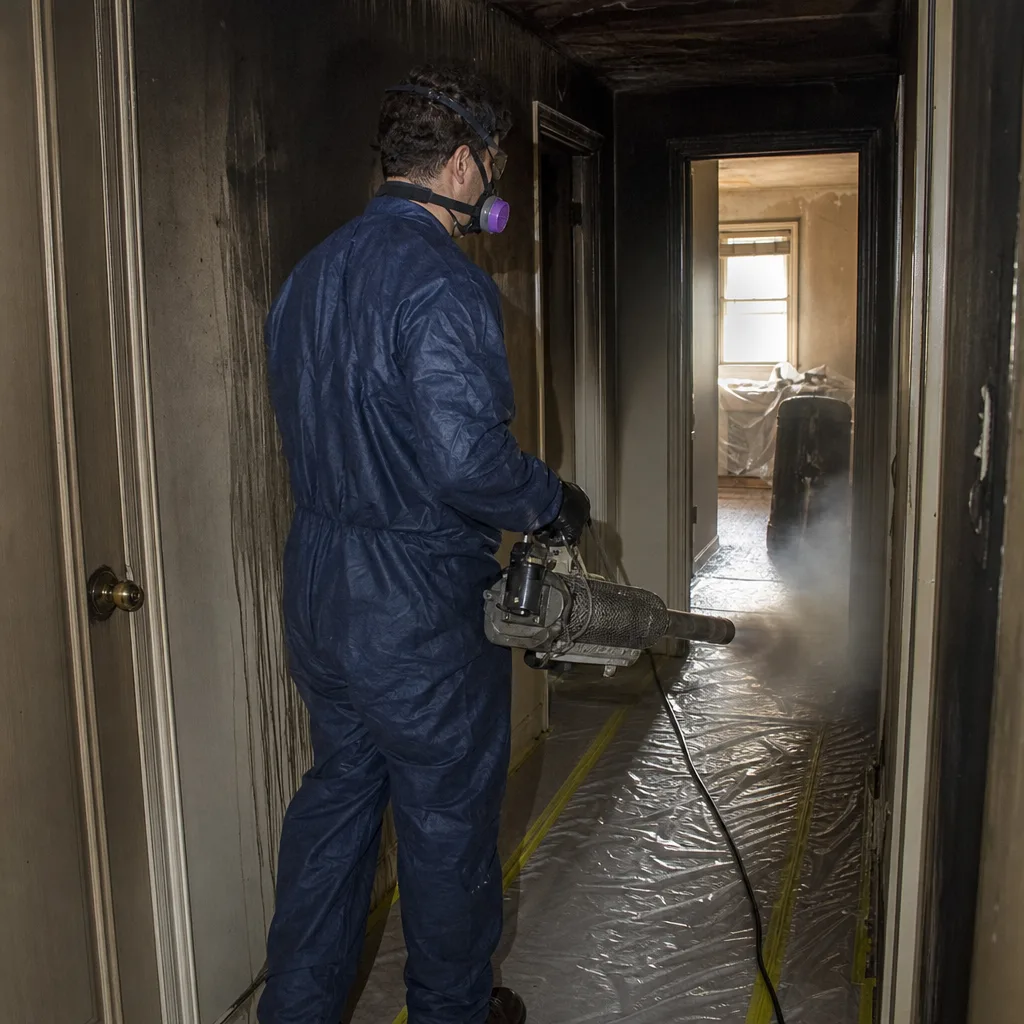
When the combined sewer system backs up into a brownstone basement on a summer afternoon, that water is Category 3. It carries sewage, bacteria, and whatever else was in the line. We treat it accordingly: extraction, containment, antimicrobial cleaning, and HEPA air scrubbing until the air is safe again. Then we address the source, which often means sump pump installation, backwater valve work, or shutting off the line that feeds the drain.
Emergency Board-Up
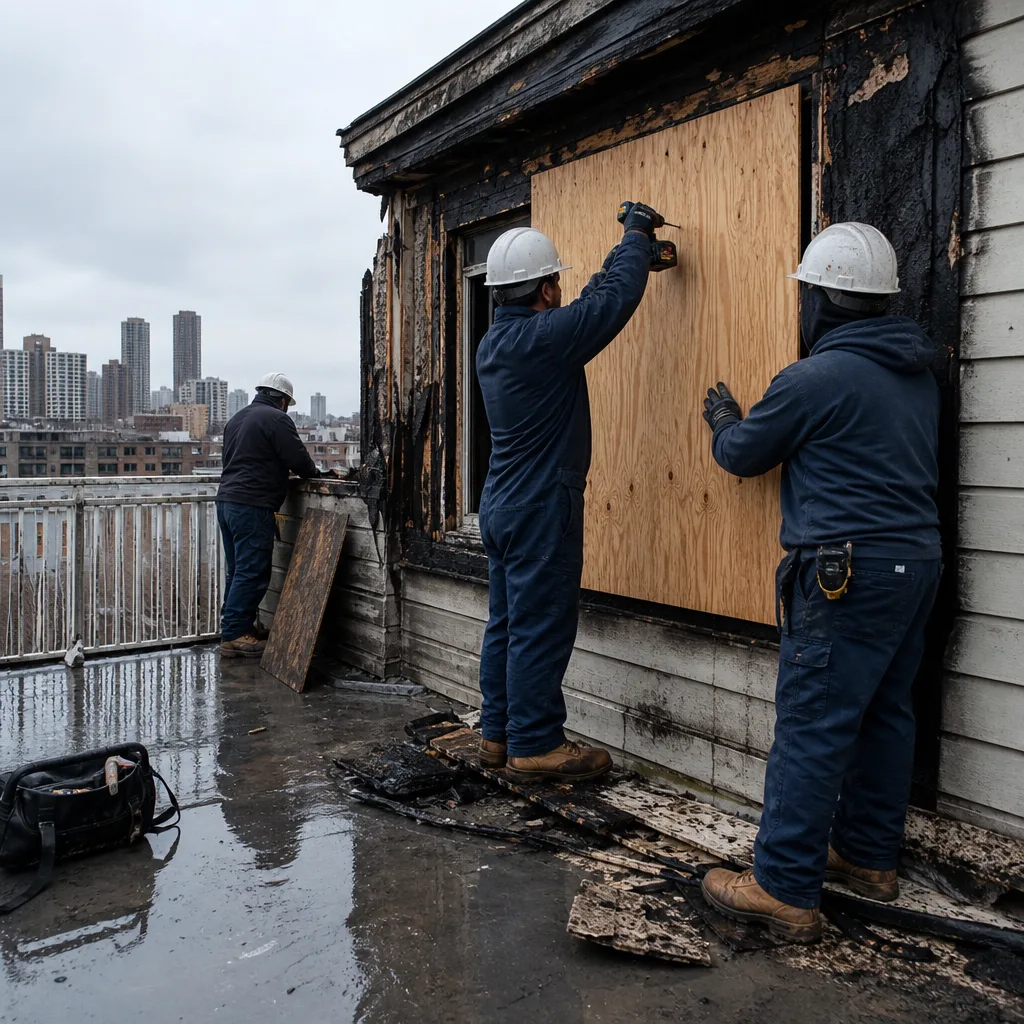
Storm damage rarely respects business hours. When wind tears a window out of a pre-war walk-up on Lenox Avenue or a tree limb goes through a storefront on 125th Street, the opening has to be secured immediately. We board up with plywood, fasten it properly for the building type, and document everything for your insurance carrier. We’re there when you call, not the next morning.
Roof Tarping
A tar-and-gravel flat roof on a 1910 Harlem brownstone is already fighting age. When a nor’easter strips the roofing membrane or a branch punctures it, we tarp the opening same-day so the water stops entering the building. The tarp isn’t a permanent fix, but it stops the clock on new damage until a full roof repair or replacement can be scheduled. On multi-unit buildings, the sooner the roof is sealed, the fewer units are drawn into the claim.
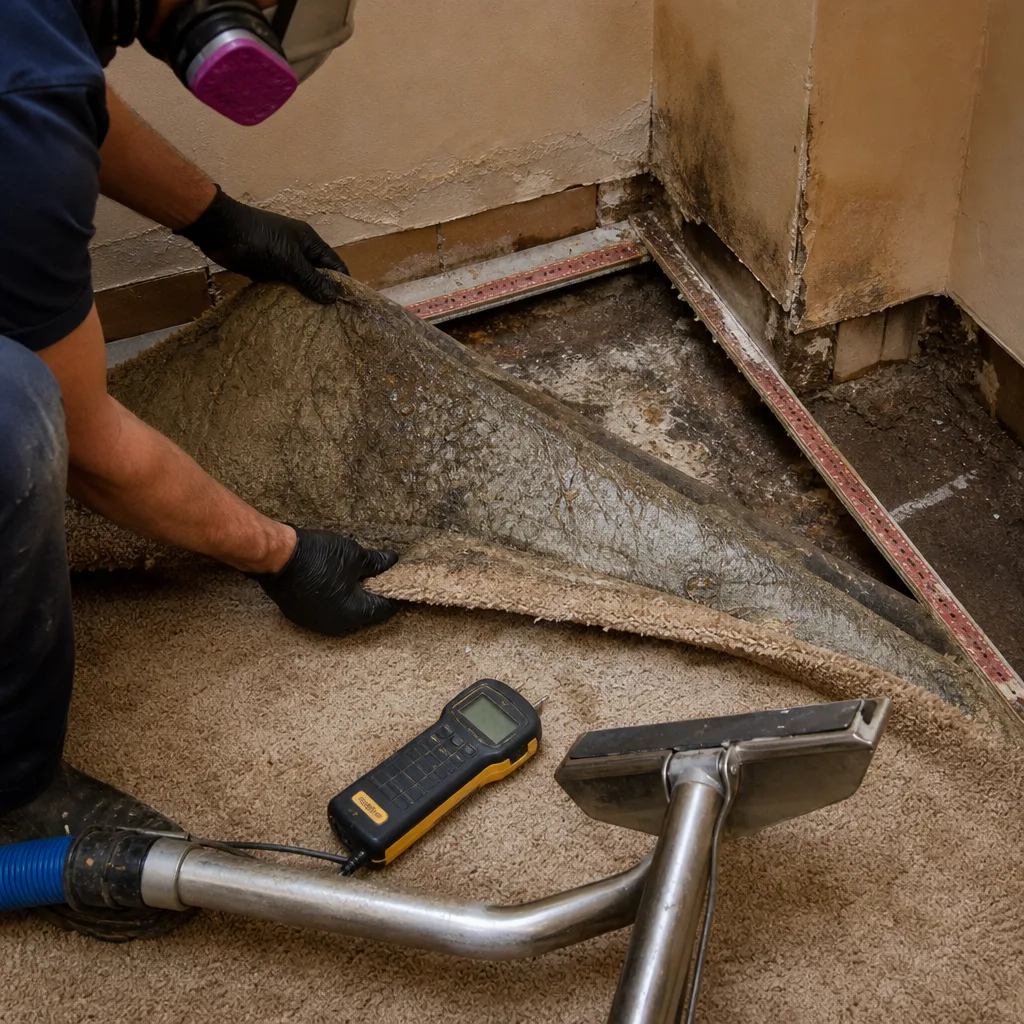
Debris Removal
Broken glass, fallen plaster, waterlogged contents, and wind-blown debris all have to come out before the drying and rebuilding can start. We remove it safely, catalog what’s being discarded for your insurance claim, and keep the building code-compliant while we work. In buildings with narrow stairwells and no freight elevator, which includes most Central Harlem walk-ups, that’s a slower, more careful job than it looks.
What happens when you call
- 1
A real person answersNo phone trees - you reach a local pro.
- 2
You get an upfront price rangeHonest numbers before anyone is dispatched.
- 3
A background-checked tech heads outLicensed & insured, dispatched right away.
- 4
You approve before work beginsNothing starts until you say go.
Storm & Disaster Restoration Costs in Central Harlem, NY
Storm restoration pricing in Central Harlem depends on how far the water traveled and how old the building is, but here are honest ranges from our work in this neighborhood. A simple storm damage cleanup with extraction and drying in one room of a brownstone typically runs $2,000-$4,500. Sewage back-flow cleanup from a combined sewer surcharge, with Category 3 water needing containment, antimicrobial treatment, and air scrubbing, usually lands between $4,000 and $9,000 depending on the square footage affected. Full flood damage restoration across a basement and first floor, including structural drying, drywall or plaster replacement, and reconstruction, runs $12,000-$35,000 in Central Harlem’s pre-war buildings. What moves the price is the presence of sewerage, whether party walls are involved and more than one unit needs access, and whether the building is landmarked, which adds LPC filing and compliant materials. Our free visual inspection turns these ranges into a firm written scope before any work starts, and most storm claims are at least partially covered by insurance. Call (917) 924-4221 for an exact quote. Estimates are free.
We Also Serve Cities Near Central Harlem
Floodline Restoration Co. of Manhattan serves the broader upper Manhattan and Bronx corridor. Our crews also respond to storm and disaster calls in Fairview, Harrison, East Bronx, and Hunts Point. The same 24/7 live dispatch and certified crews cover those areas.
Central Harlem Storm & Disaster Restoration Questions, Answered
Does Central Harlem require Landmarks Preservation Commission approval for emergency storm damage repairs on brownstones?
Yes, if the building is on a designated historic district block like Strivers’ Row or Mount Morris Park, Landmarks Preservation Commission approval is required before replacing original plaster, millwork, or masonry, even in an emergency. In a genuine safety emergency, an experienced restoration contractor can file an expedited LPC application while securing the area, but tearing out historic finishes without the permit triggers stop-work orders and mandatory reinstatement at the contractor’s expense. Our crews photograph everything, file the LPC emergency application immediately, and never substitute drywall for original plaster on a designated block. Call (917) 924-4221 and we’ll handle the paperwork as part of the restoration.
How do Central Harlem’s party-wall brownstones affect flood restoration after a single burst pipe?
A burst cast iron stack in one brownstone routinely pushes water through the shared party wall into the adjacent unit or units, so a single-pipe failure becomes a two- or three-address restoration job. We use thermal imaging and moisture mapping to track lateral migration through the walls, set containment on both sides of the party wall, and coordinate access between the affected owners and their insurers. The drying time is longer than in a detached house because moisture travels through masonry, not just framing cavities. This is the single most common reason a “small” Central Harlem pipe burst becomes a large claim.
Why does Central Harlem experience more Category 3 sewage flooding than other Manhattan neighborhoods?
Central Harlem is served by some of New York City’s oldest combined sewer lines, and the system surcharges during heavy thunderstorms when stormwater and sewage share the same pipes. The result is back-flow through basement floor drains as Category 3 water, carrying raw sewage and bacteria into the lowest levels of pre-war buildings. The concentration of 1890s-1930s brownstones with below-grade basement drains and no backwater prevention valves makes these blocks statistically more likely to see sewage flooding than newer-built areas of Manhattan with separated storm and sanitary lines. Installing backwater valves and sump pumps is the standard fix after the first event.
Can old cast iron drain stacks in Central Harlem brownstones be repaired, or do they usually need replacement after storm damage?
Cast iron drain stacks from the 1890s-1930s are typically at the end of their service life once they’ve rusted through or cracked under storm flooding pressure, so patching is usually a temporary measure at best. The problem goes beyond the visible split: the interior of the pipe is usually corroded thin along its entire length, and a patch just moves the failure point up or down the stack. Replacement is the norm. On party-wall buildings, the replacement material and routing must be compatible with the shared drainage so the neighbor’s side isn’t compromised, and our structural crew coordinates that work across adjoining units. Partial repairs are sometimes possible when the pipe is otherwise sound and the damage is localized at a joint.
How soon after a storm does mold start in Central Harlem’s plaster-over-lath walls?
Mold can begin colonizing wet plaster, lath, and trapped organic material in as little as 48 to 72 hours, and Central Harlem’s pre-war construction makes it worse because the thick plaster and lath hold moisture longer than drywall. The hidden cavity between the plaster and the masonry or framing is warm, dark, and moisture-rich, which speeds up growth. That’s why our crews start extraction the same visit and have dehumidifiers running within hours, not days. For land marked buildings, we document mold locations photographically before any plaster removal, because the LPC needs that record before we touch the surface. If the water sat for more than two days before we got there, mold testing and clearance testing become part of the scope.
How fast can a crew actually reach Central Harlem after a storm?
Our commitment is a 45-minute response time for Central Harlem locations. We maintain local dispatch coverage through our New York City office, and our crews are staged throughout Manhattan so a nor’easter or flash flood doesn’t put us an hour away. In severe citywide events, the first truck usually reaches the site within that window, but if streets are blocked or transit is disrupted, we’ll tell you honestly when the crew will arrive and keep you updated until they’re at your door. Call (917) 924-4221 for current response status. The dispatcher is live and will tell you the truth.
Will my homeowner’s insurance cover storm and flood damage in Central Harlem?
Storm damage from wind, fallen trees, roof failure, or burst pipes is typically covered under a standard homeowner’s insurance policy, subject to your deductible and policy limits. Sewage back-flow and surface flooding are often excluded unless you carry a specific rider, which many Central Harlem co-op and condo owners add after their first basement backup. Flood insurance is a separate FEMA-backed policy for rising surface water. We recommend checking your policy declarations page and calling your agent, and we also document the loss from hour one so your claim has the best possible evidence regardless of what’s covered. Look for the line item that says “water backup” or “sewer and drain.” If you don’t see it, ask your agent about adding it.
What should I do in the first 30 minutes after storm damage in Central Harlem?
Shut off the water main if the damage is from a burst pipe or plumbing failure, and shut off electricity to any affected area if water has reached outlets, appliances, or the breaker panel. Take photos of everything before moving anything, because your insurance carrier will want the before-documentation. Call us at (917) 924-4221. Then, if the water is from sewage or storm back-flow, stay out of the affected area and don’t run any water in the house. Don’t attempt to dry the area with household fans, and don’t plug in a dehumidifier in a wet room. The first 30 minutes determine whether a Category 1 clean water loss stays clean or becomes a contaminated Category 2 or 3 claim.
Serving Central Harlem, NY - Our Local Coverage Area
We’re based in the Central Harlem area and know this community well. Use the map below to see our service coverage - if you’re nearby, we can almost certainly help.
Floodline Restoration Co. of Manhattan: Serving Central Harlem Before, During, and After the Storm
Central Harlem’s buildings are unlike any other housing stock in the country, and the restoration crews that work them need to know the difference between a Strivers’ Row brownstone and a 1910 tenement walk-up. We’ve been at this long enough to know what a stop-work order costs, what a party-wall migration does to a claim, and what the combined sewer system does to a basement in August. Curt Bowman founded Floodline Restoration Co. in 2010 around a dispatch board, not a sales desk, and the company has grown into a full-cycle restoration firm serving Central Harlem with background-checked, IICRC-certified technicians and professional-grade Dri-Eaz, Phoenix, and XPOWER equipment on every job. We start at the floodline, the honest mark the water left on the wall, and we stay until the rebuild is finished and the 90-Day Done Right Promise is in your hand, in writing. No surprises on the bill. No mid-job handoffs. No arguing over a guarantee that’s written down. Call (917) 924-4221 for a free visual inspection and a square deal.
Written by Curt Bowman, Owner at Floodline Restoration Co., serving Central Harlem with full-cycle storm restoration and reconstruction.