
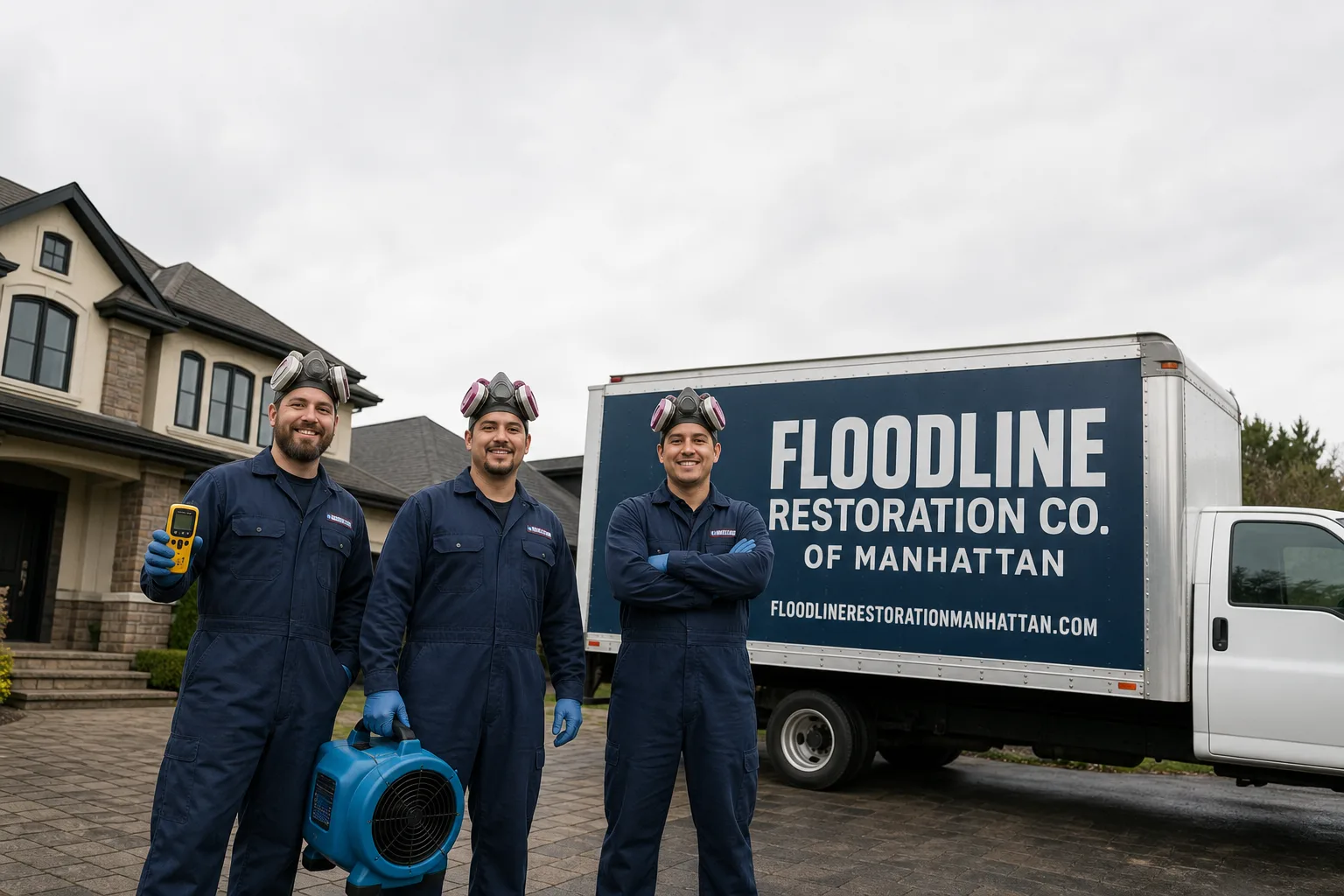
Free visual inspection and a written scope of work before any mitigation begins - photos, moisture readings, and drying logs go in your claim file
The scope we write is the scope we bill. Anything new gets shown to you, in writing, before we touch it.






 Before
 After
After Before
 After
After Before
 After
After24/7 Emergency Mold Remediation in Jersey City
Mold remediation in Jersey City typically costs $1,800-$6,500 depending on containment scope and how far the colony has spread, and our crews respond the same day you call. If you’re standing in a wet basement in Greenville or watching a stain climb a party wall in Van Vorst Park, call (917) 924-4221 right now. A live dispatcher answers at 2 a.m., not a recording. The first hour matters because mold’s hyphae root into porous plaster and unsealed brick within 24 to 48 hours of a water event once relative humidity passes 60 percent. In Jersey City’s row-house stock, where shared walls and chronically damp basements are the norm rather than the exception, that clock runs faster than most homeowners expect. We’ll get a certified crew to your door, run a free visual inspection, and tell you plainly whether you need full remediation or a targeted cleaning.
Floodline Restoration Co. of Manhattan’s Mold Remediation team serves Jersey City with the same certified crews, professional-grade drying equipment, and written 90-Day Done Right Promise we bring to every job. No handoffs. No subcontractor surprises. One team, from first containment to final air-clearance test.
Understanding Mold Remediation Severity in Jersey City Properties
Mold remediation work splits into three service tiers, and Jersey City’s housing stock pushes a lot of jobs into the upper two. A Level 1 job is surface mold under 10 square feet, usually from bathroom humidity or a minor roof drip. We clean it with HEPA-vacuum methods and antimicrobial treatment, no containment needed. A Level 2 job covers 10 to 100 square feet of visible growth, or mold inside wall cavities. That triggers full containment: 6-mil poly barriers, negative air pressure, and HEPA air scrubbing running continuously until the job closes. A Level 3 job means the mold has entered a ventilation system, spread across structural framing, or contaminated standing water is involved, which shifts the work to Category 3 remediation protocols with full hazmat-grade PPE and post-remediation clearance testing by an independent indoor environmental professional.
Why does this matter in Jersey City specifically? Because the city’s signature building type, the attached brick row house built between roughly 1880 and 1930, shares mortar-jointed masonry walls with the neighbors on both sides. Mold does not respect property lines. A bloom that starts in a next-door unit’s bathroom routinely migrates through the wall cavity and colonizes your original plaster. And in neighborhoods like Greenville, Bergen-Lafayette, and the bayfront, where the land is filled former wetland, groundwater alone keeps basement relative humidity above 60 percent most of the year. That means the mold’s moisture source never truly stops, so Level 1 jobs can become Level 3 jobs in the time it takes to schedule a quote.
Why Jersey City Property Owners Choose Floodline Restoration Co. of Manhattan
- 45-minute response commitment for emergency water and mold calls anywhere in Jersey City, from Exchange Place up to The Heights.
- A live person answers, 24/7. No phone trees, no answering service script. A dispatcher who can send a crew is on the line at 3 a.m.
- IICRC-certified crews trained to WRT (Water Damage Restoration), AMRT (Applied Microbial Remediation), and FSRT (Fire & Smoke) standards. Background-checked and uniformed.
- Free visual inspection with moisture mapping so you know exactly what you’re dealing with before you commit to anything.
- Direct insurance billing. We document, photograph, and coordinate with your adjuster so you never play messenger between us and the carrier.
- One team from start to finish. The same certified crew that sets containment and scrapes the bloom handles the rebuild. No mid-job handoff to a different company.
Our Mold Remediation Process
Inspection & Assessment
We start with a full visual inspection, thermal imaging to find moisture behind walls without opening them, and hygrometer readings to map the humidity profile. In Jersey City row houses we also test the party walls, because what’s growing in your neighbor’s side shows up in your cavity.
Containment & Source Control
Before any tool touches mold, we seal the work area with 6-mil poly sheeting and run HEPA-filtered negative air machines. This keeps spores from moving through the shared wall system and into living spaces. The water source gets shut down and addressed.
Drying & Dehumidification
Dri-Eaz and Phoenix dehumidifiers pull moisture from the air and structure. We log daily moisture readings until substrates hit their dry standard. In Jersey City’s below-grade finished basements this phase often runs longer because the surrounding soil keeps feeding humidity back into the masonry.
Cleaning & Antimicrobial Treatment
We HEPA-vacuum all affected surfaces, remove contaminated porous materials that cannot be salvaged, and apply EPA-registered antimicrobial treatments to the remaining structure. Original plaster often survives; saturated drywall usually does not.
Specialty Treatment: Air Scrub & Odor Removal
HEPA air scrubbers run through the entire remediation and for 24-48 hours after material removal is complete. We treat for the musty odor at its source, not with masking agents. In sealed row-house cavities, this step is what keeps the problem from coming back in six months.
Repairs, Restoration & Clearance Testing
We replace what we removed, prime and paint surfaces that need it, and schedule post-remediation verification. Mold Remediation clients get a written scope of what was done and a final moisture log. We stand behind it with the 90-Day Done Right Promise in writing.
Need Emergency Mold Remediation in Jersey City Now?
Crews minutes away, answering live 24 hours a day. The sooner we start, the less it costs.
Working With Your Insurance Company
Mold remediation claims in Jersey City are usually covered when the mold stems from a sudden, covered water event like a supply-line break, a water heater rupture, or a storm-driven leak that was reported promptly. Gradual mold from long-term groundwater seepage in a Greenville basement is typically not covered, because policies classify it as a maintenance issue rather than a sudden loss. Either way, we handle the paperwork. From the first hour on site, we document everything: moisture readings, photos of all damage room by room, drying logs showing daily progress toward the dry standard, and a line-item scope of work built on industry-standard pricing, not inflated numbers designed to impress an adjuster. We communicate directly with your carrier so you are not the one relaying messages or defending the claim.
What We Provide Your Insurer
- Thorough documentation of the loss
- Photos of all damage, room by room
- Moisture readings and drying logs
- A detailed, line-item scope of work
- Direct coordination with your carrier
Built for Jersey City’s Loss Calendar
Jersey City’s mold season does not follow a single predictable curve, because the moisture sources here are structural more than seasonal. January and February bring deep freezes that burst supply lines in uninsulated bayfront homes, saturating original plaster and forcing full remediation within days. Spring thaw pushes groundwater up through 1890s rubble-stone foundations in Greenville and along the Newark Bay shore, where basements that stayed dry all winter abruptly read 70 percent humidity and higher on our hygrometers. Summer thunderstorms overwhelm the city’s combined sewer system, sending Category 3 sewage-contaminated water into basements across Paulus Hook, Downtown, and Bergen-Lafayette. And nor’easters in the fall push storm surge up the Hudson from two directions, because Jersey City is a peninsula bracketed by the Hudson River to the east and Newark Bay to the west. There is no quiet season. There are just different kinds of wet. We built our dispatch around that reality: live call answer every hour of every day, and a crew that has seen every failure mode this city produces.
Mold Remediation Across Jersey City’s Neighborhoods
The mold problem in Van Vorst Park looks different from the one in The Heights, and our response plan accounts for that. In the flat, sea-level blocks of Paulus Hook and Exchange Place, where Superstorm Sandy reminders linger in every foundation, groundwater intrusion and storm-surge residue drive remediation scopes that skew toward Category 3 work. Shared walls matter here more than anywhere else in the city: a single pipe burst in one unit routinely spreads moisture into two or three adjacent row houses, which is exactly what our crews found on Jersey Avenue when a top-floor bathroom pipe let go and soaked original plaster on both sides of the party wall. Up in The Heights, perched on the Palisades above the rest of Jersey City, the failure mode flips: freeze-thaw cycling on exposed brick facades and ice dams on steep Victorian rooflines push meltwater into wall cavities that stay wet for weeks because thick original masonry traps the moisture. In Bergen-Lafayette and Greenville, the historic filled wetland soil means basements flood from groundwater alone after sustained rain, no pipe burst required. Each of these neighborhoods needs a different containment strategy, and that is what we build the scope around.
Specialized Mold Remediation Services We Offer in Jersey City
Mold Inspection & Testing
Before we remediate, we need to know exactly what we are dealing with. Our inspection includes thermal imaging to find moisture behind plaster and tile without destructive demolition, air and surface sampling where warranted, and a written assessment with photos. In Jersey City row houses, we also inspect the party wall on both sides, because what is growing in the neighbor’s cavity is a problem for you within months.
Mold Removal
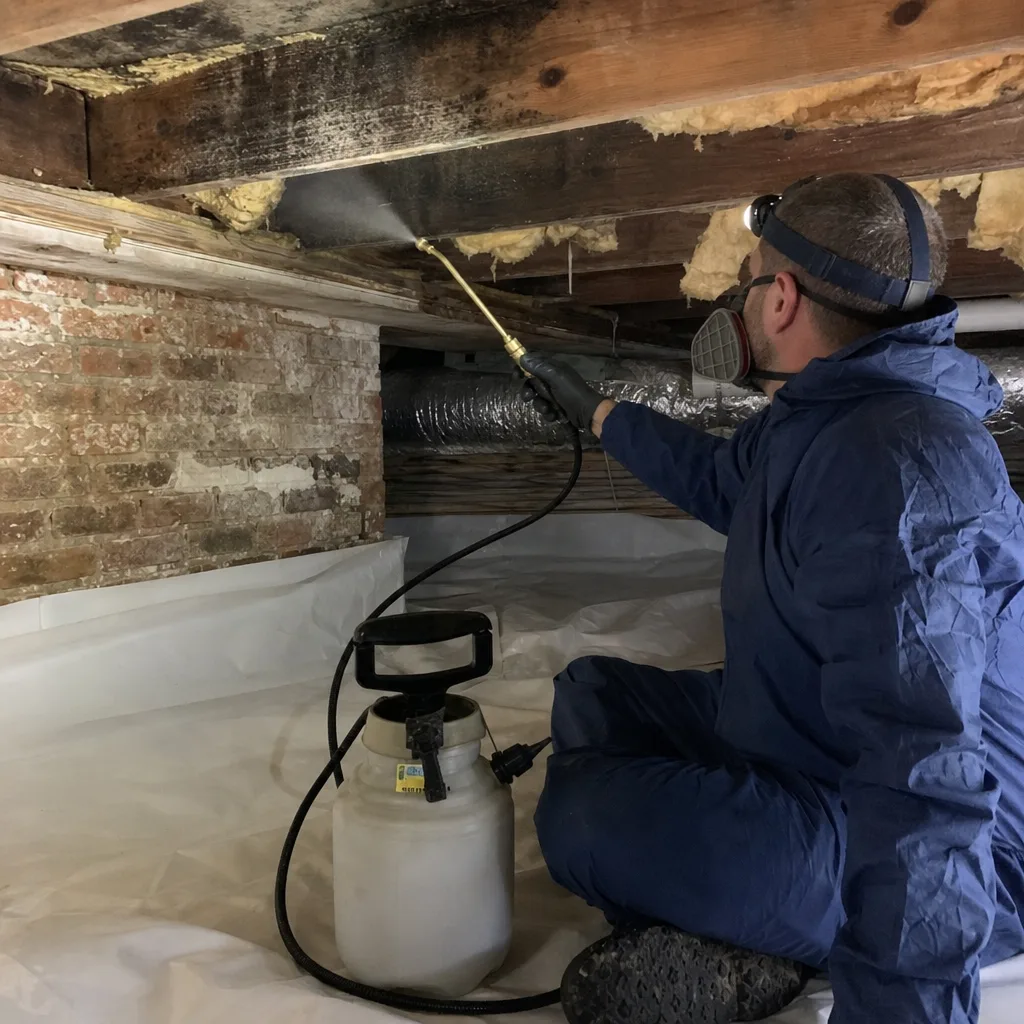
For surface mold and moderate wall-cavity colonies, we remove the contaminated material under full containment, HEPA-vacuum the studs and surrounding structure, and apply antimicrobial treatment to the framing. This is the work that stops a small bathroom bloom from becoming a house-wide problem.
Black Mold Remediation
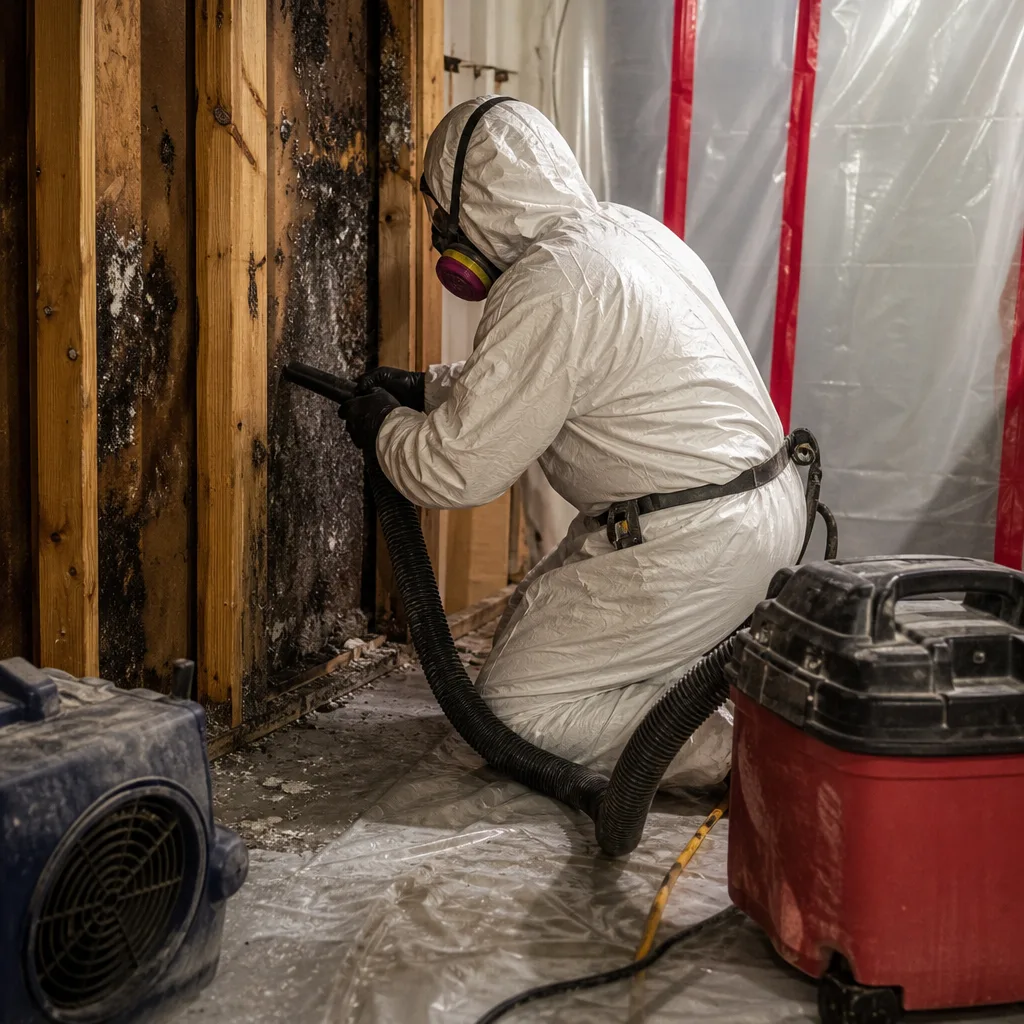
Stachybotrys chartarum, what people call black mold, loves the chronically damp, poorly ventilated spaces Jersey City’s old row houses produce: basements on wet ground, behind plaster walls on shared masonry, under windows that have leaked for years through failing mortar. We treat it with full Level 2 or Level 3 containment, whatever the scope demands, and we do not cut corners on the PPE or the clearance testing. A square deal means doing the job the way it is supposed to be done, not the way a cheap bid does it.
Air Quality Restoration
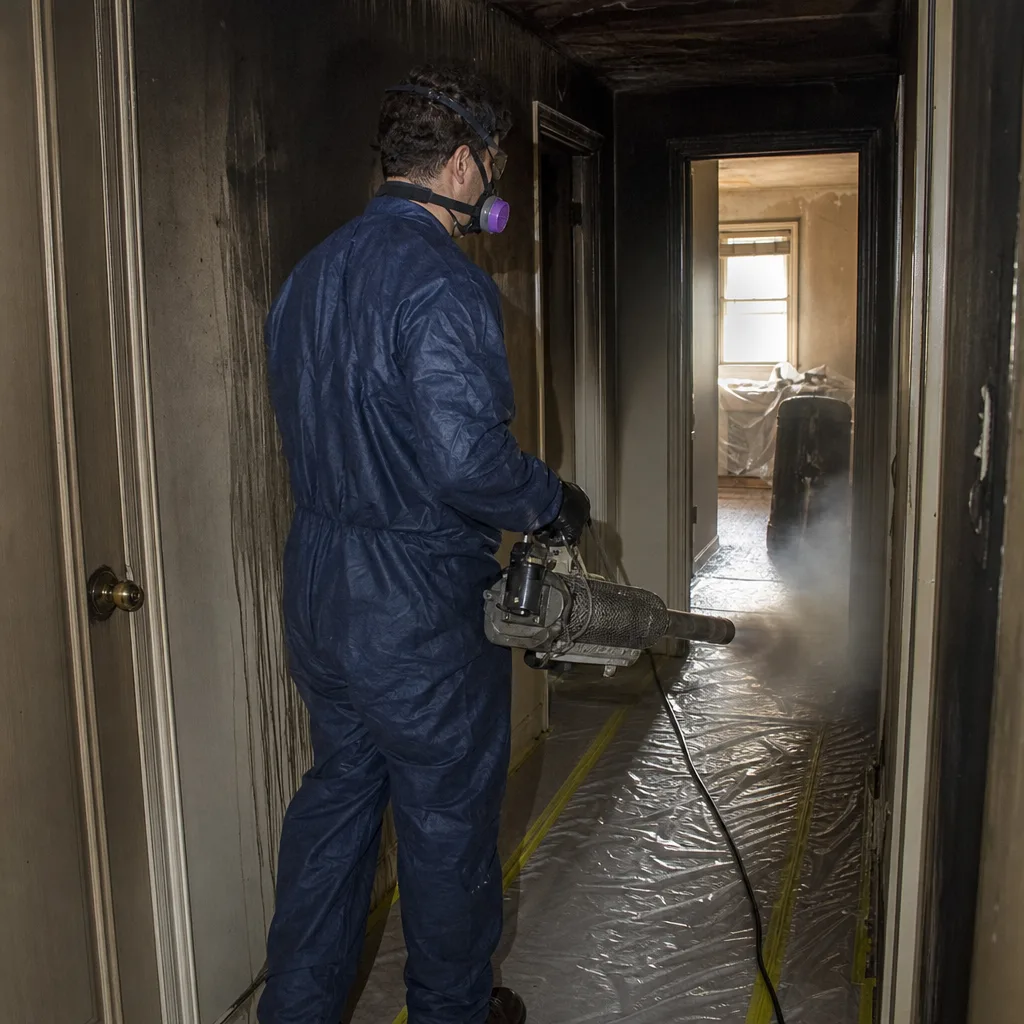
After material removal, mold spores can linger in the air for days and resettle on clean surfaces. We run HEPA air scrubbers throughout remediation and for 24 to 48 hours after, then test to confirm spore counts have returned to baseline. For Jersey City homeowners with allergies, asthma, or compromised immune systems, this step is not optional, and we treat it that way.
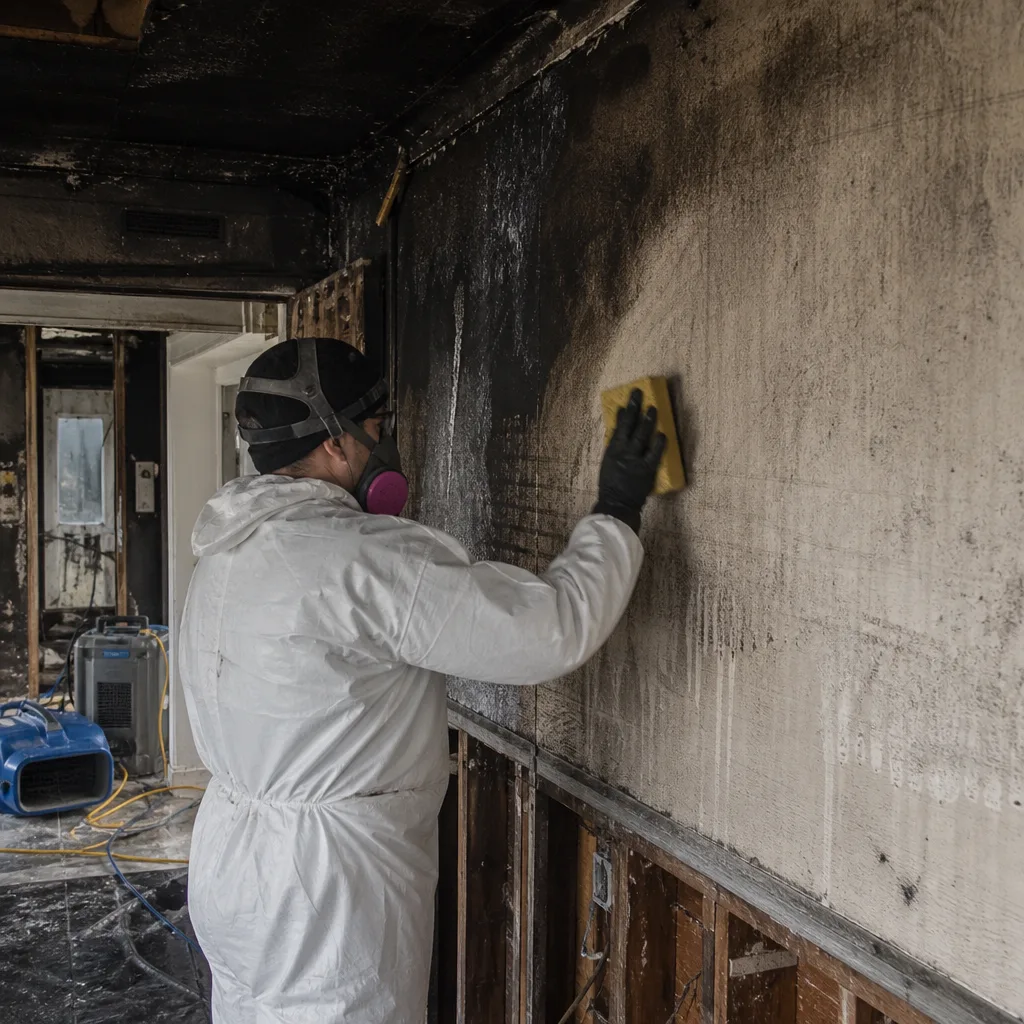
Crawl Space Treatment
Crawl spaces in Jersey City’s older homes are often just a few inches of clearance over perpetually damp soil. We install vapor barriers, seal foundation vents where appropriate, treat the wood framing with antimicrobial products, and set up dehumidification if the space demands it. Moisture and humidity control here is preventive, and it is the difference between a crawl space that works and one that feeds mold into every floor joist above it.
What happens when you call
- 1
A real person answersNo phone trees - you reach a local pro.
- 2
You get an upfront price rangeHonest numbers before anyone is dispatched.
- 3
A background-checked tech heads outLicensed & insured, dispatched right away.
- 4
You approve before work beginsNothing starts until you say go.
Mold Remediation Costs in Jersey City, NJ
Mold remediation in Jersey City runs $1,800-$6,500 for most single-family and row-house jobs. A small bathroom mold removal with containment typically lands around $1,800-$2,800. A full basement remediation with Category 3 protocols, structural drying, and rebuild work can run $5,000-$12,000+ depending on how much framing and drywall must come out. Mold inspection and testing alone runs $350-$650 when ordered separately, and it is free as part of our visual assessment when we are already on site for a water loss. What moves the price: the square footage of containment, whether the mold is in wall cavities or just on surfaces, how many rooms are affected, and whether the structural drying phase runs long because of Jersey City’s high-groundwater basements. We give you a written, line-item scope before any work starts, so the number we quote is the number you approve. No surprises on the bill. For exact pricing on your specific situation, call (917) 924-4221 and we will send someone out for a free visual inspection.
We Also Serve Cities Near Jersey City
Floodline Restoration Co. of Manhattan runs certified mold remediation crews throughout the Hudson County area, including Jersey City, Hoboken, Union City, Weehawken, and Harrison. If you are in one of these neighboring communities, the response time and the process are identical. Same live dispatch, same certified techs, same written guarantee.
Jersey City Mold Remediation Questions, Answered
How quickly can you get to a mold job in Jersey City?
We commit to 45 minutes for emergency water and mold calls within Jersey City, and in practice our crews are usually on scene faster downtown, in Journal Square, and the surrounding neighborhoods. A live dispatcher answers 24/7, so call (917) 924-4221 and a certified tech will be on the way immediately.
Will insurance cover mold remediation in my Jersey City home?
Coverage depends on the source of the moisture. Mold from a sudden, covered event like a burst pipe or storm-driven leak is typically covered. Mold from long-term groundwater seepage in low-lying areas like Greenville or the bayfront is usually not, because insurers classify it as a maintenance issue. We document everything from the first hour and coordinate directly with your adjuster either way.
How do I know if I need full remediation or just a cleaning?
If the mold is confined to a non-porous surface like tile or glass and covers less than 10 square feet, a thorough cleaning with antimicrobial treatment is often sufficient. If it is growing on drywall, plaster, wood framing, or inside wall cavities, full remediation with containment is the right call. Our free visual inspection with moisture mapping will tell you which camp you are in, no guesswork, no upsell.
How does mold remediation cost in Jersey City compare to the rest of New Jersey?
Jersey City pricing runs slightly higher than inland New Jersey because the row-house shared-wall construction adds containment complexity, and the high-groundwater basements in formerly filled wetland neighborhoods extend drying times. Expect $1,800-$6,500 for most jobs, where a comparable inland job might land 10 to 20 percent lower. The free inspection gets you a firm number specific to your building.
How long does mold remediation take in a Jersey City row house?
Most single-room mold jobs are done in 3 to 5 days including drying and clearance testing. A full basement Category 3 remediation with rebuild work typically runs 7 to 14 days. Buildings with thick brick-and-plaster walls, like the 1890s row houses in Van Vorst Park, dry slower than modern construction because the masonry holds moisture.
Can we stay in the home during mold remediation?
For Level 1 jobs, yes, though we ask you to avoid the work area. For Level 2 and Level 3 jobs with full containment and negative air pressure, we recommend staying elsewhere until clearance testing confirms spore counts are back to baseline. We will tell you honestly at the inspection, and the timeline will be in the written scope.
Why is Sandy-era flooding still relevant to mold work in Jersey City’s Paulus Hook in 2025?
Because the seawater that soaked those basements in 2012 penetrated brick and mortar far deeper than the visible damage suggested. If that hidden moisture was never properly dried and treated, dormant mold spores and compromised masonry are still in the wall systems. We find Sandy-era contamination on jobs every year, and it changes the containment scope the moment our moisture mapping picks it up.
Do we need Category 3 protocols for a basement that floods only during heavy rain in Greenville?
Yes, almost always. Greenville sits on filled wetland with a water table high enough that rainwater often arrives carrying sewage from the city’s combined sewer system. That is Category 3 water, and it means full hazmat-grade containment and antimicrobial treatment, not just a standard drying job. Call (917) 924-4221 and we will assess it for free.
Can mold from a neighbor’s row house spread into our unit through the shared wall?
Yes. The mortar joints and unsealed spaces between attached brick row houses create direct pathways for moisture and spores. We regularly contain jobs where the visible mold is in your unit but the moisture source is next door. Our containment plan includes sealing the party wall before any air movers run, and we can document that for your insurance claim.
Why do some wall cavities in The Heights stay wet for weeks after a roof leak, while downtown basements dry faster?
The thick original masonry in The Heights’ Victorian row houses traps moisture inside the wall system, and the cliff-face orientation means less direct sun on the brick to drive evaporation. Downtown basements, while often wet, are shallower and more accessible to drying equipment. We adjust drying plans accordingly, and the daily moisture log tells us when the dry standard is actually met.
How quickly do we need to start mold remediation after a water loss in a Jersey City row house before permanent damage sets in?
Within 24 to 48 hours. In Jersey City’s sea-level row-house stock, the surrounding brick and chronically damp soil mean the moisture never fully leaves on its own, so the mold window is shorter than in drier inland construction. The faster we get containment set and air movers running, the more of your original plaster and framing we can save.
What should I do in the first 30 minutes of finding mold in my Jersey City home?
Do not disturb the area, do not spray bleach on it, and do not run fans, which spread spores. Close the door to the room if you can. Then call (917) 924-4221. A live dispatcher will walk you through what to check and get a certified crew rolling to your address.
Serving Jersey City, NJ - Our Local Coverage Area
We’re based in the Jersey City area and know this community well. Use the map below to see our service coverage - if you’re nearby, we can almost certainly help.
Get a Free Mold Assessment in Jersey City
If you see mold, smell mildew, or just know your basement has been too wet for too long, call (917) 924-4221 for a free visual inspection. We will send a certified, background-checked technician to your Jersey City home, map the moisture, and give you a straight answer in plain English. A written scope before any work starts. Direct billing to your insurance carrier. The 90-Day Done Right Promise in writing. No pressure, no surprises, no nonsense.
Written by Curt Bowman, Owner at Floodline Restoration Co. of Manhattan, serving Jersey City with certified mold remediation crews and the Keystone Standard guarantee.