

Free visual inspection and a written scope of work before any mitigation begins - photos, moisture readings, and drying logs go in your claim file
The scope we write is the scope we bill. Anything new gets shown to you, in writing, before we touch it.






 Before
 After
After Before
 After
After Before
 After
After24/7 Emergency Storm & Disaster Restoration in Little Neck
Storm damage in Little Neck moves fast, and so do we. Floodline Restoration Co. of Manhattan answers live around the clock with crews dispatched into Little Neck the moment you call (917) 924-4221. Nor’easter surge off Little Neck Bay does not wait for business hours, and neither do we. A certified technician reaches your door, completes a free visual inspection, and starts extraction or board-up on that first visit. The first hour after wind-driven rain or bay water enters a basement is when you stop the damage from spreading into plaster walls, floor joists, and the crawl space. Every call is answered by a real person, and the crew that arrives is background-checked, uniformed, and trained to IICRC standards.
Understanding Storm & Disaster Restoration Severity in Little Neck Properties
Storm damage in Little Neck is rarely one problem. It is usually three or four stacked on top of each other. Category 3 storm surge from the bay carries silt, sewage, and salt, and it moves through a 1930s basement differently than clean water from a burst supply line. Plaster-over-lath walls from the 1920s and 1950s hide moisture longer than modern drywall, which means a wall can feel dry on the surface and still hold water inside the lath channels. Moisture mapping with thermal imaging and penetrating meters finds what eyes miss. Structural drying with professionally placed air movers and dehumidifiers works only when the right amount of airflow hits the right surfaces for the right number of days. Skip that step on a Little Neck Tudor or Cape Cod and secondary mold moves in behind the original plaster, often in under 72 hours. We classify water the way IICRC standards require, isolate the affected area, and dry to documented dry standard, not to a guess.
Why Little Neck Property Owners Choose Floodline Restoration Co. of Manhattan
- 45-minute response commitment: Once you call (917) 924-4221, a live dispatcher confirms a crew is rolling toward Little Neck, not leaving a message for someone to return in the morning.
- 24/7 live answer: A person answers the phone at 2 a.m. during a nor’easter. Not a recording. That matters when bay water is rising on a low block near Northern Boulevard.
- IICRC-certified crews: Our technicians hold WRT and FSRT credentials and follow the same drying protocols on every job, whether it is a flooded basement off Marathon Parkway or a wind-damaged Colonial near the Bay.
- Free visual inspection: We walk the property, identify what is salvageable and what is not, and hand you a written scope before any work begins. No pressure, no vague promises.
- Direct insurance billing: We document everything from the first hour and coordinate directly with your adjuster, so you are not the one carrying paperwork between two parties.
- One team, start to finish: The same certified crew that extracts and dries is the crew that repairs and rebuilds. No mid-job handoff to a subcontractor you never met.
Our Storm & Disaster Restoration Process
Inspection & Assessment
We walk the entire property, not just the obvious damage. Thermal imaging and penetrating moisture meters tell us where water traveled inside walls, under floors, and into the crawl space. We photograph everything before touching anything.
Extraction & Stabilization
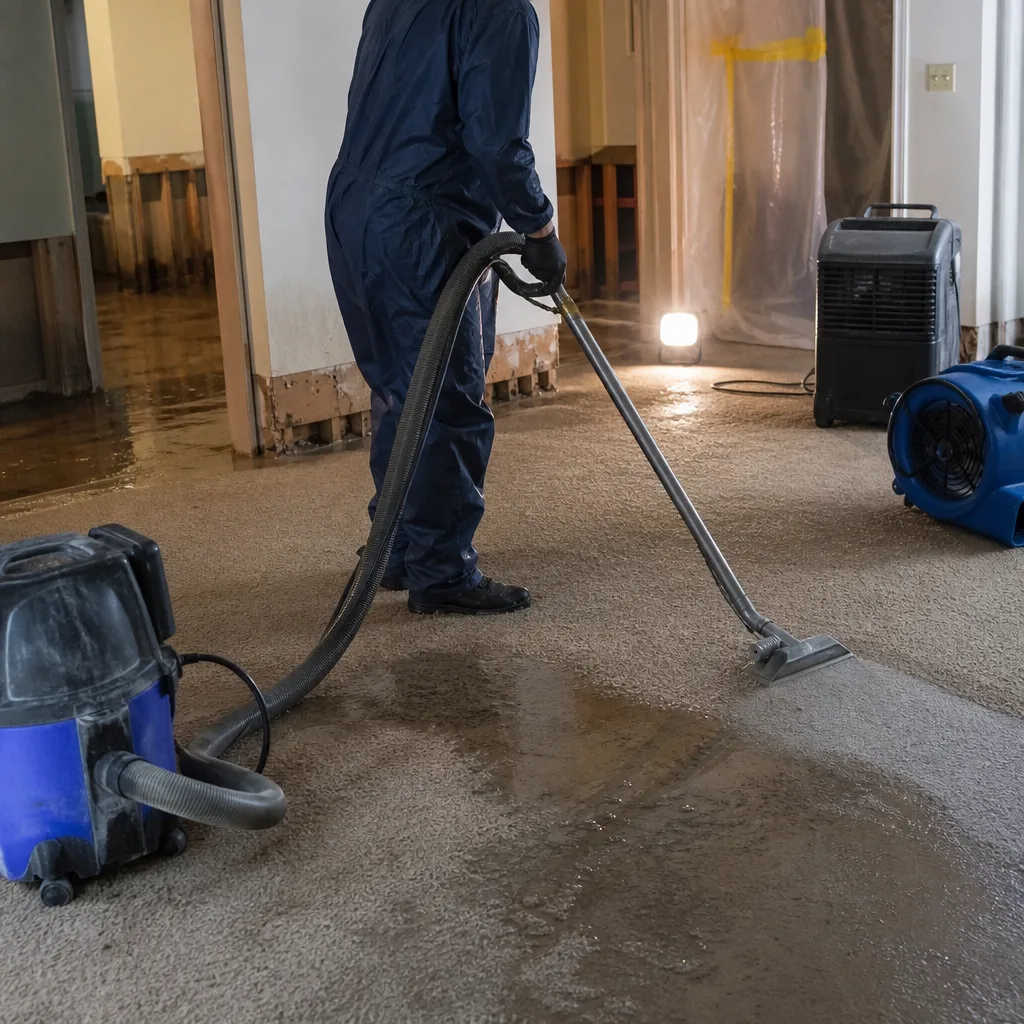
Standing water comes out first with truck-mounted extraction. Then we stabilize the structure: tarping damaged roofs, boarding broken windows, and shutting off compromised utilities. The goal in hour one is stop the loss from growing.
Drying & Dehumidification
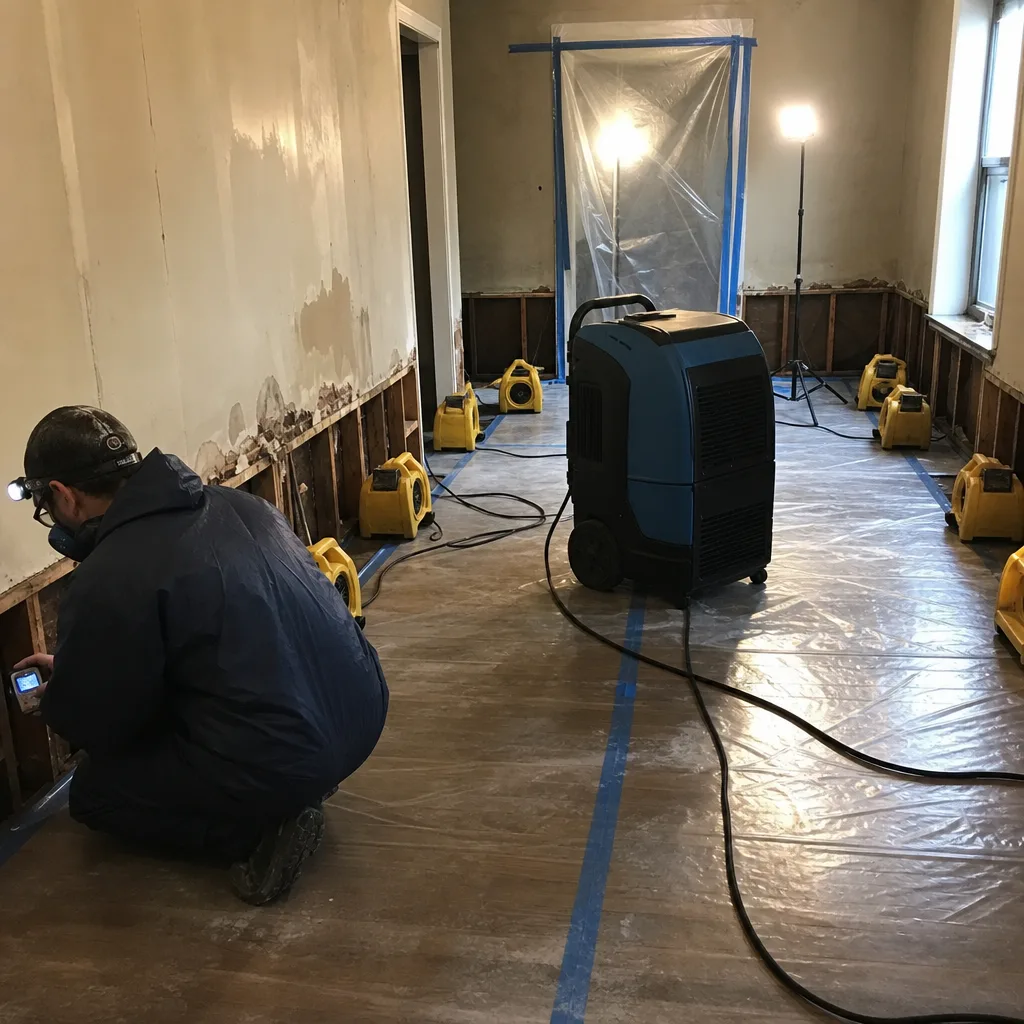
We set Dri-Eaz and Phoenix air movers and dehumidifiers to hit the affected surfaces, not just the room. Daily moisture readings are logged until the entire structure reaches dry standard, not just the visible areas.
Cleaning & Sanitization
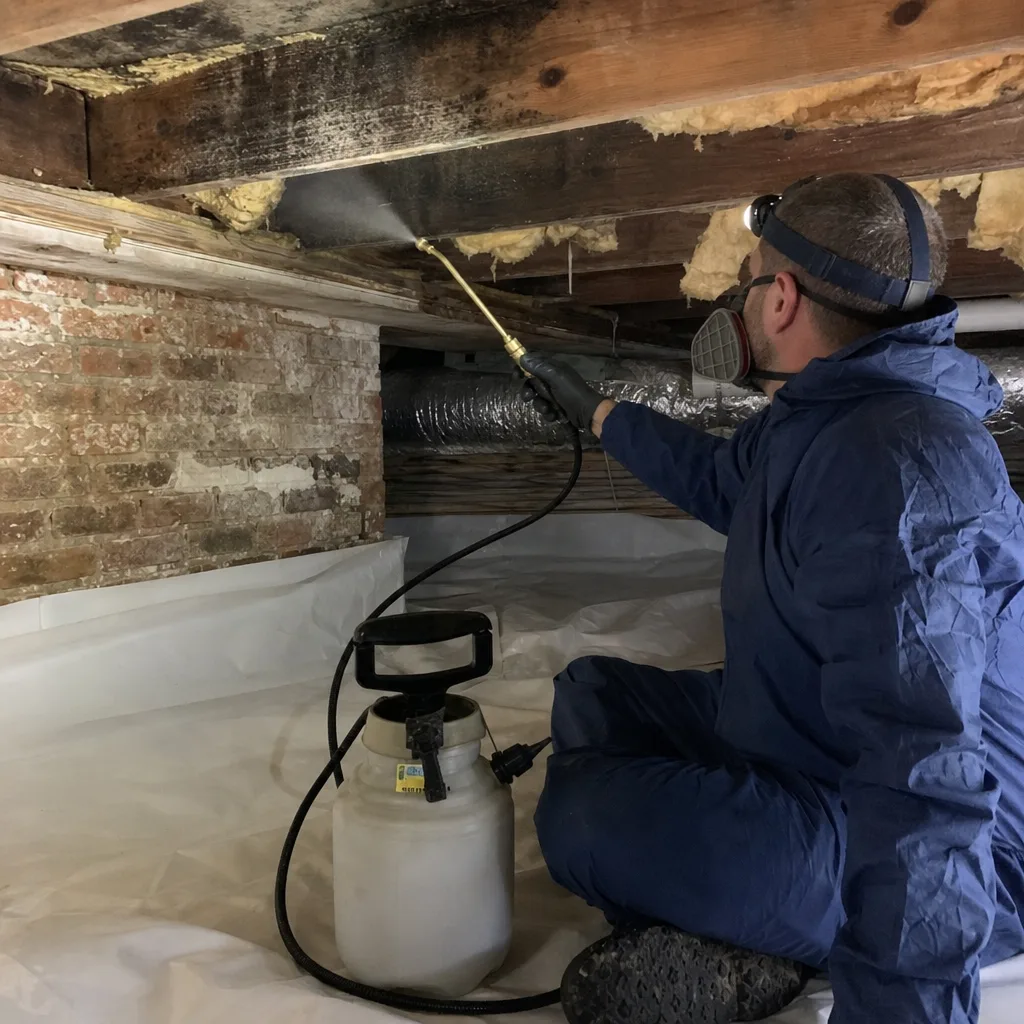
Category 3 water leaves contamination behind. We apply antimicrobial treatments to affected framing and masonry, clean salvageable contents, and remove what cannot be safely restored.
Storm-Specific Treatments
For Little Neck properties, that means wind-load checks on exterior doors and windows, weatherstripping replacement on 1920s and 1950s frames, and opening hidden plaster cavities where Sandy-era moisture still hides.
Repairs & Restoration
We rebuild to pre-loss condition or better, including plaster repair, floor replacement, trim, paint, and any structural work the property needs. One crew, one written scope, one 90-Day Done Right Promise behind the whole job.
Need Emergency Storm & Disaster Restoration in Little Neck Now?
Crews minutes away, answering live 24 hours a day. The sooner we start, the less it costs.
Working With Your Insurance Company
We have handled hundreds of storm claims in Little Neck, and we know what adjusters need to approve a loss without dragging it out. From the first hour, our crews photograph every affected room, take moisture readings before and during drying, and build a line-item scope of work that matches carrier expectations. We speak to your adjuster directly, answer their questions, and provide the documentation they request. You should not have to translate restoration terminology into insurance language. That is our job. And if the carrier disputes a line item, we have the drying logs and photos to back it up.
What We Provide Your Insurer
- Thorough documentation of the loss
- Photos of all damage, room by room
- Moisture readings and drying logs
- A detailed, line-item scope of work
- Direct coordination with your carrier
Built for Little Neck’s Loss Calendar
Little Neck does not have one storm season. It has several. January and February bring deep-freeze pipe bursts in unheated basements and crawl spaces under Capes and Colonials on blocks like Glenwood Street and 250th Street. March and April nor’easters push bay surge over bulkheads and onto low streets near Northern Boulevard faster than the combined stormwater system can drain. Summer thunderstorms dump an inch of rain in 40 minutes, overwhelming gutters on tight lots and sending water through foundation cracks that have been there since the Coolidge administration. Autumn hurricanes and coastal low-pressure systems are the wildcard, and Sandy proved what a direct bay surge can do. We schedule our crews and equipment readiness around this calendar, not around a generic national playbook. When a storm hits Little Neck, we already know which blocks flood first and which houses hide water the longest.
Storm & Disaster Restoration Across Little Neck’s Neighborhoods
Little Neck is not one uniform housing market, and the loss patterns change block by block. The bay-side blocks south of Northern Boulevard, including the streets leading down toward Little Neck Bay, take storm surge and wind-driven rain harder than anywhere else in the neighborhood. Those 1920s and 1930s Colonials and Tudors sit low to the water, and basements on those blocks flood before the city drains catch up. Further east, the residential streets around Marathon Parkway and the blocks near the Douglaston border hold some of the oldest housing stock in the area, with original plaster walls and unvented crawl spaces that hold moisture for years after a storm. The P.S. 221 area and the blocks above the LIE see more wind damage to roofs and siding, with mature oak and maple limbs coming down on garages and dormers. Each area gets the same crews and the same response time, but the first thing we check changes based on where the house sits relative to the bay.
Specialized Storm & Disaster Restoration Services We Offer in Little Neck
Flood Damage Restoration
Bay surge, storm sewer backup, or groundwater rising through the slab: we extract, dry, and restore. Category 3 water in a Little Neck basement requires containment, antimicrobial treatment, and often removal of saturated plaster and flooring. We handle all of it in one scope.
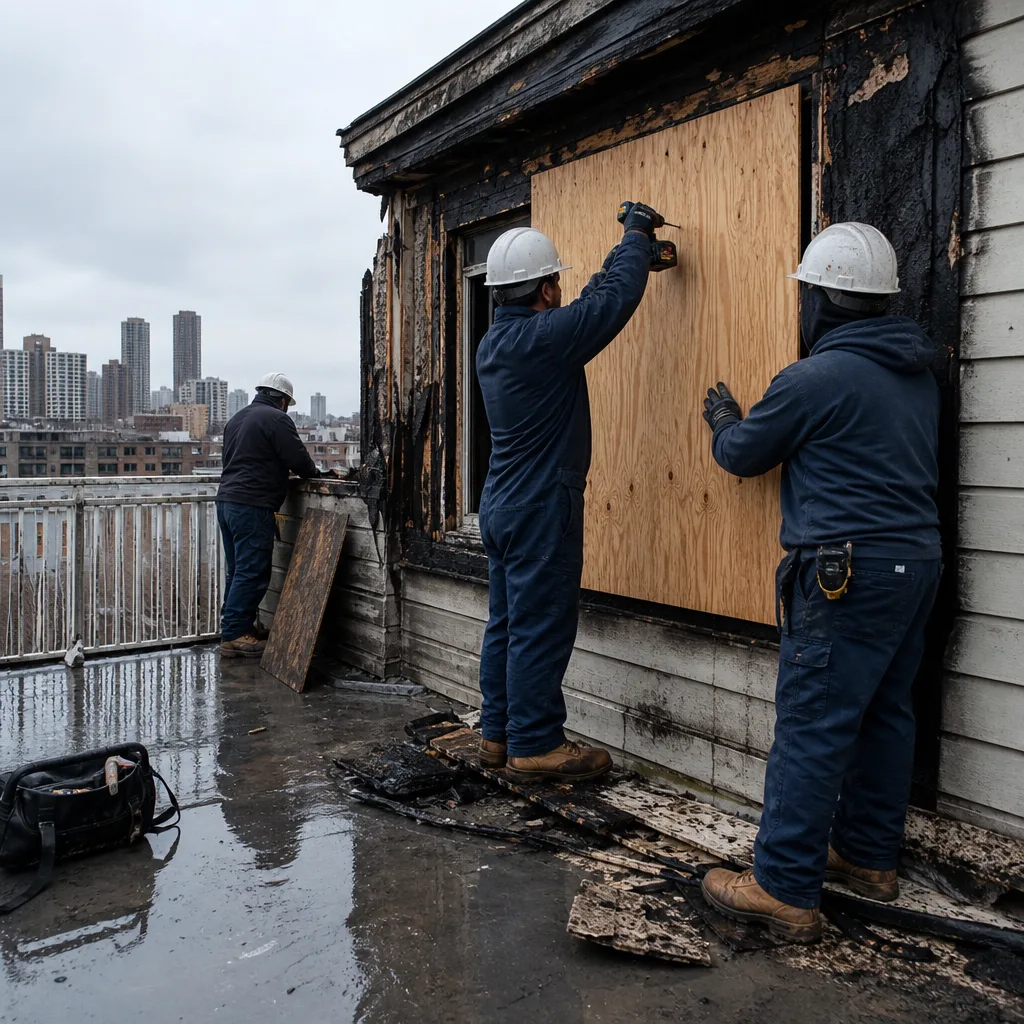
Emergency Board-Up
When a tree limb goes through a bay-front window or wind tears off a door, the opening is an invitation. We board with plywood cut to fit, tarp the opening, and secure the property the same visit. A bay-front Colonial does not get a standard board job; the wind load off the water changes what holds.
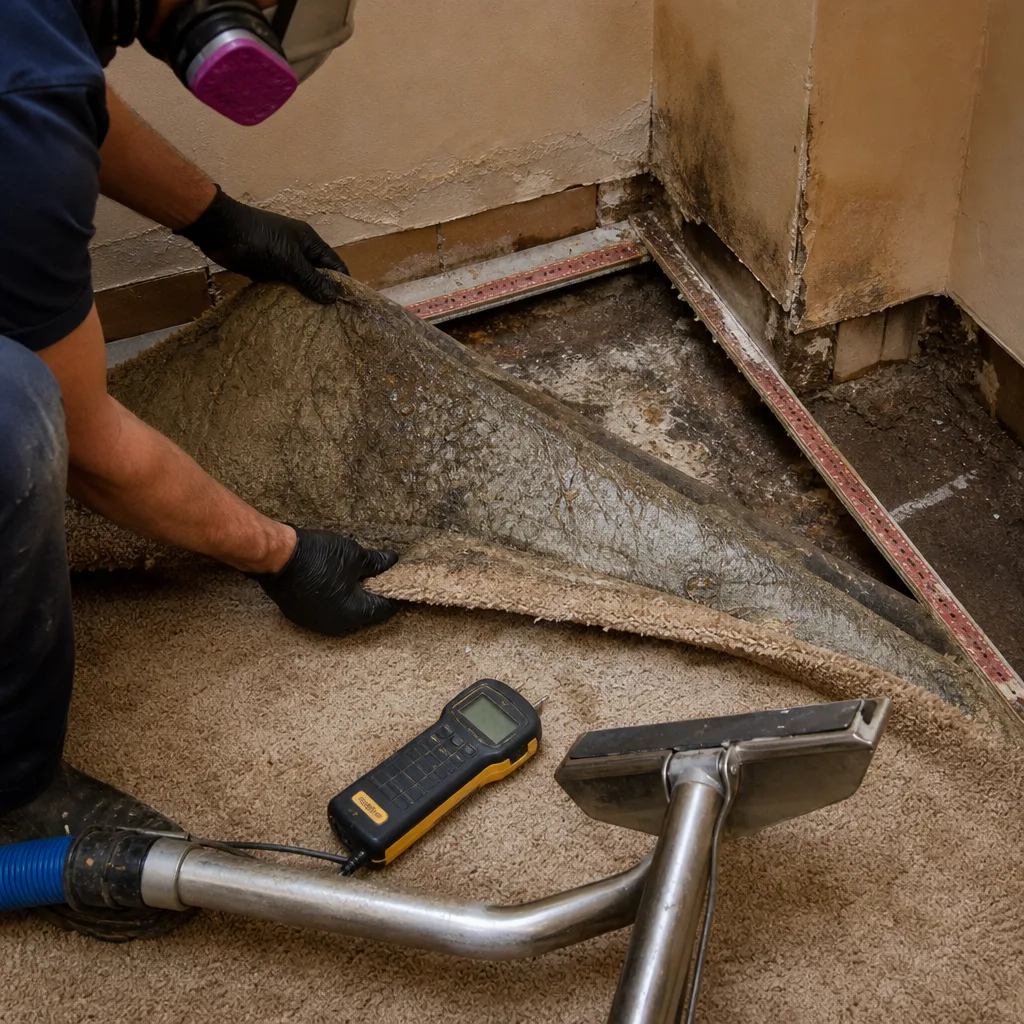
Storm Damage Cleanup
Debris removal, glass and nail pickup, gutter clearing, and structural drying after wind-driven rain. We remove what the storm left and document everything for the carrier before cleanup begins, so the claim file is built correctly from minute one.
Roof Tarping
A fast tarp job keeps rain out of the attic and away from plaster ceilings. Done wrong, it fails with the next gust. We tie tarps to anchor points that hold against bay wind, not just a couple of nails in the fascia.
Debris Removal
Downed branches, displaced fencing, and water-logged contents are removed and disposed of properly. We photograph the debris pile before hauling, because your insurer needs that documentation to approve the claim.
Wind Damage Repair
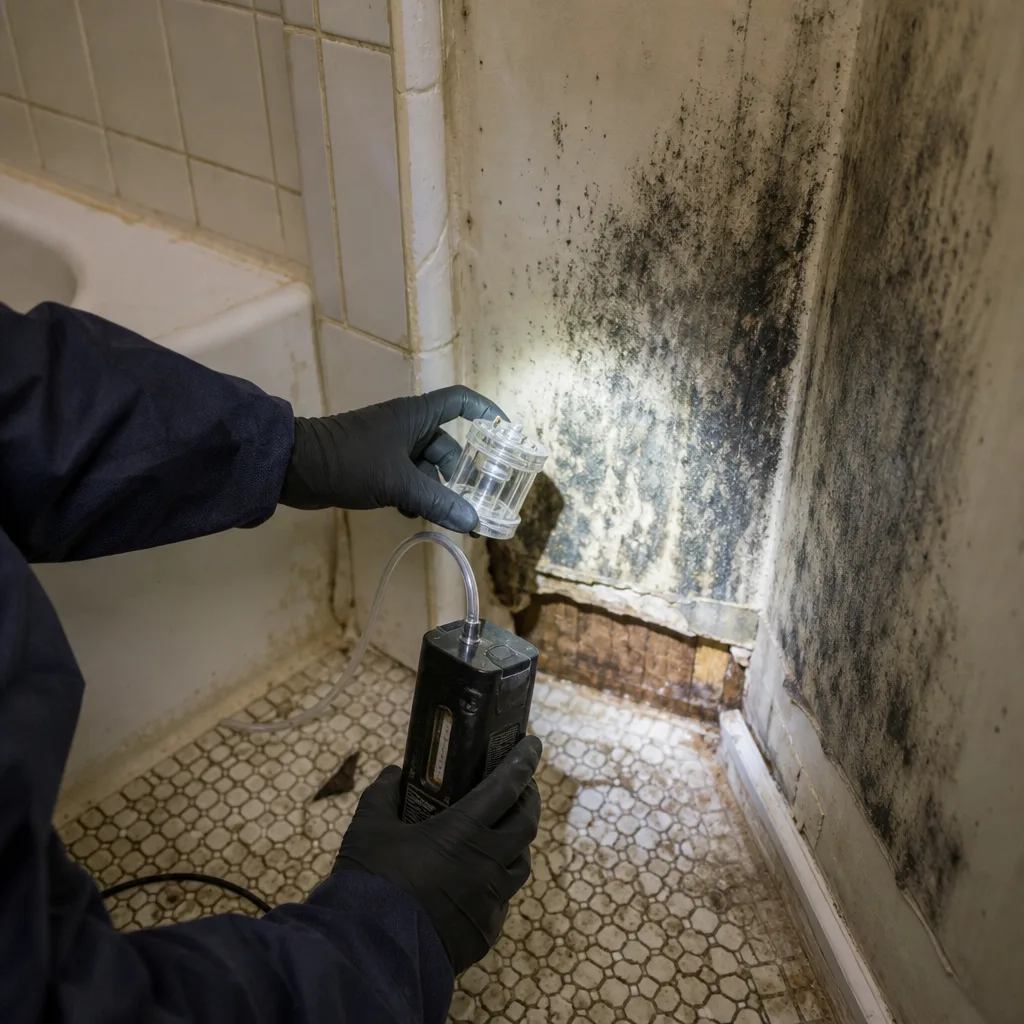
We check door frames, window casings, and roof edges for the rot and failed weatherstripping that let wind-driven rain into basements and wall cavities. On 1920s to 1950s houses, the frames are often original, and the gap between the millwork and the wall is where the damage starts.
What happens when you call
- 1
A real person answersNo phone trees - you reach a local pro.
- 2
You get an upfront price rangeHonest numbers before anyone is dispatched.
- 3
A background-checked tech heads outLicensed & insured, dispatched right away.
- 4
You approve before work beginsNothing starts until you say go.
Storm & Disaster Restoration Costs in Little Neck, NY
Storm restoration costs in Little Neck depend on how much of the water got into original plaster and how long it sat. A simple wind-driven rain intrusion with one day of drying on a single room typically runs $900 to $1,800. A Category 3 basement surge extraction with containment, antimicrobial treatment, and four to five days of structural drying usually lands between $3,500 and $7,500. Full plaster wall removal, pack-out, and rebuild after a bay surge can reach $12,000 to $25,000 or more depending on square footage and finish level. Wind damage repair, including board-up, tarping, and door or window replacement, typically runs $800 to $3,000 before insurance. Higher costs come from hidden moisture behind plaster, crawl spaces that need encapsulation, and the volume of contaminated material that has to come out. The free inspection gives you a written number before any work starts. Call (917) 924-4221 and we will walk the property and give it to you straight.
We Also Serve Cities Near Little Neck
Floodline Restoration Co. of Manhattan serves homeowners in Great Neck, Glen Oaks, Bellerose, and Oakland Gardens with the same live-answer dispatch, certified crews, and 90-Day Done Right Promise. If you are near the Little Neck line and dealing with storm damage, call (917) 924-4221 and we will be on the way.
Little Neck Storm & Disaster Restoration Questions, Answered
Why does Little Neck see more storm-surge flooding than nearby inland Queens neighborhoods like Bayside?
Little Neck sits directly on Little Neck Bay, and the bay’s funnel shape pushes tidal surge onto low-lying streets near Northern Boulevard during nor’easters faster than the city’s combined stormwater and sewer system can handle. Bayside sits higher and farther from the water, so it does not take the same hydraulic force. That is why restoration work here requires Category 3 protocols more often than inland Queens. Call (917) 924-4221 if surge water has entered your basement.
What does a wind-rated door inspection involve for a 1940s Cape Cod in Little Neck before hurricane season?
We check the frame for rot, test the weatherstripping, inspect the threshold seal, and confirm the hinges and strike plate are still anchored to solid wood. On a 1940s Cape Cod, the original door is often still in place, and the frame has shifted enough to leave gaps that invite wind-driven rain. We recommend repairs before the storm, not after. Call (917) 924-4221 to schedule a pre-season inspection.
How do restoration pros handle hidden Sandy moisture still trapped behind plaster walls in Little Neck homes?
We use thermal imaging and penetrating moisture meters to find what is still wet behind the plaster, then open the affected cavities and dry them directly. Simply drying the room air will not reach moisture trapped behind 1920s lath. That hidden pocket keeps feeding mold until it is removed. Call (917) 924-4221 for a free inspection if you suspect old water is still in your walls.
Is emergency board-up different for a bay-front Colonial in Little Neck than a standard Queens brick rowhouse?
Yes. A bay-front Colonial on a low block takes wind off the water at full force, so plywood has to be anchored to framing that can hold under repeated gusts. A rowhouse shares party walls and absorbs wind differently. We size the anchorage and the panel thickness for the exposure, not just the opening. Call (917) 924-4221 the moment a window or door fails.
When a nor’easter floods a Little Neck basement, how quickly does mold become a threat given the older plaster walls?
Mold can start in as little as 48 to 72 hours, and plaster-over-lath walls hide it longer than drywall because the lath channels create dark, damp cavities. If the water was Category 3, the contamination risk is higher. The faster extraction and drying start, the less material has to be removed. Call (917) 924-4221 immediately after the water enters.
How fast can someone actually get to my Little Neck home after I call?
Our response commitment is 45 minutes for emergency storm calls. A live dispatcher answers, confirms your address, and a crew already staged near Little Neck rolls to you. The sooner we arrive, the more we can save. Call (917) 924-4221 any hour.
Will my insurance cover storm and flood damage in Little Neck?
Storm damage from wind, rain intrusion, and fallen trees is typically covered under homeowners insurance. Flood damage from bay surge requires a separate flood policy, usually through FEMA’s National Flood Insurance Program. We document everything and coordinate directly with your adjuster either way, and we will tell you honestly which path your claim is on. Call (917) 924-4221 for help sorting it out.
What should I do in the first 30 minutes after storm water enters my Little Neck house?
Shut off electricity only if you can do so safely and without standing in water, then call (917) 924-4221. Do not run fans on standing water, do not open wet walls yourself, and do not touch anything that may have been contaminated by bay water. Take photos if you can, then wait for a certified crew to arrive. The less you move, the less you spread.
Serving Little Neck, NY - Our Local Coverage Area
We’re based in the Little Neck area and know this community well. Use the map below to see our service coverage - if you’re nearby, we can almost certainly help.
The Little Neck Storm Difference
Little Neck’s bay-side residential blocks sit in FEMA Special Flood Hazard zones where nor’easter storm surge from Little Neck Bay, funneled by the bay’s shape, inundates low-lying streets near Northern Boulevard faster than the city’s combined stormwater and sewer system can drain. That hydraulic condition, which inland Queens ZIP codes simply do not share, changes everything about storm restoration in this neighborhood. A standard Category 1 cleanup does not apply when the water that entered your basement was moving saltwater with sewage and silt in it. Our crews are trained and equipped for that distinction. We run Category 3 protocols, we contain the affected area, we remove what cannot be sanitized, and we log moisture readings daily until the structure hits dry standard.
After a March nor’easter pushed Category 3 bay water into a 1930s Colonial on a low block near Little Neck Bay, our crew set containment, extracted, and ran moisture mapping with Dri-Eaz and Phoenix air movers and dehumidifiers. After 72 hours of structural drying with daily drying logs, we removed saturated plaster lath, applied antimicrobial treatment, and restored the crawl space to pre-loss condition. The moisture map also caught a hidden 2012 Sandy moisture pocket behind an unvented crawl space wall that would have kept feeding mold long after the visible damage was dried. That is the difference between a restoration company that reads the surface and one that reads the building. We stand behind the result with the 90-Day Done Right Promise, in writing.
If you need Storm & Disaster Restoration in Little Neck, call (917) 924-4221. A live dispatcher answers, a certified crew responds, and the job is done right from the first extraction to the final piece of trim. We are Storm & Disaster Restoration in Little Neck, available 24 hours a day, every day of the year.
Written by Curt Bowman, Owner at Floodline Restoration Co. of Manhattan, serving Little Neck and surrounding communities.