
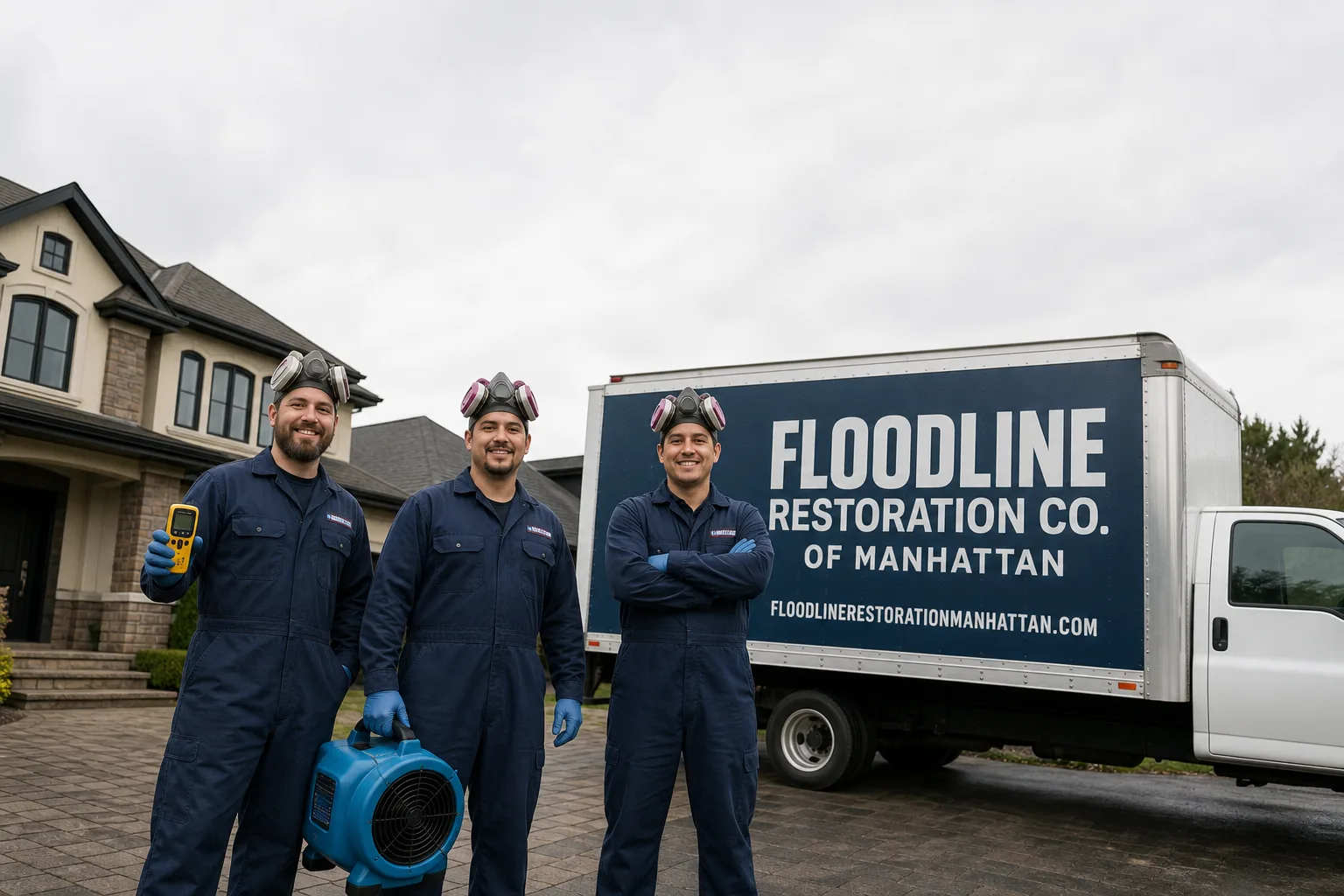
Free visual inspection and a written scope of work before any mitigation begins - photos, moisture readings, and drying logs go in your claim file
The scope we write is the scope we bill. Anything new gets shown to you, in writing, before we touch it.






 Before
 After
After Before
 After
After Before
 After
After24/7 Emergency Commercial Restoration in Jefferson Valley-Yorktown
Commercial restoration in Jefferson Valley-Yorktown runs on one timeline: the first hour. Water moving through a retail space, office, or multi-unit building near the Amawalk Reservoir corridor follows the path of least resistance, and that usually means drywall, base trim, inventory, and electrical. Our crews answer live at (917) 924-4221 twenty-four hours a day, seven days a week, and we dispatch into Jefferson Valley-Yorktown neighborhoods within 45 minutes. The first visit includes a free visual inspection inside the affected building, where we map the moisture line and start containment before the damage spreads further into shelving, stock, or tenant units. We bill your carrier directly, and the scope of work is in writing before equipment goes in. If you’re standing in a wet showroom, a flooded office basement, or a multi-unit building with water moving between units, call now. The line the water left is where we start.
Understanding Commercial Restoration Severity in Jefferson Valley-Yorktown Properties
Most commercial water damage in Jefferson Valley-Yorktown falls into two buckets. Clean water from a burst supply line or failed water heater is Category 1: inconvenient, but manageable if dried fast. Water that has traveled through building materials, picked up contamination from the 1960s-1980s commercial stock along Routes 6 and 132, or sat for more than 48 hours degrades into Category 2 or 3, and that changes the job entirely. Category 3 water, what we see in sewage backups or storm-driven groundwater intrusion through fractured bedrock, carries pathogens and requires full containment, antimicrobial treatment, and often removal of porous materials rather than drying in place.
The severity curve matters more in Jefferson Valley-Yorktown than in flatland commercial districts because the shallow, fractured bedrock ledge under much of northern Westchester prevents water from percolating away once it enters a foundation. Moisture that would drain in other geologies sits here, held against concrete slabs and block walls by hydrostatic pressure. That’s why we run thermal imaging and moisture mapping on every commercial job, not just the big losses. A damp spot behind a display case can mean lateral seepage through a foundation crack, not a spilled mop bucket, and if you treat the symptom instead of the source, mold shows up inside 48 hours.
Why Jefferson Valley-Yorktown Property Owners Choose Floodline Restoration Co. of Manhattan
- 45-minute response commitment. We dispatch from a live board, not a voicemail. A crew rolls into Jefferson Valley-Yorktown within 45 minutes of your call, day or night.
- A real person answers, 24/7. At 2 a.m., you get a live dispatcher on the phone, not a recording. That’s been true every day since Curt Bowman founded this company in 2010.
- IICRC-certified technicians. Our crews carry WRT, FSRT, and AMRT certifications and follow IICRC standards on every water, fire, and mold loss. You get trained, background-checked, uniformed people in your building.
- Free visual inspection. Before any equipment goes in, we walk the loss with you and explain exactly what we’re seeing and what it will take to fix it.
- Direct insurance billing. We bill your carrier directly and speak to the adjuster on your behalf. You’re not the messenger between us and the insurance company.
- One team, start to finish. The same Floodline Restoration Co. of Manhattan crew that extracts and dries the building is the crew that rebuilds it. No mid-job handoff, no inherited subcontractors.
Our Commercial Restoration Process
Inspection & Assessment
We arrive with thermal imaging and moisture meters within 45 minutes. We map the water line, identify the intrusion source, classify the water category, and give you a written scope before any equipment is unloaded.
Extraction & Stabilization
Commercial-grade extraction starts the same visit. We remove standing water, secure the affected area, and set up containment so the damage doesn’t spread into adjoining tenant spaces or retail areas.
Drying & Dehumidification
We place Dri-Eaz air movers and Phoenix dehumidifiers based on a moisture map, not guesswork. Daily readings are logged until the dry standard is met, and you and your carrier get the log.
Cleaning & Sanitization
Affected surfaces get antimicrobial treatment appropriate to the water category. For Category 2 or 3 losses, we run HEPA air scrubbers during the drying phase and perform clearance testing before we hand the space back.
Document & Inventory Recovery
We pack out affected documents and inventory, dry what’s salvageable, and restore what can be restored. Business records, product stock, tenant files: we treat them as recoverable until proven otherwise, and we photo-document every step.
Repairs & Restoration
The same crew that pulled the water rebuilds what needs rebuilding. Drywall, flooring, trim, paint, and any structural repairs are done to IICRC standards and backed by our 90-Day Done Right Promise in writing.
Need Emergency Commercial Restoration in Jefferson Valley-Yorktown Now?
Crews minutes away, answering live 24 hours a day. The sooner we start, the less it costs.
Working With Your Insurance Company
Commercial water damage claims in Jefferson Valley-Yorktown move faster when the documentation is bulletproof from hour one. We photo-record every affected area before we touch anything, log moisture readings daily through the drying phase, and provide your adjuster with a line-item scope that matches industry-standard estimating software. When the carrier wants more detail, we speak to them directly so you don’t have to play middleman. Our goal is simple: you get the full amount your policy owes you, and the building gets restored to pre-loss condition without a fight. The Keystone Standard, our 90-Day Done Right Promise, is part of every commercial file we open in Jefferson Valley-Yorktown.
What We Provide Your Insurer
- Thorough documentation of the loss
- Photos of all damage, room by room
- Moisture readings and drying logs
- A detailed, line-item scope of work
- Direct coordination with your carrier
Built for Jefferson Valley-Yorktown’s Loss Calendar
January and February freeze the supply lines running through the uninsulated crawl spaces and utility rooms of Jefferson Valley-Yorktown’s 1960s-1980s commercial buildings. A burst pipe behind a strip-mall wall can dump hundreds of gallons into retail space before anyone notices, and the water follows the slab grade into neighboring units. March and April bring the thaw, when snowmelt and spring rain push laterally through the fractured rock ledge and into basements that have been dry all winter. The stream valleys threading through Yorktown’s hills, especially near the Amawalk Reservoir, take on groundwater during these months even when the surface looks fine.
Summer convective storms hit fast and hard in northern Westchester. Intense rainfall overwhelms window wells, roof drains, and sump pumps, and the near-impermeable bedrock under Jefferson Valley-Yorktown sends runoff horizontally instead of down. Fall nor’easters bring the tree-fall calls. The mature oak and maple canopy that makes this area beautiful also makes it vulnerable; a wind-driven limb through a flat commercial roof opens the building to water for hours until help arrives. We see the same loss calendar every year, and we staff for it.
Commercial Restoration Across Jefferson Valley-Yorktown’s Neighborhoods
Jefferson Valley-Yorktown’s commercial districts cluster along the Route 6 and Route 132 corridors, from the retail strips near the Jefferson Valley Mall up through the older commercial blocks heading toward Yorktown Heights. Retail storefronts along Route 6 tend to be slab-on-grade construction built in the 1960s and 1970s, which means water from a roof leak or a burst pipe moves through floor coverings fast and wicks into the lower wall cavities. Office buildings along Route 132 are often raised structures with crawl spaces or shallow basements, and these are the ones that catch the lateral groundwater seepage from the fractured rock ledge after a prolonged rain.
The Amawalk Reservoir corridor runs through the eastern edge of Jefferson Valley-Yorktown, and commercial properties along that spine have a distinct water-intrusion signature: groundwater that rises through the slab under hydrostatic pressure even when no surface flooding occurs anywhere on the lot. Multi-unit and HOA properties in the stream valleys, including the older garden-apartment and condo clusters, see water moving between units through shared walls and floor assemblies. A burst pipe in one unit becomes a multi-unit pack-out fast. We know the response routes into every one of these areas, and we know which buildings tend to lose power first when a nor’easter comes through.
Specialized Commercial Restoration Services We Offer in Jefferson Valley-Yorktown
Office & Retail Restoration
A retail space near the Amawalk Reservoir corridor took on groundwater during a prolonged rain event that drove water up through the slab via fractured bedrock. Our techs used moisture mapping to confirm lateral seepage, not surface runoff, then set up containment, ran Dri-Eaz air movers and Phoenix dehumidifiers around the clock, and applied antimicrobial treatment before restoring the sales floor to pre-loss condition without closing the business a single day. That’s the standard we work to on every office and retail loss in Jefferson Valley-Yorktown: restore the space, protect the inventory, keep the doors open when it’s safe to do so.
Multi-Unit & HOA Restoration
Multi-unit buildings in Jefferson Valley-Yorktown’s stream valleys present a specific problem: water doesn’t respect property lines between units. A Category 2 water event from a burst pipe on the third floor migrates through floor assemblies into the units below, and if remediation starts without proper containment, the building gets evacuated instead of just the affected stack. HOAs choose us because we contain the loss, pack out affected units only, and document everything the association’s insurance carrier needs. We’ve handled enough HOA losses in Jefferson Valley-Yorktown to know that the fastest path to reopening units is a clean containment line and a drying plan that accounts for shared walls and chase spaces.
Industrial Facility Cleanup
Industrial and light-manufacturing buildings along the Route 6 corridor often sit on concrete slabs over bedrock, which means groundwater intrusion arrives as a slow, persistent seep rather than a visible flood. That’s the hardest loss to catch early and the most damaging when missed, because moisture sits under pallets, machinery bases, and racking where it can’t be seen. We run moisture mapping across the entire slab, not just the wet spot, and our drying plan is built around the building’s actual use. Equipment stays in place when it can, moves when it can’t, and we coordinate with your operations manager so production downtime is measured in hours, not days.
Large-Loss Response
When a commercial building in Jefferson Valley-Yorktown takes a large loss, a roof punch-through from a fallen oak, a major supply-line failure, a nor’easter-driven envelope breach, the first 24 hours determine the final cost. We scale crews to the building’s square footage, not to the size of the initial call, and we bring enough air movers, dehumidifiers, and HEPA scrubbers to run the entire affected area at once. Our Commercial Restoration team has handled large-loss events throughout Jefferson Valley-Yorktown’s commercial corridors, including evening starts and holiday weekends, because water doesn’t wait for business hours and neither do we.
Business Interruption Minimization
Every day a Jefferson Valley-Yorktown business is closed is revenue that doesn’t come back. During a 24 to 48 hour windfall event, whether it’s a burst pipe or a roof breach, we make an assessment and act immediately. We dry and dehumidify extensively to prevent mold growth before it can take hold. We’re dedicated to making sure every decision we make protects your business’s ability to reopen. We have treated more water damage than we can count in Jefferson Valley-Yorktown’s conditions, and we know that drying is the cheapest and fastest response, but it demands an immediate and sustained response. We don’t hesitate, because hesitation is the real cost.
What happens when you call
- 1
A real person answersNo phone trees - you reach a local pro.
- 2
You get an upfront price rangeHonest numbers before anyone is dispatched.
- 3
A background-checked tech heads outLicensed & insured, dispatched right away.
- 4
You approve before work beginsNothing starts until you say go.
Commercial Restoration Costs in Jefferson Valley-Yorktown, NY
A typical office or retail water-damage restoration in Jefferson Valley-Yorktown runs $2,500 to $7,500 for a contained Category 1 loss: burst supply line, partial room involvement, drying completed in under a week. Multi-unit or HOA losses involving multiple units, shared walls, or Category 2 water run $8,000 to $25,000 depending on square footage and containment complexity. Large-loss commercial events, full floor involvement or structural drying after a roof breach, run $25,000 to $100,000 plus reconstruction. Most of these costs are covered by commercial property insurance, and we bill your carrier directly, so your out-of-pocket is usually the deductible. The free visual inspection is how you get from the unknown to a firm, written scope. Call (917) 924-4221 and we’ll walk the building with you, no charge.
We Also Serve Cities Near Jefferson Valley-Yorktown
Our crews respond throughout northern Westchester and the surrounding area, including Jefferson Valley-Yorktown and the nearby communities of Fairview, Harrison, East Bronx, and Hunts Point. If your commercial property sits in one of these neighboring towns, the same 45-minute response commitment and 24/7 live dispatch apply.
Jefferson Valley-Yorktown Commercial Restoration Questions, Answered
Why do commercial basements in Jefferson Valley-Yorktown flood even when the property sits well above any floodplain?
Jefferson Valley-Yorktown sits on shallow, fractured bedrock ledge. After prolonged rain, groundwater moves laterally through the fractures and rises against foundations under hydrostatic pressure. The water enters through slab cracks and cove joints, not through surface flooding. Out-of-area contractors often misdiagnose this as a drainage or grading problem, but it’s a foundation and hydrostatic-pressure issue that requires interior structural drying and dehumidification, not just outdoor mitigation.
How quickly can a Jefferson Valley-Yorktown restaurant reopen after a water event if you start mitigation the same day?
Most Jefferson Valley-Yorktown restaurants can reopen within 72 to 96 hours if extraction starts the same day and the water is Category 1 or contained Category 2. The key is starting immediately before water wicks into drywall and flooring. We’ve restored retail and restaurant spaces along the Route 6 corridor without the business closing for a single shift when we got the call early. Call (917) 924-4221 the moment you see water.
Does Floodline Restoration handle large-loss commercial water damage in the stream valleys around the Amawalk Reservoir?
Yes. Large-loss response is one of our core Commercial Restoration services. Properties in the Amawalk Reservoir corridor deal with a distinct lateral-seepage pattern where groundwater comes up through the slab, not over the surface. We scale crews and equipment to the building’s square footage and run the full drying array around the clock until the dry standard is met.
What does a commercial water damage scope of work look like for an office building on a rocky Westchester lot?
A scope for an office building on Jefferson Valley-Yorktown’s rocky subgrade includes documentation of the water category, a moisture map showing the intrusion pattern, containment setup, extraction, structural drying with daily readings, antimicrobial treatment appropriate to the category, and a written rebuild scope for affected materials. The scope is approved by you before work begins, and the same document goes to your carrier.
Why do HOAs in Jefferson Valley-Yorktown choose you for multi-unit water damage instead of an out-of-town franchise?
Because we know the buildings and the geology. Multi-unit losses in Jefferson Valley-Yorktown’s stream valleys involve water moving through shared walls and chase spaces, which demands containment from the first hour, not just extraction. Out-of-town franchises often miss the bedrock-driven lateral seepage pattern and stop drying too early. HOAs also get direct carrier billing, a written 90-Day Done Right Promise, and the same crew from first extraction through rebuild.
Will my commercial insurance cover water damage from a burst pipe or groundwater seepage?
Most commercial property policies in Jefferson Valley-Yorktown cover sudden and accidental water damage from a burst pipe or failed appliance. Groundwater seepage through a foundation is trickier; many policies exclude it unless you carry specific seepage endorsements. We’ve handled enough of these claims in northern Westchester to know what carriers look for, and we document everything the adjuster needs. We’ll bill your carrier directly and fight for the coverage you’re owed.
Do I need full remediation or just a cleaning after a water event in my Jefferson Valley-Yorktown commercial space?
It depends on the water category and how long it sat. Category 1 water from a clean supply line, extracted within hours, often needs drying rather than full remediation. Category 2 or 3 water, or water that has sat more than 48 hours, requires containment, antimicrobial treatment, and often material removal, which is why our Jefferson Valley-Yorktown Fire & Smoke Damage Restoration team applies the same rigorous documentation standards. The question is answered in the first 30 minutes of our free inspection. We’ll tell you honestly if a cleaning is enough; we don’t sell remediation that isn’t needed.
What should I do in the first 30 minutes after discovering water in my Jefferson Valley-Yorktown commercial building?
Shut off the water source if you can do so safely, kill power to the affected area, move inventory and documents out of standing water if it’s safe to reach them, and call (917) 924-4221. Don’t use a wet-dry vac on Category 2 or 3 water; you’ll spread contamination. Don’t wait to see if the water recedes on its own; it won’t. Start the clock on drying now, and you’ll lose less inventory, less drywall, and fewer business days.
Serving Jefferson Valley-Yorktown, NY - Our Local Coverage Area
We’re based in the Jefferson Valley-Yorktown area and know this community well. Use the map below to see our service coverage - if you’re nearby, we can almost certainly help.
Get Commercial Restoration Help in Jefferson Valley-Yorktown Today
You called because there’s water where it shouldn’t be, a roof opened up, or a multi-unit building is spreading damage between tenants. You don’t need a sales pitch. You need a crew that answers the phone at 2 a.m., arrives in Jefferson Valley-Yorktown within 45 minutes, and starts extraction the same visit. That’s what Floodline Restoration Co. of Manhattan does. We’re licensed, insured, and IICRC-certified. We bill your carrier directly. We stand behind the work with the 90-Day Done Right Promise, in writing. Call (917) 924-4221 now for a free estimate. The line the water left is where we start.
Written by Curt Bowman, Owner at Floodline Restoration Co. of Manhattan, serving Jefferson Valley-Yorktown since 2010.