
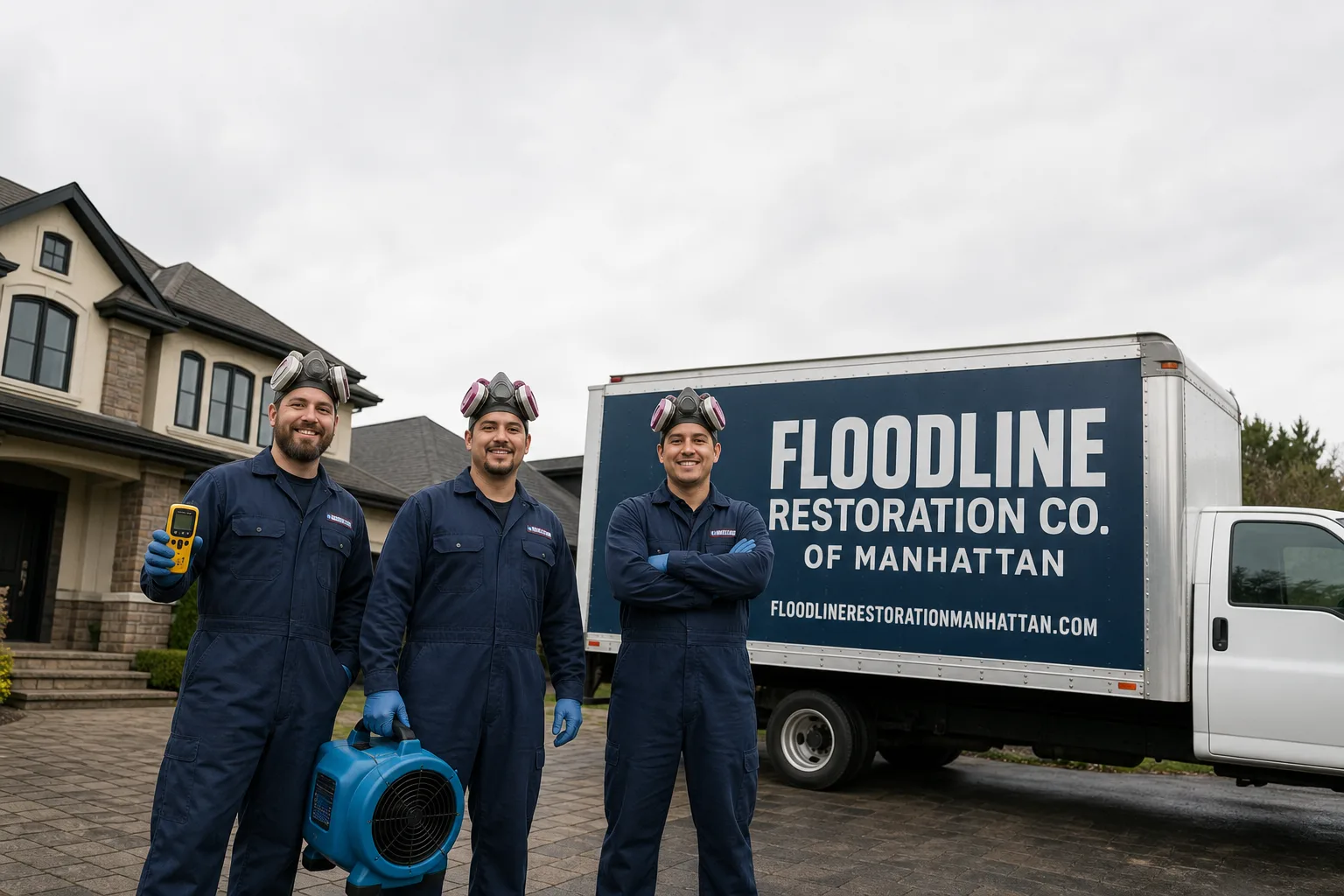
Free visual inspection and a written scope of work before any mitigation begins - photos, moisture readings, and drying logs go in your claim file
The scope we write is the scope we bill. Anything new gets shown to you, in writing, before we touch it.






 Before
 After
After Before
 After
After Before
 After
After24/7 Emergency Mold Remediation in Greenville
Mold remediation in Greenville runs $1,800 to $6,500 for a typical single-room job, and most calls we take from this area involve damage that started weeks or months before anyone noticed. If you’ve found mold in a Greenville home, call (917) 924-4221 right now. A live dispatcher answers at any hour, and we can usually have a certified crew at your door inside 45 minutes for a free visual inspection.
The first hour matters because mold colonies in unoccupied or under-ventilated homes expand fast. Greenville’s seasonal cottages and older farmhouses give mold exactly what it needs: trapped moisture, low airflow, and building materials that hold water. The sooner we contain the affected area, the less demolition you’ll need and the lower the final bill.
Understanding Mold Remediation Severity in Greenville Properties
Mold jobs in Greenville don’t look like mold jobs in year-round suburbs. Most of what we see here is what the industry calls a long-latency loss. A pipe lets go in a vacant seasonal cottage in January. Nobody finds it until April. By then the water has settled into wall cavities, soaked through plaster and lathe, wicked up through unsealed stone foundations, and fed fungal growth for months.
We classify water by category. Category 3 water is grossly contaminated, the kind that carries sewage, floodwater, or months of standing microbial growth. That’s what most Greenville burst-pipe discoveries actually are by the time we arrive, even though the owner thinks it’s a fresh leak. The remediation protocol is different: full containment, negative air pressure, HEPA air scrubbing, antimicrobial treatment, and removal of all porous materials that absorbed contaminated water. Surface cleaning won’t touch what’s behind the drywall in a mid-century bungalow with no vapor barrier.
That’s why we never treat a Greenville spring ‘pipe burst’ as a simple dry-out. We moisture-map first. We log readings. We verify what category of water we’re actually dealing with before we cut anything open.
Why Greenville Property Owners Choose Floodline Restoration Co. of Manhattan
- 45-minute response commitment for emergency calls in the Greenville area. We dispatch from a live board, not a voicemail box.
- A real person answers, 24 hours a day, 7 days a week. You’ll never get a recording when you call (917) 924-4221 at 2 a.m.
- IICRC-certified remediation crews trained to WRT and AMRT standards, with RIA and IFA protocols behind every job.
- Free visual inspection with photo documentation and a written scope before any work begins. No pressure, no vague estimates.
- Direct insurance billing. We document, we photograph, we coordinate with your adjuster. You don’t play messenger.
- One team from start to finish. The same Floodline crew that contains the mold is the crew that rebuilds the wall. No handoffs.
Curt Bowman founded Floodline Restoration Co. in 2010 around a dispatch board, not a sales desk. Every job carries the 90-Day Done Right Promise, our written guarantee that if it’s not done right, we make it right. No arguing, no paperwork battles. That’s the Keystone Standard, and it’s on every scope of work we hand a Greenville homeowner.
Our Mold Remediation Process
Inspection & Assessment
We start with thermal imaging and moisture mapping to find hidden water you can’t see. In Greenville’s older homes, that means checking wall cavities, sill plates, and the rim joist where stone foundations meet framing.
Containment & Stabilization
Before any demo starts, we seal the affected area with 6-mil poly sheeting and set up negative air pressure with HEPA filtration. In an absent-owner cottage, this step is what keeps mold from spreading into unaffected rooms when we open the walls.
Drying & Dehumidification
We run Dri-Eaz dehumidifiers and Phoenix air movers on a moisture map, not a guess. Daily readings are logged until every affected material reaches its dry standard. In uninsulated mid-century walls, that takes longer than in modern construction.
Cleaning & Antimicrobial Treatment
Porous materials too saturated or contaminated get removed. Salvageable surfaces get HEPA-vacuumed, scrubbed, and treated with an EPA-registered antimicrobial. Crawl spaces get special attention, since that’s where most Greenville mold starts.
Air Quality Restoration
Once remediation is complete, we run HEPA air scrubbers until the indoor air clears. Final clearance testing confirms spore counts are back to baseline before we take down containment.
Repairs & Restoration
The same crew that removed the mold rebuilds what came out. Drywall, insulation, flooring, trim, and vapor barriers go back in place. The 90-Day Done Right Promise covers the whole job.
Need Emergency Mold Remediation in Greenville Now?
Crews minutes away, answering live 24 hours a day. The sooner we start, the less it costs.
Working With Your Insurance Company
Insurance coverage for mold remediation in Greenville depends heavily on the cause of loss and the policy language. Most homeowner policies cover mold remediation when it results from a covered peril, like a sudden pipe burst. But here’s the catch with seasonal properties: if the damage sat unreported for months, the carrier may argue neglect. That’s where documentation changes everything.
From the first hour on site, we photograph everything. Every wall, every stud bay, every moisture reading. We create a chain of evidence that shows what happened, when it likely happened, and what we did about it. Floodline Restoration Co. communicates directly with your adjuster. You get a line-item scope of work, not a vague paragraph. For Greenville owners dealing with absent-owner claims, that documentation is often what turns a denial into a paid claim.
What We Provide Your Insurer
- Thorough documentation of the loss
- Photos of all damage, room by room
- Moisture readings and drying logs
- A detailed, line-item scope of work
- Direct coordination with your carrier
Built for Greenville’s Loss Calendar
Greenville’s mold season doesn’t follow the calendar the way it does in suburban Rockland or Westchester. Here, the biggest mold discovery month is April and May, when owners drive up from Manhattan and open a cottage door to four months of stale air and the smell of rot.
January and February deep freezes burst pipes in unheated seasonal homes. The water runs until the pressure drops or the ice thaws. March snowmelt saturates soil around stone foundations with no waterproofing membrane. April brings the first spring rain, pushing groundwater into crawl spaces that never got a vapor barrier. May is when the owners finally show up and find mold climbing the drywall.
Summer brings humidity into uninsulated wall cavities, feeding whatever spores survived the winter. Hurricane Irene’s 2011 flood scar is still visible along Catskill Creek tributaries, and every major rain event re-wets the same low-lying foundations. Fall is the window for preventive work: crawl space encapsulation, dehumidifier installation, and pipe insulation. Smart Greenville owners use the fall to get ahead of the spring discovery.
Mold Remediation Across Greenville’s Neighborhoods
Greenville’s loss patterns change depending on where the house sits. Along Route 32 and Route 81, we see older farmhouses from the late 1800s and early 1900s, balloon-framed with original plaster walls. When those walls get wet, moisture travels vertically through the stud bays. Mold doesn’t stay in one room. It migrates. Remediation means opening walls from floor to attic in the affected chase.
The seasonal cottage clusters near the Catskill Creek tributaries and the lake edges are our most frequent spring calls. These mid-century bungalows sit close to the ground, with shallow crawl spaces that stay damp from March through June. The mold we find in these homes is almost always Category 3 by the time it’s discovered, simply because nobody was there to catch it early. Containment and full removal are non-negotiable.
Up toward Hempstead Road and the higher elevations, we see ice-dam damage on low-pitch cottage roofs. Meltwater backs up behind the eaves, seeps into the attic, and soaks the ceiling below. By the time an owner notices the stain, there’s usually a mold bloom on the back side of the drywall.
The year-round neighborhoods closer to Greenville’s center, the homes near the schools and the village core, deal with a more familiar set of problems: bathroom exhaust fans venting into attics, crawl space vents left open year-round, and older additions with poor drainage. Those jobs are smaller, but they’re still mold, and they still need proper containment.
Specialized Mold Remediation Services We Offer in Greenville
Mold Inspection & Testing
We don’t guess. Before any remediation plan is written, we inspect. That means visual assessment, moisture mapping with thermal imaging, and when needed, air and surface sampling. In Greenville’s seasonal cottages, we’re looking for what the homeowner can’t see: moisture in the sill plate, mold on the back of drywall, spores in the crawl space. A proper inspection tells you whether you have a small, contained problem or a full Category 3 remediation. Our Mold Remediation team gives you a written scope based on what the inspection actually found.
Mold Removal
Removal in Greenville means removing the mold and the materials it’s feeding on. Drywall that’s been wet for months comes out. Insulation that’s holding spores comes out. We don’t paint over mold or spray something and call it done. We cut back far enough to reach clean, dry material, treat the framing, and rebuild. The 90-Day Done Right Promise covers the entire job.
Black Mold Remediation
Stachybotrys, what most people call black mold, grows on materials that have been wet for a long time with a consistent moisture source. Greenville absent-owner cottages are a textbook environment for it: slow, undetected leaks, low airflow, high humidity. Black mold remediation requires full containment, negative air, HEPA scrubbing, and removal of all affected porous materials. We don’t shortcut this, and we don’t let homeowners shortcut it either.
Air Quality Restoration
After the mold source is removed, the air still carries spores. We run HEPA air scrubbers to pull airborne particulates out of the living space. In homes where mold went undetected for months, air quality restoration is the difference between a job that’s done and a job that comes back in July. Final clearance testing confirms the spore count is back to normal.
Crawl Space Treatment
We treat more crawl spaces in Greenville than almost any other space in a home. These shallow, damp cavities under seasonal cottages and farmhouses are where mold gets its start. We remove contaminated insulation, treat the framing, and when appropriate, install a vapor barrier and dehumidification. It’s not glamorous work. It’s the work that keeps the rest of the house dry.
Moisture & Humidity Control
Mold comes back when the moisture comes back. For Greenville homeowners, that means dealing with stone foundations that bleed groundwater, crawl spaces that stay damp, and bathrooms that vent into attics. We fix the moisture source, not just the mold it caused. Gutters, downspout extensions, crawl space encapsulation, dehumidifiers, and ventilation corrections are all part of keeping mold out of your home permanently.
What happens when you call
- 1
A real person answersNo phone trees - you reach a local pro.
- 2
You get an upfront price rangeHonest numbers before anyone is dispatched.
- 3
A background-checked tech heads outLicensed & insured, dispatched right away.
- 4
You approve before work beginsNothing starts until you say go.
Mold Remediation Costs in Greenville, NY
A typical single-room mold remediation job in Greenville runs $1,800 to $3,500. That covers containment, removal of affected drywall and insulation, antimicrobial treatment, drying, and basic rebuild of the wall. Crawl space treatment runs $2,000 to $5,000 depending on the size of the space and whether we’re installing a vapor barrier and dehumidifier.
Full Category 3 remediation in a long-latency cottage loss, the kind where a pipe burst in January and mold grew for months, runs $4,500 to $8,500 or more. Those jobs involve multiple rooms, saturated framing, subfloor removal, and sometimes full crawl space treatment.
Our current offers may apply: $50 off any repair over $250, and a senior and veteran 5% discount, always. The free visual inspection is how you get a firm number for your specific situation. Call (917) 924-4221 and we’ll come look.
We Also Serve Cities Near Greenville
Our crews regularly work in Red Hook, Chelsea, Shrub Oak, and Shenorock. If you own property in one of these nearby communities, or if you have a seasonal home in Greenville and a year-round house somewhere else in the Hudson Valley, we can help. The same 24/7 dispatch, the same certified crews, and the same 90-Day Done Right Promise apply wherever the job is.
Serving Greenville, NY - Our Local Coverage Area
We’re based in the Greenville area and know this community well. Use the map below to see our service coverage - if you’re nearby, we can almost certainly help.
Greenville Mold Remediation Questions, Answered
How fast can you get to a Greenville home for mold remediation?
We commit to a 45-minute response window for emergency calls in the Greenville area. Call (917) 924-4221 and a live dispatcher starts routing a crew immediately. For non-emergency inspections, we schedule within 24 to 48 hours.
How does Greenville’s absent-owner vacation home pattern change mold remediation scope?
It changes everything. A pipe that bursts in January and isn’t discovered until April means the water sat for months. That’s not a Category 1 clean-water loss anymore. That’s Category 3 contaminated water with entrenched mold colonies. The scope expands from a dry-out to full remediation: containment, demo of saturated materials, antimicrobial treatment, and rebuild. Greenville contractors who treat these as fresh leaks miss the mold behind the drywall, and the problem returns by summer.
Do I need a mold inspection before remediation in a Greenville seasonal cottage?
Yes, and not a superficial one. In a cottage that’s been closed up for months, you need moisture mapping, not just a visual walk-through. Our inspection finds hidden water in wall cavities, sill plates, and crawl spaces. That inspection becomes the basis for a written scope of work, so you know exactly what you’re paying for before any demo starts. Call (917) 924-4221 to schedule one.
Can you remediate mold in a Greenville crawl space without removing the cottage’s original stone foundation?
Absolutely. We never remove a stone foundation unless structural conditions make it necessary, and that’s rare. We treat the foundation by cleaning the stone, applying antimicrobial treatment, and addressing the moisture source. That typically means regrading exterior soil, extending downspouts, installing a vapor barrier inside the crawl space, and adding a dehumidifier if the space stays damp. Your foundation stays. The mold goes.
What does Hurricane Irene’s flood history mean for mold remediation along Catskill Creek tributaries in Greenville?
It means the groundwater in those areas has been elevated and unstable since 2011. Foundations that sat dry for decades now see seasonal water intrusion. Every heavy rain or snowmelt re-wets the same soil. If your home sits along a tributary, we factor that history into the remediation plan. Getting the mold out isn’t enough. The grade, the drainage, and the foundation waterproofing have to be addressed, or you’ll be calling us again in two years.
How do I know if the mold in my Greenville farmhouse is from a one-time leak or chronic moisture?
The pattern tells us. A one-time leak usually produces a concentrated mold bloom near the leak source, like under a window or below a roof penetration. Chronic moisture produces mold across wide areas: along baseboards, across crawl space joists, behind furniture on exterior walls. We confirm with moisture mapping. Chronic moisture means we have to fix the source, not just clean the mold. Otherwise it comes right back.
Can I stay in my Greenville home during mold remediation?
Depends on the scope. A small bathroom job with proper containment usually allows you to stay. A full Category 3 remediation in a long-latency cottage loss usually doesn’t, because we’re removing contaminated materials and running negative air. We’ll tell you honestly either way. The safety of your living space comes first.
What should I do in the first 30 minutes after finding mold in my Greenville home?
Don’t disturb it. Don’t scrub it, don’t spray it with bleach, don’t run fans. Disturbing mold releases spores into the air and spreads the problem. Close the door to the affected area if possible, shut off any HVAC system that could carry spores through the house, and call (917) 924-4221. We’ll tell you what you’re dealing with and whether it needs immediate containment.
In a mid-century seasonal cottage off a Catskill Creek tributary, our techs arrived in April to a January pipe burst that had soaked the drywall for months. We sealed the crawl space with negative air, ran Dri-Eaz dehumidifiers and XPOWER air movers after moisture mapping showed 30%+ moisture content in the studs, and performed full Category 3 water extraction and antimicrobial treatment. The cottage was dry, cleaned, and rebuilt before the owners drove up from Manhattan for Memorial Day.
Greenville’s mold problem isn’t like the mold problem in year-round suburbs. The homes here were built for summers, not winters. They sit on stone foundations, with thin walls and shallow crawl spaces, and they wait empty while the freeze-thaw cycle does its work. When we arrive, we’re usually looking at months of damage, not days.
That’s why Floodline Restoration Co. of Manhattan treats every Greenville job as a potential long-latency loss. We map the moisture, we log the readings, and we build a scope of work for what’s actually behind the drywall, not what the owner assumes is there. Call (917) 924-4221 for a free inspection and a square deal in writing.
Written by Curt Bowman, Owner at Floodline Restoration Co., serving Greenville and the Hudson Valley since 2010.