
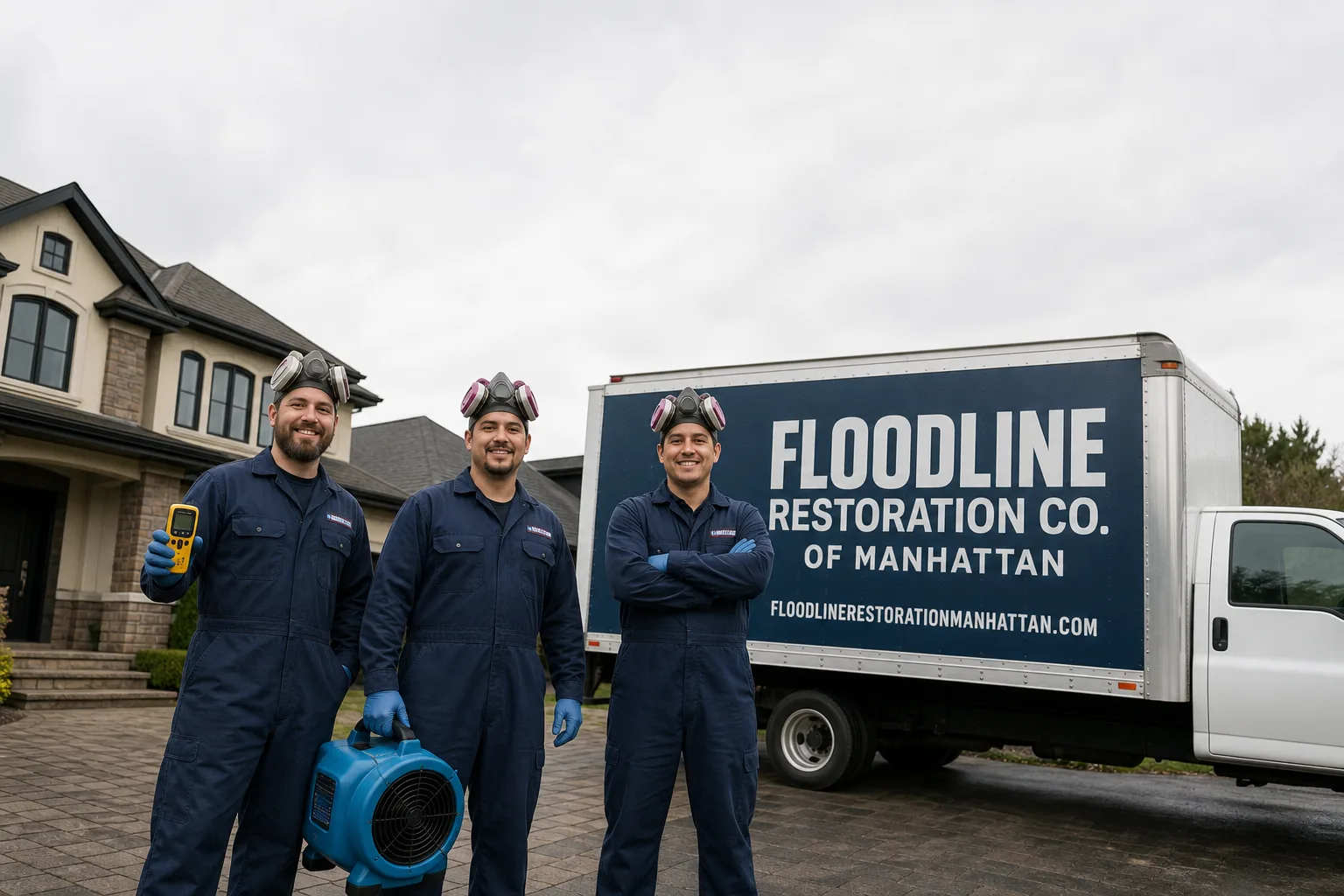
Free visual inspection and a written scope of work before any mitigation begins - photos, moisture readings, and drying logs go in your claim file
The scope we write is the scope we bill. Anything new gets shown to you, in writing, before we touch it.






 Before
 After
After Before
 After
After Before
 After
After24/7 Emergency Mold Remediation in Millwood
Mold remediation in Millwood typically costs between $1,800 and $6,500 depending on how far the growth has spread and whether structural drying is required. Most jobs we handle here fall in the $2,400 to $4,200 range because Millwood’s mid-century basements, the ones built in the 1950s through the 1970s, tend to hide mold behind paneling and vapor barriers long before anyone sees it. Call (917) 924-4221 any hour, day or night. A live dispatcher answers, not a recording, and we can have a certified crew at your door inside 45 minutes for a free visual inspection. The first hour matters because mold colonies double in size every 24 to 48 hours once they find moisture, and by the time you smell it, the problem has usually been growing for weeks behind a wall or under a crawl space. We serve all of Millwood, from the Millwood Road corridor to the residential streets off Route 100, with the same crew that starts the job finishing it.
Understanding Mold Remediation Severity in Millwood Properties
Mold severity breaks down by square footage contaminated, moisture source, and whether the affected materials are porous or non-porous. A small patch under a bathroom sink, under 10 square feet, is a cleanup job. Anything over 10 square feet requires containment, negative air pressure, HEPA air scrubbing, and controlled demolition of saturated drywall or insulation. Millwood’s housing stock makes this classification trickier than it sounds. The mid-century colonials and split-levels built here in the 1950s through 1970s often have fieldstone or poured-concrete basement walls that wick groundwater upward through capillary action. That means a “small” surface patch on drywall can trace back to moisture traveling up from a sill plate, hidden behind a vapor barrier someone stapled up twenty years ago. Split-levels present their own problem: the half-below-grade level shares framing with the crawl space, so mold in the crawl space outgasses into living areas through floor registers and wall cavities. Older farmhouses on the larger parcels along Seven Bridges Road and Millwood Road can have original plank framing with no vapor barrier at all, which means once water intrudes, spores spread through the entire wall assembly in days. We classify severity by what the moisture map tells us, not by what’s visible on the surface.
Why Millwood Property Owners Choose Floodline Restoration Co. of Manhattan
- 45-minute response commitment: Our dispatch desk is inside the New York City metro, and we route Millwood crews within the hour. When you call, you’ll know who’s coming and when they’ll arrive.
- 24/7 live answer, never a machine: Two in the morning, weekends, holidays. A person picks up. That’s been true since Curt Bowman founded this company, and it hasn’t changed.
- IICRC-certified crews: Our technicians hold IICRC certifications including AMRT (Applied Microbial Remediation Technician) and WRT (Water Restoration Technician). They’re background-checked and uniformed on every job.
- Free visual inspection: We’ll assess the extent of mold growth and give you a written recommendation. No charge for the inspection, no obligation from the visit.
- Direct insurance billing: We bill your carrier directly and handle adjuster communication. You don’t play messenger between us and the insurance company.
- One team from start to finish: The same crew that sets containment and runs drying handles the rebuild. No mid-job handoff, no inherited subcontractor who never saw the moisture map.
Our Mold Remediation Process
Inspection & Assessment
We start with visual inspection, thermal imaging, and hygrometer readings to map moisture throughout the affected area. In Millwood basements and crawl spaces, we pay particular attention to sill plates and rim joists where groundwater wicking concentrates.
Containment & Stabilization
Before any material is disturbed, we set up full containment with 6-mil polyethylene barriers and negative air pressure using HEPA-filtered air scrubbers. This prevents cross-contamination into living areas while we work.
Drying & Dehumidification
We deploy Dri-Eaz dehumidifiers and Phoenix air movers sized to the cubic footage of the affected space. Daily moisture readings are logged until materials reach the dry standard, typically 6-10% moisture content for framing lumber.
Cleaning & Sanitization
Affected surfaces are HEPA-vacuumed, then treated with EPA-registered antimicrobial solutions approved for use in the Kensico Reservoir watershed. Porous materials that cannot be fully dried or cleaned are removed and bagged for disposal.
Moisture & Humidity Control Treatment
This is where Millwood jobs differ from neighboring towns. We correct the underlying moisture source, whether that means installing a vapor barrier in a crawl space, sealing a fieldstone basement wall, or adding dehumidification to a musty split-level lower level. Without this step, remediation is just a bandage.
Repairs & Restoration
We rebuild what was removed: drywall, insulation, framing, flooring, trim. The same crew that did the demolition does the reconstruction, and every job ends with clearance testing and a written scope of what was done, backed by our 90-Day Done Right Promise.
Need Emergency Mold Remediation in Millwood Now?
Crews minutes away, answering live 24 hours a day. The sooner we start, the less it costs.
Working With Your Insurance Company
Mold claims in Millwood are usually covered when the mold results from a covered peril: a burst pipe, a storm-driven roof penetration, a water heater failure. Gradual seepage through a fieldstone basement wall is typically excluded, but the water damage that led to it may still be covered, and so may the drying and remediation needed to correct it. We document everything from the first hour: photos room by room, moisture readings, daily drying logs, and a line-item scope of work using industry-standard estimating software. Our team communicates directly with your adjuster, so you don’t have to interpret policy language or negotiate line items yourself. We’ve found that adjusters move faster when the documentation is complete, dated, and tied to a covered cause of loss. And if the carrier questions an item, we walk them through the why with data, not arguments. The 90-Day Done Right Promise covers our workmanship regardless of what insurance does or doesn’t pay.
What We Provide Your Insurer
- Thorough documentation of the loss
- Photos of all damage, room by room
- Moisture readings and drying logs
- A detailed, line-item scope of work
- Direct coordination with your carrier
Built for Millwood’s Loss Calendar
Millwood’s mold season does not follow a single calendar. It follows water, and water hits this part of northern Westchester on a schedule written by the Hudson Valley’s geography. January and February bring deep freezes that split supply lines in unheated crawl spaces and the plumbing chases of 1960s split-levels. When the thaw comes in March and April, that water shows up as seepage through fieldstone basement walls, and the mold that follows is already germinating inside wall cavities by the time anyone notices a musty smell. Summer brings thunderstorms that drop two to four inches of rain in hours, and Millwood’s shallow bedrock and dense tree canopy mean drainage is slow everywhere. Basements that took on an inch of water in a June downpour are often showing visible mold by the Fourth of July. Nor’easters in the fall and early winter, plus the occasional tropical remnant, punch holes in roofs when mature oaks and tulip poplars shed limbs the size of small trunks. Every one of those penetrations becomes a moisture pathway into attic insulation, and from there into ceiling drywall. Our Mold Remediation team expects these patterns. We schedule response capacity around them. And we know which Millwood streets flood first, which basements stay wet longest, and which houses were built before vapor barriers existed. That local knowledge shortens the time from damage assessment to a dry, mold-free space.
Mold Remediation Across Millwood’s Neighborhoods
The homes along Millwood Road and the Route 100 corridor include some of the oldest farmhouses in the hamlet, many with original plank framing, fieldstone foundations, and cellars that have been damp for a century. Mold here tends to be chronic rather than event-driven, and remediation usually requires addressing decades of moisture intrusion, not just a single leak. Up along Seven Bridges Road and the residential streets branching toward the Kensico Reservoir, the homes sit on heavily wooded lots where leaf litter and shade keep soil damp, and where the reservoir’s proximity raises ambient humidity enough that basements with poor ventilation grow mold on stored items even without a flood. The mid-century colonials and split-levels concentrated around the hamlet center off Station Road and the side streets near the Metro-North line are the workhorses of Millwood’s housing stock. Their concrete and fieldstone basements seep after heavy rain, their crawl spaces are often vented incorrectly, and their original 2×4 wall assemblies provide plenty of organic material for mold once moisture gets in. We know these streets because we’ve worked them. We also serve Millwood property owners from the reservoir side to the Briarcliff line, and the building types don’t change; the failure modes do, depending on how each street drains and how the original builders framed the foundation.
Specialized Mold Remediation Services We Offer in Millwood
Mold Inspection & Testing
A Millwood mold inspection starts with visual assessment, but it doesn’t end there. We use moisture meters and thermal imaging to find hidden growth inside wall cavities and under flooring, because in 1960s colonials, what you see is rarely the whole story. Air sampling and surface sampling are available when a clearance test or a pre-purchase evaluation requires lab verification.
Mold Removal
We remove mold by controlled demolition of affected porous materials and HEPA cleaning of salvageable surfaces. In Millwood basements, that often means cutting out drywall that wicked moisture up from a wet sill plate, then treating the framing behind it with an EPA-registered antimicrobial before rebuilding.
Black Mold Remediation
Stachybotrys chartarum, the “black mold” that homeowners worry about, loves the chronically damp conditions found in Millwood’s fieldstone basements and under-crawl spaces. We treat it with full containment, negative air pressure, and the same remediation protocol as any other toxigenic mold, which means protecting your living space during removal and verifying clearance after.
Air Quality Restoration
After remediation, we run HEPA air scrubbers to remove airborne spores and particulates before clearance testing. For Millwood homes near the reservoir, where ambient humidity keeps spore counts higher than drier inland areas, this step matters more, not less.
Crawl Space Treatment
Millwood’s split-levels and raised ranches commonly have vented crawl spaces that pull humid air directly into the home. We install vapor barriers, seal vents where appropriate, and add dehumidification sized to the space. The goal is a crawl space that stays at or below 50% relative humidity year-round, which starves mold of the moisture it needs to colonize framing lumber.
What happens when you call
- 1
A real person answersNo phone trees - you reach a local pro.
- 2
You get an upfront price rangeHonest numbers before anyone is dispatched.
- 3
A background-checked tech heads outLicensed & insured, dispatched right away.
- 4
You approve before work beginsNothing starts until you say go.
Mold Remediation Costs in Millwood, NY
Mold remediation pricing in Millwood reflects the same factors any honest contractor uses: square footage of contamination, moisture source difficulty, and whether structural materials need replacement. Here’s what we see in this market. A small isolated patch, under 10 square feet, with no structural damage, typically runs $500 to $1,200. A standard basement remediation involving containment, HEPA air scrubbing, removal of 20 to 40 square feet of drywall, antimicrobial treatment, and drying equipment for three to five days usually lands between $2,400 and $4,800. When a storm-driven roof penetration has saturated attic insulation and ceiling drywall, the number can reach $6,000 to $9,000 because insulation replacement and rafter repairs get added to the remediation scope. Crawl space encapsulation with vapor barrier and dehumidification in a typical Millwood raised ranch runs $3,000 to $7,500 depending on square footage and access. Those are the honest ranges for this area. What moves the price is access, the age of the building, and whether the moisture source is a one-time event or an ongoing seepage problem. The free visual inspection we offer is the path to a firm, written scope. For exact numbers on your situation, call (917) 924-4221. Estimates don’t cost you anything. And don’t forget the standing offers: $50 off any repair over $250, the $89 seasonal tune-up, and a 5% discount for seniors and veterans, always.
We Also Serve Cities Near Millwood
Our Millwood crews also handle mold remediation jobs in Chappaqua, Mount Kisco, Ossining, and Briarcliff Manor. Same live dispatch, same 45-minute response commitment, same written guarantee. If your property is in one of those towns, call (917) 924-4221 and we’ll route the nearest available certified crew.
Millwood Mold Remediation Questions, Answered
Does Millwood require special permits for mold remediation near Kensico Reservoir?
Mold remediation itself typically doesn’t require a town permit in Millwood, but properties near the Kensico Reservoir fall under New York City DEP watershed regulations that restrict which antimicrobial and biocide products can be used and require containment of all runoff and wastewater. Contractors who use standard chemicals without checking DEP compliance can create a watershed violation for the homeowner. We use only EPA-registered products approved for the watershed and document everything for any compliance review.
How quickly can mold grow in Millwood’s 1950s-1970s colonials after a basement seep?
Mold colonies can begin forming within 24 to 48 hours of water intrusion in the organic materials common to Millwood’s mid-century homes: drywall paper facing, wood framing, and old insulation. In a 1960s colonial with a damp fieldstone basement, mold often establishes behind paneling or vapor barriers within days of a seep event, even if the visible water was mopped up. Call (917) 924-4221 quickly after any basement water event.
What makes Millwood’s roof penetrations from fallen trees a mold risk?
Mature oaks and tulip poplars over Millwood’s residential lots drop heavy limbs that punch through roof decking and leave rafter splits, saturating attic insulation before anyone sees visible damage. That trapped moisture feeds mold growth in the attic and ceiling drywall for weeks or months after the storm. Remediation here requires not just drying but rafter repair and insulation replacement to prevent mold re-colonization.
Are there DEP rules about antimicrobial treatments in Millwood basements?
Yes. The NYC DEP watershed regulations that govern properties near Kensico Reservoir prohibit certain biocides and require containment of all treatment runoff. Standard mold remediation chemicals used elsewhere in Westchester may not be approved here. Our crew selects EPA-registered antimicrobials that meet watershed compliance, and we record the products used in the job documentation for your records.
Why do Millwood split-levels need crawl space treatment after every heavy storm?
Split-levels built in the 1960s and 1970s have a half-below-grade foundation level that shares air and framing with the crawl space. When a heavy storm saturates the ground around the foundation, the crawl space stays humid for weeks, and that damp air migrates into the living area through floor registers and wall cavities. Crawl space treatment, meaning a vapor barrier plus dehumidification, is the fix that prevents recurring mold in these homes.