
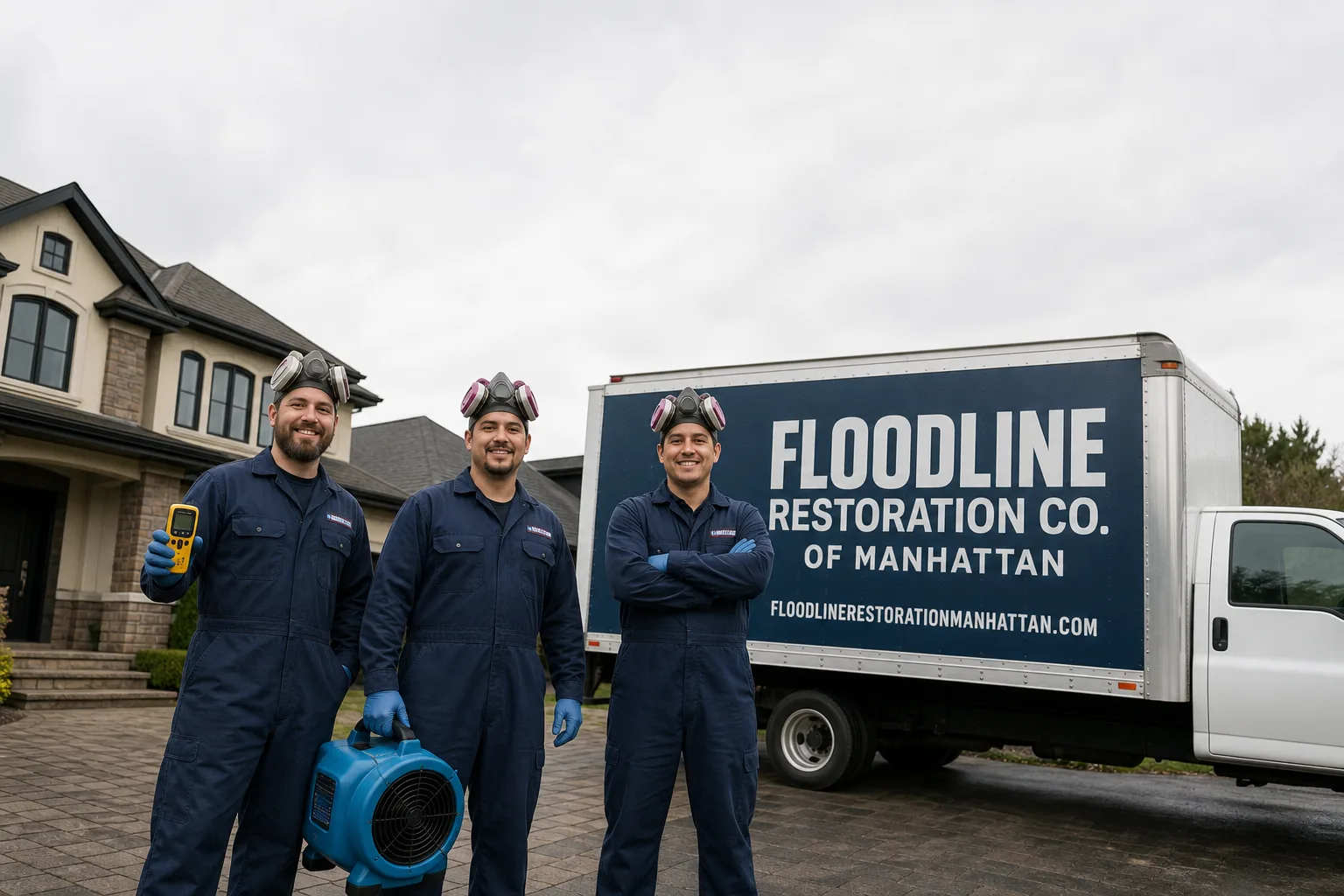
Free visual inspection and a written scope of work before any mitigation begins - photos, moisture readings, and drying logs go in your claim file
The scope we write is the scope we bill. Anything new gets shown to you, in writing, before we touch it.






 Before
 After
After Before
 After
After Before
 After
After24/7 Emergency Commercial Restoration in Rochelle Park
Commercial water damage in Rochelle Park typically costs $2,400-$11,000 to restore, depending on whether the building sits on the Saddle River floodplain clay or on higher ground toward Saddle Brook. Most mitigation work starts within 90 minutes of your call. If water is standing in a retail space, an office suite, or a tenant unit right now, call (917) 924-4221 and a live dispatcher answers, day or night. We dispatch crews into Rochelle Park from our New York City office, and the first visual inspection is free.
Here’s the thing about commercial water loss in this borough: the clock runs differently than it does in Hackensack or Paramus. The clay-heavy glacial soils under Rochelle Park hold saturation for days after a nor’easter or a heavy summer storm. That means the water you see on the floor is only half the problem. The other half is still moving through the slab and up the drywall, and every hour it sits there makes the restoration longer and more expensive. We start extraction the same visit, not the next day.
Understanding Commercial Restoration Severity in Rochelle Park Properties
Restoration professionals classify water damage in three categories. Category 1 is clean water from a supply line or a burst pipe. Category 2 is “gray” water with some contamination, like a condensate drain overflow or a sump failure. Category 3 is black water, which carries sewage, storm runoff, or ground flooding from the Saddle River watershed. In Rochelle Park, an overtaxed storm drain backing into a commercial basement is Category 3, and treating it like Category 1 is how a building ends up with antimicrobial hazards hiding in tenant spaces six months later. We don’t guess. We test, then we treat.
Severity in Rochelle Park also depends on what’s under the floor. A large share of the borough’s post-war commercial and office structures were built as slab-on-grade or shallow-crawl construction. When groundwater wicks up through a saturated slab, moisture mapping picks up readings far beyond the visible wet patch. That’s why we run thermal imaging and hygrometer readings daily, not once, and log everything until the dry standard is met. Early gypsum board and vinyl asbestos tile complicate the picture further, because you can’t simply cut out a wet section and toss it in a dumpster. You test first, then you proceed the way the law requires.
Why Rochelle Park Property Owners Choose Floodline Restoration Co. of Manhattan
- 90-minute response commitment for Rochelle Park commercial losses. Our crews stage in the Meadowlands corridor, so we’re on West Passaic Street or Route 17 fast, not “sometime tomorrow.”
- A live person answers, 24/7. Two in the morning on a Sunday, you get a dispatcher, not a recording. We’ve run that way since Curt Bowman founded Floodline Restoration Co. in 2010.
- IICRC-certified crews on every job. Our technicians hold WRT, FSRT, and AMRT certifications and stay current on New Jersey Department of Environmental Protection abatement protocols.
- Free visual inspection, no pressure. We walk the space, map the moisture, and give you a written scope before any work starts. If it’s a small leak, we tell you it’s a small leak.
- Direct insurance billing, direct adjuster communication. You don’t shuttle paperwork between us and your carrier. We send them the documentation and speak their language.
- One crew from extraction to reconstruction. The same team that pulls the water reads the daily moisture log, runs the dry-out, and rebuilds what needs rebuilding. No mid-job handoff.
Our Commercial Restoration Process
Inspection & Assessment
We arrive, walk every affected area, and run thermal imaging and moisture meters across floors, walls, and crawl spaces. Before touching anything, we test floor tile and insulation for asbestos in Rochelle Park’s older buildings. A positive reading changes the legal path, and we want that answered before we move a single piece of equipment in.
Extraction / Stabilization
Standing water comes out with truck-mounted and portable extraction units. We contain the affected zones with plastic sheeting and negative air pressure so contaminated air doesn’t migrate into unaffected suites. In tight commercial lots, that containment matters more because neighboring spaces sit feet away, not yards away.
Drying & Dehumidification
We position XPOWER air movers and Dri-Eaz dehumidifiers based on the moisture map, not by guesswork. Daily hygrometer and moisture-probe readings get logged and shared with you and your carrier. In Rochelle Park’s clay-heavy soils, we extend the dry-out window deliberately, because premature dry-out leaves hidden moisture behind walls.
Cleaning & Sanitization
HEPA scrubbers run throughout the containment zone while we clean and antimicrobial-treat hard surfaces, wall cavities, and any salvageable fixtures. For Category 3 water events, we follow IICRC S500 protocols for sewage and storm contamination. Nothing gets put back before clearance testing confirms the space is safe for occupancy.
Specialty Treatment for Commercial Restoration
We handle document and inventory recovery onsite where possible, including freeze-drying for sensitive records, and run content pack-outs with a chain-of-custody log. For retail and office spaces, we coordinate business interruption documentation from day one so your claim reflects every day of lost revenue accurately. Industrial facility cleanup includes machinery wipe-downs, electrical panel assessments, and air-quality clearance before restart.
Repairs & Restoration
The same Floodline crew that extracted the water rebuilds what came out: drywall, flooring, framing, paint. We don’t hand you off to a third-party contractor. You get a finished, code-compliant space, a complete moisture log, and our 90-Day Done Right Promise in writing.
Need Emergency Commercial Restoration in Rochelle Park Now?
Crews minutes away, answering live 24 hours a day. The sooner we start, the less it costs.
Working With Your Insurance Company
We’ve been inside the insurance process for over a decade, and we know what carriers in New Jersey need to see. The first thing they ask for is documentation that starts at hour one. That’s why we photograph every affected area before we move anything, log moisture readings every day until the dry standard is met, and send your adjuster a line-item scope with the industry-standard software they expect. You never play messenger. Our team talks to the adjuster directly, in their terms, with the data they require.
Our goal is simple: your claim covers what it should, and your business gets back open with as little downtime as possible. We bill the carrier directly when the policy covers the loss, so you’re not fronting thousands of dollars waiting on a check. The 90-Day Done Right Promise applies to every Rochelle Park commercial job, whether insurance pays or you do. If it’s not right, we make it right. No arguing, no paperwork battles.
What We Provide Your Insurer
- Thorough documentation of the loss
- Photos of all damage, room by room
- Moisture readings and drying logs
- A detailed, line-item scope of work
- Direct coordination with your carrier
Built for Rochelle Park’s Loss Calendar
Rochelle Park doesn’t have one flood season. It has several, and they each hit differently. January and February bring deep freezes that split supply lines in unheated commercial basements and garage-level spaces. March and April thaw the frozen ground and push groundwater up through slabs and shallow crawl spaces. Summer thunderstorms drop two inches in forty minutes, overwhelming the borough’s storm drains and sending brown water through doorways on West Passaic Street and along Rochelle Avenue. September and October are nor’easter season, when the Saddle River backs up and stays backed up for days.
The 2021 remnants of Hurricane Ida are still the reference point around here. Storm drains across the borough failed, and finished basements and crawl spaces sat flooded well after the rain stopped. The lesson for commercial owners was clear: the water leaves, but the clay soil holds it, and mold follows quietly. Buildings that dried slowly or skipped structural drying entirely had follow-up problems for a year. That’s why we’re specific about the dry-out window in Rochelle Park. We’re not rushing to pull equipment because the surface looks dry. We’re reading the subfloor, the wall cavities, and the crawl space until the numbers match pre-loss condition.
Commercial Restoration Across Rochelle Park’s Neighborhoods
Rochelle Park is small, just over a square mile, but the commercial landscape changes block to block. The West Passaic Street corridor holds a dense strip of retail offices, small clinics, and service storefronts where a drain backup in one suite seeps into the one next door within hours. Response speed there isn’t optional, because containment has to go up before water migrates through shared walls and under common hallways. A 90-minute response changes the scope from three affected suites to one.
Over near Route 17, the commercial buildings sit close to the highway and catch the sheet runoff when the highway drainage can’t keep up in a deluge. Those larger-footprint buildings present a different problem: bigger open areas mean more air movement needed, more dehumidification capacity, and longer structural drying at the center of the slab where the floor can’t breathe. We stage extra XPOWER air movers and Dri-Eaz dehumidifiers on those jobs and rotate the drying plan daily based on probe readings.
The residential-adjacent office conversions around Rochelle Avenue and the neighborhoods near the Maywood border run on original post-war slabs, many on the same shallow grade they had in 1955. Water moves under those floors laterally, so a leak at the front door shows up as elevated moisture at the back wall two days later. We map the entire footprint on day one, not just the visible wet spot, and we log readings until the whole slab is back to dry standard. The same applies to the light-industrial bays off the side streets near Saddle Brook, where floor drains that were never adequate for today’s rainfall back up during heavy storms.
Specialized Commercial Restoration Services We Offer in Rochelle Park
Business Interruption Minimization
Every day your doors are closed costs revenue, customer goodwill, and staff payroll. Our approach in Rochelle Park is to get you operational in phases when code allows: secure the affected area, contain it, and let non-affected suites keep working while we restore the rest. We document the interruption trail from day one so your claim captures it accurately. If you can run partial operations, we plan the restoration around your hours, not the other way around.
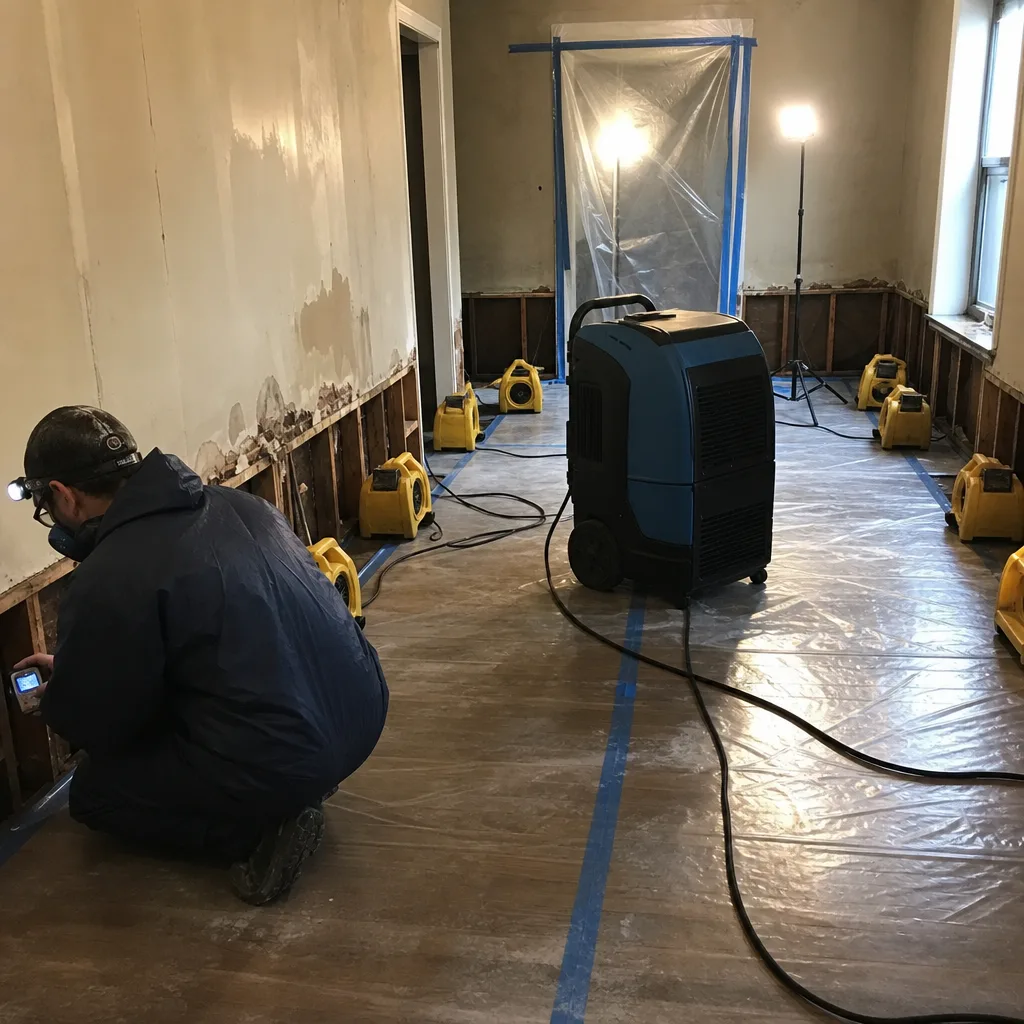
Large-Loss Response
A blocked main drain flooding a 20,000-square-foot retail building isn’t a three-man job. We bring multiple crews, industrial-scale extraction, and a storm of drying equipment on our first roll, not after a week of assessment. Our large-loss team coordinates with local fire officials, your property manager, and your insurance carrier simultaneously. The goal is to stop the bleeding in hour one and give you a written recovery timeline by hour six.
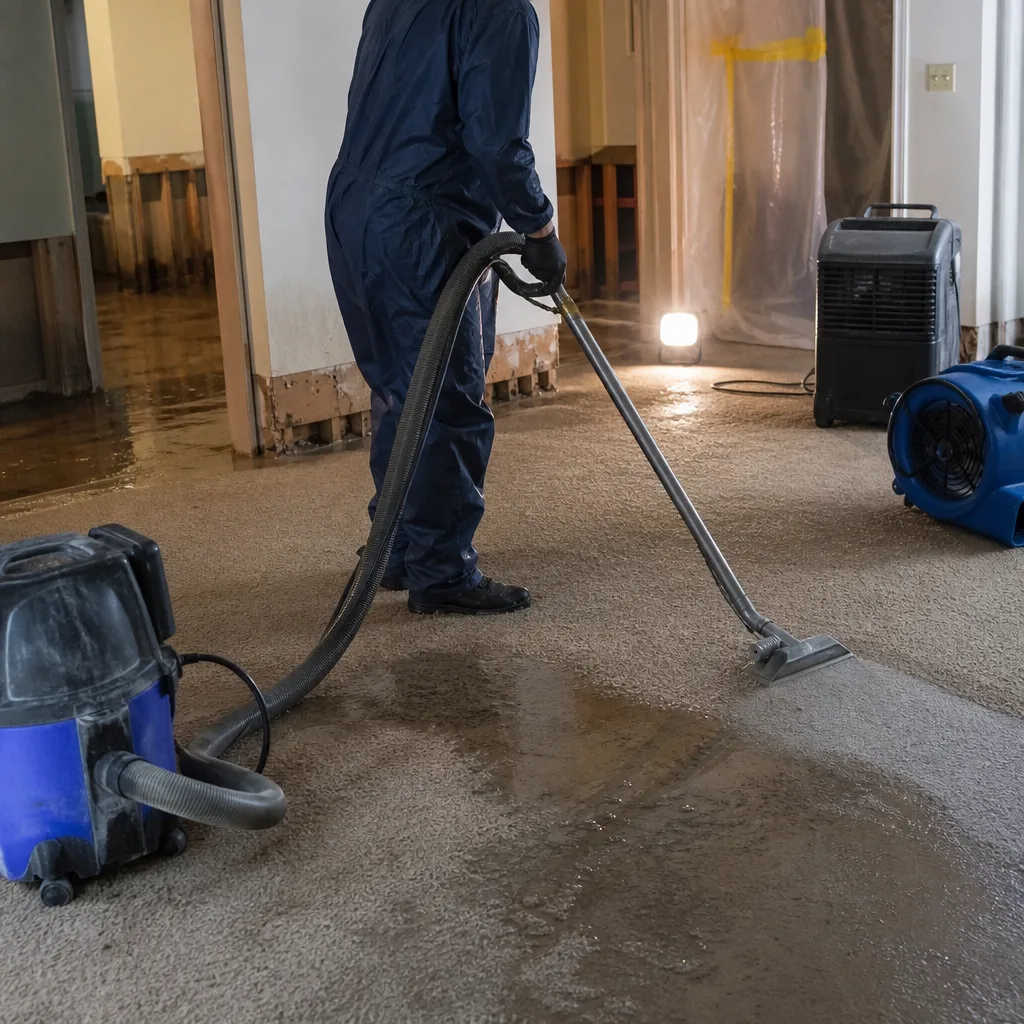
Industrial Facility Cleanup
Rochelle Park’s light-industrial and warehouse spaces run on older electrical service, aging floor drains, and slab floors that hold groundwater like a sponge. We clean and sanitize machinery surfaces, assess electrical panels for moisture intrusion before anything gets re-energized, and run air-quality clearance before you put employees back on the floor. We don’t cut corners on Category 3 contamination, because a black-water event in an industrial space is a liability that spreads with every footstep.
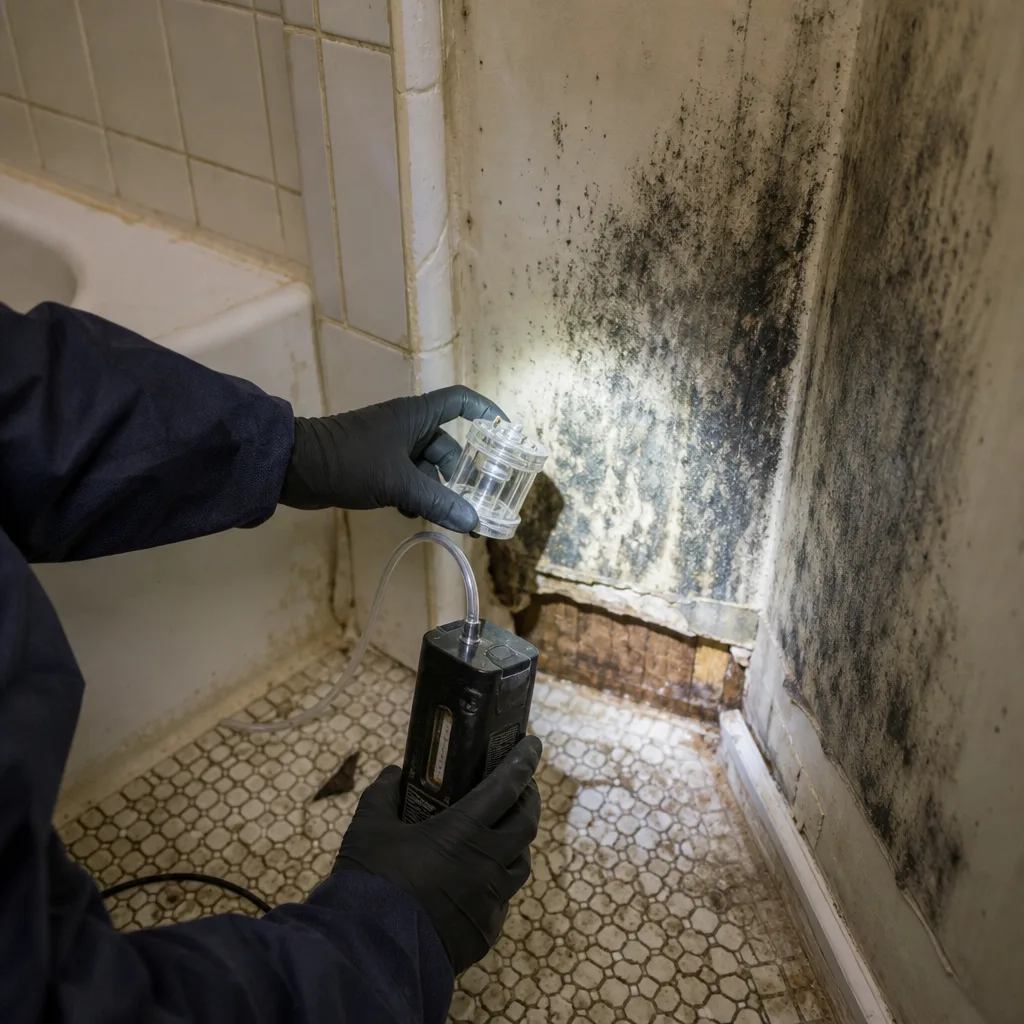
What happens when you call
- 1
A real person answersNo phone trees - you reach a local pro.
- 2
You get an upfront price rangeHonest numbers before anyone is dispatched.
- 3
A background-checked tech heads outLicensed & insured, dispatched right away.
- 4
You approve before work beginsNothing starts until you say go.
Commercial Restoration Costs in Rochelle Park, NJ
Here are honest numbers for this market. A small Category 1 water intrusion in a Rochelle Park office suite, caught early with contained drying, runs $2,400-$4,800. A moderate Category 2 loss across multiple rooms or a larger retail footprint lands between $5,500 and $11,000. Category 3 sewage or storm-flood losses in commercial spaces typically run $9,000-$22,000 or more, depending on square footage and whether asbestos abatement gets triggered under the post-war slab. Full reconstruction after a major loss can go well beyond that, but it’s scoped and priced in writing before we start, like a proper remodel.
What moves the price: building age and materials, Category of water, square footage affected, whether containment and asbestos testing are required, and how long the water sat before we arrived. The free visual inspection is the fastest path to a firm number. We walk the space, map the moisture, and hand you a written scope with a line-item price. No surprises on the bill, and we never upsell a small water-in-your-closet event into a full rebuild.
We Also Serve Cities Near Rochelle Park
Our Rochelle Park crews also cover Commercial Restoration in Rochelle Park in the surrounding Bergen County communities. We respond regularly to commercial losses in Maywood, Saddle Brook, Hackensack, and Lodi, and our equipment staging in the Meadowlands corridor keeps response times tight across all five towns.
Serving Rochelle Park, NJ - Our Local Coverage Area
We’re based in the Rochelle Park area and know this community well. Use the map below to see our service coverage - if you’re nearby, we can almost certainly help.
Rochelle Park Commercial Restoration Questions, Answered
Why does commercial water damage in Rochelle Park often require asbestos testing before we can start drying?
Because a large share of the borough’s post-war commercial buildings sit on original 9-inch VAT (vinyl asbestos tile) flooring installed between the 1940s and 1960s, and that tile is often hidden beneath carpet, laminate, or a later floor layer. The moment water penetrates the slab, plans to pull up wet flooring hit a legal wall: New Jersey DEP regulations require abatement procedures before any disturbance of asbestos-containing materials, and a positive reading halts standard restoration until a licensed abatement contractor clears the area. Testing on day one keeps the job legal and the timeline honest. Call (917) 924-4221 for a free assessment that includes testing where it’s warranted.
How does the Saddle River floodplain affect commercial restoration timelines in Rochelle Park?
It stretches the drying phase. The clay-heavy glacial soils under the Saddle River floodplain drain poorly, holding saturation for days after nor’easters or Ida-style remnant systems. Water doesn’t just sit on the surface; it wicks up through slabs and shallow crawl spaces for days, so a standard three-day dry-out can quickly become a five-to-seven-day structural drying job. We build that geology into our scope from the first moisture map, so you aren’t told the space is dry when the subfloor is still saturated.
What is the difference between Category 1 and Category 3 water in a Rochelle Park commercial building?
Category 1 is clean water from a broken supply line, a failed water heater, or a similar source. Category 3 is heavily contaminated water carrying sewage, storm runoff, or ground flooding from the Saddle River watershed, including drain backups that push black water up through commercial floor drains. In Rochelle Park, an overtaxed storm drain backing into a retail suite is Category 3, and it requires full antimicrobial treatment, possible drywall removal, and clearance testing before anyone occupies the space. Treating Category 3 as Category 1 leaves behind hazards that surface as odor, mold, and tenant health complaints months later.
Why do you set up containment in Rochelle Park commercial suites even for small leaks?
Because the buildings here sit close together, with shared walls and tight lot spacing. A small Category 1 leak in one suite sends humidity through wall cavities into adjacent units within hours, spreading the damage footprint and the eventual claim scope. We contain the affected zone with negative air pressure and plastic sheeting before we run aggressive drying, so your neighbor’s wall cavity isn’t part of the job by day three. It’s the cheapest line of defense against a multi-tenant claim.
How quickly does mold start in Rochelle Park commercial drywall after water damage?
In this borough’s humid summer months, mold can begin colonizing in as little as 48 hours on damp gypsum board, especially behind baseboards and in wall cavities where air doesn’t move. In winter, the clock runs slower but still moves. What accelerates it in Rochelle Park is the clay soil: moisture lingers in walls and under slabs longer than in sandier-soil towns, so the mold window stays open longer. That’s why same-day extraction and immediate drying matter. Call (917) 924-4221 and we’re on the way.
How fast can you get to a commercial property in Rochelle Park?
Most commercial calls in Rochelle Park see our crews within 90 minutes of the first call. We stage equipment in the Meadowlands corridor, and a live dispatcher routes the nearest available Commercial Restoration team the moment you hang up. For a retail space with standing water or a flooded industrial floor, that first hour of response time is the difference between a contained clean-up and a multi-week structural restoration.
Will my insurance cover commercial restoration in Rochelle Park?
Most commercial policies cover sudden and accidental water damage from sources like burst pipes, sump failures, and storm intrusion, though flood coverage often requires a separate policy through the National Flood Insurance Program or a private carrier. Sewer backup coverage is another add-on many Rochelle Park owners don’t know they lack until a nor’easter backs up the drain. We review your policy language with you, document everything your carrier needs, and bill directly when coverage applies. The free inspection gets you a written scope you can hand to your adjuster that same day.
Do I need full restoration or just a professional cleaning?
It depends on the Category of water and what the moisture readings show. Category 1 water that didn’t sit long and didn’t penetrate wall cavities may only need extraction, drying, and cleaning. Category 3 water or water that sat for more than 48 hours almost always requires removal of saturated drywall, antimicrobial treatment, and structural drying. We don’t oversell. If a cleaning is sufficient, we say so in the written scope. If it’s not, we show you the moisture readings that prove it. Call (917) 924-4221 for an honest assessment, free.
Written by Curt Bowman, Owner at Floodline Restoration Co. of Manhattan, serving Rochelle Park and Bergen County with commercial restoration backed by the 90-Day Done Right Promise.