
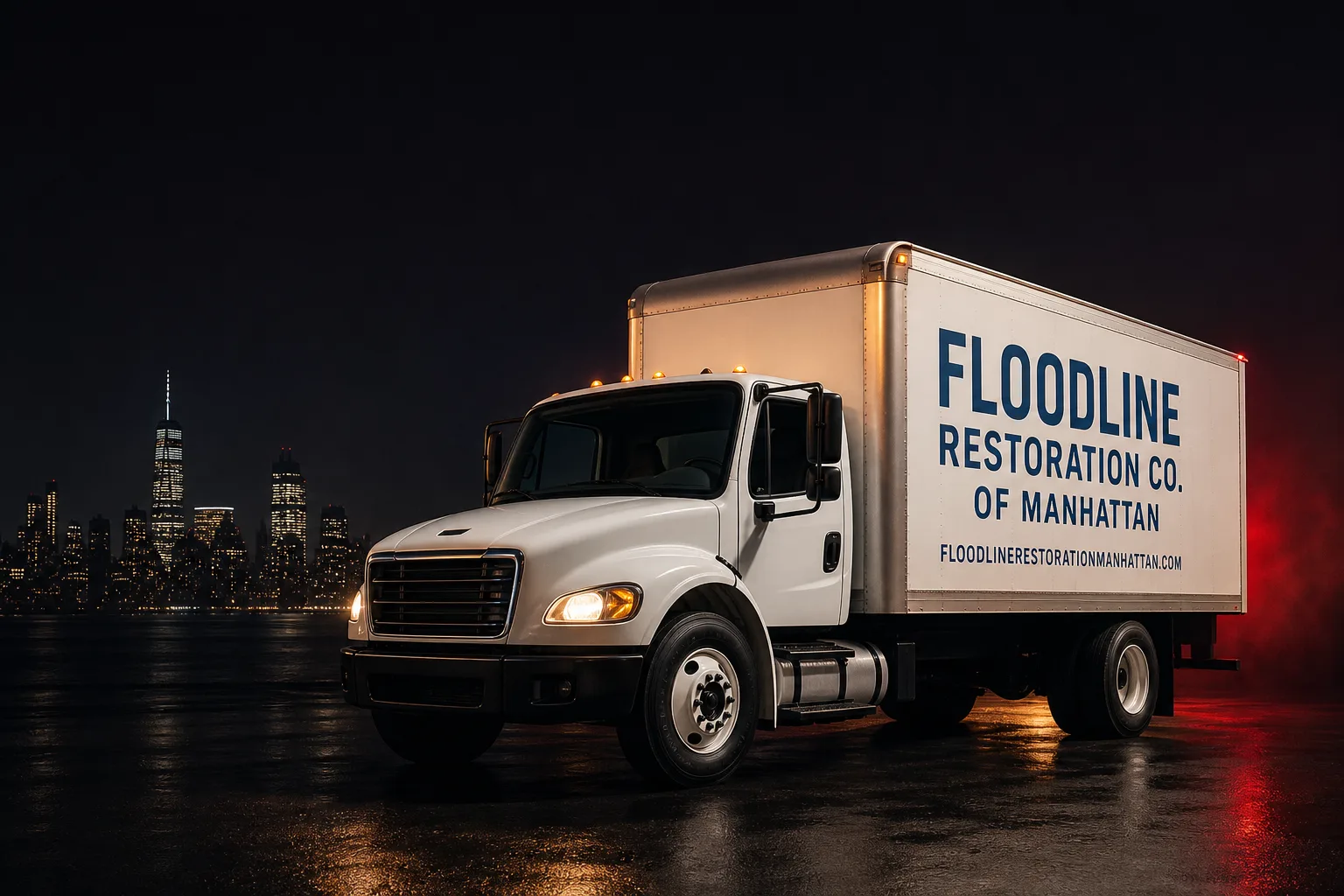
Free visual inspection and a written scope of work before any mitigation begins - photos, moisture readings, and drying logs go in your claim file
The scope we write is the scope we bill. Anything new gets shown to you, in writing, before we touch it.






 Before
 After
After Before
 After
After Before
 After
After24/7 Emergency Commercial Restoration in Travis – Chelsea
A commercial water loss in Travis – Chelsea rarely starts as a single, clean event. It starts with a nor’easter pushing the Arthur Kill over its banks, or a steady rain backing up drainage on Victory Boulevard, and then water rising through a slab floor that was poured on filled marshland sixty years ago. If your storefront, office, or multi-unit building is taking on water right now, call (917) 924-4221. A live dispatcher answers, not a recording. We send a certified crew into Travis – Chelsea immediately, with extraction equipment running the same visit. The first hour determines whether you’re dealing with a cleanup or a rebuild. Water moves through plaster, batt insulation, and untreated framing fast. The longer it sits, the deeper the demolition goes and the longer your doors stay closed. We’ll be there when we say, and we start at the floodline, the honest mark the water left on the wall.
Understanding Commercial Restoration Severity in Travis – Chelsea Properties
Not all water is equal, and in Travis – Chelsea the category of water you’re dealing with changes the entire scope. Category 1 water arrives clean, usually from a burst supply line. Category 2 carries contaminants, the kind of water you see when a drain line backs up. Category 3 is grossly contaminated, and that’s what tidal surge from the Arthur Kill delivers, saltwater, sediment, and whatever else the estuary carried inland. For commercial buildings in this neighborhood, built in the 1950s through 1970s on former wetland fill, the bigger problem is often not the water you can see. It’s the hydrostatic pressure underneath the slab. When the seasonal water table rises, water pushes up through the concrete itself. Moisture mapping with thermal imaging shows us where that pressure is concentrating long before the drywall gives way. Severity in Travis – Chelsea is measured in moisture readings inside wall cavities, not just standing water on the floor. A Category 1 loss in a building with a properly waterproofed foundation is a drying job. A Category 3 loss in a slab-on-grade structure with saturated sub-grade soil is a full-scale commercial restoration, containment, demolition, structural drying, sanitization, and rebuild.
Why Travis – Chelsea Property Owners Choose Floodline Restoration Co. of Manhattan
Commercial property owners in this neighborhood have been burned before. They call us because we answer the phone, show up when we say, and put the scope in writing before work starts. No surprises on the bill.
- 45-minute response commitment. Our Travis – Chelsea crews are on call around the clock. From the moment you call (917) 924-4221, a certified team is moving toward your property. Extraction starts the same visit in most cases.
- A real person answers, 24/7. Two in the morning, Sunday afternoon, it doesn’t matter. A live dispatcher picks up. Not a phone tree, not a callback service. You talk to someone who can send help right then.
- IICRC-certified crews. Our technicians carry WRT and ASD certifications, trained to IICRC, RIA, and IFA standards. They read moisture maps the way a mechanic reads a gauge, and they log readings daily until the dry standard is met.
- Free visual inspection. Before any work begins, we walk the property and tell you what we’re seeing. Then we put it in writing. You get a clear scope and a firm price, no games.
- Direct insurance billing. We coordinate with your carrier from the first hour, providing photos, moisture logs, and a line-item estimate. You never play messenger between us and the adjuster.
- One team from extraction to reconstruction. We don’t hand your building off to a sub crew after the water is gone. The same certified technicians handle drying, remediation, and rebuild, so nothing falls through the cracks.
Our Commercial Restoration Process
Inspection & Assessment
We arrive, walk the space, and map the moisture. Thermal imaging and hygrometers tell us where water migrated, including inside wall cavities and under flooring. You get a written scope before any work starts.
Extraction / Stabilization
Standing water comes out first, using truck-mounted and portable extraction units. We then stabilize the space, shutting down affected electrical where needed and setting up containment to stop contamination from spreading.
Drying & Dehumidification
Dri-Eaz LGR dehumidifiers and XPOWER air movers go in, sized to the building’s square footage and the moisture load in the materials. Daily readings are logged and shared with you and your insurer until the dry standard is met.
Cleaning & Sanitization
Category 2 and 3 water leave behind contaminants. We clean and sanitize affected surfaces, using HEPA filtration to scrub the air and antimicrobial treatments where the loss demands it.
Hydrostatic & Foundation Treatment
This step is specific to Travis – Chelsea. If slab moisture readings show hydrostatic pressure from the water table, we specify exterior waterproofing or a sub-slab sump system. Drying the interior without addressing this guarantees a repeat flood.
Repairs & Restoration
We rebuild what the water took: drywall, flooring, trim, paint. The same crew that extracted the water returns your building to service. Every job is backed by the 90-Day Done Right Promise, in writing.
Need Emergency Commercial Restoration in Travis – Chelsea Now?
Crews minutes away, answering live 24 hours a day. The sooner we start, the less it costs.
Working With Your Insurance Company
Commercial water damage in Travis – Chelsea almost always involves a carrier, and the first 48 hours decide how smoothly that claim goes. We document from the first hour: photos of every affected room before anything is moved, moisture readings logged with dates and times, and a line-item scope that speaks the language adjusters expect. Then we talk to your carrier directly. You don’t ferry paperwork between us and the adjuster. We provide the evidence they need to process the claim, and we bill directly where your policy allows. That means fewer delays and no surprise bills landing on your desk. The 90-Day Done Right Promise stays in place whether insurance pays or you do. Done right, and backed in writing.
What We Provide Your Insurer
- Thorough documentation of the loss
- Photos of all damage, room by room
- Moisture readings and drying logs
- A detailed, line-item scope of work
- Direct coordination with your carrier
Built for Travis – Chelsea’s Loss Calendar
Travis – Chelsea’s commercial water losses follow a pattern any longtime property owner here knows. January and February bring deep freezes that burst supply lines in unheated rear rooms and vacant units. March and April bring snowmelt and spring rain, and with the neighborhood’s poor grading and high water table, that means basement and slab seepage. Summer thunderstorms drop inches of rain in an hour, overwhelming storm drains and sending water into loading docks and below-grade storage. The real threat, though, runs from late summer through fall: nor’easters and tropical systems push surge up the Arthur Kill and through the Fresh Kills watershed, flooding slab-on-grade buildings that sit at or near the tidal water table. Hurricane Sandy wrote that lesson in permanent ink across this neighborhood. A commercial restoration plan for Travis – Chelsea has to account for all of it, because the next event is never far off.
Commercial Restoration Across Travis – Chelsea’s Neighborhoods
Travis – Chelsea’s commercial footprint runs along Victory Boulevard and spreads out through the side streets that drop toward the Arthur Kill. Victory Boulevard is the neighborhood’s spine, a mix of retail strips, offices, and older commercial buildings, many dating to the 1960s and 1970s, with slab-on-grade construction that sits low relative to the surrounding tidal waterways. The blocks closest to the Arthur Kill and the former Fresh Kills watershed take the worst of the surge, and we’ve worked those buildings enough to know which ones cycle through water and mold problems every few years. The residential-adjacent commercial corridors near Travis Avenue see older mixed-use buildings where a basement flood in a storefront means water wicking into shared walls and common areas. Multi-unit and HOA properties along South Avenue and the surrounding blocks often call us for shared-loss response, where one flooded retail unit affects the tenants on either side. And the industrial pockets near the West Shore Expressway corridor deal with a different kind of loss: large square footage, concrete floors, and equipment that has to be moved before drying can begin. Each of these areas has its own loss pattern, and our Commercial Restoration team reads the building before we move a single air mover.
Specialized Commercial Restoration Services We Offer in Travis – Chelsea
Multi-Unit & HOA Restoration
HOA and multi-unit buildings in Travis – Chelsea share walls, share plumbing, and share problems. A water loss in one unit migrates through floor assemblies and into the units below. We contain the affected areas, coordinate with building management and unit owners, and dry the entire affected section as one job, not a series of disconnected calls. Direct insurance billing keeps the HOA board out of the collections business.
Large-Loss Response
When a nor’easter floods a Travis – Chelsea retail strip or an industrial space takes on surge water through the slab, the scope is measured in days and truckloads of equipment, not hours. We deploy multiple crews, trailer-mounted desiccants, and enough air movement to dry tens of thousands of square feet. Large-loss response in this neighborhood means planning for hydrostatic pressure, not just surface water. Since we serve Travis – Chelsea directly, our crews know the terrain and the buildings.
Industrial Facility Cleanup
Industrial buildings in Travis – Chelsea sit low, and their contents sit lower: stock, machinery, electrical panels, and years of operational dust that turns to sludge when the water rises. We remove contaminated materials, sanitize surfaces, and dry structural components to the dry standard. For facilities with basements or below-grade loading areas, we specify sump systems and waterproofing so the next storm doesn’t shut you down again.
We also handle office and retail restoration, keeping your doors open where possible and rebuilding turnkey where they can’t be. And when a closure is unavoidable, our documentation supports your business interruption claim: every hour of downtime logged, every line item tied to the loss.
What happens when you call
- 1
A real person answersNo phone trees - you reach a local pro.
- 2
You get an upfront price rangeHonest numbers before anyone is dispatched.
- 3
A background-checked tech heads outLicensed & insured, dispatched right away.
- 4
You approve before work beginsNothing starts until you say go.
Commercial Restoration Costs in Travis – Chelsea, NY
Commercial restoration pricing in Travis – Chelsea runs higher than inland parts of Staten Island, and the reason is the water table. A straightforward water extraction and drying job in a small retail space typically runs $3,500 to $8,500. Add Category 3 contamination from tidal surge and you’re looking at $8,000 to $20,000, because sanitization and demolition expand the scope. Full cavity mold remediation in a 1970s-era office building with original plaster and batt insulation runs $12,000 to $30,000 depending on affected square footage, and that’s before rebuild. If hydrostatic pressure is the root cause, a sub-slab sump system and exterior waterproofing add $8,000 to $25,000, but skipping that work means paying for the interior restoration again within one rainy season, and every property owner we tell that to around Victory Boulevard understands the math. Insurance covers most of these costs when the loss is sudden and the documentation is solid. We provide the paperwork. Call (917) 924-4221 for a free inspection and a written scope before you commit to anything.
We Also Serve Cities Near Travis – Chelsea
Floodline Restoration Co. of Manhattan runs commercial restoration crews into Fairview, Harrison, East Bronx, and Hunts Point, along with the rest of the surrounding boroughs. If your building is in a neighboring community and you’re watching water rise, call the same number: (917) 924-4221.
Travis – Chelsea Commercial Restoration Questions, Answered
Why does water keep coming back into my Travis – Chelsea commercial building after extraction?
Because your building sits on filled marshland, and the water isn’t coming from above, it’s coming from below. Hydrostatic pressure from a high seasonal water table pushes groundwater up through slab-on-grade foundations. If the crew that dried your space didn’t specify exterior waterproofing or a sub-slab sump system, the water will return. That’s the single most common repeat-flood cause we see in Travis – Chelsea. Call (917) 924-4221 and we’ll map the moisture source before we touch the interior.
Does my 1970s Travis – Chelsea office need full cavity mold remediation or just surface treatment?
If your building has original plaster walls and batt insulation, surface treatment won’t hold. Those materials absorb moisture deep into the wall cavity, and mold grows where you can’t see it. Full cavity remediation, containment, removal, drying, and clearance testing, is the only fix that lasts in this housing stock. We’ll tell you what’s actually needed after inspection, not before.
Can you keep my retail store open during water damage restoration in Travis – Chelsea?
Often, yes. We use containment barriers and negative air pressure to isolate the affected area, so foot traffic can continue in the rest of the store while drying runs behind plastic. If safety or contamination makes closure necessary, we document every hour for your business interruption claim and get you back open as fast as the structure allows.
What category water is typical for Travis – Chelsea basement flooding from tidal surge?
Category 3. Water that comes in from the Arthur Kill or the Fresh Kills watershed carries salt, sediment, and biological contaminants. It requires full containment, demolition of saturated materials, sanitization, and structural drying. Treating it like clean water is dangerous and shortens the life of the building.
Do I need a sump pump for my Travis – Chelsea commercial property even if I’ve never had major flooding?
Most buildings here should have one, and many that do have an undersized or non-functioning unit. The water table in Travis – Chelsea is high enough that sub-grade spaces are under constant hydrostatic load. A properly sized sub-slab sump with a battery backup is cheap compared to one extraction and drying cycle. We’ll assess your slab and tell you straight.
How fast can you actually get to my Travis – Chelsea building?
Our crews are positioned to reach Travis – Chelsea within 45 minutes of your call. A live dispatcher answers at (917) 924-4221, confirms your address, and moves a team immediately. Extraction equipment runs the same visit in most cases.
How long does commercial drying take in Travis – Chelsea?
Most commercial drying jobs run 3 to 7 days. In Travis – Chelsea, buildings with slab-on-grade foundations and high sub-grade moisture can take longer, sometimes 7 to 10 days, because the concrete itself holds water. We log moisture readings daily and don’t call the job done until the dry standard is met.
What should I do in the first 30 minutes after water enters my Travis – Chelsea building?
Call (917) 924-4221. Then shut off power to affected areas if you can do so safely, move what you can out of standing water, and document the scene with photos. Don’t enter standing water if there’s any chance it’s in contact with electrical systems. We’ll be there shortly.
Serving Travis – Chelsea, NY - Our Local Coverage Area
We’re based in the Travis – Chelsea area and know this community well. Use the map below to see our service coverage - if you’re nearby, we can almost certainly help.
Call Floodline Restoration Co. of Manhattan for Commercial Restoration in Travis – Chelsea
Travis – Chelsea commercial losses don’t improve by waiting. The water table doesn’t drop, the mold doesn’t stop, and the carriers don’t process claims faster for buildings that sat wet for a week. Our team answers live around the clock, reaches Travis – Chelsea in about 45 minutes, and handles the whole job, extraction, drying, remediation, and rebuild, with one certified crew and one written guarantee. Done right, and backed in writing. Call (917) 924-4221 now for a free inspection and a straight answer about what your building actually needs.
Written by Curt Bowman, Owner at Floodline Restoration Co., serving Travis – Chelsea and the surrounding New York City area.