
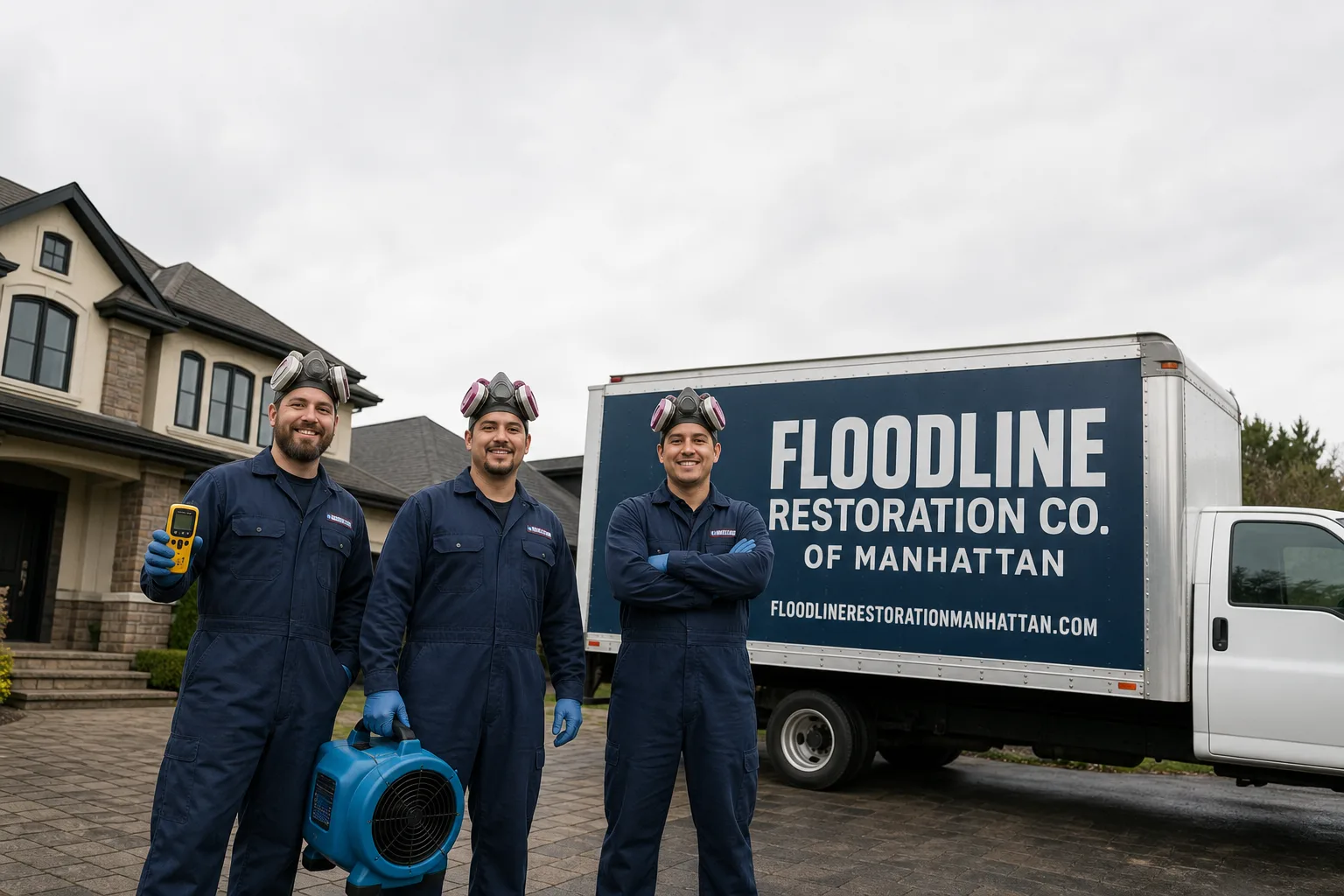
Free visual inspection and a written scope of work before any mitigation begins - photos, moisture readings, and drying logs go in your claim file
The scope we write is the scope we bill. Anything new gets shown to you, in writing, before we touch it.






 Before
 After
After Before
 After
After Before
 After
After24/7 Emergency Reconstruction & Cleanup in Alphabet City
When a pipe bursts inside a shared cast-iron stack or a roof breach soaks through century-old plaster, the clock starts before you even see the stain. Floodline Restoration Co. of Manhattan answers live around the clock, every day, and crews are dispatched into Alphabet City within minutes of your call to (917) 924-4221. We arrive for a free visual inspection, map the moisture behind the walls, and start extraction or stabilization the same visit in most cases. The first hour matters most in pre-war tenements: water wicks through horsehair plaster, presses against party walls, and feeds mold colonies that have sat dormant since Sandy. Speed now means less tear-out later, and a smaller line-item scope when we write it.
Understanding Reconstruction & Cleanup Severity in Alphabet City Properties
Reconstruction in Alphabet City is rarely a simple drywall patch. The five- and six-story old-law and new-law tenements east of Avenue A share vertical plumbing stacks and original galvanized supply lines that corrode from the inside. When a category 2 or category 3 water event happens, contamination travels between units through those shared stacks and chases. Category 3 water, meaning sewage backflow or storm surge, requires containment, disposal of saturated porous materials, and antimicrobial treatment before any rebuild. We classify the water, run moisture mapping with thermal imaging and hygrometers, and mark the drying perimeter from stud bay to stud bay. In a post-Sandy building, what looks like a recent loss often turns out to be layered damage: old moisture re-activated, active mold hidden behind intact plaster that shows zero staining from the hallway. Structural drying here means accounting for masonry party walls that hold water far longer than drywall, plus flat tar roofs that pond water and leak inward days after a storm passes.
Why Alphabet City Property Owners Choose Floodline Restoration Co. of Manhattan
- 45-minute response commitment to Alphabet City. Our dispatch board routes the nearest background-checked, uniformed crew straight to your block, whether it’s Avenue B or a walk-up off Tompkins Square Park.
- A live person answers, 24/7. No automated systems, no third-party answering service run from another state. You talk to a dispatcher at 2 a.m. who knows the difference between a category 2 backup and a slab leak.
- IICRC-certified crews, trained to WRT and FSRT standards. The technicians who read your moisture map on day one are the same people running daily drying logs until the dry standard is met.
- Free visual inspection with a written scope. Before any work starts, you agree to a line-item scope. No blank authorization, no open-ended daily rates.
- Direct insurance billing. We bill your carrier directly, hand over photo documentation and drying logs, and talk with your adjuster so you don’t play messenger.
- One team from tear-out to trim. We don’t extract and then hand you off to a subcontracted rebuild crew. The same Floodline team handles Reconstruction & Cleanup from first cut to final coat of paint.
Our Reconstruction & Cleanup Process
Inspection & Assessment
We begin with thermal imaging and a visual trace of the water path. In Alphabet City’s shared-stack buildings, that means checking the unit above, the unit below, and the party wall on both sides. We classify the water category, map the affected materials, and photograph everything before a single cut.
Extraction & Stabilization
Standing water comes out first with truck-mounted extraction. Where the tenant above or below is involved, we coordinate access through building management or the landlord. Exposed lath and damaged plaster get stabilized so the cavity can dry without collapse.
Drying & Dehumidification
We set Dri-Eaz dehumidifiers and XPOWER air movers in a containment perimeter. Daily readings are logged with hygrometers at each stud bay. In a masonry and plaster assembly, drying takes longer than drywall, and we don’t rush the log. The numbers dictate the date we clear the area.
Cleaning & Sanitization
Category 2 and 3 losses require antimicrobial treatment and HEPA air scrubbing before rebuild starts. We don’t run air movers without containment in tight alley-load apartments. That’s how contaminated droplets end up in dry rooms.
Contents Restoration & Pack-Out
Soft goods, furniture, documents, and electronics get evaluated for restoration or pack-out. In a flooded basement apartment on Avenue B, we inventory, photograph, and move what’s salvageable to a climate-controlled facility while the unit is rebuilt.
Repairs & Restoration
We cut drywall back to sound framing, replace with mold-resistant board or cement board in flood-exposed rooms, match plaster profiles where required by the building, and paint. Every job closes with a written scope reconciliation and your 90-Day Done Right Promise in hand.
Need Emergency Reconstruction & Cleanup in Alphabet City Now?
Crews minutes away, answering live 24 hours a day. The sooner we start, the less it costs.
Working With Your Insurance Company
Insurance carriers accept claims faster when the documentation is built from hour one. We photograph every room before demolition, log moisture readings daily, and write estimates in the Xactimate format adjusters expect. Our project managers speak directly with your carrier’s adjuster, so you don’t spend a week leaving voicemails. In a Flood Zone AE building where ground-floor and basement units sit below base flood elevation, the difference between a covered loss and a denied claim often comes down to proving that the damage was sudden, not long-term seepage. We write the scope to reflect what the moisture map actually shows, not what’s cheapest to submit.
What We Provide Your Insurer
- Thorough documentation of the loss
- Photos of all damage, room by room
- Moisture readings and drying logs
- A detailed, line-item scope of work
- Direct coordination with your carrier
Built for Alphabet City’s Loss Calendar
Alphabet City’s reconstruction season peaks in January and February, when sustained deep freezes split the old galvanized supply lines that run through unheated stairwells and exterior chases in pre-war tenements. One burst line in a new-law building can saturate four or five floors before the super gets the riser shut. Spring thaw brings seepage through the flat tar roofs and courtyard-facing foundation walls, especially on the blocks east of Avenue B where the water table sits close to the surface. Summer’s short but violent thunderstorms overwhelm the combined sewer system and push category 2 water back through floor drains in basement and garden-level apartments. Then comes the nor’easter season, when East River storm surge reminds this neighborhood why it sits in FEMA Flood Zone AE. Every one of these events lands on a reconstruction crew’s schedule in this zip code, and each writes its own pattern into the building’s walls.
Reconstruction & Cleanup Across Alphabet City’s Neighborhoods
The blocks that make up Alphabet City each carry their own access constraints and loss patterns. Along Avenue A, buildings sit wider and deeper, with service entrances that fit a crew on wheels and staging room in rear courtyards. East of Avenue B, toward the East River, alley-load buildings with 28-inch front doors and no elevators mean hand-carrying equipment up five flights. Around Tompkins Square Park, the old-law tenements built before 1901 have narrow interior stairs and original plaster over wood lath that turns to powder when saturated. The rent-stabilized walk-ups near Avenue C carry the deepest Sandy history: ground-floor and basement units that took storm surge in 2012 and were cosmetically patched, now hiding active mold behind perfectly painted hallway walls. On Avenue D, where the FEMA Flood Zone AE boundary runs block to block, first-floor reconstructions require flood-resistant materials rated for future immersion. We move crews through these streets knowing which corner requires permit coordination and which super we need to speak with before we open a wall.
Specialized Reconstruction & Cleanup Services We Offer in Alphabet City
Full-Service Reconstruction
When the damage runs deeper than drywall, we rebuild to the stud. That means framing repair where water killed the old pine, plaster matching to preserve the building’s original profiles, and finish work that looks like it was always there. In Alphabet City walk-ups, full reconstruction often includes coordinating with the landlord, the neighbor below, and the managing agent before the first hammer swing.
Drywall & Flooring Repair
We cut drywall back to sound framing every time, no exceptions. In pre-war units, we match plaster thickness and texture where the building requires it. Flooring follows the same rule: subfloor drying and replacement before any finish floor goes down. On a fifth-floor Avenue C new-law tenement, our crew opened a ceiling after a category 3 back-up in the shared stack and found Sandy storm surge had soaked the original plaster-and-lath. We ran containment with negative air, pulled moisture readings from every stud bay, cut back to sound framing, and hung mold-resistant drywall rated for future flood exposure.
Contents Restoration & Pack-Out
Your furniture, documents, clothes, and electronics get inventoried with photos before they move. We pack out salvageable contents to a climate-controlled facility while the unit dries and rebuilds. In flooded garden-level apartments on Avenue B, pack-out is often the difference between keeping and losing a lifetime of belongings. Every item gets a line item.
Carpet & Upholstery Cleaning
After a clean water loss, carpet and upholstered furniture can often be saved with hot-water extraction and drying. After category 2 or 3 water, porous materials get evaluated for disposal versus restoration, and we’ll say so flat-out when replacement is the cheaper and safer route. No upselling into services you don’t need.
Post-Construction Cleanup
After reconstruction, rooms are left with fine dust in every crevice. We run a full post-construction clean: HEPA vacuuming of walls, floors, and fixtures, wiping down surfaces, and clearing the air before you move furniture back. The job isn’t done when the paint dries. It’s done when the apartment smells like home again.
What happens when you call
- 1
A real person answersNo phone trees - you reach a local pro.
- 2
You get an upfront price rangeHonest numbers before anyone is dispatched.
- 3
A background-checked tech heads outLicensed & insured, dispatched right away.
- 4
You approve before work beginsNothing starts until you say go.
Reconstruction & Cleanup Costs in Alphabet City, NY
A drywall patch with paint after a small ceiling leak in Alphabet City runs $400 to $900. Full ceiling replacement with drying and containment in a pre-war unit lands between $1,800 and $3,500 depending on the room size and whether plaster matching is required. A kitchen floor tear-out and rebuild after a category 2 supply line failure typically runs $3,000 to $7,000 when joists and subfloor are affected. Full apartment reconstruction after a shared-stack category 3 backup can reach $15,000 to $40,000 when multiple rooms are involved, and that’s before contents restoration. The variables are the age of your plumbing, how many units the loss touched, and whether you’re east of Avenue B in the flood zone. Insurance picks up most covered perils. Our inspection is free, and you’ll see a written scope with a firm number before any work begins. Call (917) 924-4221 and we’ll walk the loss with you.
We Also Serve Cities Near Alphabet City
Our crews cover the streets around Alphabet City and the surrounding neighborhoods, including Fairview, Harrison, East Bronx, and Hunts Point. If your building sits on the edge of the flood zone or a block into the next zip code, we’re still close enough to get there inside the hour.
Serving Alphabet City, NY - Our Local Coverage Area
We’re based in the Alphabet City area and know this commercial restoration community well. Use the map below to see our service coverage - if you’re nearby, we can almost certainly help.
Alphabet City Reconstruction & Cleanup Questions, Answered
Why do we have to cut open a wall that looks dry from the hallway in an Alphabet City old-law tenement?
Because water moves inside walls, not on their surface. In old-law tenements, the plaster-and-lath assembly absorbs moisture and holds it against wooden studs for weeks. The hallway side can look untouched while the cavity is actively growing mold. We cut test holes, take moisture readings from the stud bays, and only rebuild after the numbers confirm the assembly is dry. Skipping this step is exactly how Sandy-era mold survived hidden for a decade.
Can you do reconstruction in a five-story walk-up with no elevator and a 28-inch alley door?
Yes. We hand-carry all equipment, including Dri-Eaz dehumidifiers and XPOWER air movers, through alley-load doors and up narrow pre-war stairwells. Our crews are used to tight clearances and landing constraints that would stop a crew rolling large equipment on a cart. Access in these buildings is slow, but it’s never a reason to cut corners.
What’s the difference between category 2 and category 3 water when it comes to my damaged drywall?
Category 2 water is contaminated but not sewage, things like washing machine overflow or sump pump failure. Category 3 water carries pathogens, meaning sewage backflow, storm surge, or river water. In category 3 losses, saturated drywall and plaster get removed and disposed, not dried in place. In category 2, some materials can be saved with fast extraction and antimicrobial treatment. Either way, we’ll show you the classification in writing before we cut.
How do you know if my ceiling needs full replacement or just drying after a roof leak in a new-law building?
We take moisture readings from the drywall, the plaster keys, and the joists above. If the drywall has lost structural integrity, swelled, or soaked up category 2 or 3 water, full replacement is faster and safer than drying in place. If the assembly is wet but sound, we dry it in place with dehumidifiers and air movement. The decision comes from the moisture map, not a sales pitch.
Can you save my belongings if my basement apartment flooded again on Avenue B?
In most cases, yes. Hard furniture, metal, glass, and sealed items often survive flood water with cleaning and drying. Upholstered furniture, documents, and pressed wood usually don’t. We inventory everything with photos, pack out the salvageable contents to a climate-controlled facility, and itemize the non-salvageable items for your insurance claim. Call (917) 924-4221 and we’ll tell you straight what’s worth saving before you spend money moving it.
How fast can you actually get to an Alphabet City address?
Our commitment is 45 minutes from your call to our arrival in Alphabet City. We answer live 24/7, so a dispatcher routes the nearest certified crew while you’re still on the phone. In a shared-stack building where water is moving through multiple units, that speed matters more than anywhere else in Manhattan.
Will my insurance cover reconstruction after a category 3 backup in a shared cast-iron stack?
Usually yes, if the cause was sudden and accidental. What gets contested is long-term seepage and pre-existing mold. That’s why we photograph everything, log moisture readings daily, and write scopes that match what the building actually shows. We coordinate directly with your adjuster and bill your carrier. You’ll never have to argue about scope on your own.
What should I do in the first 30 minutes after I see water coming through my ceiling on Avenue D?
Call the super or building management to shut the riser. Move small belongings and electronics out of the path if you can do it safely. Don’t puncture the ceiling to drain it, that spreads contamination and can collapse the whole section. Then call (917) 924-4221. We’ll walk you through the next steps on the phone while the crew is dispatched.
Written by Curt Bowman, Owner at Floodline Restoration Co. of Manhattan, serving Reconstruction & Cleanup in Alphabet City and the surrounding blocks.