
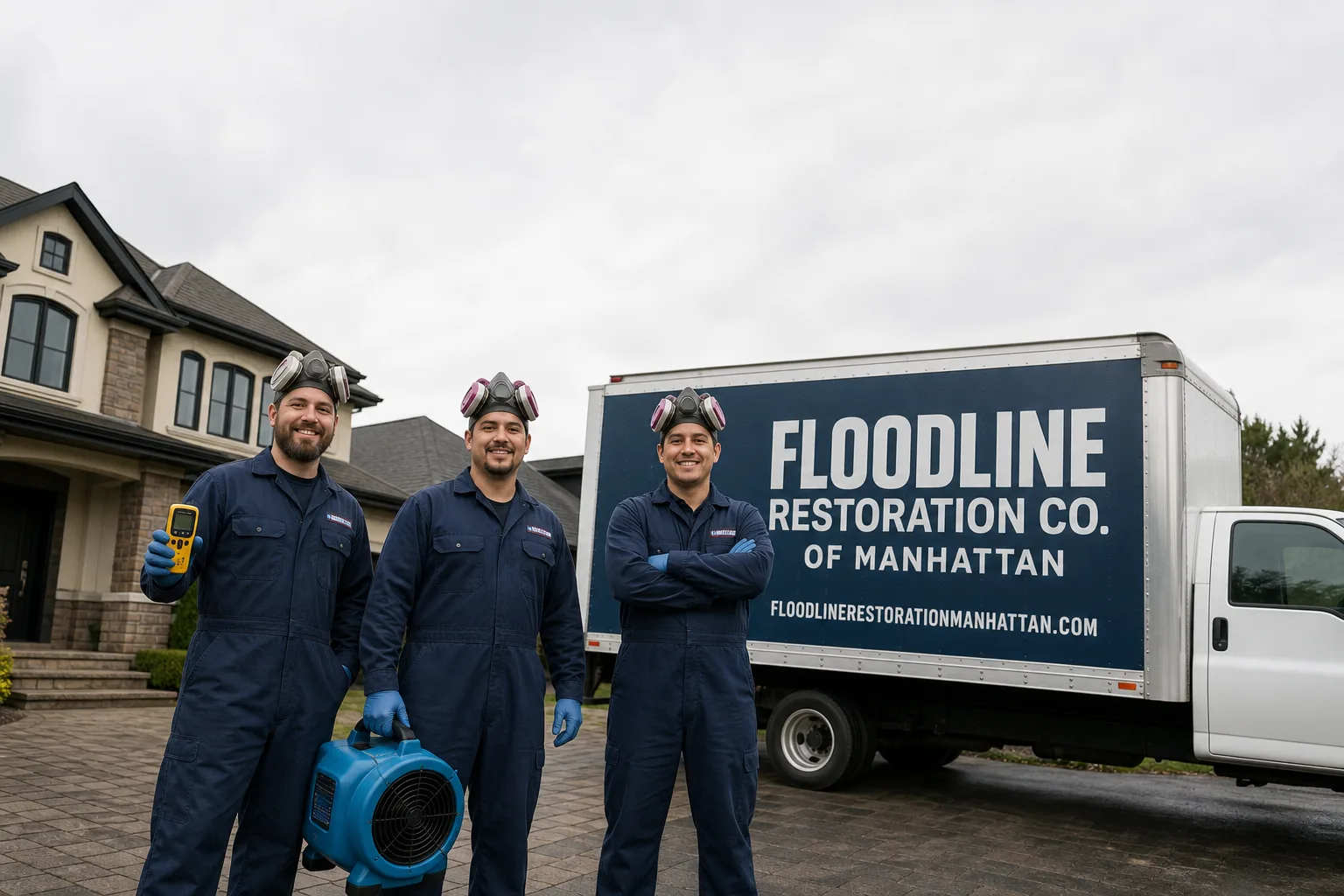
Free visual inspection and a written scope of work before any mitigation begins - photos, moisture readings, and drying logs go in your claim file
The scope we write is the scope we bill. Anything new gets shown to you, in writing, before we touch it.






 Before
 After
After Before
 After
After Before
 After
After24/7 Emergency Mold Remediation in Westwood
Mold remediation in Westwood, NJ typically costs $1,800-$6,500 depending on how far the colony has spread and whether it sits behind walls or in open air. Most jobs in Westwood run 3-7 days from containment to clearance testing, and the first crew can reach your door in about 45 minutes. That speed matters because mold doubles its footprint every 24 to 48 hours once moisture feeds it. Call (917) 924-4221 and a live person answers, any hour, any day. We dispatch background-checked, uniformed technicians into Westwood the same visit, not the next morning.
The first hour after you spot mold is when you stop it from crossing into a full gut job. While you wait, shut down any fans or HVAC running through the affected room, close the door, and keep family and pets out. Mold spores ride air currents, and a box fan pointed at a damp wall in a Westwood basement will seed spores into carpet, furniture, and ductwork by morning. Don’t disturb the colony. Don’t spray bleach on it. Let us get eyes on it first. Our visual inspection is free, and we’ll tell you honestly whether you’re looking at a cleaning or a removal, no scare tactics applied.
Understanding Mold Remediation Severity in Westwood Properties
We classify mold work in Westwood by square footage of affected material, moisture source, and whether spores have reached the HVAC system. A bathroom ceiling stain under 10 square feet with a known plumbing leak above is containment-level work: we isolate the room, cut the affected drywall, treat the framing, and replace. A basement wall where mold runs 4 feet up from the sill plate after a groundwater event is a different animal entirely. That’s full containment with negative air pressure, HEPA air scrubbing running continuously, and clearance testing before we pull the plastic down.
Westwood’s housing stock makes this distinction sharper than in newer NJ towns. The 1950s and 1960s colonials and cape cods along streets near Arthur Kill Road and Western Avenue sit on block or poured foundations that were never waterproofed to modern code. Original cast-iron drain lines and galvanized supply pipes run through those basements. When a nor’easter pushes groundwater up through the slab or a 60-year-old drain line backs up, the water that enters is Category 2 or 3, meaning it carries bacteria or sewage. Mold that grows from that water needs more than a wipe-down. Those homes also hold cellulose insulation in exterior walls, which wicks moisture like a sponge and holds it against framing for months after the visible water is gone. If your Westwood home was built before 1980 and you’ve never had basement walls opened, assume any recurring musty smell has a colony behind it.
Why Westwood Property Owners Choose Floodline Restoration Co. of Manhattan
- 45-minute response commitment to Westwood. Our dispatch board tracks the closest crew, and we commit to having boots on your street inside 45 minutes on emergency calls, with a call when we’re 15 minutes out.
- 24/7 live answer, never an answering service. When you call (917) 924-4221 at 2 a.m. during a nor’easter, a human picks up. Not a recording. You’ll know who’s coming, what they’ll do first, and when.
- IICRC-certified crews trained to AMRT and WRT standards. Applied Microbial Remediation Technician certification means your crew understands containment engineering, air pressure differentials, and clearance testing protocols, not just scrubbing walls.
- Free visual inspection with a written assessment. We don’t charge to walk your property in Westwood, tell you what we’re seeing, and put the scope in writing. You decide from a firm number, not a hand-wave.
- Direct insurance billing, no homeowner-as-messenger. We submit documentation to your carrier, talk to the adjuster, and handle supplements. You get a copy of everything.
- One crew from first containment to final replacement. The same uniformed technicians who set containment and run air scrubbers also handle the rebuild. No mid-job handoff to a subcontractor you never met.
Our Mold Remediation Process
Inspection & Assessment
We walk the property in Westwood with thermal imaging and moisture meters, searching for moisture sources behind walls and under slabs. Spore testing and surface sampling tell us whether you’re dealing with common outdoor molds or something that demands full containment. You get a written scope and a firm price before any walls are opened.
Containment & Air Filtration
Before disturbing the colony, we seal the affected area with 6-mil poly sheeting and run HEPA air scrubbers under negative air pressure. This traps spores inside the work zone so they cannot migrate through your Westwood home. We log pressure differentials and change HEPA filters on schedule.
Source Removal & Material Disposal
Moldy drywall, insulation, and compromised baseboards come out in sealed bags. In Westwood basements with block foundations, we often cut walls to 4 feet to reach wet insulation that wicked moisture upward from the slab. Cast-iron drain line repairs happen at this stage if the backup is the source.
Cleaning & Antimicrobial Treatment
Remaining framing and structural surfaces get HEPA-vacuumed for loose spores, then treated with an EPA-registered antimicrobial. We don’t seal over active colonies. The treatment sets up the surface, and the drying does the real killing.
Structural Drying & Moisture Mapping
Dri-Eaz dehumidifiers and XPOWER air movers run until moisture readings on every stud and slab hit the dry standard. We log daily readings. In Westwood’s freeze-thaw climate, this is where hidden foundation moisture gets found before it becomes next spring’s regrowth.
Repairs, Rebuild & Clearance Testing
We hang new drywall, replace insulation with mold-resistant board where appropriate, and repaint. Before containment comes down, we run post-remediation verification and air sampling. Your home gets a written pass or we fix what’s short, at no added charge, per the 90-Day Done Right Promise.
Need Emergency Mold Remediation in Westwood Now?
Crews minutes away, answering live 24 hours a day. The sooner we start, the less it costs.
Working With Your Insurance Company
Most Westwood homeowners don’t realize their policy covers mold remediation when the mold stems from a covered water event, like a burst supply line or storm surge from the Arthur Kill. What matters is that the cause gets documented the day it happens, with photos, moisture readings, and a written scope that links the mold to the event. If your carrier can argue the mold was pre-existing, they will. Our job is to make sure that argument fails.
On a 1950s colonial near Arthur Kill Road, we found mold behind original cellulose insulation after a Category 3 flood from Sandy’s surge. Our techs set up full containment with negative air, cut the walls to 4 feet to remove wet insulation and cast-iron drain line muck, then used Dri-Eaz dehumidifiers and air movers for structural drying. Because the homeowner had ICC coverage, we logged every moisture reading and antimicrobial treatment, and the claim was approved.
What We Provide Your Insurer
- Thorough documentation of the loss
- Photos of all damage, room by room
- Moisture readings and drying logs
- A detailed, line-item scope of work
- Direct coordination with your carrier
Built for Westwood’s Loss Calendar
Westwood sits in southwestern Staten Island’s tidal flood corridor near the Arthur Kill, and its post-war residential blocks see a specific rhythm of mold-triggering events through the year. January and February bring deep freezes that burst supply lines in unheated basements and crawl spaces, especially in 1950s ranches where original copper runs through uninsulated sill plates. The mold from those bursts shows up in March, after the pipe is fixed but the wall was never dried. Spring thaw is worse in Westwood than inland because the water table sits high and the ground drains toward the Kill. April and May mean groundwater seepage through unwaterproofed block walls, soaking bottom plates and wall cavities where mold incubates unseen.
Summer is thunderstorm season, and Westwood’s combined sewer system backs up under heavy rain. Category 2 and 3 water comes up through floor drains and basement toilets, and if it’s not extracted and dried within 48 hours, you’re in mold remediation territory within the month. Fall brings nor’easters that push surge up the Arthur Kill and Raritan Bay, flooding crawl spaces and low-lying basements. Homeowners with ICC coverage from Sandy-era claims need every one of these events documented with flood-versus-moisture separation, or their supplement gets denied. We’ve worked that documentation path enough times to know exactly what the carrier will ask for.
Mold Remediation Across Westwood’s Neighborhoods
The blocks between Arthur Kill Road and the water are ground zero for surge-driven mold in Westwood. Those streets, many of them tracing the shoreline toward Lemon Creek Park, hold some of the oldest housing stock in the neighborhood, with full basements at or below the FEMA base flood elevation. When water hits those foundations, it isn’t clean rainwater. We run containment on those jobs as a default, because the water that entered carries whatever the Kill and the storm drain system carried with it.
Over near Western Avenue and the commercial corridor, we see a different pattern: post-war storefronts and mixed-use buildings where slow, recurring plumbing leaks behind walls have been feeding mold for years unnoticed. Those jobs get tricky because interior wall assemblies are often shared, and mold migrates through common cavities. Homeowners in this pocket of Westwood tend to catch the problem late, when the musty smell pushes through paint.
East of the rail line, toward Bloomfield Avenue and up past the high school, the housing shifts to 1970s colonials and bi-levels on slightly higher ground. Here the mold sources are less about storm surge and more about failed perimeter drains, clogged downspouts, and aging underground oil tank lines that rust out and let moisture into foundation cracks. Crawl space treatment is the big ask in this section of Westwood, especially for homes with vented crawl spaces that pull in humid summer air and condense it on cold joists. We run vapor barrier installation, encapsulation, and dehumidification on those jobs before any wall repair makes sense.
Specialized Mold Remediation Services We Offer in Westwood
Mold Inspection & Testing
We start with visual inspection, moisture mapping, and thermal imaging, then use surface and air sampling only where it changes the scope. In Westwood, testing matters most when you’re buying or selling a home near the flood zone and need a baseline, or when you’ve had repeated mold returns and need to know what species you’re dealing with. We don’t sell testing as a scare tactic. We sell it as documentation. For sellers on blocks near Arthur Kill Road, a clean third-party-style sampling report often moves the sale faster than a handshake and a half-empty bleach bottle.
Mold Removal
Mold removal in Westwood means cutting out affected material, not just spraying it. On drywall, that usually means removing all porous material that wicked moisture, because drywall cannot be fully cleaned once mold penetrates the paper face. On framing, we HEPA-vacuum, sand, and treat. The line between clean and replace depends on how deep the hyphae grew into the wood grain. We check with a moisture meter and a borescope where we’re uncertain. Guessing is how mold comes back.
Black Mold Remediation
What people call black mold in Westwood is usually Stachybotrys chartarum, which grows where water has sat for days or weeks on cellulose, drywall paper, ceiling tile, or the back of old insulation. It’s not more dangerous than every other mold by default, but it does indicate a long-standing moisture problem, and that means the scope is bigger. Full containment, negative air, and clearance testing are mandatory on these jobs. We document everything, because after a black mold remediation in Westwood, your insurance carrier and your future buyer both want to see the file.
Air Quality Restoration
After physical removal, the air in a Westwood home often carries more spores than the surfaces do. We run HEPA air scrubbers during remediation and take post-remediation air samples to confirm spore counts returned to normal background levels for the area. If your HVAC ducts carried spores through the house, we inspect the returns and supply runs. Sometimes duct cleaning is part of the scope; sometimes a filter upgrade and a week of scrubber runtime does the job. We’ll tell you which one you need and why.
Crawl Space Treatment
Westwood homes with vented crawl spaces fight a losing battle against southeastern Staten Island humidity. The ground stays damp, the vents pull in summer air, and floor joists condense water like a cold glass on a July afternoon. We install vapor barriers, seal rim joists, and add dehumidification where the space supports it. The goal is to break the moisture cycle before it becomes a mold cycle above your living room floor. Most crawl space jobs in Westwood run $3,000-$9,000 depending on square footage and access.
Moisture & Humidity Control
Mold cannot survive below about 60% relative humidity at the surface. The homes we work in near the Arthur Kill rarely get there on their own. We address the mechanical side: dehumidifiers sized to the basement square footage, exhaust fans in bathrooms that actually vent outside, and downspout extensions that move water away from block foundations. These aren’t add-ons. In Westwood’s climate, they’re the only reason remediation lasts longer than two winters.
What happens when you call
- 1
A real person answersNo phone trees - you reach a local pro.
- 2
You get an upfront price rangeHonest numbers before anyone is dispatched.
- 3
A background-checked tech heads outLicensed & insured, dispatched right away.
- 4
You approve before work beginsNothing starts until you say go.
Mold Remediation Costs in Westwood, NJ
A typical mold remediation in Westwood runs $1,800-$6,500 for a contained job. Small bathroom or ceiling patches under 10 square feet run $800-$1,500 when we can handle them without full containment. A full basement wall treatment with containment, air scrubbing, material removal, drying, and rebuild runs $4,000-$9,000. Crawl space encapsulation lands between $3,000 and $9,000. Black mold jobs with HVAC involvement and clearance testing can push past $10,000 when the spread is extensive.
What moves the price in Westwood: whether the moisture source is flood-related (ICC documentation adds admin time), whether original cast-iron drain lines need repair before drying can proceed, how much cellulose insulation has to come out, and whether structural drying on block foundation walls stretches the timeline. Most homeowner policies cover mold remediation when it stems from a covered event. If the mold predates the loss, that portion may be out of pocket, and we’ll tell you that before any walls are opened. The free inspection gives you a firm number. No one works off a time-and-materials handshake. Call (917) 924-4221 and we’ll walk the property, give you the scope, and let you decide.
We Also Serve Cities Near Westwood
Our Westwood crews run the same routes into Harrington Park, Hillsdale, Park Ridge, and Norwood, with the same 45-minute commitment and the same live 24/7 dispatch. Most of our technicians live in the area, which means we know those basements and block foundations as well as we know Westwood’s.
Westwood Mold Remediation Questions, Answered
How does Westwood’s ICC coverage change how we document mold remediation after a storm surge event?
ICC coverage pays for mold work only when the damage is tied directly to a flood event listed on your elevation certificate and flood insurance policy. The critical step is separating flood-caused mold from pre-existing mold at the first inspection, with separate photo logs, moisture readings, and material sampling for each category. If the two get mixed in one lump scope, the carrier can deny the supplement because they cannot determine what the flood actually caused. We document the flood line, photograph everything above and below it separately, and note which materials were wet from surge versus wet from a long-standing leak. This is claim paperwork, not just remediation, and it changes how every wall is logged.
Why do Westwood basements with original cast-iron drain lines keep getting mold after ‘complete’ remediation?
Because the water source never left. Original cast-iron drain lines in 1950s and 1960s Westwood homes corrode from the inside until they crack or separate at the joints, then leak Category 2 or 3 water into the slab or wall cavity every time a toilet flushes or a shower drains. If a remediation crew removes mold and seals the wall without camera-scoping or pressure-testing the drain lines beneath that wall, the same contaminated water reintroduces spores within weeks. We inspect the drains as part of the mold scope in any home built before 1975, and we don’t close walls over a line that we can’t verify.
Is mold from a Category 3 flood in Westwood automatically a tear-out, or can anything be saved?
Porous materials are gone, no exceptions. Drywall, insulation, carpet pad, upholstery, and ceiling tile that contacted Category 3 flood water get cut out and disposed. Non-porous surfaces like concrete block, tile, glass, and metal framing can be cleaned, treated, and kept with aggressive antimicrobial work and proper drying. Semi-porous wood framing usually gets saved if we catch it within the first week and dry it below 16% moisture content. In Westwood’s post-Sandy homes, the saved versus replaced line is drawn with a moisture meter and a borescope, not a guess. Your carrier’s estimator will make the same call, and our documentation has to stand up to theirs.
How do Westwood freeze-thaw cycles on older block foundations affect our mold remediation plan?
Westwood’s winter freezes push water into the pores and micro-cracks of unwaterproofed block foundations, then the thaw releases it, leaving efflorescence and spalling facing that stays damp through early spring. If we remediate mold on interior walls without moisture-mapping the block behind them, that trapped moisture feeds new mold within months. Our dry standard on block is stricter than on interior framing. We run Dri-Eaz dehumidifiers to pull moisture from the block itself, not just the room air, and we log daily readings until the masonry hits a stable equilibrium. In Westwood’s climate, this is the single biggest predictor of whether mold comes back.
What should a Westwood homeowner ask a mold contractor about pre-loss condition documentation?
Ask whether the contractor documents the condition of the affected area before work starts, with timestamped photos and moisture readings that show what was wet, what was dry, and where the visible mold stopped and started. This pre-loss baseline is what your ICC supplement or homeowners claim hangs on. Also ask whether they separate flood-caused mold from pre-existing mold in their logs, and whether they’ll provide you copies of every reading and photo. If the answer is vague, keep looking. We hand every Westwood homeowner a complete documentation packet, not just a final invoice.
How fast can someone actually get here from Westwood?
Crews are dispatched from our regional network, and a certified technician typically reaches Westwood within about 45 minutes on emergency mold and water calls. Our dispatch board shows the closest available crew, and we confirm the address and route before hanging up. Call (917) 924-4221 and you’ll get a time commitment for your exact block, not a general service window.
We have mold in one room. Can we stay in the house during remediation?
Usually yes, but it depends on the scope, the mold type, and whether the affected area can be properly isolated from your living space. Small contained jobs in a single bathroom or basement corner rarely require you to leave. Larger remediations involving multiple rooms, HVAC contamination, or anyone in the home with respiratory conditions may justify temporary relocation. We’ll make that call honestly at the inspection and document it so your carrier can review if needed.
What certifications should a mold remediation crew in Westwood have?
At minimum, the crew should hold IICRC WRT (Water Damage Restoration Technician) and AMRT (Applied Microbial Remediation Technician) certifications. Those credentials mean the technicians understand moisture science, containment engineering, air pressure management, and clearance testing protocols. Our Westwood technicians are also trained to RIA and IFA standards, are background-checked, and arrive in uniform. Ask to see certification numbers. A legitimate contractor will show them without hesitation.
Serving Westwood, NJ - Our Local Coverage Area
We’re based in the Westwood area and know this community well. Use the map below to see our service coverage - if you’re nearby, we can almost certainly help.
Why Floodline Restoration Co. of Manhattan Is Westwood’s Mold Remediation Choice
Floodline Restoration Co. is led by Curt Bowman, who founded the company in 2010 around a dispatch board and a simple rule: answer the phone with a person, show up when you say, and stand behind the work in writing. That rule plays out in Westwood every time a basement takes water or a wall blooms with mold. We don’t hand the job off. The same certified crew that sets containment and runs the air scrubbers rebuilds the wall, finishes the paint, and hands you a moisture log with the 90-Day Done Right Promise attached. If it’s not done right, we make it right. No paperwork battles, no arguing. That’s the Keystone Standard, and it’s in writing on every Westwood job.
Our Mold Remediation team works the full cycle, from first inspection through finished rebuild. For Westwood homeowners, that means one phone number, one point of accountability, and one name on the work. Call (917) 924-4221 for a free estimate. We’ll walk the property, give you a straight answer on scope and cost, and if you hire us, you’ll know exactly who’s coming to your door and what they’ll be doing.
Written by Curt Bowman, Owner at Floodline Restoration Co. of Manhattan, serving New York and New Jersey since 2010.