
Free visual inspection and a written scope of work before any mitigation begins - photos, moisture readings, and drying logs go in your claim file
The scope we write is the scope we bill. Anything new gets shown to you, in writing, before we touch it.






 Before
 After
After Before
 After
After Before
 After
After24/7 Emergency Reconstruction & Cleanup in Upper Manhattan
When a windstorm rips a door off its hinges on W 187th Street or a January deep freeze bursts a galvanized supply line in a 1920s Harlem walk-up, the damage doesn’t wait for business hours. Neither do we. Floodline Restoration Co. of Manhattan answers live around the clock, and our crews reach Upper Manhattan within 45 minutes, ready to extract water, stabilize the structure, and start the rebuild. Call (917) 924-4221 the moment you see water, a blown panel, or a cracked window, because the first hour determines whether you’re dealing with a localized repair or a three-floor cascade through plaster-and-lath walls. A free visual inspection comes with every call, and the same certified team that shows up at 2 a.m. is the team that finishes the reconstruction.
Understanding Reconstruction & Cleanup Severity in Upper Manhattan Properties
Upper Manhattan’s housing stock runs thick-walled and pre-war, which means a wind-blown door or window doesn’t just break glass; it lets water behind brick veneer and into three-coat plaster, where it sits and feeds mold before anyone sees it. We classify every loss the moment we arrive. Category 1 water from a burst supply line is clean; Category 2 carries contaminants from steam radiator condensate or overflow; Category 3, the kind that backs up through a combined sewer during a Harlem River storm surge, is grossly unsanitary and requires full containment. On the fire and storm side, we map soot residue types, from dry protein smoke on upper floors to wet, acidic smoke that etches surfaces fast. In pre-war buildings with wood lath behind the plaster, moisture mapping reads differently than drywall. We use thermal imaging and penetrating meters to find water that surface readings miss, because a wall that feels dry can still hold enough moisture in the lath to fail weeks later.
Why Upper Manhattan Property Owners Choose Floodline Restoration Co. of Manhattan
- 45-minute response commitment. Our local crews stage across Upper Manhattan, so a certified technician reaches Inwood, Washington Heights, or Harlem fast, ready to start extraction the same visit.
- A live person answers, 24/7. No automated system, no callback queue. A dispatcher picks up at any hour, and that person can send a crew to your address.
- IICRC-certified crews. Our techs hold WRT, FSRT, and AMRT certifications, with continuing training through RIA and IFA standards. They know pre-war plaster, not just drywall.
- Free visual inspection. You see the scope in writing before any work starts. No pressure, no surprise line items.
- Direct insurance billing. We bill your carrier directly and coordinate with the adjuster, so you’re not playing messenger between three parties.
- One team from extraction to reconstruction. The same background-checked, uniformed crew that pulls wet plaster on day one rebuilds the wall and hangs the new door at the end. No mid-job handoff.
Our Reconstruction & Cleanup Process
Inspection & Assessment
We walk the entire loss area with thermal imaging and moisture meters, mapping where water traveled behind walls and under floors. You get a written scope and a firm price before we touch anything.
Extraction & Stabilization
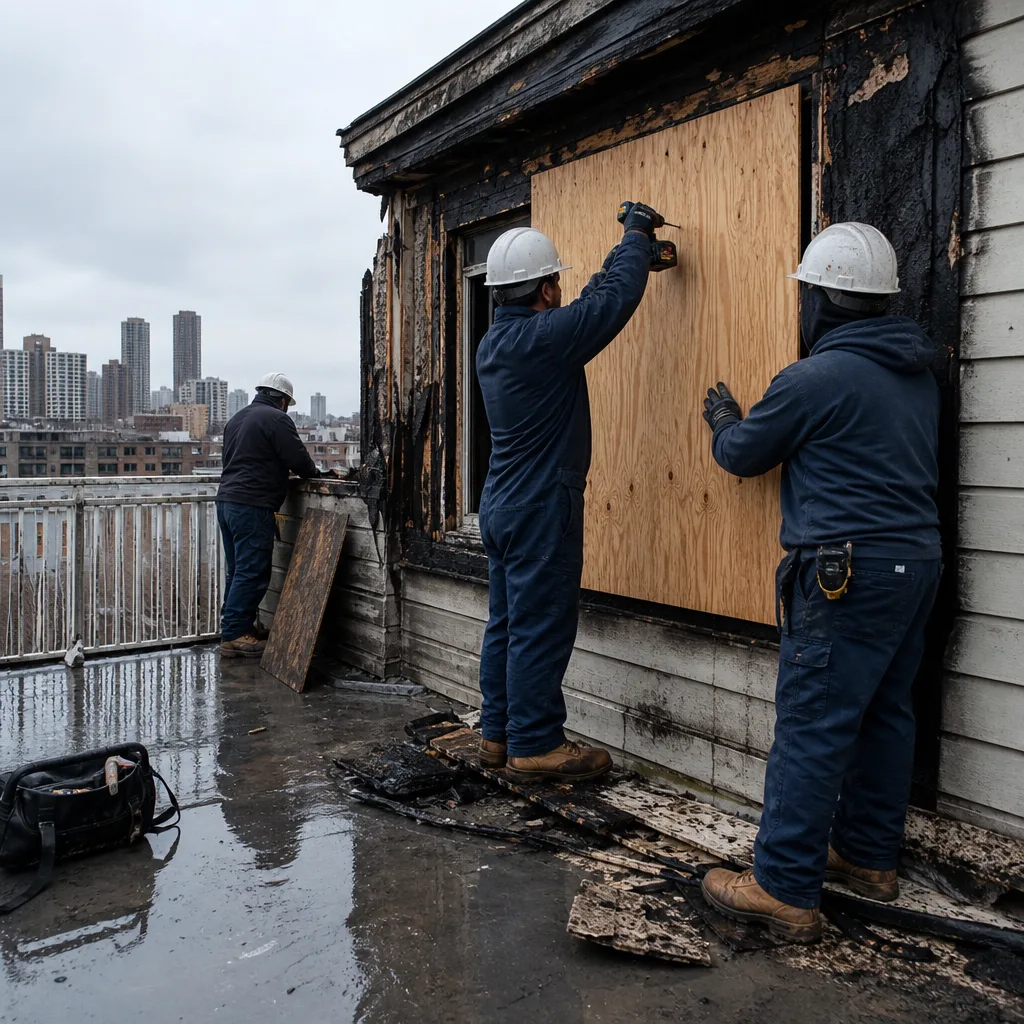
Standing water comes out first, using truck-mounted extraction and sub-surface wands. For storm damage, we board up openings and tarp the envelope so no more water gets in while we work.
Drying & Dehumidification
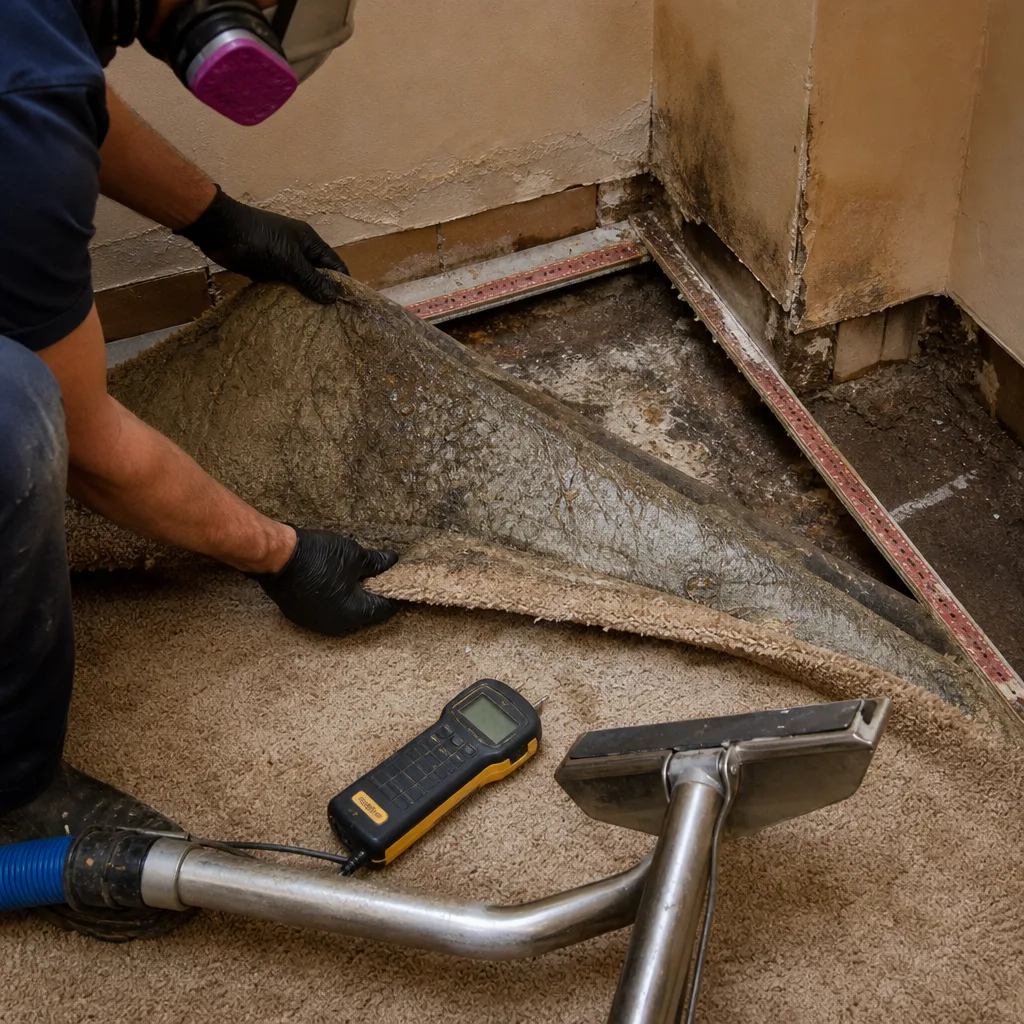
Dri-Eaz dehumidifiers, Phoenix air movers, and Injectidry systems run on a balanced drying plan. We log daily moisture readings until the structure hits the dry standard, because pre-war plaster needs longer cycles than drywall.
Cleaning & Sanitization
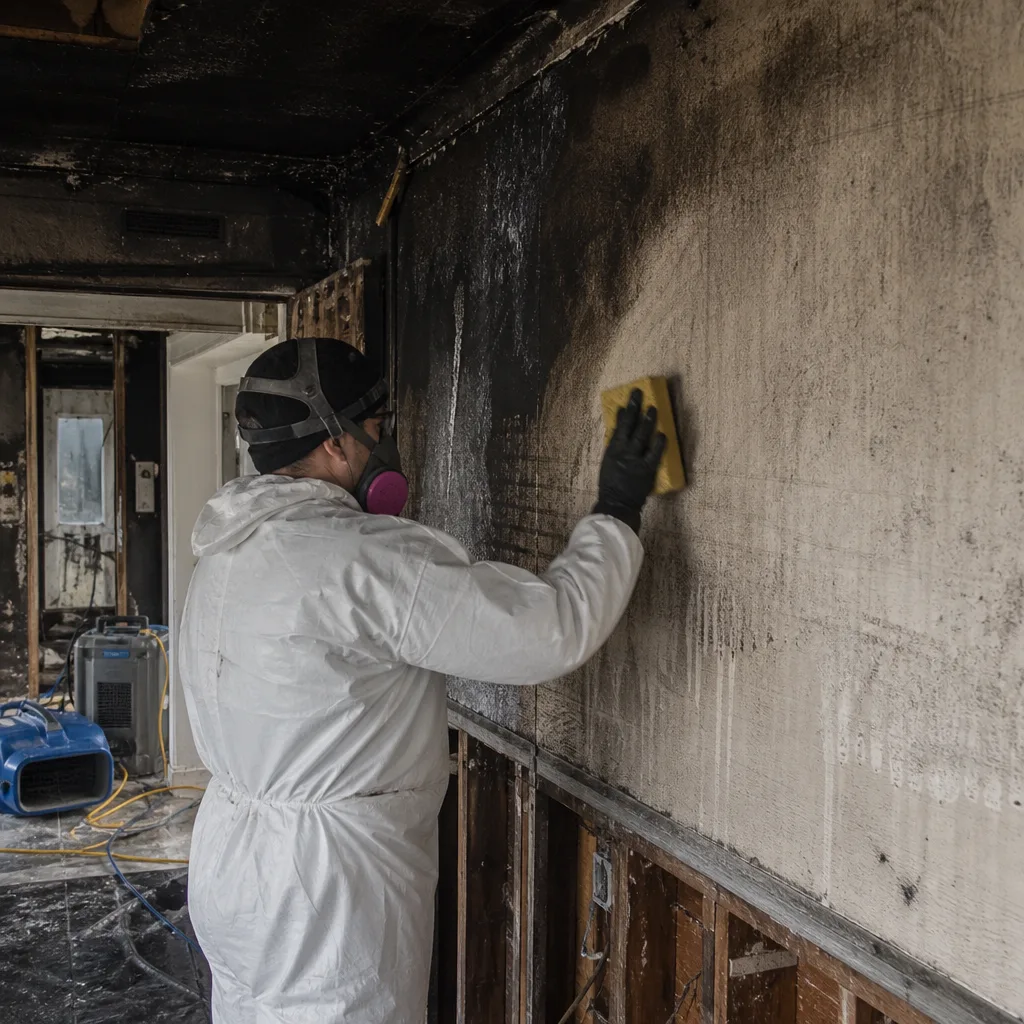
HEPA air scrubbers run during all remediation work. We clean salvageable surfaces, apply antimicrobial treatment where needed, and remove materials that can’t be saved.
Structural Repair & Wind Rating Compliance
This is where Upper Manhattan’s code requirements matter. We repair masonry and flashing around any door or window we replace, then install wind-rated or impact-rated units that meet current NYC facade safety standards.
Rebuild & Restoration
Drywall, plaster, flooring, trim, paint, and final door or window installation. We hand you the drying log, the photo documentation, and the 90-Day Done Right Promise in writing.
Need Emergency Reconstruction & Cleanup in Upper Manhattan Now?
Crews minutes away, answering live 24 hours a day. The sooner we start, the less it costs.
Working With Your Insurance Company
Storm and water claims in Upper Manhattan get scrutinized twice as hard when the building predates 1940. The carrier wants to know what the pre-loss condition was, and if you can’t document it, they’ll attribute the failure to age and deny the reconstruction scope. That’s a five-figure gap for a condo board or co-op owner. From the first hour, we photograph every layer of damage, room by room, before we move anything. We log moisture readings daily, write a line-item scope using industry-standard estimating software, and coordinate directly with your adjuster so you don’t have to. The goal is simple: prove the claim, get it approved, and rebuild to code.
What We Provide Your Insurer
- Thorough documentation of the loss
- Photos of all damage, room by room
- Moisture readings and drying logs
- A detailed, line-item scope of work
- Direct coordination with your carrier
Built for Upper Manhattan’s Loss Calendar
Upper Manhattan’s damage season runs in cycles, and we plan crews around them. January and February bring deep freezes that burst uninsulated supply lines in pre-war walls, flooding apartments from the fifth floor down. March thaws push groundwater into basements through foundation cracks that went unnoticed all winter. Summer thunderstorms drop two inches an hour on East Harlem and Inwood, overwhelming combined sewers and forcing Category 3 water back through floor drains. And from late summer through fall, nor’easters and hurricane remnants hit the Harlem River corridor hardest, ripping loose window panels and unrated doors from 1920s facades, then driving rain through the openings into plaster walls. We staff for all of it. When the next storm comes, the crew you need is already in the neighborhood.
Reconstruction & Cleanup Across Upper Manhattan’s Neighborhoods
Upper Manhattan runs from 110th Street in Harlem up through Washington Heights and Inwood, and the loss patterns shift block by block. In central Harlem, the 5-to-7-story brick walk-ups on streets like Lenox Avenue and Adam Clayton Powell Jr. Boulevard carry original cast-iron supply lines that fail at the fittings after ninety years of steam heat cycling. Washington Heights, especially around Fort Washington Avenue and W 187th Street, has some of the tallest pre-war elevators in the borough, six to ten stories of brick with original wood-frame windows that inspectors flag after storms have already blown the glazing out. Inwood’s low-lying blocks near the Harlem River at Dyckman Street flood from both directions: stormwater at the street and sewer backflow at the basement floor. East Harlem sees the same combined sewer pressure during heavy rain, and its older housing stock often has compromised foundation waterproofing. Each area needs the same core service, Reconstruction & Cleanup, but the building science changes with the address. A wet plaster wall on Fort Washington Avenue dries on a different schedule than one on 116th Street, and we read the meters accordingly.
Specialized Reconstruction & Cleanup Services We Offer in Upper Manhattan
Full-Service Reconstruction
When a storm-damaged door or window cascades water through three floors of a Washington Heights walk-up, you need a team that rebuilds as well as extracts. We handle the entire scope, from framing and plaster repair to finish carpentry and paint, and we rebuild to the current NYC facade safety code, not just to the pre-storm condition.
Drywall & Flooring Repair
For non-plaster areas, we patch and refinish drywall, then repair or replace hardwood, tile, or vinyl flooring that warped or delaminated after water exposure. In Upper Manhattan’s pre-war units, we match plaster transitions carefully so the repair doesn’t read as a patch job.
Insurance Claim Documentation
This is the service that saves Upper Manhattan condo boards from denied claims. We document pre-loss conditions, photograph every layer of storm damage, and provide the moisture logs and line-item scopes that adjusters require when a 1930s building is involved.
What happens when you call
- 1
A real person answersNo phone trees - you reach a local pro.
- 2
You get an upfront price rangeHonest numbers before anyone is dispatched.
- 3
A background-checked tech heads outLicensed & insured, dispatched right away.
- 4
You approve before work beginsNothing starts until you say go.
Reconstruction & Cleanup Costs in Upper Manhattan, NY
Full-service reconstruction after a storm or water loss in Upper Manhattan typically runs $4,000 to $18,000, depending on how many floors of plaster the water wicked through and whether structural framing needs replacement. Drywall and flooring repair alone lands between $1,200 and $6,500 for a single apartment. Contents restoration and pack-out runs $800 to $5,000 depending on volume and cleaning complexity. Post-construction cleanup after a rebuild is $400 to $1,800. These are real ranges for this market, where pre-war plaster and code-compliant door replacements push costs higher than newer buildings. The fastest path to a firm number is a free visual inspection. Call (917) 924-4221 and we’ll put a written scope in your hands, with no pressure and no surprises.
We Also Serve Cities Near Upper Manhattan
Our crews regularly run emergency response and reconstruction work into Fairview, Harrison, East Bronx, and Hunts Point. If your building sits just outside Upper Manhattan proper, the same certified team and the same 45-minute response commitment still apply.
Serving Upper Manhattan, NY - Our Local Coverage Area
We’re based in the Upper Manhattan area and know this community well. Use the map below to see our service coverage - if you’re nearby, we can almost certainly help.
Upper Manhattan Reconstruction & Cleanup Questions, Answered
Do Upper Manhattan buildings need a wind-rated door before the next hurricane season, or can we just board up after a storm?
Wind-rated doors are required for any replacement in an NYC facade-adjacent opening, and boarding up is only a temporary measure. A reinforced steel door installed to current code prevents the storm from becoming an interior water loss at all, which is far cheaper than remediating three floors of plaster. Call (917) 924-4221 for a free assessment of what your building actually needs.
A windstorm ripped our old steel door off its hinges and we’re on the second floor of a Harlem walk-up. How fast can you patch that before mold sets in?
We can have a crew at your Harlem address within 45 minutes, any time of day. The first step is board-up and tarping to keep rain out, then we assess the water that already entered the surrounding masonry and plaster. In pre-war walls, mold starts in the hidden lath layer within 48 to 72 hours, so speed matters. Call (917) 924-4221 immediately.
What’s the right way to document a storm-damaged door and wet plaster ceiling for an insurance claim in Washington Heights?
Photograph everything before moving anything: the blown door, the water staining, the ceiling, the wall bases, and any contents that got wet. Then let us document the rest. We photograph every room, map the moisture with thermal imaging, and write a line-item scope that matches your policy language. The pre-loss condition of the door and surrounding masonry is the key evidence, so don’t throw anything away. Call (917) 924-4221 and we’ll help from the first hour.
Should we replace a blown-in window with an impact-rated unit in an Inwood pre-war co-op, or is a standard double-pane enough?
For any window facing the Harlem River corridor or exposed to nor’easter winds, impact-rated glazing is the right call, and your co-op board will likely require it under NYC facade safety rules. Standard double-pane units can still bow and blow out under wind load, and the water damage that follows costs far more than the upgrade. Call (917) 924-4221 for a recommendation specific to your floor and exposure.
How do you dry out a wind-damaged plaster wall in a 1920s building without tearing the whole thing down?
We use moisture mapping to find exactly where the water traveled, then run Injectidry systems to pull air through the wall cavity and Dri-Eaz dehumidifiers to pull water out of the plaster and lath. In most cases we can save the original plaster by cutting access points at the base and drying in place, with daily moisture logs until the dry standard is met. Call (917) 924-4221 to have your specific wall evaluated.
How long does full reconstruction take after a windstorm in Upper Manhattan?
A single-unit door or window replacement with water remediation usually takes 5 to 10 days from start to finish. A multi-floor loss through pre-war plaster can run 3 to 6 weeks, because the drying cycle alone is 60 to 80 percent longer than drywall work. We give you a written timeline at inspection.
Are your technicians certified to work in pre-war Upper Manhattan buildings?
Yes. Our crews hold IICRC WRT, FSRT, and AMRT certifications, plus training through RIA and IFA. They understand plaster, lath, galvanized steel lines, steam radiators, and NYC facade code. They’re background-checked and uniformed on every job.
What should I do in the first 30 minutes after a storm blows a door or window out?
Call (917) 924-4221 first. Then, if you can safely do it, move furniture and valuables away from the opening, and put down towels or plastic to catch water pooling on the floor. Don’t try to lift a blown door or remove debris near broken glass. Let our crew handle the board-up and stabilization when we arrive, usually within 45 minutes.
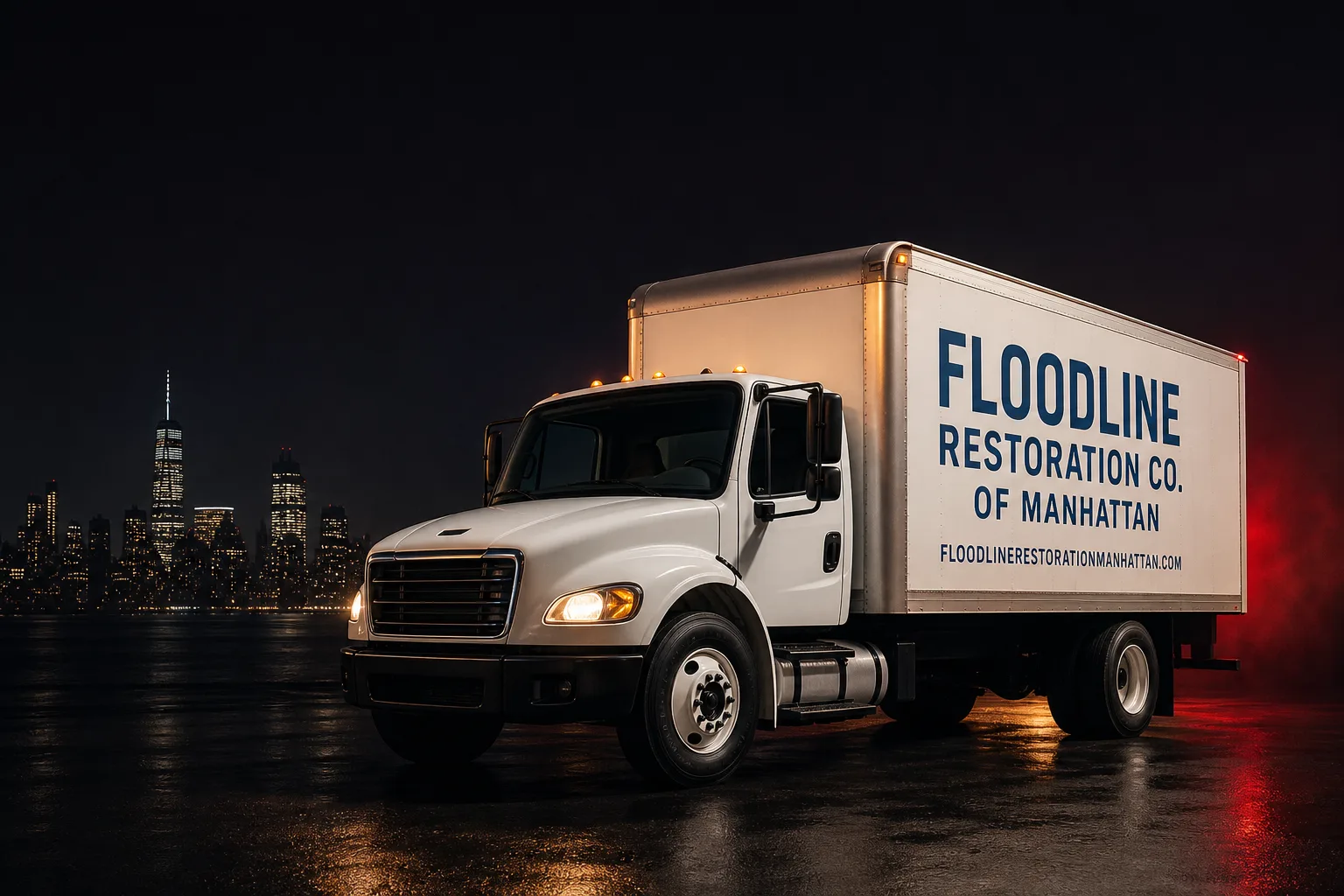
When a storm tears through Upper Manhattan, the damage starts at the facade and travels inward fast. We start at the same place and don’t stop until the unit is dry, rebuilt, and code-compliant. The name on the truck is the name you call again next time. That’s how we’ve built our reputation across Upper Manhattan, one pre-war building at a time.
Written by Curt Bowman, Owner at Floodline Restoration Co. of Manhattan, serving Upper Manhattan, NY.